Showing posts with label Alastair Reynolds. Show all posts

Tuesday, 28 August 2012

Alastair Reynolds: Blue Remembered Earth (2012)

Edition: Gollancz, 2012
Review number: 1462

The setting of Blue Remembered Earth is a post-scarcity world, where an environmental collapse has been followed by the rise of African states as superpowers, a renaissance which is originally solar then fusion powered. The Akinya family has played a leading part in this, and its members are now famous and wealthy. The plot is set in motion by the death of their matriarch Eunice in her space station retreat. The main characters are her grandchildren, the idealistic Geoffrey and Sunday, who have rejected the Akinya corporate legacy, and the mercenary Hector and Lucas. A secure deposit box belonging to Eunice sends the first two on a quest to discover her true legacy, the first step in a treasure hunt across the solar system where each clue points to the location of the next, and Hector and Lucas are not far behind them.

This rather childish-seeming plot is not what the book is really about - and Reynolds can certainly do better at this aspect of novel construction. Reynolds is a master at world-building, and Blue Remembered Earth is basically a tour of the man-made wonders of the solar system of the future. The novel is a gallery to show off some of his ideas, some of which could easily be the foundation for whole novels of their own: from the "ethics shunt" installed in Lucas' brain to prevent morality getting in the way of business, to the Evolvarium, an area of Mars in which machines are left to evolve and compete, like a physical version of the genetic algorithms run in many of today's computer simulations.

While most of Alastair Reynolds novels remind me of writers like Iain M. Banks, Blue Remembered Earth is much more like older genre figures, in particular Arthur C. Clarke. Instead of writing a wide ranging space opera, here Reynolds sticks to the solar system, which is full of its own wonderful objects, including an updated version of Clarke's famous lunar monolith - Reynolds' version is on the Martian moon Phobos, and is fantastically carved by human tourists. There is an element of guided tour about the novel as a result, which will not be to all tastes. Like Clarke's 2001, the story builds up to a climactic revelation. The big question for a potential reader is going to be whether this ending really is a climax, or just a disappointing let-down. This is of course also the case for any story in any medium which is constructed as a sequence of "reveals" (to use a film-making term); The Whisperer, which I recently read, is an example of a thriller set up in this way, which I don't feel has a sufficiently good climax to work. Here, at least from the point of view of the characters, the ending is better, but to this reader, some aspects (particularly the reasons for the secrecy and the treasure hunt) don't quite gel properly.

Which brings me to the title of the novel. It is derived from A.E. Houseman's A Shropshire Lad, of which the relevant lines seem to be "What are those blue remembered hills...? That is the land of fat content ... The happy highways where I went and cannot come again." It is hard to see how Houseman's poetic evocation of nostalgia relates to a novel which has such an optimistic view of the future of the human race, even if some tribulation has to be endured before that future arrives. The key is, I think, that this is the first of a new series: it is the blue remembered earth described in this novel which will be the object of nostalgia later on, suggesting that the series will become darker as it progresses.

My rating: 6/10; not appealing to me as much as Reynolds' earlier work.

Tuesday, 4 May 2010

Alastair Reynolds: Ternminal World (2010)

Edition: Gollancz, 2010
Review number: 1400

Many science fiction novels are in a way more about their setting than anything else: it is something that non-fans tend to dislike about the genre. The best of them, of course, make the setting the core of a wider, rounded, story. Where this core is an artefact, it is referred to in science fiction fandom as a "Big Dumb Object" or BDO, for which the prototype is Larry Niven's Ringworld (see the article in the TV Tropes WIKI for other famous examples). BDOs are usually alien artefacts being investigated by human explorers, and Reynolds has already written some stories of this type, such as Absolution Gap and his debut Revelation Space.

Terminal World is a slightly different kind of BDO story. Spearpoint is a huge, decaying city, towering over its surroundings. Both the city and its environs are divided into shifting Zones, where different levels of technology can work, including one known as the Bane which is so inimical that not even basic forms of life can survive. Both Spearpoint and the Zones are human artefacts, but not ones which the current inhabitants, not even the nano-technology using "angels" of the upper levels of the city, can now understand.

Doctor Quillon, the main character of Terminal World, is a renegade angel, product of an experiment by these people - already drastically changed from their human ancestry - to modify themselves so that they could live in the lower levels of Spearpoint. When it seems that his past is about to catch up with him, Quillon escapes from the city and begins a journey across the strange fractured landscape outside the city. While the doctor is quite a well realised character, this journey, the main part of Terminal World, is more about making it possible for the reader to see more of the Zones and the different cultures which have grown up with each level of permissible technology.

This is a pity, as it means that the plot is pretty rudimentary, just a framework to illustrate the Zones in a way that is less interesting than it could be: I think that the way they affect life in Spearpoint is more interesting than what it is like outside the city. The image of a sophisticated cyborg effectively chaining himself to a boiler room in order to use steam power, while unlikely, is intriguing; while that of the Swarm, a loose federation of airship fliers, is much less so. Some of the plot doesn't quite hold together: for example, the leader of the Swarm has recently developed a means of producing large quantities of medicine which helps humans deal with the physiological effects of the passage from one Zone to another just at the time when a major humanitarian crisis caused by shifting Zones in Spearpoint means that it is urgently needed. A journey of discovery like this is typical of BDO stories, but I would have preferred a plot which remained in the fascinating city; this would perhaps have made Terminal City seem rather like one of China Miéville's novels, but that would not necessarily be a bad thing.

The ideas behind Terminal World are connected with quantum dynamics. In each of the Zones, it appears that the basic structure of matter is slightly different, which means that technologies which rely on, say, electricity may not work in some of them. I don't think the rules are applied quite consistently: how different are the electrical currents in the wire connecting a slight switch and a bulb from the signals in animal nervous systems at a fundamental physical level? So perhaps quantum mechanics - which is suggested by one of the characters in the novel as a possible explanation for the Zones - is not actually behind Reynolds' concept at all, but a red herring.

However, it does fit in with something else: the role of the tectomancers. These are characters with some kind of mental connection to the Zones. They can move the Zone boundaries, and are persecuted and feared as witches or dismissed as legends. One of the more mysterious aspects of quantum mechanics is the role of an observer, whose intervention is required to collaps a statistical description of a phenomenon (the probability that a particle is in a volume of space) to a physical one (the knowledge whether or not the particle is in that volume). Tectomancers seem to be a kind of super-observer, able not just to affect the collapse of the quantum state vector but the rules which define it.

In the end, the combination of one or two good characters, an interesting BDO, and some ideas about quantum mechanics are not enough for Terminal World to be a great science fiction novel. Part of the problem is that none of the characters really understand the Zones, so the reader is not left with much information to work out what they really are, and part is the abandonment of the city for the middle section of the novel. Other questions - such as whether Spearpoint is built on the Earth of the far future, or elsewhere - are left undiscussed, perhaps to provide material for a sequel. Terminal World does make an interesting change from the space opera for which Reynolds is most well known, and is well worth reading by fans of the author. My rating: 6/10.

Friday, 8 December 2006

Alastair Reynolds: Century Rain (2004)

Published: Gollancz, 2005

The last time I read (and reviewed) a novel by Alastair Reynolds, I felt that it would be good for him to be refreshed by moving to a new setting, separate from the future history he had used up to that point. In Century Rain, he has done just this, renewing his creativity by doing so. (I can't claim any credit: apart from anything else, I didn't discuss this issue in my review.) This novel is a science fiction noir thriller, where time travellers become involved in a murder mystery in an alternate fifties Paris.

Reynolds' future has Earth rendered uninhabitable by nanotech weapons, and the destruction wrought by them makes any artefacts obtainable from the planet's archaeology massively valuable. But when a trip to the Earth's surface organised and lead by archaeologist Verity Auger goes badly wrong, she faces the tribunal which will end her career - if she's lucky. At this point she is offered a choice: take on a mysterious task or be left to face the music. It turns out that the task is to travel through a secret tunnel in space-time (something more exotic than a wormhole, she is assured), the other end of which is in a Metro tunnel just outside a station in an alternate Paris in 1959. A colleague of Verity's was studying this version of Paris, and was killed soon after discovering something important. Verity's task is to obtain papers that this woman had left with her landlord; however, unknown to her, the landlord felt that there was something odd about the death and has hired a private detective to investigate it.

As briefly indicated, this isn't the real Paris: the German invasion in 1940 was beaten back, so the Second World War barely happened, with the result that the fifties seem almost more like the thirties, politically and technologically. The travellers from the future are not sure how this happened. There are several possibilities, ranging from someone taking advantage of the chaos surrounding the destruction of life on Earth to revise the history books and insert the Second World War, to the idea that this alternate Earth is a sophisticated simulation, to the possibility that it really is part of another timeline. For much of the Century Rain it doesn't matter what the truth is, and anyway, it is more enjoyable to soak up the Simenonesque atmosphere. Indeed, the Paris sections work better than the future sections - an observation which seems a bit odd considering in which genre Reynolds made his name! The novel is basically a clash between the X-Files and Casablanca. The reader is clearly intended to make the second comparison, as many of the famous lines are quoted from the film (which of course doesn't exist in the alternate universe). A little ironic touch is that "We'll always have Paris" is missing.

Century Rain also includes a nanotech weapon which is somehow more frightening than the murderous, spectacular and unsubtle ones commonly seen in science fiction. The Amusica virus removes the ability to process music: it becomes just background noise. It is a little unlikely to be possible, particularly if the hypothesis that the role of musical awareness in human evolution was as a precursor of linguistic processing turns out to be true. (This is a hypothesis argued for, convincingly and in detail, in Steven Mithen's recent book, The Singing Neanderthals.) The virus leaves a culture essentially without music, where those few immune to the virus for some reason are envied and hated.

Thursday, 26 August 2004

Alastair Reynolds: Absolution Gap (2003)

Edition: Gollancz, 2003
Review number: 1260

This novel completes the story of Revelation Space and Redemption Ark, about how the human race falls foul of machines named Inhibitors or wolves, which destroy interstellar civilizations when alerted by the use of particular kinds of advanced technology. (Chasm City and the pair of novellas Diamond Dogs, Turquoise Days share the same background, but are not part of the same story.) At the end of Redemption Ark, one group of humans had taken refuge on the backwater planet of Ararat; one strand of Absolution Gap starts when the Inhibitors attack them. The other main narrative thread is set on the bizarre world of Hela (a third describes the discovery of this world). Hela is an icy moon, home to a really strange religious movement. Many satellites have synchronous orbits, keeping one face towards the planet they orbit, as the Moon does to Earth - nobody could see the far side before the days of space travel. Hela nearly does this, but not quite, so the planet of Haldora appears to slowly move through the sky. On the equator is a route travelled by the strange cathedrals, slowly moving, huge buildings; their aim is to keep the planet directly overhead, under constant observation. (Of course, only one can do so at a time, causing a great deal of rivalry.)

Absolution Gap is a long novel, and to start with moves too slowly. Even though I had enjoyed Reynolds' other writing, I seriously considered giving up on this story. The depiction of Hela is a serious problem; although the cathedrals are a fascinating idea, with a great deal of scope for baroque description in the manner of Peake or Moorcock (they're easily the best thing in the novel), we don't actually learn very much about them. This is because Reynolds doesn't want to reveal twists in the plot beforehand, but it means that the reader's interest isn't sustained. Basically, Absolution Gap could have been better constructed; it is a lengthy wait for things to start to get interesting. Read it if you want to find out the end of the story of the Inhibitors; otherwise, it's not really worth the effort.

Saturday, 26 October 2002

Alastair Reynolds: Redemption Ark (2002)

Edition: Gollancz, 2002
Review number: 1128

Redemption Ark is far more closely linked to Reynold's first novel, Revelation Space than is his second, even though all three are set in the same vision of the future. The actions of Sylveste in that novel have awakened an ancient horror in the galaxy; he has unknowingly made the signal that calls it to action. This is a culture of machines, which has the purpose of keeping intelligent life in check to guard against a future catastrophe. This is the reason that human explorers have found the galaxy full of the archaeological remains of extinct alien cultures, but none surviving. Sylveste has for the first time used a technology proving the existence of a new race of intelligent beings with an interstellar cultures, and this has made the Inhibitors swing into action once again.

There are others who notice the use of these tools, for they are doomsday weapons so fearful that not only have they never been used, but the technology used to create them was deliberately forgotten. They were made by the Conjoiners, a faction of humanity which has used mechanical aids to brain function to create a hive mind; and they want them back.

Being the third novel set in this universe, Redemption Ark lacks the "wow factor" experienced in reading the first two. It settles down a bit more to character, and in doing so reveals more definitely that Reynolds is from the same school as Iain Banks' Culture novels. There is more hard science (particularly nanotechnology) and less humour, but there are many similarities. The major difference, that Banks' novels are far less interconnected, imparts strengths and weaknesses to each writer's work. The ending of Redemption Ark really calls out for a sequel; it is nothing like as definite as those of Revelation Space and Chasm City. More additions to this series are, I hope, inevitable. Reynolds is one of the finds of twenty-first century science fiction, amply confirming the promise of his debut.

Wednesday, 13 February 2002

Alastair Reynolds: Chasm City (2001)

Edition: Gollancz, 2001
Review number: 1064


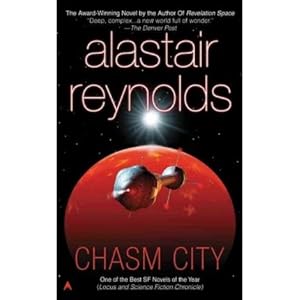
Reviews of Revelation Space, Reynolds' first novel, compared it to Dan Simmons' Hyperion. In terms of quality and subgenre, this comparison is justified; both are extremely good space operas. Chasm City is much more like Simmons in style and content than its predecessor; and without being derivative it maintains the standard.

Set in the same universe as Revelation Space, it takes place some time earlier. Its central character (and narrator) is former soldier and security expert Tanner Mirabel, from the backward world of Sky's End, ruined by generations of warfare. When his employer and his employer's wife are murdered in the jungle, Tanner follows the man who arranged the killings to Yellowstone, thirty light years away. This trip for vengeance is one he can't easily return from, as his home will have greatly changed - travel is slower than light though with suspended animation. Even so, knowing that the last news he heard about Yellowstone is years out of date, he is totally unprepared for what he finds on one of the most technically advanced planets. A massive plague has basically turned all the nanotechnology wild, causing huge numbers of deaths as it mutates and leaving a shanty town in place of the main settlement on the planet, Chasm City, and causing the destruction of many of the orbitals which once filled much of the available space around Yellowstone.

This is not the only problem facing Tanner on his arrival, as he is suffering from a form of amnesia which is an occasional side effect of the revival from cryogenic freezing, and he appears to have been infected with an engineered virus, a piece of nanotechnology used by a cult on Sky's End for indoctrination - a truly frightening science fiction idea which I have not seen elsewhere even though nanotech is a trendy subject at the moment. These things combine to produce doubts of his own identity, a strange (and ambitious) effect in a first person narrative which is convincingly done by Reynolds.

Chasm City is perhaps not as involving as Revelation Space, but it certainly confirms Reynolds as one of the outstanding new writers of science fiction of this decade.

Wednesday, 28 November 2001

Alastair Reynolds: Revelation Space (2000)

Edition: Gollancz, 2000
Review number: 998

Reynold's debut novel is billed on its cover as "the first great science fiction novel of the century". Leaving aside pedantic dissections of this based on its date of publication, this is only a little over the top; it is one of the best attempts to combine hard science fiction with intelligent characterisation that I have read, and it contains a fascinating depiction of life a few hundred years in the future that is much more unlike our own than many writers ever manage.

The story starts off, as several science fiction novels have before, at an archaeological dig into alien artefacts from a vanished race. This is a fertile beginning, and related scenarios have produced wildly different stories (as Dan Simmons' Hyperion, Frederick Pohl's Gateway and Paul J. McAuley's Four Hundred Billion Stars testify). In this case, the Amarantin were a birdlike people who were wiped out by some kind of anomalous event in their star, but they have left tantalising clues that somehow a pre-technological people had actually mastered space flight.

The dig, run by the leader of a colony on the Amarantin planet set up for the purpose, runs into trouble when dissension among the colonists leads to a coup. This leader, Dan Sylvestre, is a member of a powerful family, who is, in the other main facets of the plot, being pursued by an assassin and by the crew of an Iain M. Banks - like spaceship who want him for the medical knowledge contained in a computer simulation of his father. (The relationship between Dan and his father is very complicated, and is central to the depiction of the main character.)

This excellent novel paints a convincing picture of a possible future, of some of the ways in which humanity might change. In five hundred years, people will be at least as incomprehensible to use as our way of life would be to an Elizbethan, but not many science fiction authors make much of this. Indeed, given the speed of current developments in the biological and computer sciences, the sort of advances depicted by Reynolds and their psychological consequences may well be with us sooner than this.