Showing posts with label science fiction. Show all posts

Thursday, 21 May 2020

фANTASTIKA: Almanac for Bulgarian Speculative Fiction

Edition: Terra Fantasia (Association of Bulgarian SF & F Writers and Artists), 2020
Review number: 1520

This is an extensive collection, a showcase of Bulgarian science fiction and fantasy, including both writing (translated into English) and art. I have never read any Bulgarian speculative fiction (at least, not knowingly), and so I'm approaching this with interest and am hoping to be impressed. I've written a mini-review of each story, and at the end I've added some general thoughts about the anthology as a whole.

The first section in the anthology contains stories which are considered to be straightforwardly science fiction.

The Last Interview of Adam Sousbe, by Lyuben Dilov (short story)
This story positions itself as a journalistic interview of a proponent of male rights in 2980, which has been proclaimed the "Year of Man" - the final interview before Adam Sousbe is murdered. The idea that gender inequality might be reversed in the future is not unique, of course, and it can be hard to tell whether a story on this theme is intended to highlight continued unequal treatment of women or to suggest that feminism has gone too far already. It is very much a John W. Campbell story, complete with the feeling of slight discomfort at the politics (though here I am less sure of the intention than I would be with Campbell's). I couldn't see a date for this piece, but the "about the author" paragraph places him in the 1970s, and it is certainly a story which wouldn't be at all out of place in any collection of short science fiction from that decade.

Beating the Air, by Velko Miloev (short story)
What would happen if people could choose to become a wind? This brilliant story takes this strange question and runs with it. The point of view character is a "wind inspector", checking up on someone who has taken that option, who is conversing with a wind that is tired of paid work producing picturesque effects for a poet. Reading this whimsical story is one of my fiction highlights of my 2020 science fiction reading, and it deserves to be widely known.

It's Only Fair, Botkin, by Khristo Poshtakov (short story)
There is still something of a tendency in science fiction to depict space exploration as a glorious adventure. In this story, it is a tedious job, and one which doesn't reflect well on the explorers. The story is a thinly veiled attack on the attitudes of Earthly colonialists on the native peoples they encountered; fairly predictable, and less interesting to me than the depiction of what it's like to be doing a dull job in space at the start of the story. Worth reading, but less good than the stories which precede it.

In the Beginning Was the Subway, by Lyubomir P. Nikolov (short story)
The beginning of this story is a bit incoherent, but by the second page it resolves into a tale of a ghost arranging for a young man to receive a mysterious device, though which esoteric scientific information is imparted to him over a period of weeks. It's a weirdly utopian tale, which in tone reminded me of Olaf Stapledon, with an old fashioned, didactic tone. Interesting, but not a story which appealed to me.

Three Tales of a Very Windy Town, by Lyubomir P. Nikolov (short story)
"Up on the cliffs by a rough sea, there falteringly existed a town" is a great start to a story. It sets the whimsical tone of an amusing tale, which is essentially three tall stories about the wind. Together with Beating the Air, it suggests that Bulgarian writers may have something of an obsession with the wind! It is very unusual in an anthology with several authors to have two stories in a row from the same author (especially as they are not among the shortest stories); if I had to pick, I would choose this one to keep - it is both more inventive and more enjoyable to read.

Virgil and the Water, by Svetoslav Nikolov (short story)
Another strange story, of the Roman poet Virgil, who in this version oversees the whole of the history of the Roman Empire, and is obsessed with plumbing. From the note following the story, it appears that this is likely to be the most well known story from this collection to Western readers. It's engagingly written, but to me suffers (in a slightly bizarre way) from one of the major problems facing science fiction authors: finding a good way to give the reader all the information s/he needs in order to be able to understand the story. Because of the way this story works, the infodumps here are not about interplanetary trade relations, or the foibles of faster than light travel, but concern Roman history. In some ways, this is brought to life by the insertion of Virgil as narrator into the centre of events, but I suspect that there will be many readers whose interests don't extend to a summary the events of six centuries in a few pages.

How I Saved the World, Or, The Best Job by Valentin D. Ivanov (short story)
Training to be a hero is not fun in a (minimally described) post-apocalyptic world. Obsolete equipment and vehicles do not have the expected glamour. But just wait until you find out what the job actually entails.... Humorous story with some neat physics in the twist. A short, but excellent story.

Deflation, by Valentin D. Ivanov (short story)
Illegal astronomy?! This very short story is about an undercover investigation into illegal astronomy, and right from the beginning I was hooked: why is the use of telescopes banned? Unusual for these stories, Deflation is set into the USA, in may ways still the spiritual home of modern science fiction (and, indeed, a lot of modern astronomy). Not quite as good as How I Saved the World, but Deflation also has a good reveal of the physics involved at the end.

Dragonflies and Planets, by Aleksandar Karapanchev (short story)
Even shorter, this two page story is a beautiful lyrical prose poem about the exploration of distant worlds. Dragonflies and Planets is a distillation of the sense of wonder which lies at the heart of science fiction.

The Empty Room, by Aleksandar Karapanchev (short story)
Karapanchev's second story is also short and poetic, about the seasons and death and renewal, but is less successful than Dragonflies and Planets. However, the intention is to chill rather than enchant, and it certainly does that.

The Most Terrible Beast, by Khristo Poshtakov
This amusing story is the space exploration equivalent of tall fishing stories in a bar - swapping tales of the most hair-raising beasts encountered on newly discovered planets, each one topping the last with larger, more fearsome and dangerous creatures. Here, it's accompanied by some fun but seemingly unrelated cartoons, perhaps the most unusual of all the art in the book.

Father, by Ivaylo G. Ivanov (short story)
A son has a lot of questions when the police question him because his father, dead for many years, appears to have left his fingerprints at a robbery scene. This is a story which has an emotional punch, though the twist at the end is unlikely to take any reader by surprise.

10-9, by Nikolay Tellalov (synopsis and extract from a novel)
As the title suggests, the topic is purportedly nanotechnology (a nanometer is 10-9 metres), though in the extract itself, there is not a great deal of nanotechnology to be seen. I found this tale confusing, especially the time shifts within the extract (which starts, "Thirty-two years earlier") - the synopsis doesn't give sufficient temporal anchors to make it possible to work out where the different times fit within the synopsis. The writing itself is good, but I don't think the presentation of this story is helpful to it.

To Wake a Dragon Girl, by Nikolay Tellalov (synopsis and extract from a novel)
Tellalov's talents as a writer are much better served by this story. It's a love story, and also, in a sense, a tale of an alien encounter. One of my favourites from the anthology.

Sun Untouchable, by Nikolay Tellalov (synopsis and extract from a novel)
A third excerpt from a longer Tellalov story; even though it is just a part of the whole, it is one of the longest contributions included in the anthology. This tale has illustrations by the author (where elsewhere the art included in the collection is just that, with no connection to the literary content). Of all the art in the book, I least liked these illustrations. And this story failed to grab me; To Wake a Dragon Girl is easily the best of the three Tellalov tales.

Love in the Time of Con Crud, by Elena Pavlova (short story)
Finally, a story by a female author - I was beginning to wonder if science fiction in Bulgaria is a completely masculine phenomenon! A story where the epigraph is one of my favourite silly physics jokes is sure to be good... It's a time travel story set in 2017 and the 2030s, and one of especial relevance now, as it's about attempting to derail and epidemic which leads to a permanent drop in the quality of life around the globe: "Helsinki 2017 takes pride in its pure water. Helsinki 2030 doesn't have that luxury." It's unintentionally chilling to read that line, published in 2019, in May 2020 - if we don't get things right, now, then what will life be like in 13, 15 years time?

The Assassination, by Johan Vladimir (short story)
This story begins the second section, classifying its stories as fantasy and magic realism. The title is simply a description of the subject of this lengthy story, about the planning for an assassination. The science fiction elements are provided by the central character, the assassin, who has visions of long-past events, other deaths and executions, and by the zmeys, the mysterious guardians of a utopian world order. This is hugely ambitious and complex for a short story, and is mostly successful, provided that the required level of concentration is granted by the reader. The "about the author" note reveals that Johan Vladimir is the second woman author here, writing under a pseudonym.

The Coin (Part One of Aurelion: Eternal Balance), by "Lights amidst Shadows" (synopsis and extract from a novel)
Any story by a large collaborative group of young authors is an unusual beast, and this is in fact a synopsis of and an extract from a novel, first of a trilogy for young readers. It is a story about a clash between science and magic, the coin of the title proving to be the key to preserving the latter. The extract consists of the prologue and the first two chapters from the novel - starting as one of the main characters has just had his pocket picked, losing the coin. The extract makes me want to read the whole trilogy despite being considerably older than the target audience - and I would not have guessed either that the tale was written by a group, nor that they were "children and young people" (as the note at the end puts it). It stands alongside the rest of the anthology with ease.

They Don't Believe in Fairy Tales, by Martin Petkov (synopsis and extract from a novel)
In this case, the "synopsis" is a summary of a discussion of the nature of law and the breaking of laws, and a link between this and children no longer believing in fairy tales. I'm quite glad to have this discussion in a shortened version - what there is appears to be just enough to provide the setting for the story, while letting the reader get to the action in only a page and a half. In the end, though, the extract doesn't really work, not being long enough to do more than give a vague idea of what the novella might be like - the ideas are clearly interesting, but not how they are worked through.

I, Sinner Ivan by Nikolay Svetlev (synopsis and extract from a novel)
Another extract, a story based on the life of Ivan Rilski, a tenth century hermit who became the patron saint of Bulgaria. It is a fantasy weaved around the basic biography of the saint, portraying him in this extract as a strange child, half in the mundane world, half in a spiritual one where the Christian God and pagan deities are close by and where he can command strange powers. Without the rest of the story, I found it quite hard to follow what was going on - it's clearly an unusual story told an a strange way, but it was not immediately comprehensible.

Mina, the Spells, and the White Vial, by Vesela Flambulari (synopsis and extract from a novel)
This story is for children, and to me seems unlikely to appeal to older readers; this is perhaps to do with the tone, which is very much in the face of the reader. It's a novel about a school for gifted children, gifted in the artistic sense, though this is a world with magic in it too. The extract didn't to me give much feeling for whether the novel would be more rewarding; it is taken from early parts of the book, before the main part of the plot starts up, it seems.

Orpheus Descends Into Hell, by Georgi Malinov (synopsis and extract from a novel)
An alternative universe, in which the Bulgarians conquered Constantinople and rule the known world, at the end of the fifteenth century when this story is set. Strange things are happening across the empire, though. Again, the extract is rather unsatisfying; I think I would much rather have read one of Malinov's short stories, a complete work.

The Dragon and the Orange Juice, by Genoveva Detelinova (short story)
A humorous short story about wizards trying to control a dragon. Vlad is different to the other wizards, as can be seen from the results of his trying to explain mobile phones to his raven familiar. He is convinced he's going to die soon, so his major preoccupation is to amend his bucket list so he can get it done and to hone his "famous last words"; the last thing he wants is the dragon, the national icon, to be misbehaving. This is very silly and quite funny, even in translation, which often flattens humour.

Journey to Akkad, by Val Todorov (extract)
This story marks the beginning of the third section of this compilation, which is made up of avant garde science fiction. Journey to Akkad is (as might be expected from the avant garde label) a strange story, poetic stream of consciousness, describing a journey through the land of the dead. It has good illustrations by Plamen Atanasov. Interesting and enjoyable to read, though remaining baffling.

The Book, by Val Todorov (extract)
The Book is a second extract from the same source as Journey to Akkad. It's a lot shorter than Journey to Akkad, and is much the same in style, tone, and quality.

The Thing Gone with The Birds, by Val Todorov (short story)
This is like a more surreal version of the Kafka's famous story Metamorphosis. Rather than a cockroach, Mr S. turns into a balloon... Another interesting but weird story, a lot more fun than the other two.

The Film-thin Bound, by Kalin M. Nemov (short story)
Shades of Samuel Beckett's "I can't go on, I must go on" immediately sprang to my mind reading the first paragraphs of this story, which almost literally repeats this, at least in the English translation. In two pages, it moves from death, mourning and despair, to a new love, and a heroic salvation. It doesn't to my mind quite work; it would take a top class literary master to manage such a change in that short a space, and the initial desperate sadness is much better portrayed than the ending, which as a result approaches glibness. Interesting, and a gallant attempt to be great.

Asked the Soldier, "Who Called Me?", by Yancho Cholakov (short story)
This story starts with affecting emotion, as did The Film-thin Bound (is there something about Bulgarian avant garde fiction which makes it easy to convey emotion), and goes on to deal with a topic which perhaps now seems difficult to discuss in a way which it might not have done a few months ago: the way that travellers can bring disease which may be fatal to those who have no immunity. Perhaps the most interesting story in the anthology, though in places the translation doesn't seem quite as good as many of the other stories here.

The Story of the Lonely Ranger, by Yancho Cholakov (synopsis and extract from a novel)
The synopsis of this work is almost more a description of the methods used in it rather than the plot - it's more a multimedia dossier than a novel, containing "pseudo-documentary" photos, drawings, and musical notes". The plot sounds rather Moorcockian, as "the huge figure of the Lonely Ranger is set against the dying mankind" - and hopefully the work offers an interesting depiction of the nature of heroism/villainy and the end of civilisation for the current era. Unfortunately, the excerpt - a half page of thirteen rather sentences reading like a scene from a gory pulp monster movie - is far too short to make a sensible assessment.

A Small Step, by MĂ ri (short story)
Three actors are hired to pretend to be astronauts as NASA fakes the first moon landing. A fun story with twists even though short - I'm not sure why it's considered to be avant garde.

Impossibly Blue, by Zdravka Evtimova (short story)
A story about writing stories, a story about life, writer's block, and the neurotic thoughts that pass through most people's minds - maybe especially writers - from time to time. And it is fantastic.

Wrong, by Zdravka Evtimova (short story)
Another story about writing from Evtimova, this time about translating a work that is disliked, until a meeting with a mysterious stranger. Also good, it is pretty similar to Impossibly Blue.

The Matrix: Resolutions, by Atanas P. Slavov (short story)
This is Matrix fan fiction - it's basically an imagined conversation with the films' central character Neo. Possibly reactions to the story will depend on what the reader thinks of the films, personally I can take or leave them, and the same is very much true for the story.

The Keresztury TVirs, by Ivan Popox (fictionalised book review)
This article starts the final section, entitled "Futurum", a section title which is very unclear (and perhaps deliberately so). The Keresztury TVirs purports to be a review of a banned book describing computer viruses which affect cable TV transmissions, allowing editing of the picture and audio. It discusses their use by radical political factions as well as pranks and commercial advertising. Interesting and thought provoking - as science fiction should be!

Mindster, by Valentin D. Ivanov (short story)
Valentin D. Ivanov already has two stories earlier on in this anthology. This is rather more straightforwardly science fiction than The Keresztury TVirs, suggesting that the meaning of Futurum is simply near future science fiction. That is, assuming that the central concept is in fact a possibility: the story is about moving beyond file sharing online to mind sharing. Interesting, and a fitting conclusion to the anthology.

Overall thoughts

I was sent this anthology as an ebook with a request to let the compilers know if there was anything which was significantly less good than the rest, something which should be dropped. It's a big anthology, and the stories do not all appeal equally - but this is true of every anthology, and there is nothing which stands out as much poorer than the other stories. On the other hand, there were several stories which I enjoyed a great deal, including one I would pick as among the best things I've read this year in any genre.

On the negative side, I was not entirely convinced by the structure of the anthology. In a multi-author compilation, it is unusual to feature authors multiple times. This is done repeatedly here, and is more obvious because most of the multiple contributions are clustered together. This has the unfortunate consequence that it makes it seem as though there are not enough good science fiction and fantasy writers to fill the anthology with unique contributions: I hope this is not the case, and that there are plenty of other writers who could have been included. The biggest problem with the content of the anthology is the number of excerpts from longer works. They are clearly meant to give a flavour of the novel they come from, but in some cases, the extract is too short, or the accompanying synopsis doesn't quite give enough context to make for satisfying reading, which is a pity.

Like any other local science fiction community around the world, Bulgaria's is still influenced by the US, but this collection shows that there is local flavour there too, and a good deal of talent. I hope that the release of this ebook raises the profile of Bulgarian writers around the world - there are several I will seek out, given the chance (and, I'm afraid, the translations, as I speak no Bulgarian).

My overall rating: 8/10.

Saturday, 1 December 2018

Ann Leckie: Ancillary Justice (2013)

Edition: Orbit, 2013
Review number: 1514

Back in 2013/4, Ancillary Justice won just about every award going in the science fiction genre: Hugo, Nebula, Arthur C. Clarke, BSFA. It's the only novel to have done this (no others have won even all the first three), though the more limited scope of some of the awards makes this slightly less impressive than it otherwise would be. It also led to suggestions that Leckie was a natural successor to Iain M. Banks (as reprinted on the back cover of this edition).

Ancillary Justice tells the story of Breq, a Radsch ancillary. The Radsch are the rulers of a space empire, colonialists dedicated to the expansion of their civilisation, and ancillaries, known colloquially as "corpse warriors", are their soldiers, basically zombies with added artificial intelligence, sharing a gestalt mind with several others of their kind. Breq is part of the mind of a warship, and she is at a colony planet when the human officers of the ship are ordered to carry out a mass murder. The ship's reaction to this leads Breq to discover that the gestalt human mind which makes up the leader of the Radsch is divided against itself, and to a journey to kill this group individual. Rather unusually for a part of a trilogy, Ancillary Justice has its own satisfying ending, which leaves enough openings for a promising second and third volume (which I have already read, as this is my second reading of the series).

The first thing that strikes me about Ancillary Justice (and its sequels) is the originality of the universe that Leckie has invented. Yes, it has echoes of other pan-galactic civilisations in science fiction, especially Banks' Culture, but it contains many different elements which make it unique, and also fascinating as expert world building. Many details contribute to this, especially the otherness of Breq. Leckie very cleverly takes ideas used in much science fiction (artificial intelligence, space travel, interstellar wars and colonial empires, telepathic communication, and so on) and gives them a novel twist, guaranteeing the interest of the long term science fiction fan.

Engagement with issues is also very clearly part of what Leckie wished to achieve, from nearly the beginning of Ancillary Justice: there are few novels which deal with why people follow orders to commit an atrocity, and what effect this has on otherwise normal, decent human beings when they have done so. And it is unusual for science fiction to deal with this kind of issue. The fictional discussion of colonialism is more commonplace, but adds another aspect to an already multiply faceted background.

Leckie manages to describe the feelings of Breq-as-part-of-a-gestalt in a convincing way to those of us who have never experienced being a mind split between several bodies. This experience is used to make Breq seem alien to the reader: successful portrayal of the alien is rare in science fiction, when it is so much easier to make an "alien" just like a human being inside a costume. Another aspect of this is provided by making Breq unable to identify the gender of the humans she meets, assigning (as she says at one point) masculinity or femininity to people based on whether she thinks their actions are masculine or feminine, which results in a fluid concept of gender, one very different to the still common binary expectations of many of today's humans. This also ties into Leckie's use of the novel to engage with issues, with its clear ties to discussions of what gender means in the twenty first century.

Science fiction, it is said, is always about the era in which it was written. And Ancillary Justice definitely has contemporary relevance. It is also a fascinating portrayal of an alien world, and an exciting story about characters the reader cares for. It is perhaps in this way that Leckie can be described as a successor to Iain M. Banks, and she joins him in my list of favourite science fiction authors. My rating: an unsurprising 10/10.

Sunday, 8 July 2018

Ernest Cline: Armada (2015)

Edition: Century, 2015
Review number: 1512

Ernest Cline's first novel, Ready Player One, was one of my top reads of 2018, when I finally read it. Even though I am not a gamer, I was introduced to computers in the 1980s and played many games in that decade, and Cline's nostalgia for that decade combined with the excitement of the story resonated with me. After that, it wasn't long before I sought out Cline's second novel.

In Armada, narrator Zack Lightman is an obsessive teenage player of the game Armada, a first person shooter where the aim is to prevent an alien invasion. When it becomes clear that Armada and other games are secretly training drone operators to fight an expected (and now happening) alien invasion of Earth, Zack is enlisted and flown to a secret base on the far side of the moon. But he becomes uneasy, as he starts to think that there is something wrong with the story he and the world have been told about the aliens.

In many ways, Armada is very similar to Ready Player One. The games and their integration into the story, the young, nerdy hero, the eighties nostalgia are all basically identical. The characters generally could be interchangeably in either novel. This makes Armada less than ideal to read soon after Ready Player One, but is not necessarily a bad thing - many genre writers essentially continue writing what they know and what made them successful in the first place, and a large number of readers enjoy each slightly different version of the same story.

As in Cline's first novel, the writing is good, drawing the reader in and providing an exciting read. I often find that lengthy descriptions of combat in science fiction become tedious, but this is not a problem here. (This tedium is really why I have never been greatly interested in first person shooter games.) Further interest is provided by an underlying critique of the clichĂ©s of game scenario design - in fact, these are the clues which suggest to Zack that there is something going on behind what is on the surface. While this is interesting, it is damaging to Armada if regarded as a thriller, because of the way it undercuts so many scenes - visceral excitement is hard to generate if the protagonist is constantly wondering whether his role is too easy, if the enemy being fought is holding back for some reason, so that every battle is just within the capability of the player.

I would rate Armada at 6/10 - and I suspect it would get a higher rating if I'd waited for longer before reading it.

Friday, 29 September 2017

Iain Pears: Arcadia (2015)

Edition: Faber & Faber, 2016
Review number: 1508

Iain Pears' 2015 novel may seem to be something of a departure from his earlier work - if I'd been asked to read it blind and guess the author, I think I'd have picked David Mitchell. As both are among my favourite authors, this boded well for enjoying the book.

Arcadia is a complex narrative, with multiple strands and connections which involve time travel. The order of the chapters is (at least to begin with) not actually hugely important; indeed, it is sufficiently random that there is an app available to allow readers to restructure the book (which I haven't had the opportunity to try out). The complexity comes partly from the shortness of the chapters, but is mainly because they don't follow a chronological order as experienced by an individual character.

The structure is closely entwined with the form of time travel which Pears uses as the basis of the novel. Many time travel novels are built round an exploration of the grandfather paradox - how a time traveler in the past can influence the future to make it different from the one they came from - and this is no exception. It is, however, unusually fully thought through. In Arcadia, time travel is about manipulating probabilities. Only one universe can exist, but if that universe is no longer the most probable, then it disappears and a new sole universe not only come into being, but has always existed (except in the mind of the traveler). Pears is not absolutely consistent about this position, and there is debate among the characters about whether this is a true description of the universe. So far as I can remember, this is the only time travel novel I have read which is so ruthless about multiple timelines without making change impossible, though it perhaps has a predecessor in Clifford Simak's Time Quarry, which I was coincidentally reading at the same time.

There are three main universes in Arcadia. The central one is a version of Oxford in 1960, where a minor writer, one of the Inklings alongside Tolkien and Lewis, has written about his own fantasy world. This world itself is also a universe, deliberately brought into being in Professor Lytten's basement by Angela Meerson. She is a fugitive character from the third universe, a dystopian England where research into time travel is being carried out on a Hebridean island. A third major character is Rosie Wilson, a fifteen year old girl who becomes a friend of Professor Lytten and discovers Anterworld in the basement. A major theme, which I suspect may have been the original motivation for writing the book, is the relationship between Lytten and the world he imagined.

Clearly, Arcadia is extremely ambitious, more so than any of Pears' earlier novels. I found it challenging, partly because my reading of it wasn't helped by having to put it aside for days at a time on a number of occasions. In the end, I would have enjoyed it more if the narrative had been more traditional and linear; it felt as though the content was not quite interesting enough in itself to reward the effort of comprehending the structure. I think I'd have enjoyed it more at a time when I wasn't so distracted by other things. My rating: 6/10.

Thursday, 29 December 2016

EXO Books: The Last Day of Captain Lincoln (2015)

Edition: Kindle, 2015
Review number: 1503

The title of this novel is a good summary of its content, if not its purpose. Captain Lincoln is a retired captain of a generation ship, on which a carefully designed and controlled society keeps the population exactly stable: each five years, a new generation is born, each older generation moves on to a new phase of their life, and those who are 80 die to make room for the new children. What the book is not about is the social and emotional ramifications of this idea, making me wonder how the society actually works -  there are no rebels, no dissidents, no calls for changes to allow a greater population. Very little is explained or used to power a plot (readers don't even get to know the precise reason for the space flight, though its aim is to colonise another world).


The sociological ramifications of the idea are not in any sense important to EXO Books (a pseudonym which I unfortunately find irritating, for no particular reason). The Last Day of Captain Lincoln is not really a novel at all; the scenario is a framing device for a series of short essays about society and death. These main part of this consists of transcripts of lectures given to younger inhabitants of the ship - a distinct oddity in a novel set in the future, to use a communication method which has been criticised as ineffective for years in universities.

Because of this structure, the reader's response to The Last Day of Captain Lincoln will be determined by what they think of the ideas presented in the essay-like sections.I was actually surprised by the lack of profundity - the general message is that life is good, the afterlife is unknown, and the transition is difficult for the people facing it and those who care about them. Other than that, it seems to me that giving lectures (while convenient for the book) is an odd thing to do when you know it's your last day of life. Is this the best idea for helping with the transition that this carefully designed future society could come up with?

It is possible that I'm not doing the book justice. If science fiction novels have a serious intent, their message is not usually about the future but about the present. The Last Day of Captain Lincoln may be intended as a commentary on the attitude to death in today's Western culture, and this possibility is made more likely by the use of the names of assassinated US presidents Kennedy and Lincoln for current and former captains of the ship.

The most interesting parts of The Last Day of Captain Lincoln, for me, were the quotations heading each section; EXO Books has collected some profound thoughts about death from a wide range of authors. One of these in particular, the somewhat unexpected Isaac Asimov, provides a summary of the book in his aphorism about life and death, and I found myself looking forward to these thoughts far more than the content they frame.

It is perhaps superfluous to add that I didn't like the illustrations - this is mainly a question of the style not appealing to me than anything else.

This is a missed opportunity - the basic idea could have been used to say something more profound, more involving and more affecting. As one of the major aspects of death in any human culture is its effect on those continuing to live, not making the reader care about the characters is a major flaw. (Writing this at the end of 2016, with its litany of celebrity deaths and the reactions of fans constantly seen on social media, this side of death has been rammed home to me more forcefully than it might have been to EXO Books writing The Last Day of Captain Lincoln last year.) My rating: 4/10.

Friday, 11 September 2015

Toby Litt: Journey Into Space (2009)

Edition: Penguin, 2009
Review number: 1499

Warning: this review is going to contain lots of spoilers, without which it would be hard to say what I want to say about it. Please don't read if you don't want to know the plot of the novel.

Toby Litt is, incidentally, someone I used to vaguely know (I had rooms on the floor below him for a year when we were students). Some of his novels I like a lot, and others not at all. Journey Into Space is the first of his books which I have read which comes between the two extremes. Or, rather, it moves from one to the other, as the story progresses.

Journey Into Space is divided into five sections, each shorter than the previous one, which gives an overall impression spiralling into a central point because of the way the plot develops across them, as well as because of influence the decreasing length has on the reading experience. The whole thing is set on that standard science fiction location, the generation ship on its way to colonise another world, inhabited by a very small community. (In-breeding, something which concerns some of the other writers of this type of stories, is simply handled by gene technology.) The plot covers four generations of life on the ship, not starting at the launch but several generations into the journey.

The first section is the most unusual in science fiction terms. It concerns the meetings between two teen-aged cousins, who share their ideas about Earth, a world they have never seen except in the records carried by the ship and messages received by it. The main way they do this is through "describing", where each tries to make the other feel what it would be like to experience something - rain, grass, the presence of animals - they have never known themselves. The theme here is nostalgia, and how we look at a past we can never actually see fully. This might feel like an extended creative writing exercise ("Produce 500 words describing grass from the point of view of someone who has never seen it in reality"), but it is effective at generating a mood which is shattered at the end of the section - Celeste gives birth a child (in a strange passage using a series of images derived from the describes, while the pair are shunned for their incestuous relationship.

In the second section, the child, named Orphan, takes over as the centre of the narrative. He charms his way into becoming the captain of the ship, despite not being terribly bright, and becomes regarded as something of a king and god. He institutes a perpetual, hedonistic party, where everything is done on his slightest whim (though he is manipulated into making decisions by others who have more interest in running the ship). This section seems to be a commentary on a different aspect of today's world, where we are living in the moment without a care for the traditions of the past or for the effects our way of life will have on generations to come. The main problem with this section is that Orphan, as depicted, does not convince the reader hat he has the charm he is credited with

The third section follows the life of Orphan's third child, imaginatively named Three, from spoilt child to ascetic obsessed with being able to write on paper in the old fashioned way, and centre of a new religion, proselytised by her nephew.  It is in this section that news reaches the ship that humanity on Earth has destroyed itself. In the final two sections, the nephew takes over the ship after Orphan and Three die; the ship then returns to earth, receiving a signal to indicate that there have been some survivors, before being deliberately crashed into the earth to obliterate defective humanity (leaving just two survivors, in an escape pod, who know that there is no way they can properly survive). This nihilistic section is much less clearly linked to commentary on twenty first century humanity. It seems perfunctory, and poses a fairly common conundrum - how does the narrative survive and who adds the final words describing the death of the last two humans orbiting earth? It may be that this ending is meant to provide some positive message of hope: somehow, some remnant of human civilisation has continued - but it isn't effective in this way for me, being swamped by the nihilistic theme of the book, which seems to be that the human race is better destroyed than allowed to continue.

The message of Journey Into Space (assuming I haven't just completely misinterpreted the novel, and there is one) is made so much the centre of the novel that other aspects of fiction writing suffer, especially characterisation - Celeste and Three are the only individuals given much in the way development. Apart from the descriptions which form part of the game between Celeste and August, there isn't much filling in of the background; like a lot of modern science fiction, Journey Into Space assumes that the reader will be familiar with the basic idea of a generation ship, for instance.

While there are some interesting ideas in Journey Into Space, parts of it simply don't work, and it generally feels under-developed. My rating: 5/10.

Wednesday, 14 January 2015

Iain M. Banks: The Hydrogen Sonata (2012)

Edition: Orbit, 2013
Review number: 1493

The Hydrogen Sonata is the final Culture novel. It is tempting to see some synergy in the themes explored in the story with this fact, for it is about beginnings and endings. However, this is not the case: the rise and fall of civilisations is a theme common across the Culture series, and in the brief author interview included at the end of The Hydrogen Sonata, Iain Banks states that he had another novel's worth of Culture ideas (and that this was usual at the end of writing one).

The Gzilt race is of interest to the Culture (more than usual - the Culture is perhaps characterisable by its rampant nosiness) because they were involved in the discussions which led to the Culture's foundation, but decided not to join. They are now planning to Sublime, to move out of what is considered the real universe into a fairly vaguely defined afterlife for scientifically advanced alien races - something of a cross between a humanist afterlife/Nirvana complete with a rapture event and an inaccessible retirement home (the details are unknown even to the most powerful Culture Minds). However, there are rumours of a secret from the very earliest days of the Gzilt race, one which might cause sufficient unease that its members might not be able to sublime, and this is something the Minds can look into.

 I felt that parts of the plot didn't quite hang together; much of it is concerned with the search for someone who was around in the early days of the Culture and is still alive, who can be asked about the secret (which was known to those involved in the discussions out of which the Culture was born. It really felt to me like there was a lot of fuss being made about quite a minor issue. The details of the story are interesting and entertaining enough that this doesn't seem to matter too much, but the central motivation of the plot is lacking. Like several other of Iain Banks' later novels, The Hydrogen Sonata lacks something of the ambition of his early work.

As I said, the interest is maintained in the small scale details in the plot, and this is one of Banks' most overtly humorous novels. I particularly liked the insect-like aliens, the Ronte, whose fleets of starships engage in ceremonial dances - an idea which somehow manages to combine the alien with the familiar in a way which is really one of the distinguishing features of good space fiction. It also makes The Hydrogen Sonata an entertaining read, among Banks' lightest novels. I enjoyed reading it a lot (more than some of the other Culture novels) - my personal rating is 8/10.

Friday, 9 May 2014

Connie Willis: To Say Nothing of the Dog (1997)

Edition: Gollancz, 2013
Review number: 1485

To Say Nothing of the Dog is a time travel novel, a farce around the idea of a professional time traveller sent to a time which is not his specialist historical period - Victorian England instead of the Second World War. A powerful and rich woman is trying to recreate the original Coventry cathedral destroyed in the Blitz after the sixties replacement is turned into a shopping centre. She is able to monopolise the services of the Oxford time travellers, retrieving items believed destroyed by the bombing at the last moment (so their removal doesn't create a paradox). But there is one ornament which is supposed to be there on the night of the bombing, but which can't be found - so operative Ned Henry is sent further back than 1940 to find out what happened to it.

In the 1880s, Henry gets involved with eccentric Oxford dons, a trip down the Thames, an upper class houseparty, and a manic attempt to introduce the right pair of lovers to each other so that the future is saved, even though Henry only knows the identity of one of them and the initial letter of the name of the other.

On top of this manic plot, Willis piles on a huge variety of references to other literature: a wide selection of the more popular English language writers from Jane Austen to PG Wodehouse and Robert Heinlein via Dorothy Sayers are either directly referenced or are clear influences. The book as a whole is a homage to Three Men in a Boat - the title To Say Nothing of the Dog is the subtitle to Jerome's comic classic. (I want to point out that the ending of The Moonstone is given away - so anyone planning to read Wilkie Collins' novel who doesn't want to know what happens beforehand should read that first.) Few of the references need to be familiar in order to follow To Say Nothing of the Dog; the most important after Three Men in a Boat is probably Gaudy Night. However, the more of them which the reader picks up, the more they will enjoy the game. This is a type of meta-novel which appeals to me greatly, and I would put several of them into my all time favourites list, of which To Say Nothing of the Dog is now also one.

Very funny, fantastically clever: To Say Nothing of the Dog leaps straight into my list of favourite science fiction novels. I'm a little surprised I hadn't read it before, as it's a Hugo winner and I have been avidly reading the genre since well before it was published, but now I am very glad I have done - 10/10.

Saturday, 29 March 2014

Ken MacLeod: Intrusion (2012)

Edition: Orbit, 2012
Review number:1484

Ken MacLeod is an author whose work I sometimes really like (the Star Faction books) but who at other times doesn't really connect with me (the Engines of Light trilogy). Intrusion falls into the second category.

It is one of several recent novels by MacLeod which are stand-alone near future dystopias, rather like the series of similar works produced by John Brunner in the 1970s. There are two main elements to Intrusion: an encroaching "nanny state", particularly concerned to make people live more and more healthy lifestyles; and the moral and social consequences of advances in genetic engineering.

These are given a human aspect through the central character, a pregnant woman who refuses to take "the fix", a pill which sorts out an embryo's genetic abnormalities. Although this refusal is not a crime, Hope is unwilling even to discuss the reasons behind her decision, and this makes her a person of interest to the police - rather in the way that attending a mosque seems to do in the West today. The issues soon become muddled, as the plot development is based on the possibility that Hope's husband might have the second sight, and this begins to take prominence over the elements which were important at the beginning.

My problem with this is that the second sight, by its nature more fantastical than the otherwise realistic seeming near future setting of the novel, just doesn't fit in to Intrusion. It feels like a device used to push the plot forward, without being integrated into the action in a meaningful way. It is given a pseudo-scientific explanation, but one with some pretty obvious holes in it to my mind.

In other areas, too, it feels that there is a certain laziness to the construction of Intrusion, as evidenced by the name of the protagonist. This may be intended to be an ironic gesture, but is neither so outrageously obvious to be fun (as Hiro Protagonist is in Snow Crash), nor sufficiently understated to be interesting.

The subject touches on issues at the very basis of how humans live in social groups. To do so necessitates giving up some individual freedom for the good of the group; the question is, where does the line between individual and state lie? Since the answer to this question differs radically from person to person, culture to culture, and subject to subject, it is not one which can be discussed in depth in a single book - indeed, I think it could be argued that the whole of political theory, and much of sociology and anthropology, deals with ways in which this question can be answered. So it is not surprising that even the relatively limited scope of the discussion in Intrusion merely scratches the surface of what might be said about health care and the government, but I did feel that more could be said - Intrusion seems to be more a statement of a fixed position (essentially, that Hope should have the right to refuse if she so wishes), than an analysis or a treatment in which the plot involves a developing portrayal of the issues. Brunner's dystopias were mainly about attempts to change society (or, more specifically, attempts to reform society to ameliorate problems caused by undirected sociological development), and this makes them much more satisfying if more depressing than this novel.

All in all, an unsatisfying novel which never really gripped my attention - 4/10.

Monday, 18 November 2013

John Scalzi: Redshirts (2012)

Edition: Gollancz (2013)
Review number: 1482

Redshirts is based on a fairly simple but effective idea. In bad science fiction television shows - and the original series of Star Trek was especially notorious for this - there are frequent missions in which the dramatic tension is racked up by killing off one of the characters, almost always an ephemeral one with no back story played by an unknown actor. In Star Trek, these individuals usually wore red shirts. Scalzi's idea is to look at these events from the point of view of the low ranking, inexperienced officers who would be likely candidates for death by the writers' pens.

What makes Redshirts more than a fan-fiction style parody is Scalzi's use of multiple levels of irony, as his characters gradually become aware that they are living in a fictional universe, when, in fact, they and the writer of the TV show are fictional products themselves. Not only that, he manipulates the plot to use this in a variety of ways, some more subtle than others. For instance, he invents an episode of The Adventures of the Intrepid, part of the novel's back story, in which an encounter with a black hole sends the characters back to 2010 (the date at which the episode is supposed to have been broadcast), which is, as the characters point out, a science fiction cliché which makes it possible to comment on contemporary society as well as (in a low budget TV show) saving on production costs. The ironic twist is that when Ensign Dahl and his companions use the same trick in order to complain to the show's writers about their treatment, they travel back in time to 2012, when Redshirts was published.

There is a widely circulated stereotypical view that Americans don't understand irony. This is something which Scalzi disproves with ease. When, therefore, we notice that, in his effort to highlight the absurdities in the cliché of the expendable extra, Scalzi has fallen into another common recourse of the lazy genre writer, the apparent weak character who turns out to be the hero of the story, we might well suspect that something else is going on. That this is common (good examples include stories by J.R.R. Tolkien, Robert A. Heinlein and Lois McMaster Bujold) is almost an understatement - it is something which is part of the appeal of science fiction and fantasy to the teenager and especially the stereotypical type of fan, the geeky social outcast. To some extent the use of this trope is n inevitable consequence of the premise of Redshirts: by concentrating on the minor characters, he is promoting them to central status. I am sure that Scalzi is aware that he has done this, and that it is therefore another ironic twist in the novel's construction.

John Scalzi's work is frequently compared to that of Robert A. Heinlein, partly because the military science fiction of his debut Old Man's War reminded people of of Starship Troopers. In a recent blog post, he asked people to suggest writers that his work might be compared to, and he specifically said that there was no point in answering, "Heinlein". Here, though, two other writers came to my mind. James Blish is an obvious point of comparison, as the writer of many Star Trek novelisations, though it is far too long since I read any of them for me to pick out specific similarities (and I think that TV science fiction, including Star Trek itself, is a far more important influence anyway). A more obscure writer, though, has touched on a similar theme, with the same kind of humour but without the irony: James Alan Gardner's League of Peoples series is about the role of ECMs (expendable crew members) in space exploration.

In my view, Redshirts is Scalzi's best fiction so far. I enjoyed Old Man's War and Agent to the Stars, but found The God Engines unreadable. I've generally found his blogging more interesting: I would urge everyone to read the fabulous collection of his blog posts in book form, Your Hate Mail Will Be Graded (almost worth reading from the title alone). Enjoyable, funny, approachable, yet with clever irony, I rate Redshirts at 9/10.

Tuesday, 22 October 2013

Gareth Roberts: Shada - The Lost Adventure of Douglas Adams (2012)

Edition: BBC Books (2012)
Review number: 1481

Despite not being a huge fan of the series, this is the second Doctor Who book I have read this year. Like The Coming of the Terraphiles, I picked up Shada because it is connected to one of my favourite authors.  Unlike Michael Moorcock's novel, though, Shada is excellent.

One of the most famous Doctor Who stories is one which has never been shown. It was one of the three written by Douglas Adams while he was working as script editor on the series in the early eighties. Ffilming was interrupted by a studio technicians' strike, and was never resumed, for a variety of reasons. Now, Gareth Roberts has completed the story, re-working parts of it and extending it to a full novel length. Douglas Adams was, he later said, relieved by the interruption; he was almost as famous for his inability to keep to deadlines as he was for his humour, and Shada was still incomplete even as filming was under way. Roberts took various versions - a video of the incomplete series released by the BBC in the 1990s and script drafts mainly, and put together this novel, clearly a labour of love for one of the scriptwriters who has worked on the more recent revived Doctor Who.

The story shares a character with Dirk Gently's Holistic Detective Agency, which was written by Adams later in the eighties, in the person of Urban Chronotis, Regius Professor of Chronology. Shada, though, is the story for which he was originally conceived, and he naturally fits very well into the Doctor Who mythos. In Shada, Professor Chronotis turns out to have one of the ancient talismanic artifacts of the Time Lords hidden among the books in his Cambridge college rooms, and this becomes the target for megalomaniac alien Skagra who wants to take over the whole universe and "tidy it up". This brings the Doctor calling, along with Romana and K9, as they try to retrieve the artifact and thwart Skagre - and find out who, or what, the mysterious Shada is.

This is a genuinely good novel - easily the best Doctor Who novelisation I have ever read. Moreover, I have read two other books which appeared after Douglas Adams' death and which were intended to supplement the novels published in his lifetime, Salmon of Doubt and And Another Thing. Neither were very good, but Shada is truly a worthy addition to the Adams canon - well written, funny where necessary, full of interesting ideas. Hats off to Gareth Roberts for his efforts here. Now, if only the Adams estate had asked him to write the continuation of The Hitch Hiker's Guide to the Galaxy...

My rating: 9/10.


Saturday, 7 September 2013

John Varley: Red Thunder (2003)

Edition: Ace, 2004
Review number:1480

Heinlein's science fiction novels were the introduction which many fans had to the genre for a long time, and his stories for young teens in particular have been hugely influential, whether loved or hated. When writing for younger readers, many science fiction authors have struggled to throw off the need to copy his self-reliant, competent, science-obsessed teenage boys who succeed where adult professionals could not. They are clearly very appealing to the sort of bright, but not socially successful teens who are stereotypically genre fans.

In Red Thunder, John Varley seems to me to have been unable to make the final decision whether he wanted to produce a homage or a parody. Often funny, it warps Heinlein's stock plot elements with a great deal of affection.

The main characters are a group of Florida teens - high school leavers failed by the local education system, but who are obsessed with space travel  - and a disgraced former astronaut they almost kill when driving along the beach at night while he is lying on it in a drunken stupor. When it becomes clear that the United States will be beaten to land humans on Mars by China, they put together a space ship of their own, pretty much out of junk, and set of to arrive before the Chinese.

This pretty ludicrous plot is clearly a parody of Heinlein, and by bringing in girls and making his characters flawed, Varley makes pretty obvious points about the some of the more obvious limitations of the earlier man's work. The unlikelihood that teens and a broken man can succeed in an enterprise which stretches the richest nations on Earth is made even more obvious because it is founded on an impossibility, the discovery of a new kind of propulsion, described as "free energy" - a perpetual motion machine.

And yet, the reader is drawn in, and much about Red Thunder is charming and enjoyable in much the same way as Heinlein can be. The parody is partly to tell us that Varley is aware of Heinlein's faults; everything else about his novel really seems to tell us that Varley likes his books anyway.

Three of my favourite science fiction books have very heavy debts owing to Heinlein: Ender's Game; Orbital Resonance; and Saturn's Children. Red Thunder is not quite as good as any of these, but is less serious in tone, so it is a lighter read (not that any of the others are particularly heavy). I enjoyed it a lot, which is not something I always feel about Varley's fiction; it could well be the most fun of any of his novels. My rating: 8/10.

Thursday, 4 July 2013

Jack Finney: The Body Snatchers (1955)

Edition: Gollancz, 2010
Review number: 1478

Jack Finney's most famous novel, filmed four times (and also known, like two of the films, as The Invasion of the Body Snatchers), is a masterclass in how to manage tension in a thriller.

The story is set in the small town of Santa Mira (oddly, wrongly named on the back cover of this edition) in northern California, a place where seemingly nothing ever changes. The narrator is the town's doctor, Miles Bennell, and begins when a patient comes to see him with a bizarre story: her uncle is no longer her uncle. Things escalate, and it soon appears that only a few humans are left in a town where everyone else has been replaced by aliens who look identical to the originals and even share their memories.

The way that the tension is built up is fairly obvious. Each chapter ends with a statement of increasing loneliness, as more and more possibilities are blocked off (the phone exchange is taken over, a friend in the army is unable to help, and so on).  It's a simple trick, but very effective.

There has been a fair amount of criticism of The Body Snatchers over the years. Its science is clearly suspect, though that is true of a lot of science fiction. Here, though, there is some self-contradiction (the pods from which the aliens come are said to be moved by light pressure, but then rise from the surface of the earth, for example). It has a straightforward plot, and the characters other than Miles are basically ciphers.

In the earliest film version, the alien interlopers are clearly signposted as a metaphor for Communist infiltration into the US of the fifties. As Graham Sleight points out in his introduction to this edition, this interpretation is not anything like as obvious in the novel: it is consistent with it, but not required. I would agree with him that what comes across more as the point of Finney's writing is related to the end of the innocent small town community portrayed in Santa Mira at the beginning of the story. Even in that now lost (and possibly never really existing) culture, did anyone really know their neighbours through and through?

But these issues do not prevent The Body Snatchers from  being a much loved genre classic, and the way that Finney constructs the story and carries the reader along into an increasingly paranoid and tense situation is the reason why. My rating: 9/10.

Monday, 25 February 2013

Aldous Huxley: Ape and Essence (1948)

Edition: Vintage, 2005
Review number:1473

When I came across Ape and Essence in the local library, I was surprised. I like Huxley, and I have read a lot of science fiction, but here was a science fiction novel by Huxley I'd never heard of before, let alone read.

On reading it, the reason that Ape and Essence is comparatively obscure is pretty clear. It is, firstly, not a conventional novel. It purports to be a short description of the discovery of a film script in a Hollywood studio's reject file, followed by the script in question. Huxley himself worked in Hollywood as a script writer, unsuccessfully: the story, retold in David Bradshaw's short biography printed as the introduction to this edition, is that Walt Disney rejected a synopsis of Alice in Wonderland, explaining that he "could only understand every third word". The pairing of Disney and Huxley is incongruous in itself, without wondering what the eventual author of Doors of Perception might have made of Lewis Carroll - and what the children who watched a Disney cartoon using the script would have thought of the result. On the basis of the screenplay incorporated in this book, it would not have been one of the studio's greatest successes.

Ape and Essence, the screenplay, is a post-apocalyptic story, set in a devastated Los Angeles in 2108, decades after a nuclear war, on the occasion of the landing there of an exploratory mission from New Zealand, which was isolated enough to escape destruction. The savages who now inhabit the ruined city interpret the war as the time when Satan took control of the earth, and they are first encountered looting the graves in an exclusive cemetery. Their purpose in the story is almost too clearly satirical: there is no real subtlety here. The theology of the savages, who are portrayed at one point performing a ritual in praise of Satan, is something which would probably provoke protests even today if a film were ever made of this script.

Controversial material is not the only problem with Ape and Essence. The script has a large role for an off-screen narrator, who is very pretentious, almost to the point of parody, drawing conclusions about how the real events of 1948 lead into the world depicted as its future. The voice is similar to the best-skipped introductory essays which George Bernard Shaw added to many of his plays, especially that in Back to Methuselah, which also depicts the future of humanity. The narrator is irritating even in the script; in a cinema I think it would be unbearable, and makes me wonder whether Huxley had been to any films since sound came in. There's also a kind of masque forming the first section of the screenplay, a symbolic drama featuring baboons and multiple Albert Einsteins which is very dated, and might well have seemed so in 1948, even though its subject matter is firmly post-Hiroshima.

The title is picked up in the body of the script, most clearly on p. 55: "Only in the knowledge of his own Essence has any man ceased to be many monkeys." Huxley's point in Ape and Essence is to discuss the relationship between the bestial and civilised parts of human nature, and what he wants the reader to pick up is that it is only by understanding that he or she has a bestial side that it is possible to have any hope of overcoming it. It is a potentially pessimistic point of view, and motivates a thoroughly pessimistic tale. There are some good lines in the story, but generally, anything of interest in Ape and Essence has already been said better in Brave New World. My rating: 4/10.

Saturday, 1 December 2012

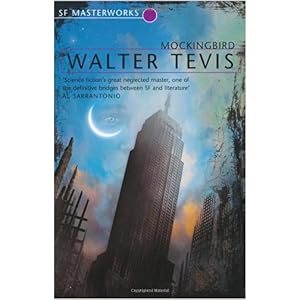
Walter Tevis: Mockingbird (1980)

Edition: Gollancz, 2007
Review number:1468

The best known novels by Walter Tevis are famous as films: The Hustler, The Man Who Fell to Earth, and The Color of Money - a trio which certainly demonstrates versatility. As a genre writer, he is also known for Mockingbird, here reprinted as one of Gollancz's "SF Masterworks" series.

One of TS Eliot's most famous lines, known to many who have no idea who wrote it (one online quotation search engine bizarrely attributes it to actor Vin Diesel) is "This is how the world ends, not with a bang but a whimper". It is almost a one sentence summary of Mockingbird, and is quoted at one point towards the end of the novel. Perhaps "human civilization" would be more apt than "world", but otherwise the mood and fit of the line is pretty much perfect.

The setting of Mockingbird is at the end, then, of the human history. With all tasks handled by robots, humans have sunk into a listless, drugged apathy, almost entirely of their own (or their ancestors') making. The main characters include one of the last, most advanced, robots to be made, named Spofforth, and one of the youngest remaining humans, named Bentley, who eventually realises the meaning of the demolition of his school once he and the rest of his year group leave: there are no more children.

The third major character is a woman named Mary Lou, who has been living an outsider's life in New York Zoo, inhabited otherwise only by the robots who manage it and who pretend to be children visiting - and which may well also be many of the exhibits. She has been surviving by eating sandwiches made available by a bug in the management system: a robot is provided with them to fill a vending machine, but always has five more than fit, and no instructions for what to do with them, so is effectively immobilised until May Lou takes them from it. She has managed somehow to escape from the system and is therefore free from the drugs taken by every other human. The robots have seen that humans are happier in general without high intelligence or dramatic events, so the drugs make their takers less excitable and less clever.

Once this is established, a strange thing happens, the most important event in the story, and one which almost knocks the whole novel off its mournful path. Spofforth denounces Bentley as a criminal - a true accusation, for Bentley, having worked out how to read from a book, teachers Mary Lou, and this is a crime because reading can distract from the bland happiness which humans are supposed to experience. Bentley is sent to prison, and Spofforth moves himself and Mary Lou into an abandoned apartment, following a rather atavistic prompting of a hidden part of his mind, which was not constructed but is based on a recording of the mind of a human being.

With the end of reading, of education, there is so much that people just don't know any more. Like a prehistoric inland dweller who has never seen the ocean, Bentley comments: "I did not know sea water was undrinkable. No one had ever told me." This, on top of the general apathy brought by the drugs, is really what is bringing the end; things break down, and no one knows how to fix them or how to get a robot to fix them, and no one cares to do either, anyway. Temporary measures, such as the one which added contraceptives to the drugs to curb population increase, are set in place, but then no one remembers to rescind them afterwards.

The title of the novel comes from a caption in a silent film watched by Bentley, who is put to recording the words of such films as no one can read the captions any more: "Only the mockingbird sings at the edge of the forest". Apparently, the Northern Mockingbird does indeed live and sing at the edge of forests during their breeding season, but Tevis' intention is to say something about his theme, but I found it hard to choose between several different interpretations of the phrase. The lives which are led by Bentley, Spofforth, and Mary Lou could be said to be a mockery of those who are living normal lives in the forest, and the mockingbird a symbolic outsider; the odd relationship between Spofforth and Mary Lou, while she is pregnant, is a mockery of twentieth century city life (as well as referencing the breeding season of the bird); or it could refer to Tevis' role as a commentator on the negative sides of the human drive to increase comfort and settle for the banal in experience as safer than living on the edge.

This is the kind of novel I would point to as a counter to those who think nothing with a science fiction genre label on it can be literary, or discuss real issues. Dealing with apathy, depression, and suicide as it does, Mockingbird is hardly cheerful reading, but is definitely recommended. My rating: 9/10.

Thursday, 1 November 2012

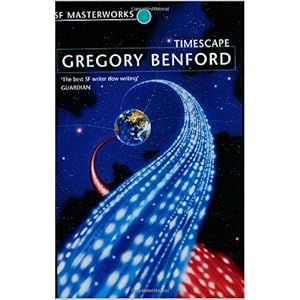
Gregory Benford: Timescape (1980)

Edition: Millennium, 2000
Review number: 1467

Gregory Benford is an author whose writing I like, but I have never got round to reading much of his work. Timescape is a classic science fiction, not quite about time travel but considering how history might be affected by the possibility of sending messages to the past. Half of the novel is set in San Diego in 1963, and half in Cambridge in 1998, with chapters more or less alternating between the two settings. (The dates were clearly chosen to that the novel appeared halfway between the two.)

In 1998, the world is experiencing a massive environmental catastrophe caused by mutations in oceanic plankton induced by the indiscriminate use of certain chemicals in agriculture. Physicists in Cambridge are investigating tachyons, sub-atomic particles which travel faster than the speed of light, and it occurs to one of them that it would be possible to send some kind of message to the past by sending a beam of tachyons to the point in space where the Earth once was, and interfering with physics experiments being carried out at the time when the Earth was at that position (direct detection of the tachyons being impossible, as technology wouldn't be in a position to pick them up at that point). The early sixties were chosen as a target because experiments which can be affected by beams of tachyons were beginning to be studied then.

Some people divide the science fiction genre into "hard" and "soft" writing. Hard SF is concerned with science: it views the genre almost as a way to carry out an informal discussion of more less speculative ideas, usually in physics, in a fictional setting. Soft SF is more often interested in the social aspects of science and technology, centring on culture. It is perhaps something of an outmoded way to view the genre, which seems to be more simply speculative in nature (i.e. centred around "what if" ideas) than anything else, where science fiction elements (such as space travel) are not simply props to a story which doesn't depend on them except as part of the background.

If the distinction has any meaning, then Gregory Benford has usually been regarded as a hard science fiction writer, partly because he is also a physics professor, and partly because he is also concerned to get the science in his stories as compatible with known fact (and interesting fact-based speculation) as possible. Most of the physics in Timescape is  based on what was known, or what at least seemed plausible in 1980, including what is quite likely to be the earliest mention of dark matter in a science fiction novel. The exception to this is the tachyons, which physicists still generally doubt could possibly exist. How they could behave if they did exist has been the subject of a certain amount of speculation, and Benford builds in part on this. And of course, tachyons are needed for the central plot device in Timescape of sending the message back in time, even if this violation of causality is one of the main reasons that their existence is considered unlikely. Benford has a rather convoluted but clever and interesting mechanism to get out of this trap, which I will not give away.

At the same time, Benford is able to write well enough to avoid the major criticism often levelled at hard SF writers, that they neglect important aspects of the story such as characterisation because of their overwhelming interest in the scientific idea. In Timescape, the reader does care about the characters in both timelines, and the background is believable - possibly in part because the setting is the physics research community which Benford is a member of in real life. It all works well, and the end product is a fascinating novel - at least, I think it would be to anyone interested in the physics. My rating - 9/10.

Thursday, 18 October 2012

Michael Moorcock: The Twilight Man (1966)

Also available under the title The Shores of Death
Edition: Sphere Books, 1970
Review number: 1466

Like The Blood Red Game (which I bought in the same second hand bookshop as The Twilight Man in May), this is a reworking of an earlier piece of writing, in this case a serial which was written to fill space in New Worlds during the earliest months of Moorcock's editorship of that later famous science fiction magazine.

Clovis Marca is a former leader of Earth's government, leading a humanity which is now doomed to extinction after an alien visitation has left everyone infertile. As the book begins, Marca returns from a year in space, his way of dealing with the catastrophe. The desperate decadence of the society he finds on his return is a clear precursor of my favourite Moorcock series, The Dancers at the End of Time.  The Twilight Man is a staging post between it and the Arthur C. Clarke novel, The City and the Stars, which appears to have influenced Moorcock greatly, though I do not actually know that he read this particular novel (as I discuss in its review). Doomed decadence is one of Moorcock's recurring themes, as well - part of what he wants to say to his readers through his writing.

While much more Moorcockian (so to speak) than The Blood Red Game, The Twilight Man is still not fully individual in its style: clearly still the work of a writer finding his way, even five years after the publication of the first Elric novel, The Stealer of Souls. Perhaps because it is more like the author's later work, The Twilight Man is less interesting to read than The Blood Red Game: it is slightly too much like the fan's guess as to what early Moorcock would be like to engage.

Reasonably enjoyable in itself, I would give The Twilight Man 6/10.

Tuesday, 28 August 2012

Alastair Reynolds: Blue Remembered Earth (2012)

Edition: Gollancz, 2012
Review number: 1462

The setting of Blue Remembered Earth is a post-scarcity world, where an environmental collapse has been followed by the rise of African states as superpowers, a renaissance which is originally solar then fusion powered. The Akinya family has played a leading part in this, and its members are now famous and wealthy. The plot is set in motion by the death of their matriarch Eunice in her space station retreat. The main characters are her grandchildren, the idealistic Geoffrey and Sunday, who have rejected the Akinya corporate legacy, and the mercenary Hector and Lucas. A secure deposit box belonging to Eunice sends the first two on a quest to discover her true legacy, the first step in a treasure hunt across the solar system where each clue points to the location of the next, and Hector and Lucas are not far behind them.

This rather childish-seeming plot is not what the book is really about - and Reynolds can certainly do better at this aspect of novel construction. Reynolds is a master at world-building, and Blue Remembered Earth is basically a tour of the man-made wonders of the solar system of the future. The novel is a gallery to show off some of his ideas, some of which could easily be the foundation for whole novels of their own: from the "ethics shunt" installed in Lucas' brain to prevent morality getting in the way of business, to the Evolvarium, an area of Mars in which machines are left to evolve and compete, like a physical version of the genetic algorithms run in many of today's computer simulations.

While most of Alastair Reynolds novels remind me of writers like Iain M. Banks, Blue Remembered Earth is much more like older genre figures, in particular Arthur C. Clarke. Instead of writing a wide ranging space opera, here Reynolds sticks to the solar system, which is full of its own wonderful objects, including an updated version of Clarke's famous lunar monolith - Reynolds' version is on the Martian moon Phobos, and is fantastically carved by human tourists. There is an element of guided tour about the novel as a result, which will not be to all tastes. Like Clarke's 2001, the story builds up to a climactic revelation. The big question for a potential reader is going to be whether this ending really is a climax, or just a disappointing let-down. This is of course also the case for any story in any medium which is constructed as a sequence of "reveals" (to use a film-making term); The Whisperer, which I recently read, is an example of a thriller set up in this way, which I don't feel has a sufficiently good climax to work. Here, at least from the point of view of the characters, the ending is better, but to this reader, some aspects (particularly the reasons for the secrecy and the treasure hunt) don't quite gel properly.

Which brings me to the title of the novel. It is derived from A.E. Houseman's A Shropshire Lad, of which the relevant lines seem to be "What are those blue remembered hills...? That is the land of fat content ... The happy highways where I went and cannot come again." It is hard to see how Houseman's poetic evocation of nostalgia relates to a novel which has such an optimistic view of the future of the human race, even if some tribulation has to be endured before that future arrives. The key is, I think, that this is the first of a new series: it is the blue remembered earth described in this novel which will be the object of nostalgia later on, suggesting that the series will become darker as it progresses.

My rating: 6/10; not appealing to me as much as Reynolds' earlier work.

Saturday, 4 August 2012

Liz Jensen: My Dirty Little Book of Stolen Time (2006)

Edition: Bloomsbury, 2007
Review number: 1461


If the title did not warn the reader, the first sentence's appropriation of the famous opening to Rebecca would make it clear that My Dirty Little Book of Stolen Time is not going to be entirely serious. It is a personal history, told by Charlotte, a prostitute from late nineteenth century Copenhagen. When times are hard, she manages to inveigle her way into a respectable house as a maid, only to be accidentally catapulted into twenty-first century London bye the HG Wells-style time machine hidden in the basement.

My Dirty Little Book is broad comedy, sometimes even cruel (Charlotte's treatment of the dim overweight woman who accompanies her is a case in point). But it is still very funny. In fact, I was reading it alongside a P.G. Wodehouse I hadn't read before (The Girl in Blue), and Liz Jensen held her own even in this company. Few indeed will be those readers who follow Charlotte's exhortation in a time of adversity to return the book in disgust to the shop or library from which it was obtained.

I have tagged this review as science fiction because of the time travel element, though one of the reviews quoted on the cover describes it as "less science fiction than fairy tale", which is in many ways true. I don't have a tag for fairy tale currently, but I actually think that science fiction is the right genre in which to place this book (subsidiary to humour, which is obviously its main point). My feeling is that Tom Holt and Terry Pratchett are readily filed under science fiction or fantasy, because the genre themes and ideas are important elements in the structure of their books, provide much of the humour, and are the subjects of parody. Not only that, but the detailed nature of the genre elements is frequently given in some detail and is important to the story: dragons in The Colour of Magic (to pick one example) are not just fairy story beasts with no explanation, but projections of a human belief in dragons and a parody of Anne McCaffrey's Pernese dragons. And I think that all these criteria hold for Liz Jensen's book as well. Time travel is essential to the plot and the humour; there are moments of genre parody, particularly of H.G. Wells; the time machine itself is analysed further (there is even some discussion of the famous grandfather paradox). In fact, the nature of the fuel which propels the time machine is the closest that My Dirty Little Book comes to having a serious point, consisting as it does of three liquids embodying the struggle of history (blood, sweat, and tears), mixed with that more comical essential lubricant, strong alcoholic spirits.

The plot of My Dirty Little Book is farcical and not particularly important, except as the means by which the humour is generated. This mainly takes the form of Charlotte's observations of the worlds of both time periods. She is a most lively storyteller, occasionally a little too keen to address the reader directly, perhaps, but certainly an individual and entertaining voice. The amoral narration and humorous twists and turns of Charlotte's exploits made me think of Harry Flashman, not a bad model for this sort of comic novel.

My rating: 8/10.

Sunday, 22 July 2012

Michael Moorcock: The Blood Red Game (1974)

Edition: Mayflower Science Fiction, 1974
Review number: 1459


The contents of this novel are actually from the very beginning of Moorcock's career, appearing as a pair of stories in a science fiction magazine in 1962, at around the same time as the first Elric novel, which was much more of a signpost to the type of writing he was going to go on to become known for. This packaging of the stories together which appeared in the mid-seventies must have seemed rather out of step with the cool New Wave work he was writing at the time; The Blood Red Game is, by contrast, clearly derivative from pulpy SF writers like E.E. "Doc" Smith and AE Van Vogt, especially the latter. (I should perhaps mention that, according to Fantastic Fiction, the two stories also appeared as - extremely short - separate novels in 1966.)

The first story, originally entitled The Sundered Worlds, has a hero, Renark, who has the psychic ability to sense the universe as a whole. He realises that it is beginning to contract, threatening the total destruction of humanity, a slightly strange premise that is apparently forgetting that it would take billions of years to contract the universe, even if the contraction occurred at almost the speed of light. No explanation is given of why it poses such an urgent problem, or even any indication that the contraction is very fast. The sundered worlds of the title are a small group of planets which travel between dimensions, and Renark thinks that they will hold the key to saving the galaxy. So he, with a small group of friends, travels to the sundered worlds the next time they pass through our universe, even though no human has ever returned from similar trips.

The second story, sharing its title with this book, follows immediately on from the end of The Sundered Worlds, so much so that I suspect some re-writing was done to cover the join for publication as one. The story now sees humanity facing a different external crisis, being forced to participate in a series of incomprehensible psychic games against alien species, for the amusement of more powerful beings.

In themselves, the two stories are fairly mediocre. To the Moorcock fan, they do have interesting ideas which relate to important concepts behind his later work, including an undeveloped form of the multiverse, with clashes between universes playing a part as they do in several later stories. I can see that they would have been of sufficient interest to a magazine editor in 1962 to publish, but I don't think that anyone would have bothered to re-package them as a novel without Moorcock's name associated with them - if, say, they had been the only published stories by someone who went on to become an advertising executive or a banker, instead of a world famous and hugely influential science fiction editor and author. As things turned out, it is still interesting to read them in the context of Moorcock's other work.

My rating - 4/10.