Showing posts with label Leslie Charteris. Show all posts

Tuesday, 7 May 2019

Leslie Charteris: Salvage for the Saint (1983)

Edition: Thomas & Mercer, 2014
Review number: 1519

After almost forty years, this is the final Saint book which I am reading for the first time, as well as being the last one published (aside from the Burl Barer contributions, neither of which I've been able to like enough to read right through). Salvage for the Saint was adapted  by Peter Bloxsom from a double episode of The Return of the Saint TV series written by John Kruse, the two of them being frequent choices by Leslie Charteris to work with turning TV scripts into books.

The story starts at a motorboat race on the Isle of Wight, in which Simon Templar is unable to save fellow competitor Charles Tatenor from a fatal accident - or possibly from murder.  He also meets the dead man's beautiful widow Arabella. The action moves to the south of France (one of the favourite European locations of Saint stories), Simon to investigate the murder and Arabella to sell a yacht, as her husband unexpectedly left nothing but it and debts.

In places, Salvage for the Saint has a wistful atmosphere which is appropriate to the last novel in such a series, and includes a number of melancholy references to older Saint stories. This is far more subtle than in the Burl Barer-penned Capture the Saint, which is full of contrived attempts to introduce names of older stories into the narrative - a piece of silliness which becomes infuriating after a few pages. It was Leslie Charteris' decision to stop at this point, and these touches are perhaps pointers to this being the final Saint story.

Diving is an crucial part of Salvage for the Saint, as it was to the early novel Saint Overboard, published almost fifty years earlier. In both novels, the diving technology is important to the plot, and it is hugely different - heavy suits with air hoses to the surface are now replaced by compact scuba tanks; to read both is to have a glimpse of how much had changed during the time that Leslie Charteris was writing.

All in all, this is a worthy conclusion to the Saint saga, though it doesn't match up to the quality of the early stories. My rating: 7/10.


Sunday, 14 April 2019

Leslie Charteris: Count on the Saint (1980)

Edition: Coronet, 1980
Review number: 1518

According to the saint.org website, this is by uncredited (as far as I can see) writers Graham Weaver and Donne Avenell - the same as the previous Saint book, The Saint and the Templar Treasure. Like many of the books which originated from the TV Saint adventures, Count on the Saint contains two independent stories, The Pastor's Problem and The Unsaintly Santa.

As soon as I started reading the first story, it felt as though I was back in the heyday of the Saint. This is a big contrast to The Saint and the Templar Treasure, which is a competent thriller but which is not convincing as part of the series. The setup is very Saintly indeed, as Simon Templar steals a chalice belonging to a church in order sell it to help the pastor raise money for the parish; the chalice can't be sold legitimately to raise money directly. (The chalice is meant to be real; the very obviously fake chalice shown on the cover of this edition does the story no favours.)

In his long history, Simon Templar points out several times that he is not a detective, usually before solving a mystery. The Unsaintly Santa is definitely a mystery, and Simon is definitely detecting. Set in Cambridge just before Christmas, the puzzle is to work out the identity of a killer dressed as Santa. Unlike some of the earlier attempts at detecting (where Simon's method is basically to accuse each person until the right one is exposed), this works quite well as a puzzle - but there very little need for it to be a Saint story.

For the reader, this is one of the best of the late Saint books. My rating: 8/10.

Friday, 29 March 2019

Leslie Charteris: The Saint and the Templar Treasure (1978)

Edition: Coronet, 1978
Review number: 1517

Another late Saint novel, written by Donne Avenell and Graham Weaver in the days when Leslie Charteris was editing new entries in the series rather than writing them himself.

It feels like a somewhat trite idea that Simon Templar should become involved with the Knights Templar, but in fact the way it is handled is competent, if a little clichéd for a thriller setup - Simon gives a lift to a couple of young men heading for a French vineyard to work in the summer, and gets there to discover that someone has set the barn on fire. The vineyard is at a house which was originally one of the last Templar castles to remain in the hands of the knights after the suppression of the order by the French king in 1307, and suspected by some to hold the hidden Templar "missing" treasure (while more sober individuals suspect that the treasure never existed in the first place, and that the riches of the order were exaggerated).

While the book is satisfying as a thriller, it doesn't really read like a Saint book. It could almost be any late 1970s British thriller writer. The early Saint stories were unique, standing out from the crowd (even if they had obvious debts to Dornford Yates and Sapper), and Leslie Charteris was an expert at maintaining this specialness. It was partly that he made Simon Templar a genuinely charming character, rather than the direct man of action favoured by many other writers. That is really what is missing here; Simon Templar just isn't Simon Templar by 1978.

My rating: 6/10.

Tuesday, 19 March 2019

Leslie Charteris: The Saint in Trouble (1978)

Edition: Coronet Books, 1978
Review number: 1516

Another compilation of stories which originally were TV episodes of Return of the Saint, The Saint in Trouble comprises The Imprudent Professor (by Terence Feely) and The Red Sabbath (by John Kruse), both adapted from the TV scripts by Graham Weaver.

In the first story, Simon Templar is asked to look out for the safety of Professor Maclett by his daughter, in the glamorous setting of Cannes. Maclett is the centre of a lot of attention, being of interest to both British and Russian spies, and the story is a hectic series of encounters between the various parties involved and the Saint. Even if only ranked against the other TV adaptations, The Imprudent Professor is not a high quality story. It seems to be Saint-by-numbers - a location which would have been exotic in 1978, beautiful women, Saintly tricks, and Simon sorting everything out in the end.

The Red Sabbath is better. It follows on directly from The Imprudent Professor, as Simon disembarks in London from the plane he took in Cannes at the end of the first story, and is accosted by men who take him to talk to an Israeli intelligence officer. This leads to Simon hunting an Arab terrorist through London, a task he invests in personally. It is perhaps more typical of other thrillers of the second half of the seventies than of the Saint oeuvre, though the nature of the story reminds the reader that Arab terrorists are not new in fiction post 9/11.

Averaging out my ratings for the two stories, I would give The Saint in Trouble a solid 5/10.

Thursday, 27 December 2018

Leslie Charteris: The Saint and the People Importers (1971)

Edition: Thomas & Mercer, 2014
Review number: 1515

In recent years, the news has been full of refugees; immigration, legal and illegal, is seen as a problem by many. But people have been concerned about it for decades, and even centuries, and this is a novel about illegal immigration from the early seventies (the TV episodes that the novel was based on were aired in 1969 and the book came out in 1970).

This is not the first Saint novel to take on social and political issues, including pre-war attacks on the Nazis in Prelude for War (aka The Saint Plays With Fire). Many Saint stories have a moral content, as Simon Templar is almost always taking on the bad guys in order to help an innocent victim. Here, his activity is prompted by a newspaper report of the killing of one of the immigrants as a warning by the traffickers. However, there is no serious attempt to integrate any of the issues surrounding immigration into the story, the abuse of would-be immigrants by traffickers being only the motivation for a TV thriller. The eventual "solution" to the problem of the existence of a group of rescued immigrants seems crass and insensitive today. To be fair, the TV episode and this novel were not intended as any kind of serious exploration of the issue; the adventures of the Saint are about entertainment pure and simple. The nature of the MacGuffin in The People Importers is not really suitable for this treatment, and it shows.

Like many of the TV based stories, this is a much more straightforward thriller than the earlier Charteris stories. Although his introduction says that he added his own signature touches to each one, that is little in evidence here. One for Saint collectors only, really.

My rating: 6/10.


Friday, 29 January 2010

Leslie Charteris: The Saint in Pursuit (1970)

Edition: Coronet, 1989
Review number: 1395

Many of the later Saint stories are adaptations of episodes from the TV series (both The Saint with Roger Moore and Return of the Saint with Ian Ogilvy), but The Saint in Pursuit is I think unique in that it originated as a comic strip printed in American newspapers.

The story is a fairly standard Nazi Gold caper set in the late fifties (when the strip first appeared). A young woman, whose father was in the US Army and disappeared towards the end of the war, receives a letter from a lawyer sending her to Lisbon. This alerts US military intelligence, which still has some questions it wants to have answered about her father's disappearance. He worked as an investigator, and he may have disappeared because of this work, which involved tracing large sums of money - and they want to know why. They in turn contact Simon Templar, who did some work for them during the war (as detailed in the Saint novels from The Saint in Miami to The Saint on Guard). The Saint is hardly going to turn down this treasure hunt assignment...

Without stretching the format, or even giving Charteris any need to think very hard, this is an enjoyable Saint book, and one which delights the collector in me, as its acquisition leaves me with just three to complete the set. My rating - 8/10.

Thursday, 1 May 2003

Leslie Charteris: Meet the Tiger (1927)

Alternative title: The Saint Meets the Tiger (Buy from Amazon)
Edition: Ward, Lock & Co., 1927
Review number: 1154

Before changing publishers to Hodder and Stoughton, a move which coincided with his writing career suddenly taking off, Leslie Charteris wrote about half a dozen thrillers for Ward, Lock & Co. Meet the Tiger is one of these, and is a Saint book, written three or four years before the novel which Hodder designated as the first in that long series, Enter the Saint. It's gone on to be comparatively forgotten ever since, with fewer reprints making it harder to track down. (I've been collecting Leslie Charteris for about twenty years, and this was the first copy I'd ever seen.)

Meet the Tiger derives much of its character from the juxtaposition of two widely separate worlds: the Chicago gangster culture and a sleepy, tiny Devon fishing village (these were the days before mass car ownership brought tourism to such picturesque settings). The Saint has come to Baynscombe on the trail of a massive hoard of stolen bullion, but has to work out which of the village characters are members of the Tiger's gang (known as the Cubs) and, most importantly, who is the Tiger himself. The situation is complicated by his first meeting with Patricia Holm, destined to be a part of many of the novels which eventually followed.

The most interesting question any Saint fan has about Meet the Tiger is how the series characters in their earliest manifestation match up with their later versions. (As well as Simon Templar and Patricia Holm, Meet the Tiger also introduces the Saint's manservant, Orace.) In fact, there is not all that much difference; the facetiae are not quite as polished and lighthearted, and it would be odd to describe the later Saint as "inexperienced with women". Orace is given a big part, in contrast to the way that he later fades into the background as other sidekicks come along. Patricia is much the same, the beautiful young woman who is nearly as competent an adventurer as Simon; it is nice to read the story of their original meeting at last.

It is in the plotting that Charteris shows his inexperience, a flaw which Meet the Tiger shares with the other pre-Hodder books that I have read. Like many thirties thriller writers, Charteris consistently shows a liking for the fantastic - incredible disguises, villains leading double lives as respectable citizens, and so on. Later on, he can make it seem believable (The Saint in New York being an outstanding example), but here the creakiness of the plot is quite clear.

Saturday, 23 February 2002

Leslie Charteris: Send For the Saint (1977)

Edition: Coronet, 1978 (Buy from Amazon)
Review number:1076

This volume contains two stories from the TV series Return of the Saint, adapted by Peter Bloxsom in the same way that Fleming Lee adapted several of the stories from the earlier Saint series. Like many of these adaptations, they lack the unique features, particularly the humour, which mark the Saint out from other thriller heroes. As was by this point the usual practice for Saint books, the stories are set in the past, in the fifties. (The TV series, on the other hand, was I think intended to be contemporary, which must have made the adaptations a little bit more difficult; this is probably why there is very little in terms of period detail in the stories to identify the date.)

The first story, The Midas Double, starts when a Greek shipping magnate kidnaps Simon Templar from Athens airport. He is eventually persuaded to take a bizarre job; the millionaire is convinced that he is being impersonated by a double, who aims to discredit him by making it appear that he has been undertaking shady business deals.

The other story, The Pawn Gambit, has Simon infiltrating a company of mercenaries, to avenge the death of a wartime friend, and this story has a particularly world-weary Saint not at all like the character's usual self. Neither of them is really equal to the usual standard of the series, let alone to the best of it.

Wednesday, 13 February 2002

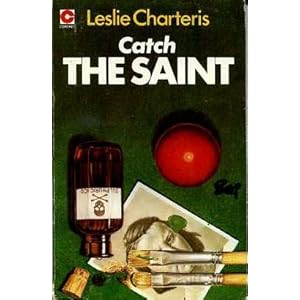
Leslie Charteris: Catch the Saint (1975)

Edition: Coronet, 1977
Review number: 1063

It is here that Leslie Charteris abandons, explicitly, the idea that Simon Templar's adventures are to be considered contemporary to the time of writing, though there is little in either which dates them to any particular period between the thirties and seventies.

Returning to the past fails to re-invigorate Charteris' writing, unfortunately. The two stories - The Masterpiece Merchant, about a kidnapped painter, and The Adoring Socialite, about a hunt for a hidden crime boss, are among the least imaginative of the whole series. Ideas are re-used from earlier tales, notably The Saint in New York, and even from other sources, one twist coming straight from the film Charade. The writing is competent, and as thrillers the stories work reasonably well; the paucity of original ideas is the only reason for rating them lower than most of Charteris' work.

Friday, 25 January 2002

Leslie Charteris: The Saint and the Hapsburg Necklace (1976)

Edition: Coronet, 1978 (Buy from Amazon)
Review number: 1052

The ending of the first Saint TV series, the one starring Roger Moore, and the subsequent beginning of the second, starring Ian Ogilvy, brought some more changes to the much longer running series of books. This really began when Charteris realised, with the tie-ins to the first series, that he could put his name to Saint stories written by others; this particular novel is in fact written by Christopher Short.

In a departure from the norm for the series, The Hapsburg Necklace is a return to an earlier period in the life of the hero (and so it is not, despite appearances, a tie-in with The Return of the Saint). Set in Austria after the Anschluss but before the outbreak of war, it is more or less contemporary with Prelude for War. It is a silly story, about an attempt by an Austrian aristocrat, the last of the hereditary keepers of the Hapsburg necklace (a fabulous piece from the crown jewels of the former empire) to retrieve the gems from their hiding place in the ancestral castle, now being used as the SS headquarters for Austria.

This going back into the past will inevitably (for fans of the series) lead to a comparison with the earlier work with which it is supposedly contemporary. This novel is found wanting; it reads like a minor seventies thriller set in the past - which is what it is. Even the character of Simon Templar is greatly simplified, making him much more a two dimensional action hero.

Saturday, 5 January 2002

Leslie Charteris: The Saint and the Fiction Makers (1969)

Edition: Coronet, 1972 (Buy from Amazon)
Review number: 1025

The third Saint book to be made up from scenarios from the TV series contains just a single story, lengthened to a full novel. It is not entirely typical, containing the kind of ironic self reference more associated with The Avengers than the more straightforward action of most Saint stories.

Both novel and TV show open with a depiction of a non-Saint adventure; in the original version, this had greater impact, because it looked as though the wrong piece of film was being shown. In fact, Simon Templar is present at the première of the latest in a series of films in which Charles Lake battles against the evil S.W.O.R.D. (Secret World Order for Revenge and Destruction). He has accompanied the dumb blonde starlet who is the film's love interest, but at the end of the film is more interested by a conversation with the publisher of the original novels on which the movie is based.

When the two of them are attacked, Simon immediately accepts the proposition that has been made to him, which is to protect reclusive author Amos Klein. Travelling to a secret address, the Saint discovers the writer to be a pretty woman, but is kidnapped alongside her by a megalomaniac who has recreated her description of S.W.O.R.D. headquarters in every detail and now wants to have Simon, whom he assumes to be Klein, plan an attack on a security company's supposedly impregnable gold vaults.

The Saint and the Fiction Makers is, of course, far fetched; but it is exciting and, in its commentary on the fashions of its own genre, humourous.

Wednesday, 12 December 2001

Leslie Charteris: The Saint Returns (1969)

Edition: Hodder Paperbacks, 1970
Review number: 1012

The set up for this book is identical to that of its predecessor, The Saint on TV; so much so, in fact, that the foreword explaining that it contains scenarios reworked from the TV series is repeated verbatim. This has its ludicrous side, as it attributes the story ideas to John Kruse whereas the first is actually by D.R. Motton.

This particular story seems far-fetched even for the Saint. Simon Templar rescues a beautiful girl from two heavies, and she tells him that she is Mildred Hitler, daughter of Adolf, brought up in an Irish convent where the Mother Superior was the sister of a high ranking Nazi official, currently escaping neo-Nazis who kidnapped her to make her the figurehead for their movement. The point of the story is to work out what is really going on before the writer (Fleming Lee) explains; this isn't too difficult, and The Dizzy Daughter is not one of the better TV adaptations.

The Gadget Lover is no more convincing, but much more enjoyable. Someone has been hijacking Russian secret service equipment, so that (for example) hidden cameras explode when the last exposure is taken, killing the user. Simon becomes involved in their investigation, naturally entangling himself with a beautiful KGB officer. Taken from one of the fastest moving TV episodes, it becomes one of the best adaptations.

Wednesday, 21 November 2001

Leslie Charteris: The Saint on TV (1968)

Edition: Pan, 1970 (Buy from Amazon)
Review number: 996

After two series of The Saint TV programme, there was no more suitable material remaining among the Saint stories written in the previous thirty five or so years. This may seem a little strange, considering the vast amount that Charteris had written, but there are good reasons why so little was reusable. The initial agreement had been that no new stories were to be developed, and the decision to make each fifty minute episode self-contained was a major limitation. Other decisions were to cut out permanent companions (and Patricia Holm or Hoppy Uniatz occur pretty frequently), and to ignore easily datable tales, which makes all the wartime stories and some of those from previous years unusable. Budgetary constraits were quite stringent, ruling out stories with easily identifiable exotic locations. So, as he explains in the introduction, enough money was offered to overcome Charteris' scruples, resulting in the stories chosen here, two of the most memorable of all the TV episodes. Both are stories originally by John Cruse, adapted by Fleming Lee; the screenplays were by John Cruse and Harry W. Junkin.

The better story is the first, The Death Game. Here, Simon Templar gets involved in a student craze for simulated assassination, and discovers that it is an orchestrated front for the recruitment of real killers by a criminal organisation. In the other story, he is contacted by a furious sculptor who is convinced that the Saint has seduced his girlfriend; when Simon goes to visit this man and try to find out what has really happened, the artist is murdered in front of his eyes and attempts are made to frame him for the killing.

By choosing two of the best stories from the series, this collection is able to match up to the bulk of Charteris' output; it is one of the best of all the postwar Saint books.

Friday, 2 November 2001

Leslie Charteris: Vendetta for the Saint (1963)

Edition: Charter, 1964 (Buy from Amazon)
Review number: 985

The first full length Saint novel for some years turns out to mark an end point in the series; with the next book, the stories are lifted from the TV series rather than the other way around. As the title indicates, it pits Simon Templar against the Mafia in Sicily; when he witnesses a tourist rebuffed in a Neapolitan restaurant after asking an innocent question and then hears that the man has been murdered the next morning, he is convinced that a secret is hidden in the question and that he wants to do something to avenge the killing.

One of the interesting details of this particular novel is that Charteris seems to have finally decided to age the Saint - a decision reversed for the TV series, naturally. There are several references to the way that things might have been done differently had Simon Templar been in his prime - not that he doesn't manage to pull off superhuman feats of dexterity and endurance all the same. Perhaps too much so - the story, with its extremely powerful villains worsted by one man, is one of Charteris' more ludicrous.

Wednesday, 24 October 2001

Leslie Charteris: The Saint in the Sun (1964)

Edition: Hodder & Stoughton, 1966
Review number: 971

This early sixties collection includes stories from the preceding decade, several of which were turned into scenarios for the TV series. One is set in the Bahamas, and in the TV series a gloomy Brands Hatch (I think) stood in for a race track at Nassau, cheaper but not nearly so glamorous, and that is possibly the most interesting thing to say about these stories.

Saturday, 6 October 2001

Leslie Charteris: Trust the Saint (1962)

Edition: Hodder & Stoughton, 1964 (Buy from Amazon)
Review number: 957

Six Saint stories from the early sixties, as the date approached the launch of the TV series. Indeed, the final story is one which I remember seeing Roger Moore in, memorable because it is a silly tale about the search for the Loch Ness Monster.

Apart from this, Trust the Saint is one of the least memorable of all the collections of Saint stories. The tales are enjoyable enough when read, but quickly fade from the mind.

Saturday, 8 September 2001

Leslie Charteris: Señor Saint (1959)

Edition: Pan, 1966
Review number: 940

Four stories set in Latin America (Baja California, Mexico City, Havana and Panama) make up this collection. They are all different variations on the theme of a swindle, some from the point of view of the innocent victims - who are not necessarily the characters you expect - and some from that of the swindler.

This is well trodden, familiar territory for Charteris, and the stories are typical, charming and amusing little thrillers if nothing very special. The original appearances of the stories was in 1953 and 1954, and this is given in the prefatory material of this edition, something unusual in the Saint series. This is probably because the Cuban revolution occurred before the book version appeared, so that the situation in Havana had changed, and the publisher wanted the reader to be aware that this was the case.

Thursday, 30 August 2001

Leslie Charteris: Thanks to the Saint (1958)

Edition: Coronet, 1961
Review number: 928

In this late fifties collection of six stories, Simon Templar returns to the America that has really been his home for the preceding twenty years. It is not one of the more interesting collections, though it does have an unusually high proportion of tales where the Saint is investigating a murder. The reluctance with which he does this is something of a running joke throughout the entire series of stories, objecting on the grounds that he is an action hero rather than Sherlock Holmes, but he does usually take on the role reasonably competently. (The motive for doing so is normally that the police automatically assume that he is responsible for any crime committed while he is in the neighbourhood, so he is working to clear his name. In these stories, this isn't the case, for some reason, but the reluctance is still there.)

Friday, 17 August 2001

Leslie Charteris: The Saint Around the World (1957)

Edition: Hodder & Stoughton, 1961
Review number: 911

This collection, concluding a mid-fifties jet-setting theme in the Saint saga, literally does take Simon Templar around the world, starting in Bermuda, working through Europe and Asia to Vancouver Island. They include what may be the worst of all Leslie Charteris' Saint stories as well as the last case for Simon's old sparring partner, Chief Inspector Teal.

The best of the stories is a little murder myster set on the famous naturist island of Hyeres; also enjoyable is the silly story about dowsing for oil in Arabia, The Lovelorn Sheikh. The final story is the poorest, mainly because of the B-movie Russian villain (all "Russian engineers invented [a part in an aeroplane engine], but it was stolen by Henry Ford's spies"), but also because it trades shamelessly on the past glories of the series, introducing a girl who is the unknown child of Norman Kent, who sacrificed himself to save his friends in The Last Hero. A sad end to an enjoyable collection.

Wednesday, 8 August 2001

Leslie Charteris: The Saint on the Spanish Main (1955)

Edition: Pan, 1962
Review number: 897

This collection, like The Saint in Europe before it and The Saint Around the World after it, has a theme of travel, with each of its five stories set in different locations. They are all, in this case, in the Caribbean, which with their fifties date makes them feel more like Ian Fleming's James Bond stories than any others in the Saint series.

All five stories are nondescript and easily forgettable as thrillers, but two of them stand out because of the interest of their settings. One is Haiti, where Simon Templar becomes involved with an American businessman who is studying voodoo with the aim of cost cutting in his factories by employing zombies; it has a supernatural element unusual in Charteris' writing, but is inferior to, say, the film of Live and Let Die in its atmosphere.

The setting of the Jamaica story involves a less well known aspect of Caribbean culture. In the mountains of the island lies the territory of the Maroons, which was an effectively autonomous little state founded by runaway slaves in the eighteenth century. This is a similar story to the creation of the state of Haiti. The story itself doesn't live up to what is a fascinating and romantic background, and throughout the collection Charteris is not really at home with the Caribbean as he seems to be when writing about Europe and the United States.