Showing posts with label fantasy. Show all posts

Thursday, 21 May 2020

фANTASTIKA: Almanac for Bulgarian Speculative Fiction

Edition: Terra Fantasia (Association of Bulgarian SF & F Writers and Artists), 2020
Review number: 1520

This is an extensive collection, a showcase of Bulgarian science fiction and fantasy, including both writing (translated into English) and art. I have never read any Bulgarian speculative fiction (at least, not knowingly), and so I'm approaching this with interest and am hoping to be impressed. I've written a mini-review of each story, and at the end I've added some general thoughts about the anthology as a whole.

The first section in the anthology contains stories which are considered to be straightforwardly science fiction.

The Last Interview of Adam Sousbe, by Lyuben Dilov (short story)
This story positions itself as a journalistic interview of a proponent of male rights in 2980, which has been proclaimed the "Year of Man" - the final interview before Adam Sousbe is murdered. The idea that gender inequality might be reversed in the future is not unique, of course, and it can be hard to tell whether a story on this theme is intended to highlight continued unequal treatment of women or to suggest that feminism has gone too far already. It is very much a John W. Campbell story, complete with the feeling of slight discomfort at the politics (though here I am less sure of the intention than I would be with Campbell's). I couldn't see a date for this piece, but the "about the author" paragraph places him in the 1970s, and it is certainly a story which wouldn't be at all out of place in any collection of short science fiction from that decade.

Beating the Air, by Velko Miloev (short story)
What would happen if people could choose to become a wind? This brilliant story takes this strange question and runs with it. The point of view character is a "wind inspector", checking up on someone who has taken that option, who is conversing with a wind that is tired of paid work producing picturesque effects for a poet. Reading this whimsical story is one of my fiction highlights of my 2020 science fiction reading, and it deserves to be widely known.

It's Only Fair, Botkin, by Khristo Poshtakov (short story)
There is still something of a tendency in science fiction to depict space exploration as a glorious adventure. In this story, it is a tedious job, and one which doesn't reflect well on the explorers. The story is a thinly veiled attack on the attitudes of Earthly colonialists on the native peoples they encountered; fairly predictable, and less interesting to me than the depiction of what it's like to be doing a dull job in space at the start of the story. Worth reading, but less good than the stories which precede it.

In the Beginning Was the Subway, by Lyubomir P. Nikolov (short story)
The beginning of this story is a bit incoherent, but by the second page it resolves into a tale of a ghost arranging for a young man to receive a mysterious device, though which esoteric scientific information is imparted to him over a period of weeks. It's a weirdly utopian tale, which in tone reminded me of Olaf Stapledon, with an old fashioned, didactic tone. Interesting, but not a story which appealed to me.

Three Tales of a Very Windy Town, by Lyubomir P. Nikolov (short story)
"Up on the cliffs by a rough sea, there falteringly existed a town" is a great start to a story. It sets the whimsical tone of an amusing tale, which is essentially three tall stories about the wind. Together with Beating the Air, it suggests that Bulgarian writers may have something of an obsession with the wind! It is very unusual in an anthology with several authors to have two stories in a row from the same author (especially as they are not among the shortest stories); if I had to pick, I would choose this one to keep - it is both more inventive and more enjoyable to read.

Virgil and the Water, by Svetoslav Nikolov (short story)
Another strange story, of the Roman poet Virgil, who in this version oversees the whole of the history of the Roman Empire, and is obsessed with plumbing. From the note following the story, it appears that this is likely to be the most well known story from this collection to Western readers. It's engagingly written, but to me suffers (in a slightly bizarre way) from one of the major problems facing science fiction authors: finding a good way to give the reader all the information s/he needs in order to be able to understand the story. Because of the way this story works, the infodumps here are not about interplanetary trade relations, or the foibles of faster than light travel, but concern Roman history. In some ways, this is brought to life by the insertion of Virgil as narrator into the centre of events, but I suspect that there will be many readers whose interests don't extend to a summary the events of six centuries in a few pages.

How I Saved the World, Or, The Best Job by Valentin D. Ivanov (short story)
Training to be a hero is not fun in a (minimally described) post-apocalyptic world. Obsolete equipment and vehicles do not have the expected glamour. But just wait until you find out what the job actually entails.... Humorous story with some neat physics in the twist. A short, but excellent story.

Deflation, by Valentin D. Ivanov (short story)
Illegal astronomy?! This very short story is about an undercover investigation into illegal astronomy, and right from the beginning I was hooked: why is the use of telescopes banned? Unusual for these stories, Deflation is set into the USA, in may ways still the spiritual home of modern science fiction (and, indeed, a lot of modern astronomy). Not quite as good as How I Saved the World, but Deflation also has a good reveal of the physics involved at the end.

Dragonflies and Planets, by Aleksandar Karapanchev (short story)
Even shorter, this two page story is a beautiful lyrical prose poem about the exploration of distant worlds. Dragonflies and Planets is a distillation of the sense of wonder which lies at the heart of science fiction.

The Empty Room, by Aleksandar Karapanchev (short story)
Karapanchev's second story is also short and poetic, about the seasons and death and renewal, but is less successful than Dragonflies and Planets. However, the intention is to chill rather than enchant, and it certainly does that.

The Most Terrible Beast, by Khristo Poshtakov
This amusing story is the space exploration equivalent of tall fishing stories in a bar - swapping tales of the most hair-raising beasts encountered on newly discovered planets, each one topping the last with larger, more fearsome and dangerous creatures. Here, it's accompanied by some fun but seemingly unrelated cartoons, perhaps the most unusual of all the art in the book.

Father, by Ivaylo G. Ivanov (short story)
A son has a lot of questions when the police question him because his father, dead for many years, appears to have left his fingerprints at a robbery scene. This is a story which has an emotional punch, though the twist at the end is unlikely to take any reader by surprise.

10-9, by Nikolay Tellalov (synopsis and extract from a novel)
As the title suggests, the topic is purportedly nanotechnology (a nanometer is 10-9 metres), though in the extract itself, there is not a great deal of nanotechnology to be seen. I found this tale confusing, especially the time shifts within the extract (which starts, "Thirty-two years earlier") - the synopsis doesn't give sufficient temporal anchors to make it possible to work out where the different times fit within the synopsis. The writing itself is good, but I don't think the presentation of this story is helpful to it.

To Wake a Dragon Girl, by Nikolay Tellalov (synopsis and extract from a novel)
Tellalov's talents as a writer are much better served by this story. It's a love story, and also, in a sense, a tale of an alien encounter. One of my favourites from the anthology.

Sun Untouchable, by Nikolay Tellalov (synopsis and extract from a novel)
A third excerpt from a longer Tellalov story; even though it is just a part of the whole, it is one of the longest contributions included in the anthology. This tale has illustrations by the author (where elsewhere the art included in the collection is just that, with no connection to the literary content). Of all the art in the book, I least liked these illustrations. And this story failed to grab me; To Wake a Dragon Girl is easily the best of the three Tellalov tales.

Love in the Time of Con Crud, by Elena Pavlova (short story)
Finally, a story by a female author - I was beginning to wonder if science fiction in Bulgaria is a completely masculine phenomenon! A story where the epigraph is one of my favourite silly physics jokes is sure to be good... It's a time travel story set in 2017 and the 2030s, and one of especial relevance now, as it's about attempting to derail and epidemic which leads to a permanent drop in the quality of life around the globe: "Helsinki 2017 takes pride in its pure water. Helsinki 2030 doesn't have that luxury." It's unintentionally chilling to read that line, published in 2019, in May 2020 - if we don't get things right, now, then what will life be like in 13, 15 years time?

The Assassination, by Johan Vladimir (short story)
This story begins the second section, classifying its stories as fantasy and magic realism. The title is simply a description of the subject of this lengthy story, about the planning for an assassination. The science fiction elements are provided by the central character, the assassin, who has visions of long-past events, other deaths and executions, and by the zmeys, the mysterious guardians of a utopian world order. This is hugely ambitious and complex for a short story, and is mostly successful, provided that the required level of concentration is granted by the reader. The "about the author" note reveals that Johan Vladimir is the second woman author here, writing under a pseudonym.

The Coin (Part One of Aurelion: Eternal Balance), by "Lights amidst Shadows" (synopsis and extract from a novel)
Any story by a large collaborative group of young authors is an unusual beast, and this is in fact a synopsis of and an extract from a novel, first of a trilogy for young readers. It is a story about a clash between science and magic, the coin of the title proving to be the key to preserving the latter. The extract consists of the prologue and the first two chapters from the novel - starting as one of the main characters has just had his pocket picked, losing the coin. The extract makes me want to read the whole trilogy despite being considerably older than the target audience - and I would not have guessed either that the tale was written by a group, nor that they were "children and young people" (as the note at the end puts it). It stands alongside the rest of the anthology with ease.

They Don't Believe in Fairy Tales, by Martin Petkov (synopsis and extract from a novel)
In this case, the "synopsis" is a summary of a discussion of the nature of law and the breaking of laws, and a link between this and children no longer believing in fairy tales. I'm quite glad to have this discussion in a shortened version - what there is appears to be just enough to provide the setting for the story, while letting the reader get to the action in only a page and a half. In the end, though, the extract doesn't really work, not being long enough to do more than give a vague idea of what the novella might be like - the ideas are clearly interesting, but not how they are worked through.

I, Sinner Ivan by Nikolay Svetlev (synopsis and extract from a novel)
Another extract, a story based on the life of Ivan Rilski, a tenth century hermit who became the patron saint of Bulgaria. It is a fantasy weaved around the basic biography of the saint, portraying him in this extract as a strange child, half in the mundane world, half in a spiritual one where the Christian God and pagan deities are close by and where he can command strange powers. Without the rest of the story, I found it quite hard to follow what was going on - it's clearly an unusual story told an a strange way, but it was not immediately comprehensible.

Mina, the Spells, and the White Vial, by Vesela Flambulari (synopsis and extract from a novel)
This story is for children, and to me seems unlikely to appeal to older readers; this is perhaps to do with the tone, which is very much in the face of the reader. It's a novel about a school for gifted children, gifted in the artistic sense, though this is a world with magic in it too. The extract didn't to me give much feeling for whether the novel would be more rewarding; it is taken from early parts of the book, before the main part of the plot starts up, it seems.

Orpheus Descends Into Hell, by Georgi Malinov (synopsis and extract from a novel)
An alternative universe, in which the Bulgarians conquered Constantinople and rule the known world, at the end of the fifteenth century when this story is set. Strange things are happening across the empire, though. Again, the extract is rather unsatisfying; I think I would much rather have read one of Malinov's short stories, a complete work.

The Dragon and the Orange Juice, by Genoveva Detelinova (short story)
A humorous short story about wizards trying to control a dragon. Vlad is different to the other wizards, as can be seen from the results of his trying to explain mobile phones to his raven familiar. He is convinced he's going to die soon, so his major preoccupation is to amend his bucket list so he can get it done and to hone his "famous last words"; the last thing he wants is the dragon, the national icon, to be misbehaving. This is very silly and quite funny, even in translation, which often flattens humour.

Journey to Akkad, by Val Todorov (extract)
This story marks the beginning of the third section of this compilation, which is made up of avant garde science fiction. Journey to Akkad is (as might be expected from the avant garde label) a strange story, poetic stream of consciousness, describing a journey through the land of the dead. It has good illustrations by Plamen Atanasov. Interesting and enjoyable to read, though remaining baffling.

The Book, by Val Todorov (extract)
The Book is a second extract from the same source as Journey to Akkad. It's a lot shorter than Journey to Akkad, and is much the same in style, tone, and quality.

The Thing Gone with The Birds, by Val Todorov (short story)
This is like a more surreal version of the Kafka's famous story Metamorphosis. Rather than a cockroach, Mr S. turns into a balloon... Another interesting but weird story, a lot more fun than the other two.

The Film-thin Bound, by Kalin M. Nemov (short story)
Shades of Samuel Beckett's "I can't go on, I must go on" immediately sprang to my mind reading the first paragraphs of this story, which almost literally repeats this, at least in the English translation. In two pages, it moves from death, mourning and despair, to a new love, and a heroic salvation. It doesn't to my mind quite work; it would take a top class literary master to manage such a change in that short a space, and the initial desperate sadness is much better portrayed than the ending, which as a result approaches glibness. Interesting, and a gallant attempt to be great.

Asked the Soldier, "Who Called Me?", by Yancho Cholakov (short story)
This story starts with affecting emotion, as did The Film-thin Bound (is there something about Bulgarian avant garde fiction which makes it easy to convey emotion), and goes on to deal with a topic which perhaps now seems difficult to discuss in a way which it might not have done a few months ago: the way that travellers can bring disease which may be fatal to those who have no immunity. Perhaps the most interesting story in the anthology, though in places the translation doesn't seem quite as good as many of the other stories here.

The Story of the Lonely Ranger, by Yancho Cholakov (synopsis and extract from a novel)
The synopsis of this work is almost more a description of the methods used in it rather than the plot - it's more a multimedia dossier than a novel, containing "pseudo-documentary" photos, drawings, and musical notes". The plot sounds rather Moorcockian, as "the huge figure of the Lonely Ranger is set against the dying mankind" - and hopefully the work offers an interesting depiction of the nature of heroism/villainy and the end of civilisation for the current era. Unfortunately, the excerpt - a half page of thirteen rather sentences reading like a scene from a gory pulp monster movie - is far too short to make a sensible assessment.

A Small Step, by Màri (short story)
Three actors are hired to pretend to be astronauts as NASA fakes the first moon landing. A fun story with twists even though short - I'm not sure why it's considered to be avant garde.

Impossibly Blue, by Zdravka Evtimova (short story)
A story about writing stories, a story about life, writer's block, and the neurotic thoughts that pass through most people's minds - maybe especially writers - from time to time. And it is fantastic.

Wrong, by Zdravka Evtimova (short story)
Another story about writing from Evtimova, this time about translating a work that is disliked, until a meeting with a mysterious stranger. Also good, it is pretty similar to Impossibly Blue.

The Matrix: Resolutions, by Atanas P. Slavov (short story)
This is Matrix fan fiction - it's basically an imagined conversation with the films' central character Neo. Possibly reactions to the story will depend on what the reader thinks of the films, personally I can take or leave them, and the same is very much true for the story.

The Keresztury TVirs, by Ivan Popox (fictionalised book review)
This article starts the final section, entitled "Futurum", a section title which is very unclear (and perhaps deliberately so). The Keresztury TVirs purports to be a review of a banned book describing computer viruses which affect cable TV transmissions, allowing editing of the picture and audio. It discusses their use by radical political factions as well as pranks and commercial advertising. Interesting and thought provoking - as science fiction should be!

Mindster, by Valentin D. Ivanov (short story)
Valentin D. Ivanov already has two stories earlier on in this anthology. This is rather more straightforwardly science fiction than The Keresztury TVirs, suggesting that the meaning of Futurum is simply near future science fiction. That is, assuming that the central concept is in fact a possibility: the story is about moving beyond file sharing online to mind sharing. Interesting, and a fitting conclusion to the anthology.

Overall thoughts

I was sent this anthology as an ebook with a request to let the compilers know if there was anything which was significantly less good than the rest, something which should be dropped. It's a big anthology, and the stories do not all appeal equally - but this is true of every anthology, and there is nothing which stands out as much poorer than the other stories. On the other hand, there were several stories which I enjoyed a great deal, including one I would pick as among the best things I've read this year in any genre.

On the negative side, I was not entirely convinced by the structure of the anthology. In a multi-author compilation, it is unusual to feature authors multiple times. This is done repeatedly here, and is more obvious because most of the multiple contributions are clustered together. This has the unfortunate consequence that it makes it seem as though there are not enough good science fiction and fantasy writers to fill the anthology with unique contributions: I hope this is not the case, and that there are plenty of other writers who could have been included. The biggest problem with the content of the anthology is the number of excerpts from longer works. They are clearly meant to give a flavour of the novel they come from, but in some cases, the extract is too short, or the accompanying synopsis doesn't quite give enough context to make for satisfying reading, which is a pity.

Like any other local science fiction community around the world, Bulgaria's is still influenced by the US, but this collection shows that there is local flavour there too, and a good deal of talent. I hope that the release of this ebook raises the profile of Bulgarian writers around the world - there are several I will seek out, given the chance (and, I'm afraid, the translations, as I speak no Bulgarian).

My overall rating: 8/10.

Monday, 5 September 2016

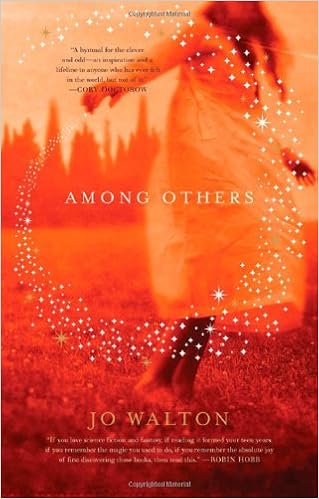
Jo Walton: Among Others (2011)

Edition: Tor (2011)
Review number: 1502

Diary of a lonely teenager? Misfit at boarding school? Both form and setting of Among Others may seem to have been done until there is nothing new which could be extracted from the limp and tired ideas. Has Jo Walton managed it?

Morwenna (Mor) has run away from her mother's home in Wales, and sought her estranged father, who she has not seen since she was a baby. Her father's sisters promptly see her sent to Arlinghurst, a boarding school, one specialising in sports - not the most sympathetic environment for a teenage bookworm with a damaged foot. Mor has another thing which makes her different: all her life she has been able to see fairy spirits invisible to most, and believes her mother is a witch whose powers Mor has inherited (though she does not want to use these selfishly, as she feels that her mother does). It is interesting that the school is almost completely devoid of magic - she has to work at it through acts like burning letters from her mother - unlike the spirit filled world of the Welsh valleys she knew before.

Much of the novel is about the science fiction she reads, exhaustively, perceptively, precociously, and perhaps unbelievably. Most of what she says will perhaps mean little to those who haven't read everything from Poul Anderson to Roger Zelazny, or those who, like myself, don't share her likes and dislikes. I can really see this book being virtually unreadable if you don't at least know something about Samuel Delany and gender politics, John Brunner and dystopias, characterisation in Ursula Le Guin, world-building in J.R.R. Tolkien (just to mention a few of the recurring topics and authors). But at the same time this extended love letter to science fiction is surely one aspect of this novel which made it successful in both the Hugo and Nebula awards, joining the handful of genre classics which have won both.

At the same time, it is possible to read the novel as a magic realist work, where the magic seen by Mor is her own way of dealing with her life - an imaginative piece of private world-building. It is perhaps important if this is Walton's intention (whether it is or not only really becomes clear at the end). In some ways, the imaginary world view of the novel is more interesting, and gives a completely different significance to the diary, as an act of therapy.

How much you like Among Others will depend very much on how irritating you find Mor as central character, how much you understand and sympathise with her likes and dislikes in science fiction. I found her more annoying as I progressed through the book, and the dogmatic science fiction pronouncements seemed less interesting and more self indulgent on Walton's part. This is perhaps because Mor does not seem to change a great deal, which is surely a realistic portrayal of a teenager starting a new school, especially not one with a traumatic past. The dramatic events which led to her arrival at Arlinghurst are followed by...nothing much really. Making friends and enemies. Lots of reading science fiction. A bit of learning - her introduction to the works of T.S. Eliot is one of the more memorable moments of the novel.

While I can see why Among Others won awards, it feels to me that it did not really deserve to do so. The subject matter resonated with science fiction fandom, which explains why it won. But I would rate it lower because Mor was so annoying, and also because to me the ending was trite and unconvincing. My rating: 5/10.

Sunday, 28 August 2016

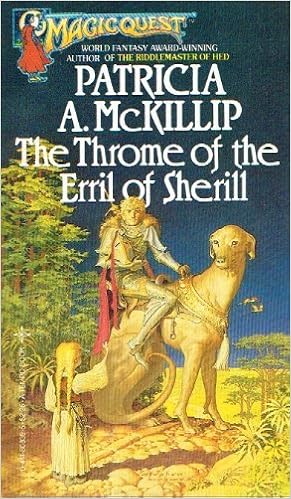
Patricia A. McKillip: The Throme of the Erril of Sherill (1973)

Edition: Tempo, 1984
Review number:1501

Unusual, poetic fantasy - the first Patricia A. McKillip which I have read, after many recommendations of her as a fantasy author.

This edition also includes The Harrowing of the Dragon of Hoarsbreath, and is still extremely short as books go: it could fairly easily be read in a single sitting. Of that short length, the title story makes up about two thirds. It is the story of a quest undertaken to win the hand of a King's daughter - the very hackneyed theme of fairy stories. The story is intended for a young adult audience, and could quite easily be read to or by children, though I think it is likely that they would miss a lot of what is really going on. To an adult well read in fantasy, it reads like a cross between Jack Vance and William Morris, with a playfulness with language which may be influenced by  Jabberwocky or possibly comes more from Vance.

The language is perhaps the most obvious of The Throme of the Erril of Sherill's unusual qualities. Apart from the title of the story itself, there are made up words (a monstrous "borobel" could be straight from Lewis Carroll), and words which look almost right - perhaps versions from an alternate world where modern English developed slightly differently ("cnite" for knight, "Damsen" for the name of the princess - a damsel, and so on). This could be irritating, but I found it atmospheric.

But strange things also happen in the story itself. The cnite starts with the standard equipment of a knight - horse, sword, shield, armour - and as the quest goes on, he is forced to exchange these for magical items, the horse for a fire-breathing dog, and so on. The people he meets are rarely what you would expect on a quest - he does not slay monsters, rescue innocent maidens. At one point, there is an adventure which made me wonder if the whole story was not meant to be an allegory of aging and death.

The Harrowing of the Dragon of Hoarsbreath is apparently much more straightforward. A strange young man visits a strange island, where winter lasts twice as long as on the mainland, twenty miles away. He claims that this is due to a dragon, which he wishes to remove. This is an action with unforeseen consequences. Though told in a normal narrative form, it still seems that there is more to the story than is visible on the surface; the reader wants to invest it with a hidden meaning. For instance, is it about the unwisdom of making unwanted "improvements" to communities - doing away with tradition in the name of progress?

Altogether, two fascinating pieces of fantasy, well worth reading at any age. My rating: 9/10.


Monday, 28 December 2015

Michael Moorcock: The Whispering Swarm (2015)

Edition: Gollancz, 2015
Review number:1500

Are there any literary devices which have not been attempted in novels, by 2015? The Whispering Swarm certainly attempts one which I have never seen before. Many novels include autobiographical elements, but here Michael Moorcock mingles straight autobiographical material with historical fantasy. The autobiographical elements match my knowledge of Moorcock's life picked up as a fan of many years' standing; the fantasy elements centre round the mysterious Alsacia, a part of central London which acts as a refuge (this part is accurate, there was such an area which for historical reasons had the rules of sanctuary applied to it), and which can take those who find it to a semi-mythical London from the past.

Does the idea work? Basically, I don't think it does. There is clearly a desire on Moorcock's part to contrast the mundane real world and the glimpse beyond that in to fantasy, but this means that The Whispering Swarm feels like it is made up of distinct parts which could be pasted together sections from two different stories. It even feels as is though the prose style used changes, more matter of fact for the real world, more poetical and descriptive for the fantasy.

For most of Part One (the first third or so of the novel), Moorcock-as-character has either not yet discovered Alsatia, or is trying to ignore what he thinks might be a delusion. So the fantasy plays little part, and this left me as a reader wanting to skip forward to something more interesting. However, even when Alsatia plays a greater part, it too turns out to be fairly dull, and it is hard for the reader to invest in any of the characters, in either milieu.

The title refers to the noise Moorcock and a few others can sense, the combined voices of the inhabitants of this fantasy London. This is in itself an interesting concept, and would relate well to the themes of his best literary novel, Mother London. That is also about the mythic significance of London, and is much more successful, partly because it is a fully synthesised novel. The best urban fantasy evocations of London (such as those written by Neil Gaiman, Ben Aaronovitch, or Kate Griffin, among others) are also better at integrating the fantasy elements with a real world setting, and also possess a sense of humour which seems to have disappeared from Moorcock's recent work.

I have long been a fan of Michael Moorcock, since my early teens, but have found much of what he has written in the last decade unpalatable for one reason or another. Despite an interesting and unusual idea, The Whispering Storm also fails to impress me. My rating - 5/10.

Monday, 2 December 2013

Saladin Ahmed: Throne of the Crescent Moon (2012)

Edition: Gollancz, 2013
Review number:1483

Even in 2013, it is quite unusual to see a fantasy genre novel which draws on a Middle Eastern background, and when you do, it tends to have a background based on the Arabian Nights. Here, though, is an original fantasy which treats ideas from Arab culture in the same way that many British or American writers draw on the western European medieval history, culture, myth, and legend.

The central character of Throne of the Crescent Moon, Dr Adoulla, is a man with a calling. He is, as far as he knows, the last of the fighters opposing the zombie-like magical constructed beings, the ghul. And he is starting to feel his age. With his apprentice, the fervently religious young dervish Raseed, he tracks the ghuls involved in an attack which left a young boy orphaned, The hunt leads them towards a dark secret which threatens the whole realm, though the Kalif is not interested in anything but his own rather unpleasant agenda.

The elements of the plot are not really terribly original, but it is the background which makes Throne of the Crescent Moon a fantastic novel for genre fans - which is why it made the Hugo shortlist this year. The background is not Islamic, though the religious part of the setting is clearly related, and of course it is immediately reminiscent to a Western reader of the Arabian Nights, though again it is sufficiently different not to feel like a straightforward leap into the world of those stories. Most fantasy still follows Tolkien's lead, and has a background derived from western Europe, often in the medieval period, and includes magic related to traditional European legends, such as those surrounding Merlin, or folktales of the faery. Much of the plot may be traditional swords and sorcery, but in this new background, it seems fresh again.

It's important that the background is well done, and placed in the service of the plot, and Ahmed does both admirably. One device which is quite common in fantasy novels, because it affords a means to expose the hard work which went into world building (as well as because Tolkien did it) is to have a group of central characters who between them represent different ethnic groups. Ahmed manages to do this here without it seeming to be a contrived, clunky, cliché - a considerable achievement in 2013.

All in all, an excellent debut, a promising indication that this is a series worth watching. My rating: 8/10.

Saturday, 7 July 2012

Robert V.S. Redick: The Red Wolf Conspiracy (2008)

Edition: Gollancz, 2009
Review number: 1457


This excellent fantasy novel tells of the voyage of the great ship Chathrand on a mission apparently to seal a peace between two empires which have been involved in a cold war for decades. But there are plots woven by several of those involved in the journey, from the Emperor himself downwards, and the story is mainly about the workings of the plans of the different factions aboard the ship. There are several major characters who take turns, chapter by chapter, to provide the narrative viewpoint (a common device in the fantasy genre); all of them are innocents in the machinations of others. One group aboard, the Ixchel, seem to be remnants of the sort of idea that sparks the writing of a novel: suppose Gulliver's Liliputians were taken from their home to be zoo exhibits, escaped, and spent the next few centuries trying to avenge the kidnapping - what would they be like?

The fantasy world in which the story is set is a richly realised one with technology approximately equivalent to the real eighteenth century (though it would have been impossible to build a ship the size of the Chathrand then - and the ship is old, built with knowledge lost by the time of the story's beginning). This means that The Red Wolf Conspiracy draws heavily on the many sea stories set during the Napoleonic Wars, particularly those less fenced in by the boundaries of the officers' quarters.

Exciting, fascinating; I am pleased that this is in fact the first of a series, because that promises much pleasure to come.

My rating: 8/10.

Tuesday, 3 July 2012

Gwyneth Jones: Spirit, or The Princess of Bois Dormant (2008)


Edition: Gollancz, 2009


Review number: 1456


There are a few writers who seem to be able to create a world which is instantly memorable, colourful and atmospheric, and it is a valuable skill to have in the science fiction and fantasy genres. Michael Moorcock and China Miéville can do it, and now Gwyneth Jones shows herself to be another member of the club.

The story opens as the central character,  a girl named Bibi, survives the massacre of the community into which she was born, by accepting the offer made by Lady Nef, wife of the attacking general, to become her servant, as an alternative to life as a concubine of the general. The novel then follows Bibi's career, as she becomes involved in the political scheming which surrounds Lady Nef and her husband, with tragic consequences. The severity of the difficulties encountered by Bibi can be seen from the comparison to The Count of Monte Cristo made in the SFX review quoted on the back cover. The middle section is basically a reworking of Dumas' novel in a science fiction setting, and is grim but fascinating.

It rather amazes me that I have not read anything by Gwyneth Jones before, if she has been writing fantasy of this quality for decades. This novel, and several of her earlier ones, have been nominated for the Arthur C. Clarke award. She has never been shortlisted for the Hugo or Nebula, awards for which I try to read the shortlisted novels each year; with writing this good, perhaps I should add the Clarke award to the list.

The atmosphere of Spirit continually reminded me of Miéville's Perdido Street Station. Both share a fantasy style but are in fact science fiction (though not hard SF) underneath - space ships and aliens, not dragons and goblins. Spirit is set in a post-technological world in which Clarke's famous dictum that advanced science is indistinguishable from magic has come true, and society's structure has at the same time moved back to a feudalistic form. The mixture of fantasy and science fiction is compelling, as it is in Miéville's work. It is also, like Perdido Street Station, a novel which is well written, dense, and yet still pacey and exciting.

Another writer I was reminded of by Spirit was Cordwainer Smith, whose influence is fairly clear in the depiction of the advent of the Princess of the sub-title in the last third of the novel. His quirky richness is especially apparent in the section set on the planet Mallorm. The plasticity of the setting, with the vague boundary between reality and virtual reality, and the menace which lies behind the outwardly absurd could have been found on Norstrilia or among the Underpeople.

In terms of criticism of Spirit, I am not sure that there is much of a point in the twenty-first century in such a clear homage to Dumas' famous novel. It's not that a novel really has to have a point at all, but The Count of Monte Cristo just seems like such a strange model to pick today. Vengeance in the modern world is the anonymous vendetta of the suicide bombers, not the more sophisticated, long drawn out, personal, and highly political destruction of the enemy. Spirit looks back to a time when there was more to revenge than just killing at random. Whether or not that is a good thing, it is certainly satisfying to read when the avenger is as sympathetic a character as Bibi.

My rating - 9/10.

Friday, 27 April 2012

Maeve Gilmore: Titus Awakes: The Lost Book of Gormenghast (2011)


The Gormenghast trilogy, by far Mervyn Peake's best known work as a writer, has many fans, including myself. And fans always want more, so we were intrigued when the publication of Titus Awakes was announced last year. Maeve Gilmore was Peake's widow (and, like her husband, an artist), who edited the fascinating but uneven compilation of Peake's less well known work, Peake's Progress. One of the items included there was the sketchy plan which eventually became Titus Awakes: a list of single words which form the themes of each of the chapters. There was also a draft of the first chapter, which I don't think was included (my copy of Peake's Progress being packed in a cardboard box in the garage, I can't easily check). Ironically, this completion of a lost novel was itself lost on Gilmmore's death in the eighties, only to be found in 2011.

The end of Titus Alone found Titus wandering in the vicinity of his ancestral home, Gormenghast Castle, before deciding to leave again. Titus Awakes begins at this point, with a brief scene between the Countess, Titus' mother, and Doctor Prunesquallor, also a character in the earlier books and fellow inhabitant of the castle. After these couple of pages, the rest of the chapter follows Titus closely, as he descends from the mountain on which the castle is built and sets off again. This is the end of the material that Peake wrote, and Gilmore then continues in the same vein.

The story consists of a series of bizarre adventures, much like those in Titus Alone, until the young man ends up in Sark, a plan which Peake divulged to his wife. Once this happens, the story has much more life; Maeve Gilmore was pretty clearly more comfortable writing about a real place familiar to her. Parts are clearly based on the writer's own life (and acknowledged as such in the introduction). This includes a sombre episode in which Titus, working temporarily at a mental hospital, meets Mervyn Peake as a patient visited by his wife Maeve Gilmore. Though all three do leave the hospital - Peake being misdiagnosed - its unending grey hopelessness is portrayed in what is probably the best written and certainly the most striking section of the novel.

The intention of the story, as in Titus Alone, is to use some of the external details of the situations in which Titus finds himself as allegorical mirrors of his growth as an individual. This means that the narrative is again heavily focused on the protagonist. I find this something of a problem with both books, as to me, and, I suspect, to many other readers, the most interesting aspect of Titus Groan and Gormenghast is the castle and the strange, ritualised lives of the grotesques who live there. While Titus psychologically needs to escape, and never quite manages to do so, the young man at the end is not as interesting as he is as the Earl of Groan, centre of the castle's culture, and the people he meets, no matter how strange, are never as interesting as the inhabitants of the castle. It must be said, too, that Peake's imagination for the bizarre is better than Gilmore's, making Titus Alone a more interesting read than Titus Awakes.

Titus Awakes is no masterpiece, no stunning new addition to the Peake canon. Few readers will have been expecting it to be, especially if Titus Alone seems less than stellar to them already. What it does offer is a glimpse at the intentions which Peake had for the later adventures of his best known character, and a measure of resolution to a story which was lacking it. My overall rating - 6/10, mainly because it is most like my least favourite novel in the original trilogy.

Edition: Vintage Books, 2011
Review number: 1454

Thursday, 9 February 2012

Keri Arthur: Destiny Kills (2008)

Having just read a novel which was the second in a series, I thought I had done the same again when I began to read Destiny Kills. The opening chapters seem to follow on straight from an earlier story, and that back-story is very complete and alluded to in such a way that it makes this seem like it continues something fully written out. But it turns out to be the start of the series - though of course it is possible that there is an earlier, unpublished story.

The opening is also remarkable for its use of a rare conceit: a narrator with amnesia. It is a striking device, which is very useful to the author as the narrator naturally needs lots of things explained to her that she would otherwise be expected to know, and this makes it easy to introduce ideas to the reader in a fashion which seems natural. There are two serious problems, however, which explain why it is rarely used: real world amnesia is not all that common, especially of the all-enveloping type which is used here, so readers find it inherently implausible (have you ever met someone who, when sober, is unable to remember their identity?); and it is a too striking device, which will all too easily overwhelm everything else in the story. Indeed, only a single other instance of its use occurs to me: the brilliant Traitor's Purse by Margery Allingham, from 1941, where the idea is sustained for much longer (and more ingeniously made part of the plot and characterisation) than it is here.

Being an amnesiac on a deserted beach with a dead body is a difficult position to be in. And it is not long before Destiny McCree (for that turns out to be the narrator's name) is on the run from the police, joining a professional thief who is the brother of the dead man, summoned telepathically by him. The moment of amnesia passes, and Destiny remembers that she is a shape-shifting sea dragon, who had fled (with the dead man, an air dragon) from a group of amoral scientists who have held her captive for a decade to study her. As in another recently reviewed novel, this leads to a chase across the United States, this one from Oregon to Maine.

While the amnesia is not used as much or as interestingly as it could have been, Destiny Kills is an enjoyable thriller-with-magic. The romance between Destiny and thief/air dragon Trae is well handled too. Compared to many fantasy novels around at the moment, the story is quite soft-centred: more Anne McCaffrey than Richard Morgan. But it's well written, and enjoyable to read, without having any pretensions to profundity - 7/10.


Edition: Piatkus, 2011
Review number: 1449

Saturday, 4 February 2012

Kate Griffin: The Midnight Mayor (2010)

I read this, the second in a series, without having read the first, so in describing this book, I may give away aspects of the first without intending to.

Sorcerer Matthew Swift is dead, but he remains alive through the symbiotic relationship he has with the blue light angels, spirits of electrical current, who now also inhabit his body. He restlessly walks the streets of London at night, until one evening at the beginning of The Midnight Mayor when he answers a payphone which rings as he passes it and is magically attacked down the wire. Before long, he discovers that London is under attack from the "death of cities", and he has been chosen to defend it, taking on the office of Midnight Mayor.

I found that The Midnight Mayor grew on me as I read through it. It seemed at first to be just another of the currently fashionable urban fantasy novels, but in the end Swift's dual character is well enough portrayed, and his solution as to how he can stop the death of cities is interesting enough, to raise the story out of the crowd. Kate Griffin began as a writer for children, and some of the details of The Midnight Mayor are somewhat reminiscent of parts of China Miéville's brilliant Un Lun Dun; examples include the heavy metal spectres and the appearance of the death of cities.

London is of course a city full of ancient myths and legends, but the interesting aspect of Griffin's take on it is the idea that magic is based on what has significance for the sorcerer, which makes it possible to build up a whole new, up to date urban mythology, where seers prophesy using the entrails of ragged plastic bags, and the words of spells are not Latin or Hebrew but come from legal and official documents such as parking tickets and ASBOs (the latter not providing terribly effective magic, naturally). Any object which is in some way part of London's culture can become part of the magic, whether graffiti tags or the information on Underground notice boards. This immediately makes Matthew Swift's world stand out from so many other works of urban fiction, as the modern urban setting is vital to its internal mythology.

The main reason why The Midnight Mayor grew on me was that it is well constructed (the way the magic works being just one example of how clearly thought through the world building is), carefully building to a climax which proves well worth the wait, if perhaps a little predictable in some of its details.


Edition: Orbit, 2010
Review number: 1439

Tuesday, 8 November 2011

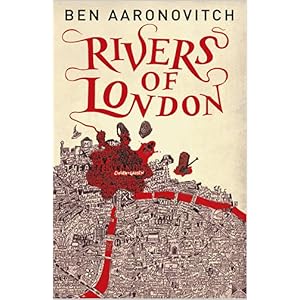
Ben Aaronovitch: Rivers of London (2011)

Rivers of London is a police procedural with a difference: Peter Grant is a trainee PC in the Metropolitan Police who discovers that he can see ghosts, and is immediately seconded to a tiny division of the force (tiny, as in - Peter brings the staff total up to two) which deals with crimes which have a supernatural element.

The supernatural unit police story has of course been done before, but not (as far as I know) with so much attention to the minutiae of police work. This juxtaposition of the supernatural and mundane is of course a source of humour, and Rivers of London is very funny in places. It reminded my strongly of Charles Stross' Laundry series, set in the Secret Service rather than the Met, combined with ideas about London mythology similar to those embodied in Neverwhere.

Aside from the narrative thread dealing with Peter's experiences of the early stages of becoming an apprentice wizard, there are two main parts to the crime story. One is a series of apparently senseless, bizarre and very violent murders, the first in Covent Garden being the occasion for Peter's discovery that he can see ghosts when a witness he starts to talk to turns out to be one. The more interesting idea is a territorial dispute between the spirits Father Thames and Mother Thames, the former of whom is not happy about the end of his territory coming at Teddington Lock (where the Thames starts being tidal); Mother Thames covers the part of the river through the city to the estuary and the mouth of the river.

Aaronovitch has been a writer for some time: he wrote one of the serials which made up the original Doctor Who, back in the eighties. So it is no surprise that Rivers of London is well constructed. If you stop to think, some of the details of the killings are rather nasty (enough to make this not a book for the squeamish), but the plot moves forwards fast enough that most readers will not dwell on the unpleasantness.

Enjoyable if not hugely original, well written and very funny. I'm definitely going to look out for the sequel, Moon Over Soho. My rating: 7/10.


Edition: Gollancz, 2011
Review number: 1434

Monday, 31 October 2011

Lev Grossman: The Magicians (2009)


Gifted Brooklyn teenager Quentin is about to go to Princeton when he is suddenly taken to a completely different college, named Brakebills, in the woods of upstate New York near West Point. There, after completing a series of baffling tests, he is offered a place to learn magic. The Magicians, first in a series from Lev Grossman, is the story of the years he spends there as a student.

The basic plot, when summarised as baldly as this, makes The Magicians sound like a rewrite of Harry Potter aimed at an adult (American) market. In fact, it seemed to me to have an atmosphere more akin to Donna Tartt's Secret History, a likeness in part fostered by the New England collegiate setting. In fact, all three (Grossman, Rowling, and Tartt) have an important theme in common, in that death and obsession with death plays a central role in all three stories. But Harry Potter, even though he has his complications, is a much more straightforwardly heroic character than either Quentin (here) or Richard (in the Secret History). Both of them are more focused on their insecurities than Rowling's character is.

Embedded in the story is a (fictional) series of children's fantasy novels, a formative experience shared by most of the students at Brakebills. Quentin, as narrator, constantly references the world of Fillory. His affection for the books, which he has continued to re-read, is obvious. He is, as a teenager, sometimes disparaging about their more childish elements. For example, he feels it is silly that good characters never die in a final manner, always appearing at the end of each novel in the series alive and well again. (This particular observation, in a book I read soon after re-reading the Harry Potter series, may seem like a bit of a dig at Rowling's ending by Grossman, but it is actually common in more feel-good fantasy fiction, to the extent that the return of dead characters was used as a running satirical joke in Buffy the Vampire Slayer back in the late 1990s.)

T.H. White is also a direct influence on The Magicians. Part of the teaching at Brakebills sees students transformed into geese for a season, just as happens to Arthur in The Book of Merlyn and in the later, better known version of this passage in The Sword and the Stone. They fly south all the way to the Antarctic, no doubt (as Quentin notes) confusing and exciting birdwatchers (if, of course, the students are visible to non-magicians during the trip). The time in the Antarctic is basically a retreat to concentrate on a regime beyond what would have been possible to undertake in the school in New England: no talking for months, days of extremely hard work to "internalise" the complicated rules which govern the use of magic on Grossman's world. As equally obvious a source is C.S. Lewis' Narnia stories: the Neitherlands come straight from The Magician's Nephew.

The way that magic works in The Magicians makes it among the hardest to use of the frameworks devised by fantasy authors. To perform a spell, you need to have innate talent, to be able to speak an incantation in an obscure and usually dead language, to move the fingers in a bone-cracking cantrip, and to modify the incantation and cantrip to match any of a whole host of circumstances, such as date, location, or the mood of the spell caster. It is hardly surprising that Brakebills seeks out only twenty of the brightest and magically talented school leavers in the States each year, and that they have to spend five years of university level study to become proficient.

Like Tartt, Grossman really captures the way that being a student is likely to be a unique time in a person's life, even if Brakebills is more like a school than any real life college I know about: they even have a uniform. Less restrictive and timetabled than most schools or workplaces, yet still an intense experience, a university course can truly act as the focal point for many students' lives, catching them just as their formative years and adolescence come to an end. Friendships can be close and enduring, pastimes can become hobbies pursued for the rest of your life. Brakebills is small, but particularly intense, which does not necessarily mean enjoyable, and Quentin hates parts of his life there. By getting there, Quentin has fulfilled his innermost fantasy (being an apprentice wizard), but remains unsatisfied.

The Magicians is a meticulously thought out fantasy novel. But it does drag in places; I was often tempted to skip a few pages. The mechanics of the plot are, in the end, less well contrived than the depiction of atmosphere, the world building, and the characters. For this reason, my rating is only 6/10.

Edition: William Heinemann, 2009
Review number: 1433

Thursday, 22 September 2011

Revisiting Harry Potter

With the final film out, and the imminent arrival of the Pottermore website, it seems to be time to re-read the Harry Potter books. Whatever else they are, they are the publishing phenomenon of our time. The later books, and later the films, created an immense amount of excitement when they first appeared. Words used in the series such as "muggle" seem to have entered the language. The series starts out as a fairly standard children's school story about trainee wizards, a plot thread used by many writers before Rowling (Jill Murphy's Worst Witch and Diana Wynne Jones' Chrestomanci are two older series which immediately spring to mind).

What is it which makes them so popular? Will they continue to be so popular, or will Rowling be forgotten in fifty years' time - will she be Charles Dickens or Marie Corelli as far as posterity is concerned? Do the stories reward re-reading?

Note before reading, that this post contains spoilers to every book in the series. At this time, it seems reasonable to do this, given that the final sentence of the whole saga appears in the Wikipedia article on The Deathly Hallows.

Harry Potter and the Philosopher's Stone (1997)


Originally reviewed 2000.

The first book in the series sets the scene for the rest of the series. It is aimed at the youngest readers, and is perhaps most likely to be considered childish by older people. The plot takes the reader through Harry's discovery that he is a wizard, and a famous one too, through his first year at Hogwarts school, culminating with his first encounter with Voldemort's plots after his initial attack on Harry as a baby.

While still finding The Philosopher's Stone enjoyable, I tended to notice some more aspects of this novel which I think could have been better. The wizarding world may be deliberately less technologically advanced than the muggle one, but much about the muggle world still seems old fashioned than its nineties setting would suggest; the general feel is perhaps more seventies - the time of Rowlings' own childhood. The only more modern items in the story are the videos and computer games of Dudley Dursley, but they play little part; even Vernon Dursley's job is in the sort of heavy industry which hardly exists in post-Thatcherite Britain. The setting is mainly 1991, before widespread public use of the Internet, before DVDs; perhaps I have been forgetting how different life was before these things.

There are fairly obvious plot holes. Why do none of the teachers at Harry's primary school notice what must have been a fairly apparent case of problems at home? Why does Dumbledore move the stone from a secure location like a bank to a school (however heavily warded) where one of the teachers is tasked by Voldemort to find just such an item, and put it behind protective screens devised by the teachers which turn out to be beatable by three eleven year old children (not to mention a task requiring the capture of flying keys where a flying broom has conveniently been left for the use of anyone wishing to use one), for example? Indeed, why are the tasks apparently specifically designed to play to the strengths of the three central characters? Why is there not better vetting of the teachers? Vicious ones like Snape or simply incompetent ones like Binns might well appear in any school, but how did Quirrell get through - surely someone might have suspected that what happened to him over the summer had some serious consequences for his ability to teach and what he might be wanting to do? (This is an issue which is perhaps more acute in the later novels, particularly in The Goblet of Fire where an imposter fools Dumbledore into thinking that he is a man whom the headmaster knows personally.)

I also feel that the first couple of chapters are not the best way to start the novel. They act as a prologue, but the story would surely grab the reader more immediately if it started with Harry in his cupboard on the day that the first letter arrives. As it is, about half the novel is completed before he even arrives at Hogwarts, and the second half concentrates on the first few days at Hogwarts and then skips over most of the year until the final confrontation with Quirrell/Voldemort.

There are problems with the world building, too. The school seems to have a large number of Muggle-born children, but very little attention is paid to helping them understand the differences between the world in which they grew up and wizarding culture. Some aspects of magic, mainly ancient charms such as that which protects platform 9 3/4, or the commonplace animated photographs, seem hugely more sophisticated than others. Quidditch is a stupid game, pretty clearly a literary invention rather than something which is actually played. Most sports can be boiled down to a single sentence describing their basics: football (soccer) and similar sports such as hockey and basketball are about trying to score goals by putting the ball in the opposition's goal/hoop, cricket is about defending the wicket from the ball (or trying to hit it with the ball, depending on which side the players are on). But Quidditch seems to consist of two games played simultaneously, the seekers' search for the snitch and the rest of the players trying to score goals rather like polo, with the scoring biased extremely heavily in favour of the former, even though the snitch is too small for the spectators to see.

Humour is always going to be less effective the second time around. Indeed, I'm not entirely sure I'd classify humour as a major part of the novel as I did in 2000, let alone of the progressively darker sequels. There are amusing touches, mainly details of the magical culture, such as Bott's Every Flavour Beans, but much of it seems childish (Dumbledore's speech at the welcome banquet, for example), and it gives the impression that some of the world building is done just for the sake of humour rather than being integrated into the background and the plot of the novel. Though I suppose that to many people in the real world, particularly children, sweets are just there, and not subject to analysis.

Despite all this, The Philosopher's Stone continues to be enjoyable to read, and forms a pretty good introduction to the rest of the series. I'd rate it now at 7/10.

Harry Potter and the Chamber of Secrets (1998)


Originally reviewed 2000

I originally thought, reading one pretty much after the other for the first time, that The Chamber of Secrets was less amusing than The Philosopher's Stone. Now, however, I find the opposite to be true; clearly, the humour in The Chamber of Secrets survives re-reading better.

The plot covers the second year at Hogwarts for Harry, during which something is attacking students, and putting threatening messages on the walls about the Chamber of Secrets, hidden somewhere inside Hogwarts castle by one of its founders. He has particular problems with a house elf named Dobby - the first to appear in the series - who attempts to dissuade him from returning to Hogwarts and has various schemes which are supposed to be to keep Harry safe but which do not please the boy at all.

Some of the early parts of The Philosopher's Stone seem a little experimental: the characters of Dumbledore and McGonagall are not perhaps fully formed in the parts which precede Harry's arrival at Hogwarts, and are slightly different to their later selves. By this second novel in the series, things are more finalised and Rowling more confident as a writer, which means that The Chamber of Secrets holds together better.

In fact, The Chamber of Secrets seems to me now to be one of the best books in the whole series. The plot is less far fetched than that of The Philosopher's Stone - the explanation for the Chamber of Secrets is more believable than that behind the presence of the stone in the school. Additionally, it provides some information about the background of series villain Lord Voldemort which is made much more interesting to read than that in The Half-Blood Prince later on.

I'd rate The Chamber of Secrets now at 8/10.

Harry Potter and the Prisoner of Azkaban (1999)


Originally reviewed 2000

This now seems to me to be the best of the whole series. It has a wider scope than the first two instalments, but still retains a concision missing from this point onwards, with The Goblet of Fire being as long as the first three books put together, and the final three novels as long or longer.

I suspect that two characters introduced in The Prisoner of Azkaban, Remus Lupin and Sirius Black, are for many fans favourites among the large cast of Harry Potter supporting characters. They also have huge meaning for Harry himself, as the closest friends of the parents he never knew. One of the big difficulties in fiction is how to pass information needed by the reader; Remus and Sirius provide something of a masterclass in how it should be done, integrated into the plot and seeming naturally part of the narrative. Unfortunately, this is a lesson she seems to have completely forgotten by the time she wrote The Half-Blood Prince.

But Harry's discoveries about his parents do not all bring him delight. Throughout the novel, Hogwarts school is surrounded by Dementors, to protect the children from an attack by Sirius, escaped prisoner thought to be a vicious murderer out to get Harry. As is now well known, these are monsters used as guards in the wizarding prisoner of Azkaban, who feed on happy thoughts (they are, in fact, a rather allegorical representation of the effects of depression). Harry turns out to be be particularly susceptible to them, as their presence takes him back to a pre-conscious memory of the day on which his mother and father were killed.

On the first reading, the big surprise is clearly meant to be the revelation that Sirius Black is not the mass murderer he is thought to be, nor the betrayer of Harry's parents, but someone who has been falsely imprisoned for years. This of course is no longer a surprise on re-reading the book (nor probably will it be a shock to new first-time readers). The ingenuity of the ending, where a lot of minor plot strands (such as the mystery of why Hermione is able to take as many subjects as she does) come together, is no longer a surprise either, though it is still to a point interesting to pick out the various strands expertly woven into the story by Rowling to prepare for it.

The Prisoner of Azkaban would make little sense on its own, but ids definitely still a series high point, the moment where everything comes together as a writer for J.K. Rowling, before the huge success of the series seems to have blunted her edge.

I'd rate The Prisoner of Azkaban now at 9/10.

Harry Potter and the Goblet of Fire (2000)

Originally reviewed 2001

The fourth Harry Potter novel is something of a sudden change of gear for the series. It is much longer than the earlier novels, though shorter than those which follow. It is darker, starting with a killing and ending in an attack on Harry from which he barely escapes with his life as his companion is contemptuously killed with the command "Kill the spare" from Harry's enemy Lord Voldemort. And teenage sexuality starts to plan an important part in proceedings.

The story proper begins with the Quidditch World Cup, held in Britian over the summer holidays. The Weasleys have tickets to a match and invite Harry and Hermione to join them, but the even is ruined by an attack by Voldemort's death eaters on the Muggles at the campsite used for the crowds. The main plot of the novel is about the Triwizard Tournament, a most unusual competition between three champions, each representing one of the premier schools of magic in Europe. The tournament has been dormant for centuries because of the death toll, but it is revived at this moment for the sake of encouraging friendship among the schools; an extremely foolish thing to have done (sporting rivalry hardly ever leads to closer relationships between groups of opposing fans). The champions are chosen by a magical artefact, the eponymous Goblet, and Harry's name is chosen as an extra champion through a subterfuge, even though he is under the legal age to compete. This is effectively an attempt on his life, as the tasks the champions face would be pretty dangerous even for an adult wizard. . Naturally, few believe that Harry was innocent and didn't himself find a way to enter his name despite the charms in place to enforce the age limit, the assumption being that a celebrity will always embrace new opportunities for fame. Fame and its drawbacks are series themes, but this is the novel in which they are most prominent, probably as a reflection of some of Rowling's own experiences, particularly with the way that the press mis-reports Harry's activities, and the ethics-free zone which is reporter Rita Skeeter.

It seems to be a bit strange in terms of overall planning for the series to include the World Cup and the Triwizard Tournament in the same novel, but Rowling handles potential similarities quite well so that The Goblet of Fire does not appear to be too tediously sport related.

The longer story gives Rowling the space to be more expansive, which works quite well in the main. There are, however, a fair number of paragraphs, and even a couple of chapters, which could be cut completely without really being missed - The Weighing of the Wands, for example, adds minimally to the background, nothing constructive to the plot development, and nothing significant to the characterisation. Generally, Rowling uses the extra words to establish a stronger sense of atmosphere, which is one reason why The Goblet of Fire and the other later novels in the series come across as darker in tone. Before I re-read the novel, my memory suggested that the Quidditch World Cup was covered in a long-winded, hugely tedious manner over a hundred or so pages, but this isn't the case at all: the World Cup just takes a couple of chapters.

All in all, I feel that The Goblet of Fire is a below average entry for the series, but I am at something of a loss to explain why. There are holes in the plots of all of the books, but here it does in places seem particularly implausible.  For example, the explanation given by Dumbledore about why Harry has to compete once his name has been drawn out of the goblet is rather unconvincing, since a magical artefact which has been so easily tricked into including his entry should not be difficult to trick again - particularly in a world with polyjuice and other tricks for hiding a wizard's identity. There would surely be some sort of safeguard built in, for example, if a chosen champion fell and broke their leg before the start of the first task, making them unable to compete through no fault of their own. More importantly, why was Dumbledore unable to detect changes in a friend of his who is being played by someone else magically transformed in appearance - it should be just about for Barty Crouch to play Moody in front of someone who knows him better. Moody himself advocated the use of questions with answers only known to the questioner and the person seeking to establish their identity as a test; why doesn't Dumbledore do that? Come to that, after the similar problem with Quirrell in Harry's first year, why aren't there charms around Hogwarts to make such an impersonation impossible? (The need to use a compromised teacher twice in the series suggests a certain poverty in Rowlings' imagination, too.)

I really quite liked this entry in the series a decade ago - my review was based on an all night reading session to finish the novel in one sitting. Other people also liked it: The Goblet of Fire was the only Harry Potter book to win a Hugo award. But on more careful re-reading ten years later, it doesn't really stand up so well. My rating now: 6/10.

Harry Potter and the Order of the Phoenix (2003)


Originally reviewed 2003

I was rather disappointed with The Order of the Phoenix first time round, but unlike The Goblet of Fire, I have warmed to it since and now think it rather better than its predecessor.

The plot is similar to the other novels, with more mature themes than the earlier books. Harry is still having to spend the summer holidays with the Dursleys, and is extremely cross about it, particularly because the letters he receives from his friends are uninformative. Then things start to happen - a Dementor attack targets his cousin Dudley, and Harry saves him with the Patronus spell, only to be summoned to a hearing for underage magic. He then discovers that the magical press has been portraying him and Dumbledore as deranged for believing in the return of Lord Voldemort over the summer: the Ministry of Magic wants to deny that this has happened to help Cornelius Fudge stay in power as minister.

Then, when the school year starts, the Ministry is interfering at Hogwarts, enforcing the appointment of nightmare teacher and Ministry official Dolores Umbridge as Defence Against the Dark Arts teacher. Naturally, she persecutes Harry especially, and his lack of control of his temper gives her the excuse to, for example, ban him from playing his beloved Quidditch for life. At the same time, he has visions of the actions of Lord Voldemort, and lessons from Professor Snape in a method to prevent this are utterly unsuccessful due to the antipathy between the two of them; eventually, Voldemort is able to take advantage of the connection to get Harry and some of his friends to fall into an ambush at the Ministry of Magic. The battle which follows effectively concludes the book, the death of Harry's godfather Sirius Black putting a damper on Harry's victory.

While Harry's teenage angst is interesting, and presumably likely to appeal to those of a similar age to the boy in the book, it is not treated in great depth. Rowling is no Homer, The Order of the Phoenix no Iliad, and Harry's anger not the wrath of Achilles of which Homer sings with the help of the muse. For a long novel, The Order of the Phoenix has a plot which seems to move quite rapidly, and builds up effectively to the battle in the Ministry; a development which is the most effective of any of the novels in the series. It is easy to get caught up and ignore the problems.

And problems there are. Like the other later Harry Potter novels, The Order of the Phoenix could do with cutting, but less so as it is better structured to fill the length it has than the others. There are (minor) inconsistencies between details here and the background elsewhere. In the Ministry battle, for instance, spells which are fired by both sides but miss their human targets cause damage to the Ministry building and its contents, which is somewhat different to the precision with which spells seem to work in most of the stories. There is the idea that a prophecy can only be retrieved from storage by someone mentioned in it, but when the children start destroying the store to divert Voldemort's followers, the stored prophecies start to recite themselves - it should, presumably be impossible to move them from the shelves even if the shelves are destroyed if the same rules which apply to the prophecy concerning Harry and Voldemort apply to the rest of them.

But in the end the faster moving plot makes this the most gripping of the later novels. My rating now: 8/10.

Harry Potter and the Half-Blood Prince (2005)


Originally reviewed 2005

The first four chapters and the last four chapters of The Half-Blood Prince are among the best in the whole Harry Potter series. Each of the first group is different from the others, even though they all involve meetings, encompassing the introduction of the new Minister for Magic to the Muggle Prime Minister, the confrontation between Narcissa Malfoy, Bellatrix Lestrange and Snape, Dumbledore talking to the Dursleys about Harry, and the recruitment of Slughorn as a teacher by Dumbledore and Harry. The last four, with the trip to retrieve a Horcrux and the attack on Hogwarts by Death Eaters which culminates in the death of Dumbledore (an event which I didn't want to reveal in my original review) also show Rowling's quality as a writer of action scenes. The latter is a really good example of a major strength of Rowling's work in Harry Potter: it is full of clues to events in the final book and with ambiguities which will also be drawn on in The Deathly Hallows.

It is a pity that the twenty two chapters in between are so dull. There are some other good bits, but the whole thing sinks under two heavy burdens: the irritation caused by Harry's obsession with Draco, and the dullness of the revelations about Lord Voldemort's early life as revealed to Harry in the special lessons he has with Dumbledore.

Throughout the whole series, the contemptuous dislike between Harry and Draco is a major theme of the stories. In this book their enmity comes to a head, and Harry is paranoid about what he might be up to, with some reason, as it turns out. But it is not really justified by the evidence available to him, as even Hermione and Ron are willing to point out. The extreme nature of Harry and Draco's obsession with each other is surely one reason why homosexual love between them is such a popular theme on fan fiction sites. The purpose of it here is partly to keep the reader guessing what exactly Draco is up to (the second chapter makes it clear that he is indeed up to something), and the continuing tension is meant to develop the characters, something which I did pick up from The Half-Blood Prince the first time around. But on a second read, it all just becomes tiresome adolescent posturing, which may be true to the emotional maturity of sixteen year old boys but which is not interesting to read about.

The imparting of background information is something which is particularly difficult in science fiction and fantasy, where the world being portrayed is unfamiliar to the reader. Rowling has actually been quite good at it up to this point, aided by the common device of a viewpoint character who is also new to the world being described: useful, because they can ask questions without the reader wondering why they needed to when it would be common knowledge. But here there are great dollops of recorded memories of the early years of Lord Voldemort: tedious, unnecessarily lengthy, tales. The reader (and, indeed Harry too) does not need to know every detail of Voldemort's back story to support Dumbledore's suspicion that Voldemort has created Horcruxes, dark magical objects which store parts of his soul and which give him an immortality of sorts (he cannot truly die while any of the Horcruxes are in existence).

This means that The Half-Blood Prince feels the hardest work to read of the whole series, which makes it particularly unrewarding a second time around. I feel that this is the poorest of the novels, and would now rate it at 5/10.

Harry Potter and the Deathly Hallows (2007)


Originally reviewed 2007

When I first read this, back in the summer of 2007, the hype and interest was such that I reviewed the novel when I had only completed the first ten chapters, in order to ensure that I did not include any spoilers in what I wrote: a unique distinction among the over 1400 reviews published here. But now I think it is safe enough to reveal what happens, especially as the ending and the epilogue are quite important influences on my opinions about the book, and, because they give the reader their final impressions, of the series as a whole.

The Deathly Hallows seems very different to the rest of the series. One contributing factor is the setting. The main locations used by the other stories (Privet Drive, the Burrow, and most of all Hogwarts School), appear only in a few chapters each, with most of the rest of the story following Harry, Hermione, and (for most of the time) Ron searching the country for the Horcruxes. Another is character. Dumbledore is of course killed at the end of The Half-Blood Prince, and it is in this book that his absence makes it clear just how important he is to the tone of the other stories. But the difference is also that in The Deathly Hallows, things really become serious; all that has happened before is in a sense just training to prepare Harry for the end of this book. (That isn't to say that the humour is lost entirely, as I noted the first time around.)

The important event which sets the plot in motion is the fall of the Ministry of Magic to Voldemort and his followers. A regime which Rowling clearly models on Nazi Germany is instantly set up, with checks on the "blood status" of witches and wizards, checks that Voldemort himself, with a Muggle father, would fail (a rather over-emphasised irony). This also leads to Harry becoming a wanted fugitive as "Undesirable Number One", and sets him along with Ron and Hermione off on the hunt for the Horcruxes. The hunt forces them to turn up in places which are not good refuges for people on the run - for example, they raid wizarding bank Gringotts after discovering that one of Voldemort's followers stores a Horcrux in her vault there.

The book climaxes - with the climactic battle between Voldemort's followers and his opponents at Hogwarts, coinciding with Harry and his friends arriving to track down the last of the missing Horcruxes (there are two more, but they are not exactly accessible to be destroyed at this point). Harry turning up is the trigger for the arrival of Voldemort's forces. It is as though (at the end of the Lord of the Rings) Frodo arrives at Mount Doom to find that it is actually the location of the Battle of Pelennor Fields. The combination makes the story rather bitty, as the the viewpoint switches between the various groups of fighters and Harry as he approaches a final confrontation with Voldemort. All in all, it's exciting, but by this point there are few surprises - I suspect most readers work out the meaning of the prophecy pretty much as soon as they know the properties of the three Hallows, and this is the key to what happens in this chapter. The direct confrontation may be more visceral, but (although generally I don't feel that Tolkien is a great writer), the Lord of the Rings does it better, giving the impression that the older story is based on a more mature understanding of the nature of evil.

Following this climax, there is the inevitable chapter for tying up loose ends, mostly. Then there is the Epilogue, set nineteen years later. Both of these are naturally anti-climactic, but the Epilogue is more interesting. What it describes is a domestic scene in the household of Harry and Ginny, now married and getting ready to take their second son to Kings' Cross station to catch his first train to Hogwarts. Rowling doesn't use it to tell the reader what happened next to the other characters, other than incidentally - among those we do learn about are Neville, Ron, Hermione, and Draco. We don't know what Harry does for a living, or any of the others except for Neville. But one thing is very clear: Harry has finally managed to get away from his fame as the Boy Who Lived. His children don't even know that he is a celebrity, which is somewhat unlikely - their oldest child James Sirius must surely have been the subject of gossip at Hogwarts. The wizarding world has not forgotten Harry, as is clear from the reaction of the those on Platform 9 3/4 when the family arrives. I know that J.K. Rowling has not precisely been comfortable with the fame that Harry Potter has brought her, and that this has found its way into several books (notably in terms of Harry's portrayal by the media). Personally, I feel that the Epilogue is not terribly interesting, and doesn't add much to the end of the book. Its main purpose is to mark that this is the end, and close off at least some of the fan desire for a sequel, through the final words "The scar had not pained Harry for nineteen years. All was well." I think that Rowling could have found a more interesting way to make this clear. In the end, the Epilogue detracts from the book and the series as a whole.

Understanding death is the main theme of the book, and has been important through the whole series because of Voldemort's continuing obsession with immortality. This works well as the mainspring of the plot, and Rowling's apparent message, that death at the end of a fulfilled life is to be peaceably accepted (as in the Nunc Dimittis, from the gospel of Luke, used as a prayer in the liturgies of many Christian denominations), marks the light from the dark effectively. So Harry can go to meet Voldemort expecting to die, and then deliberately lose the Resurrection Stone in the forest, as Dumbledore accepted his death at the end of The Half-Blood Prince, using his knowledge to promote the anti-Voldemort agenda.

A fitting end to the series (Epilogue excepted), and one of the better novels. My rating - 8/10.

The Series as a Whole


Like other school stories before this, Harry Potter describes a school year in each instalment; another obvious example for children being the Enid Blyton Malory Towers books. This gives a well defined timespan to each story, but does give the individual plots a degree of predictability, compounded by Rowling's structural plan of ending each book with a climactic battle with Voldemort. The seventh book is a little different, as Harry never actually makes it to the school until the final battle, which takes place there.

Hogwarts is an odd place to find in a series of books published around the turn of the millennium. It is a boarding school, not a type of school which will be familiar to the vast majority of the readers. It is more common in books, though, perhaps because such a school has a built-in isolation which makes it easy to give the story a circumscribed location: while at the school, Harry rarely goes outside the grounds, particularly in the earlier books. The use of the boarding school is extremely old fashioned, giving the story something of the feel of a homage to books from the thirties and forties like Blyton's, or to C.S. Lewis' Narnia stories, featuring children who also board, though the schools play little part in the novels.

The plots of the earlier novels in particular follow effectively the same plan: over the summer Harry is introduced to something he hadn't come across before in the wizarding world, while being unhappy with the Dursleys; then he gets to  school after some minor adventure; school is wonderful but overshadowed by various issues, including Snape and Malfoy; he does something (or has something done to him) which makes him unpopular with the other students; then a final testing adventure at the end of the year closes the book as a climax.

Encapsulating a school year in each book, and making the age group aimed at increase each time (perhaps suitable for readers a year or two younger than Harry if they are good readers for their age), is a good idea when the books were first released, as child fans would have grown a year in between the publication dates. Of course, it doesn't work now that all of them are available, and this is something that parents need to consider: The Deathly Hallows is unlikely to be suitable for a nine or ten year old.

These two aspects of the stories give them a sort of version of two of the three unities: time (a year, rather than a day) and place (though Hogwarts is quite a large and complex scene). Usually, novels do not approach anywhere near a unity of action, tending to focus on one main character's actions, thoughts and emotions, rather than on a single plot line, but unity is also provided here by the concentration on the struggle between Harry and Voldemort.

The three main characters are something of a cliché, too. The hero and his two helpers are common enough in fantasy fiction to be parodied in China Miéville's Un Lun Dun: the chosen one, the clever one, and the funny one. Harry, Hermione, and Ron fit very well into these slots, even though Rowling does try to make them more three dimensional than this.

The length of the later novels is a problem, as it seems to stem from a lack of willingness to cut rather than a need to include all the material, particularly in The Half-Blood Prince, the dullest of the novels. Each of the last few novels would be improved by judicious pruning, of at least fifty pages of material if not more.

What will the new Pottermore website do to J.K. Rowling's reputation as a writer? I have not yet read any of the material it contains, only the reactions of others to it, and it sounds like a collection of more or less finished background material, fleshing out the gaps in the series. This hardly ever works well - The Dune Encyclopedia is a similar sort of collection (different mainly by not being written by the original author), and served only to reduce the stature of Frank Herbert's books. The main problem with this sort of collection is that you need to be really fanatical about the stories to appreciate the details, and even then, you may prefer to use your own imagination to fill in the gaps.

All in all, I would say that the series is good, but not particularly original. The characters are well drawn, but stereotypical. The background is fun, but doesn't give the impression of consistent world building - details seem to be decided on for the purposes of the moment, not to fit into any overall structure. The plot of the series as a whole is very typical fantasy genre, the chosen hero coming of age and fighting the strong evil; but at least there is some grey in the "good" characters. And of course, the writing is quite addictive: first time around, I read several of the books in one sitting, with deleterious affects on my sleep. However, on re-reading, I've felt mystified as to why it has been just so popular; there are any number of better fantasy series around. So I'd bet that Harry Potter will be a minor footnote, barely remembered, in fifty years' time.


Review number: 1430