Showing posts with label crime fiction. Show all posts

Thursday, 19 February 2015

Susanna Gregory: The Westminster Poisoner (2008)

Edition: Sphere, 2008
Review number: 1495

This is the fourth of the Thomas Chaloner series, historical mysteries set just after the restoration of the monarchy in Britain following the Civil War and Cromwell's rule. In The Westminster Poisoner, Chaloner investigates a series of murders of government officials, despite interference from his employer, who starts out by telling him who the murderer should be.

As is now standard in this series, Chaloner spends much of the investigation as an outsider to the corrupt world of Restoration London; this provides an interesting perspective, but can become a bit wearing. The Westminster Poisoner is quite lengthy, for a crime novel, and it sometimes feels as though it's spending too much time wallowing in the depravity instead of getting on with the mystery. The depiction of Restoration London is one of the things which first interested me in the series, but I am feeling that by the fourth book it's becoming a little too much always the same.

Still, the characterisation is good, and the mystery is interesting and difficult to solve, and the historical background is meticulously researched. The ending is very good indeed. Generally, I felt that the positive aspects of The Westminster Poisoner outweighed the negative, though it is not as good as earlier books in the series where the background was fresher. My rating: 7/10.

Friday, 29 August 2014

Roy A. Teel, Jr: Rise of the Iron Eagle (2014)

Edition: Narroway Press, 2014
Review number: 1487

Rise of the Iron Eagle is a thriller, first in a series, about vigilantism and serial killers. I was warned before I started it that was not for the faint-hearted, and it certainly is that. There are frequent scenes not for the squeamish, and, though I don't really mind that usually, there are lengthy descriptions of torture which I did find disturbing - sometimes gratuitously over the top. More on that later...

The first chapter introduces a character who initially appears to be going to be the the novel's principal viewpoint character, a retired alcoholic private detective, whose granddaughter is the latest victim of the Iron Eagle killer - only for him to be kidnapped and killed himself. This is an interesting opening, to say the least. But after this promising start, the story settles down into a more straightforward tale of the FBI hunt for the vigilante who targets serial killers.

Vigilantism is a popular theme in fiction, presumably because it plays into people's fantasies of besting those who have done them a perceived injustice. Few actually have the abilities needed to be a successful vigilante, of the solitary Iron Eagle type, anyway - able to find criminals as yet unknown to law enforcement, able to overpower and murder successful killers, and able to do this while taunting the FBI and remaining uncaught - like a rather dark comic book superhero. This is rather different from the types of vigilantism which seem to happen in the real world, which would include harassment of suspected paedophiles by groups of concerned citizens. The tragedy of vigilantism is of course the possibility of targeting someone innocent, either through mistaken identity or an incorrect assumption that the person attacked is indeed guilty of the offence. Of course, the police are not immune from this issue, as the Guildford Four would attest, but by carrying out their investigations in a system where there should be checks and balances, and where judicial punishment is separate from the search for the culprit, this is less likely to happen and more easily correctable. (I am not sure that the Guildford Four would agree with this sentence, but if they had been murdered by the police when they had become convinced of their guilt, they could not have been exonerated even 15 or more years later.) So there are two reasons not to go outside the system - you might be wrong, and you might not be good enough at it to survive attacking a murderer and getting away with it.

Rise of the Iron Eagle plays lip service to this, but I couldn't help but have the sneaking suspicion that the Iron Eagle was the real hero of the book, at least most of the way through. This included the feeling that I was meant to approve of the unpleasant torture the vigilante visited on his victims, in the name of retribution and obtaining a full confession, Confessions made under torture and undue pressure are, it should be noted, notoriously unreliable (see the Guildford Four again). This particular issue was not addressed at all; all the characters, law enforcement included, seemed to take the validity of the confessions as unquestionable. (The reader knows that they were accurate, because of other things mentioned which are not known to the police.) More moral ambiguity would have improved the literary quality of this thriller, as well as providing darkness which is not just derived from the extreme violence: this is why The Dark Knight Returns and The Watchmen were so much greater than the comic books around them when they appeared in the eighties. I was, to be honest, expecting this novel to be dark in a similar way to those comic books - morally ambiguous, gothic tales which have a serious point to make.

I have never watched the TV series Dexter, nor have I read any of the books. But the theme here of a serial killer who preys on serial killers is familiar from it even so, and I suspect there would be more similarities which I would notice if I was familiar with the series. There are points of some interest, and many readers of this type of fiction might enjoy it. But overall, I felt that Rise of the Iron Eagle was not to my taste, especially the way that the idea of vigilantism is treated. The tone of the violent scenes put me off, though they are clearly well written (there are a large number of different ways in which "x did something unpleasant to y and caused y a lot of pain" is expressed). Because of my personal dislike of the treatment, I feel I can only rate the novel at 5/10.

Tuesday, 11 December 2012

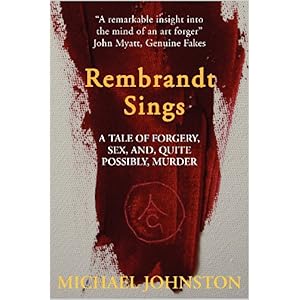
Michael Johnston: Rembrandt Sings (2012)

Edition: akanos, 2012
Review number: 1469

Art historian Bill Maguire tells the reader his life story in Johnston's new novel. At least, he narrates a version of his life: he is clearly a constant reviser of material from his journals, and undercuts much of what he says with sardonic footnotes. His story is bound up with that of a rather older man, a painter named Joe Rembrandt, and most of Maguire's story is taken up with Joe's recital of his own life story, told to the young Bill while in the last stages of terminal illness. And in turn, Rembrandt's story is bound up with (fictional) painter Alexander Golden, whose daughter he married. Or perhaps not: it is clear fairly quickly that not only is Bill Maguire an unreliable storyteller, so is Joe Rembrandt, even if he does share an insight into Golden's paintings which Maguire uses to establish his academic reputation.

What unites these characters is a love for (and knowledge of) fine art. Even their involvement in dubious activities - including forgery and possibly, murder, as the front cover puts it - is fuelled by and part of their love for painting. Johnston captures the power of their obsession well, which is particularly useful, as it is of vital importance to the plot, as well as making the characters sympathetic: a forgery (and even a murder) for the love of art is easier to accept than the same crime carried out just to make money.

Rembrandt Sings is not intended to be an action thriller, and is more concerned with the motivation of the forger than anything else. The ending has a nice thriller-style twist to it; if reading the novel, do not skip forward as you would ruin a treat. Having said that, it is also a novel I wished had been longer, a rare object. There is nothing much recorded from Bill's live between the early twenties when his academic career was beginning and the position of senior and respected art historian, a likely candidate for the next head of the Tate gallery, who is looking back to his early days in the art world. Perhaps nothing out of the ordinary would have happened, just a standard academic career path, but more information would have been interesting.

Painting is not really my thing (colour blindness means that I tend to have problems perceiving pictures in the same way as people with normal vision), but I do enjoy fiction about art. I was in fact just starting Michael Gruber's Forgery of Venus as I finished Rembrandt Sings, another novel about art forgery, with a rather different slant on the subject. And I love Iain Pears' Jonathan Argyll series, which seem to have finished, unfortunately; they are more traditionally crime stories, and have less convincing forgers than Joe Rembrandt (which is not surprising, as it is  not the point of the books). I don't think that, even though music is the art form dearest to me, I would find a musical faker as interesting as the characters in this book, no matter how well done.

Altogether, I found this an interesting and impressive picture of the forger, with a clever twist, though lacking in pace for most of the time. My rating: 7/10.

Saturday, 6 October 2012

Anthony Horowitz: The House of Silk (2011)

Edition: Orion Books, 2011
Review number: 1465

The character of Sherlock Holmes has been part of a huge literary industry, possibly the largest collection of what would now be known as fan-fiction ever produced. But The House of Silk remains an unprecedented event, being the first Sherlock Holmes novel actually authorised by the estate of Arthur Conan Doyle. The writer chosen to produce this work is Anthony Horowitz. His prior literary output consists of thrillers for teens, the Diamond Brothers and the Alex Rider series. Rather more relevant, I suspect, is his role as the creator and writer of the acclaimed historical crime TV series Foyle's War.

As an authorised continuation of Conan Doyle's writing, it is to be expected that The House of Silk is more like the 'canon' than much of the Sherlock Holmes literature produced by other writers, and this is indeed the case. It does use some of the common devices of Holmes fan-fiction, in particular the idea that narrator Dr Watson had cases that he wished to write about but which were to sensitive to publish, and which were then stored after his death for a number of years. It does not play around with the canon as some Holmes novel do, including some of my favourites, Laurie R. King's Mary Russell series.

The many Conan Doyle-like touches include an American connection, with the story opening with Holmes employed to track down a man who has been terrorising his client, believed to be a gangster from Boston, Mass., where Holmes client had been instrumental in the capture of the gang he belonged to. This story bears a resemblance to the Scowrer plot in The Valley of Fear, also involving the early employees of the Pinkerton detective agency working against a violent gang.

Slightly oddly, given the potential of a series of authorised Sherlock Holmes novels, The House of Silk seems to be designed as a one-off, judging by the preface and afterword (in which John Watson explains the reasons for not publishing this story at the time it happened). Maybe Horowitz didn't enjoy writing this, maybe the Conan Doyle estate only wanted a one off - there's plenty of time for more, though, before the final US copyright runs out on a Sherlock Holmes novel (assuming no changes in the relevant law before then).

The incidentals of the tale - the atmospheric depiction of Victorian London and its exotica, the energetic sleuthing of Holmes and Watson, and so on - are very much done in the Conan Doyle manner, but I found the puzzle very simple indeed. I found it a bit hard to work out whether this is authentic recreation of canon, or something which is Horowitz's own, because I know the Holmes stories fairly well so am not surprised by the twists in them, and I am a much more sophisticated and experienced reader of detective fiction than I was when I first encountered Sherlock Holmes in a comic strip version of The Sign of Four in the pages of Look and Learn in the mid-1970s. Thinking about it, I feel that the mysteries in Conan Doyle are mostly more difficult for the reader to solve. This is my only real caveat; in every other way, The House of Silk is a pretty good addition to the Sherlock Holmes industry, even if in 2012 it would be hard to write a novel with the impact of the original series that was true to the originals as this is. My rating: 7/10.

Wednesday, 25 July 2012

Donato Carrisi: The Whisperer (2009)

Translation: Shaun Whiteside, 2010
Edition: Abacus, 2011
Review number: 1460


Three stories come together at the beginning of The Whisperer. An investigator specialising in finding missing children rescues a boy and a girl form a paedophile, before she is immediately reassigned to work with a serial killer investigation. Although this is not Mila's area of expertise, the reason is apparent from the second strand of the story, in which five severed left arms are found buried in a wood, then a six. The first five clearly belong to five girls reported missing, but no sixth girl is known to have disappeared. The last body has another difference from the others: medical evidence suggests that she might still be alive. The clock is ticking though, as even with the proper care, she only has another ten days outside a hospital. The third thread is a description of a desperate drive by a man with an appalling secret hidden in his car, which ends and joins the serial killer thread when he is stopped by the police.

The story itself consistently seems far-fetched, but is still quite compelling to read. Serial killers who enjoy setting cryptic puzzles for the police are bread and butter for crime thriller writers, as sinister monks haunted the catacombs in eighteenth century gothic romances. The paedophile preying on children is the terror of our age, no matter how rare he might be. Using the medical deadline given to the missing girl imposes dramatic tension on the story, albeit one which feels artificial - the child has been kidnapped: are the searchers going to waste their time on Facebook without this extra incentive? All these things add up to a hackneyed plot, if one which is quite well constructed, with twists and turns in every chapter.

I found the style of The Whisperer uninspiring, descending into lazy journalistic clichés such as "It all kicked off when...".  It is hard to tell whether this is the fault of Carrisi himself, or of the translator Shaun Whiteside. In the early chapters, I found myself considering not bothering to continue several times, because I found the writing so off-putting. Eventually, though, I was drawn in, and did keep going, even though one of the twists in the story involves something I always feel is a cheat in an apparently realistic detective story: the use of a medium.

Nothing like as good as the hype - too clichéd, too poorly written, and too over the top to be seriously read as a thriller. (Maybe it's a spoof, and I just didn't notice.) My rating: 4/10.

Friday, 4 May 2012

Michael Collins: The Secret Life of E. Robert Pendleton (2006)

Campus novels are not uncommon; novels about writers even less so. But Michael Collins has here produced an excellent novel, by incorporating a striking crime thriller theme into this self-consciously literary setting.

The title character is a literature professor at Bannockburn College, a once-famous writer whose punk-like attitude helped bring about a decline in his career to the point where a meeting with an old friend who is still a best-selling author drives him to a suicide attempt. While he remains near death, a postgraduate student from the English department discovers a lost novel in his home, published decades ago by a now defunct vanity press and apparently so thoroughly forgotten that it no longer appears on Pendleton's CV. Intrigued, Abi begins to read it, and is impressed by what turns out to be a first person narrative daringly written from the point of view of a child killer. She eventually manages to get Scream published, and it becomes a best-seller as well as restoring Pendleton's literary reputation. But then a few people begin to realise that the crime depicted bears a close resemblance to a real cold case from local area.

Considered as a crime thriller, The Secret Life of E. Robert Pendleton moves at a glacially slow pace. It will, however, retain the interest of a genre fan because of the idea behind the plot. The extra space is used to include elements from literary fiction, particularly to develop the characterisation of Abi. The themes of the novel seem to be the way that bad choices come back to haunt us, and the relationship between fiction and reality - does Pendleton's depiction of the crime in Scream make him the criminal, someone who spoke to the criminal, or someone with a imagination unfortunately too close to that of the killer?

A touch of patience from thriller fans will be well rewarded. There are some fantasic scenes, such as the interrogation of another author and academic by the police, where he deconstructs the questions as though they are texts relating to an academic study of the philosophy of crime genre fiction.

All the main characters in The Secret Life are failures of one sort or another, at least in their own eyes, and are generally not at all reconciled to being so. There is the perennial student, the once fêted writer who cannot maintain his early promise, the writer who pursued commercial success and despises himself for it, the policeman unsatisfied by his second marriage, not to mention the people originally suspected of the murder, none of whom have done anything with their lives. They are not particularly likeable, either, which is something which usually makes it harder for me to enjoy a book; but this time, it did not, because of the interest of the idea and the complexity of the characters (who do at least have sympathetic traits as well).

The title is one of the poorest parts of The Secret Life of E. Robert Pendleton, being long, awkward, and unmemorable, as well as saying little about the themes of the novel. It has also been published as Death of a Writer, which is misleading and not very good either. A couple of minutes' thought suggested A Murder in Fiction, but I think that with only a modicum of effort, this too could be bettered.

My rating - 8/10.


Edition: Phoenix, 2007
Review number: 1455

Thursday, 23 February 2012

Carol Goodman: Arcadia Falls (2010)

Note: There is a serious spoiler in the final paragraph of this review.

There is almost a subgenre of fiction set in remote New England boarding schools and colleges. Like thirties house parties in English stately homes, a staple setting for vintage crime fiction (as well as P.G. Wodehouse, of course), they provide a sealed community of privileged individuals which acts to intensify relationships, promote jealousy and passion, and makes more or less normal people behave in strange and bizarre fashions - as happens, for instance, in Donna Tartt's Secret History, referenced in a review quoted on the cover of this edition of Arcadia Falls.

The specific location for this story is school focusing on art, formerly an artistic colony. It is told from the point of view of a recently widowed (and, as a result, newly poor) single mother Megan Rosenthal, who gratefully takes up a post teaching English literature at Arcadia Falls, which is accompanied by the offer of a place at the school to her daughter Sally, only to find that within a few weeks of her arrival and the start of the school year a student goes missing before her body is found at the foot of cliffs in the (extensive) school grounds. At the same time, Megan becomes fascinated by the relationship between the two women who effectively founded and then ran the school for decades with a somewhat peculiar vision (which includes participation in pagan rituals to mark the seasons by the pupils).

A "finding oneself" theme is very important in Arcadia Falls, exemplified by a children's story, The Changeling Girl, written by one of the school's founders which is told, retold, reflected and commented on throughout the novel in ironic fashion, as characters both act it out and talk about it - adopted children discovering or seeking the identities of their parents, for example, as well as Megan trying to build a new life for herself and Sally after the death of her husband. Another theme is the way that the decisions made in one generation affect the next, with several mothers giving up careers to raise children, or giving up a baby for adoption, with repercussions for both the parents and the children. Sometimes the treatment is a little mawkish, but generally these themes serve to unify the disparate elements of the story and even provide something of a moral, if the reader feels that such a thing is necessary.

Though the setting with its Gothic touches and the themes of Arcadia Falls are hardly original, it is a well written and entertaining novel on the boundary between literary fiction, crime fiction, and fantasy, the last being more suggested than the other two genres. It is the depiction of character and the touches of atmosphere which make the story worth reading. It reminded me of the novels of Mary Stewart, particularly the later ones. However, the sentimentality of the ending was a big problem for me, so in the end I would rate it at 6/10.

Edition: Piatkus, 2011
Review number: 1451

Tuesday, 8 November 2011

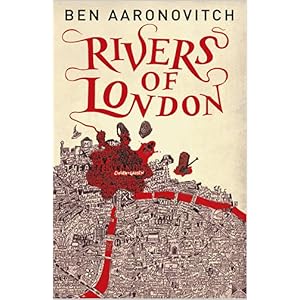
Ben Aaronovitch: Rivers of London (2011)

Rivers of London is a police procedural with a difference: Peter Grant is a trainee PC in the Metropolitan Police who discovers that he can see ghosts, and is immediately seconded to a tiny division of the force (tiny, as in - Peter brings the staff total up to two) which deals with crimes which have a supernatural element.

The supernatural unit police story has of course been done before, but not (as far as I know) with so much attention to the minutiae of police work. This juxtaposition of the supernatural and mundane is of course a source of humour, and Rivers of London is very funny in places. It reminded my strongly of Charles Stross' Laundry series, set in the Secret Service rather than the Met, combined with ideas about London mythology similar to those embodied in Neverwhere.

Aside from the narrative thread dealing with Peter's experiences of the early stages of becoming an apprentice wizard, there are two main parts to the crime story. One is a series of apparently senseless, bizarre and very violent murders, the first in Covent Garden being the occasion for Peter's discovery that he can see ghosts when a witness he starts to talk to turns out to be one. The more interesting idea is a territorial dispute between the spirits Father Thames and Mother Thames, the former of whom is not happy about the end of his territory coming at Teddington Lock (where the Thames starts being tidal); Mother Thames covers the part of the river through the city to the estuary and the mouth of the river.

Aaronovitch has been a writer for some time: he wrote one of the serials which made up the original Doctor Who, back in the eighties. So it is no surprise that Rivers of London is well constructed. If you stop to think, some of the details of the killings are rather nasty (enough to make this not a book for the squeamish), but the plot moves forwards fast enough that most readers will not dwell on the unpleasantness.

Enjoyable if not hugely original, well written and very funny. I'm definitely going to look out for the sequel, Moon Over Soho. My rating: 7/10.


Edition: Gollancz, 2011
Review number: 1434

Sunday, 16 October 2011

Nicholas J. Clough: A Safe Place to Kill (2008)

In a village church in the Yorkshire Dales, the body of one of the church wardens is found stabbed, with wounds to the hands and feet. Murder is not the most common crime in the district, and Inspator Daykin, assigned to the investigation, is under close scrutiny from his superior officers. He is also assigned a new sergeant who happens to be the son of the Assistant Chief Commissioner.

The Yorkshire Dales are among the most beautiful parts of England, but this is not one of those detective novels which hints to TV production companies that a series would have a tourism-friendly background which would help them sell it abroad. The background is mainly used to provoke a sense of emptiness and isolation, and the book could be set in any sufficiently rural part of England, barring occasional mentions of people going for walks on the moor or travelling to Leeds. What in fact makes this a slightly unusual crime novel is that it is at least as concerned with police force office politics and character interaction as it is with the investigation.

The book itself is rather shoddily produced, with poor proof-reading in particular. It is also missing most of the marketing frills of modern publishing: no endorsements from other crime writers, no quotations from reviews. Even the author biography is just a single, uninformative line: "Nicholas J. Clough lives in Bath." It does at least have a colour picture on the cover. While this might be a refreshing change from the over the top hype typical of twenty-first century marketing, it does suggest that Constable expected A Safe Place to Kill to sink without trace. It may be old fashioned, but it is better than many novels given the familiar overkill treatment. Clough has written more, but not (I gather) involving Daykin, which is a pity: he is a detective I would be happy to see more.

My rating: 8/10.


Edition: Constable, 2008
Review number: 1432

Sunday, 24 July 2011

Imogen Robertson: Anatomy of Murder (2010)

Having enjoyed Robertson's first novel, Instruments of Darkness, I had high hopes for the sequel. These were, for the most part, realised. Her two detectives, naval wife Hannah Westerman and anatomist Gabriel Crowther, have become somewhat notorious as a result of the publication of lurid pamphlets describing the events of the first novel.

This means that towards the end of 1781 they are asked to look into a body found in the river Thames, a body of interest because it had been tied town to keep it from being found - a subterfuge which failed because the killer didn't take into account the action of the tide. The dead man turns out to be a former musician from the opera house, bringing the world of eighteenth century music which featured in Instruments of Darkness into this novel as well - perhaps an unlikely coincidence, but clearly allowing Robertson to write about a world with which she is familiar and comfortable: the case involves castrati, a French soprano in fact born in the London slums, and the relationship between the opera and high society. A suspicion of espionage - the novel is set during the American War of Independence after all - provides the driving force behind the crime and its aftermath, though this is never really very convincing. The mystery itself is not particularly taxing to unravel for the reader, but the story does manage to hold the interest nonetheless.

Anatomy of Murder is a lighter read than Instruments of Darkness, lacking much of the Gothic atmosphere of the earlier novel, despite the introduction of a Tarot-card reading fortune teller. The world of the opera in London is a brighter, more passionate one than the decaying manor in the depths of rural Sussex which formed the background of Instruments of Darkness. Though squalor and deprivation are depicted, London is never made as sinister as the countryside. Moving the setting to London allows Robertson to show her extensive background knowledge of a different aspect of eighteenth century England.

The misanthropy of Gabriel's character has been softened somewhat, too, though the lack of romantic tension between Gabriel and Hannah remains a strength: the avoidance of the crime genre cliché of the detectives who start to fall for each other because of working together marks out Imogen Robertson's work as refreshingly different from the norm. After all, people often work together in the real world without developing a romantic attachment.

Sometimes sequels can be read on their own without spoiling the first book too much, but Anatomy of Murder is not really one of these. It gives away a great deal which the first time reader of Instruments of Darkness would probably prefer to first encounter in its proper place. There is of course no reason why sequels need to be stand alone; but it is a warning that the earlier story should definitely be read first.

Even though less good than its prequel, Anatomy of Murder is still an atmospheric piece of historical crime fiction, with central characters who are consistently interesting - if not entirely likeable. It could do with a better and more convincing mystery, though, which is why I rate it only at 6/10.

Edition: Headline, 2010
Review number: 1428

Thursday, 7 July 2011

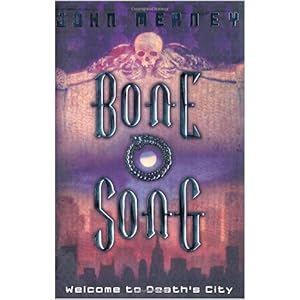
John Meaney: Bone Song (2007)

Back in February, I reviewed Absorption by John Meaney, wondering why the author of that somewhat tedious novel was described by Stephen Baxter as having "rewired SF". Bone Song, Meaney's début, is why.

While not as revolutionary as Baxter's praise suggests, Bone Song starts in a marvellously atmospheric and imaginative manner, evocatively written with a compelling central character. The setting is Tristopolis, not just the "city of sadness" its name suggests but somewhere where death is all important; ghosts and zombies are among the citizens, and wraiths power many machines, while a mystical process applied to bones provides the fuel in the city's power stations. Donal Riordan is a policeman in Tristopolis, assigned to protect a visiting opera singer: she is the next potential victim of a killer who is murdering creative people because their bones can be used to experience a "high".

The excellence of the first hundred pages is not maintained. Much of the middle of Bone Song seems to this reader to consist of dull running around by Riordan and his colleagues, provoking a tedium which perhaps makes it more true to life than many police procedurals. The interest does pick up again towards the end, and, while it never shows sufficient originality to justify Baxter's praise, Bone Song remains an intriguing novel.

In a further bout of hype, the back cover also describes Bone Song as "an extraordinary melding of visionary SF and dark horror". This might have been more convincing if China Miéville and Neil Gaiman (to pick two writers who came to mind while reading this story) had never published their fiction. While the background is more like Miéville, there is a stylistic influence from comic books which suggests Gaiman. There is even a paragraph where Meaney uses a common comic book technique where dialogue is interrupted by action but then continues as though nothing had happened: along the lines of three frames containing "Stop..." | THUD | "...that" as text.

As for a rating: I'd give the first and last thirds 9/10, and the middle 3/10, which averages to 7/10 overall.

Edition: Gollancz, 2008
Review number: 1427

Wednesday, 4 May 2011

Michael Connelly: The Reversal (2010)

Michael Connelly is a fine writer, and I have read all of his books. He is most famous for his LA cop Harry Bosch, who features in many of his books, including this one. These novels tend to be police procedurals until near the end, when a thriller-style twist leads to an exciting ending. But for me these endings usually come across as contrived and unlikely, a mechanism for avoiding the simple arrest-the-suspect conclusion which is pretty standard in crime fiction (and this disappointment has generally put me off reviewing them). This sort of ending does seem especially likely in American crime writing; Linda Fairstein is another writer whose books I like who does this, for example. All this means that in Michael Connelly's writing I prefer the books which have a different lead character.

In The Reversal the main character is Mickey Haller, even though Bosch does play an important part in the story as well. He is a Californian defence lawyer who has also appeared in several previous Connelly novels, starting with The Lincoln Lawyer. This is the third novel in which he works with Bosch, but there is a big difference here to Haller's past. He has been asked to act as a state prosecution lawyer, in a case where it is important that the work done appears to be independent of the state machinery. (The title in part refers to Haller's crossing from one side to the other in this way.)

The case is a retrial of a child murder, where the man convicted at the original trial has, after twenty four years in prison, been able to have the verdict overturned (reversed, in fact - another reference made by the novel's title) on procedural grounds. The process is that the case needs to be retried, as the Californian justice department still believes in the guilt of the imprisoned man, rather than the prisoner being released as though an appeal had been granted. Since the knowledge that the accused had already been convicted and imprisoned might influence the jury, the whole case is structured as though the first trial had never happened. I'm not an expert on American law, but this all seems rather over-elaborate: more designed to be the background for novels like this than the way a real life legal system would work. I'd certainly not heard of this happening before.

So The Reversal is a courtroom thriller. As such, it confirms to the stereotypes of the subgenre, as laid down a long time ago by Erle Stanley Gardner in his Perry Mason novels: surprise testimony, unreliable witnesses, defence and prosecution tricks, and legal rhetoric with constant se of objections on both sides: all the ingredients which make a thriller out of the tedium which is the norm in most legal trials. Like most of the genre, the reader is firmly encouraged to sympathise with one side; in this case, it is the perhaps less popular choice, the prosecution.

As a courtroom thriller, The Reversal is one of the best. Connelly keeps a fairly tight rein on the plausibility of his plot, while keeping the story engrossing. My rating - 8/10.


Edition: Orion, 2010
Review number: 1420

Saturday, 5 February 2011

Iain Pears: Stone's Fall (2009)

Iain Pears has to be one of my favourite crime authors. The magnificent An Instance of the Fingerpost is an incredible historical thriller, with three different solutions to the mystery being presented by different narrators, while the Jonathan Argyll series is an entertaining and amusing romp through the Italian art world. The two are very different sides to Pears' talent, and his newest novel, Stone's Fall is cut from the same cloth as An Instance of the Fingerpost.

Indeed, it uses quite a lot of the same structure. Stone's Fall is divided into three main parts, with a short introduction; they are arranged in reverse historical order. All are concerned with Edwardian financier John Stone, whose death falling from a window prompts his widow to employ a young journalist (Matthew Braddock) to investigate the strange bequest in his will to a child that neither she nor the will's executor knew existed, under the guise of researching an autobiography of Stone. The investigation becomes entangled with the finances of the companies owned by Stone, which are mainly armaments firms, with international politics, and with Braddocks infatuation with Stone's widow. He does eventually find a solution which convinces him, but that is only the end of the first part.

In the second part, we go back thirty years, and the narrator is now Henry Cort, a spy from the first part, now at the beginning of his career in Paris in the years after the Franco-Prussian war. This again involves Stone's (future) wife, and a plot to destabilise the Bank of England by discrediting Barings Bank, one of the biggest Victorian investment banks. This sheds further light on the personalities involved in the first part, and suggests that the convenient solution for Stone's death may not actually be correct. The narrator of the final part is Stone himself, as a young man in Venice in the 1860s; characters include Cort's father. Here we find out the origins of Stone's fortune - Braddock had wondered how someone without the training of an engineer had been able to set up a company to produce a revolutionary torpedo from a design he provided. And, again, new light is shed on Stone's death; he wrote the memoir just before his fall.

I did feel that the re-use of the tripartite structure, with a similar purpose to that in An Instance of the Fingerpost, reduced its impact. On the other hand, Agatha Christie finishes many of her novels with scenes where Poirot confronts the murder suspects as a group, and these scenes are so similar they almost follow the same script as each other (Poirot describes the evidence against someone innocent, they protest, Poirot agrees and skewers the real killer). That is not the case here; Stone's Fall is a very different thriller from An Instance of the Fingerpost, not just because it has a later historical setting. It just seems a repeat because of the striking nature of the concept. While in Pears' earlier novel, it seems as though the use of the device is making the point that it is possible to come up with multiple solutions as convincing as those most crime novels have, here his little reminder to the genre is that the kind of clear cut solution common in murder fiction are not the way that things really are; the truth behind most killings is more complex than just who did what when, and it can be the case that the roots of the death of a man like Stone could run many years back into the past. It is perhaps fair to say that Stone's Fall is concerned with emotional depth, while An Instance of the Fingerpost is about glittering cleverness. But in the end, the earlier novel was always clearly destined to be a classic of the genre, while Stone's Fall is just very good indeed. My rating: 8/10.


Edition: Vintage, 2010
Review number: 1413

Thursday, 8 July 2010

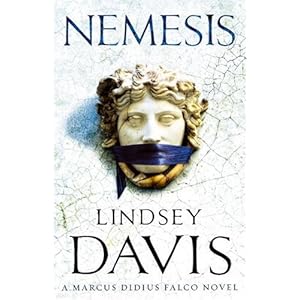
Lindsey Davis: Nemesis (2010)

Edition: Century, 2010
Review number: 1404

After the (to me) unreadable Rebels and Traitors, Davis returns to the Roman crime series which made her name, with the nineteenth Falco novel, Nemesis. But this addition to the series is much darker than most of them: this is not quite the wise-cracking Falco of old.

The darkness starts right at the beginning of the novel, which opens with the deaths of Falco's infant son and his father. The death of new born children has been a part of life throughout history. Take for example Queen Anne, who had the benefit of better medicine and all the care a British Queen could command at the turn of the eighteenth century, but none of whose fifteen children survived to adulthood. And the death of children plays an important part in novels by writers such as Charles Dickens. Yet it is something which is generally skipped over in modern historical fiction. With larger families and more infant mortality, death was a part of life in a way which, at least in the Western world, it is not today. That of course does not mean that parents then did not mourn the death of their children as much as parents today do.

So Nemesis is really about Falco's mourning for both his son and his father, even if in the latter case he doesn't want to show that he is strongly affected. The plot of the story concerns an investigation begun by Falco when he is looking into an unfinished business transaction of his father's. This spirals into a hunt for a family of serial killers, who seem to be protected by someone highly placed in the Roman government, and it becomes a case which pushes Falco onto a morally darker path than he has yet travelled - presumably because of the effects of his bereavement on his emotional state. He becomes a much more ambiguous hero than usual in this series; no  matter how bad his life became (the episode in which he went undercover as a slave in a mine is a prime example), he always previously seemed to be a basically good person. In hard boiled detective terms, the Falco of Nemesis is more Dashiell Hammett's tainted Continental Op than a wisecracking Philip Marlowe.

Pushing a character to do nasty things because of his own emotional pain is all very well, but after eighteen more or less humorous novels in a series it comes as something of a shock to readers. More points for literary quality, then, but fewer for enjoyment of the story. I'd give Nemesis 6/10 as a result - angst is not why I read Falco novels.

Tuesday, 18 May 2010

Charlotte MacLeod: It Was an Awful Shame (2002)

Edition: Five Star, 2003
Review number: 1401

Of all genre writing, it may be the case that crime short stories are the most difficult to pull off, despite the pioneering example of Arthur Conan Doyle, whose Sherlock Holmes short stories remain among the best of this type. To fit a convincing description of a crime, several suspects, their motives, means and opportunity, as well as the solution, into a few pages is not easy. To make them funny as well is so difficult that to try seems almost like showing off.

And in this collection, Charlotte MacLeod manages to do this without apparent effort. Not only that, she is often able to convey an enviable sense of place: most of the stories are set in a New England clearly dear to her heart. The stories are also rather old fashioned, and portray an upper class New England that almost certainly became extinct before the Second World War (the original publication dates for the stories are between 1963 and 1989, mainly in the first decade).

The quality of the stories is variable, but there are no really poor ones in the collection. However, the ordering of the stories does leave something to be desired for newcomers to the author (as I was when I picked up this book in the library). MacLeod wrote two long series of novels with recurring characters, and fans will be pleased to know that both make appearances in this collection. The problem is that the first two stories here are from one of these series, and don't really stand alone too well, and this is an off putting start for those readers not familiar with the novels. The stories from the second series work much better, appearing later on and apparently coming near the start of the series' internal chronology. These series characters made me think of Dorothy L. Sayers' short stories, which are not particularly distinguished (and certainly not as good as MacLeod's), but which are collected in such a way that Lord Peter stories draw the fan into reading each of the collections. There, too, a certain knowledge of Lord Peter is assumed, but not perhaps as much as MacLeod does in the first two here. The first story, which provides the title for the collection, also deals with the childish rituals of a fraternity lodge, and so seems particularly removed from real life.

Similarly, the level of humour varies between the stories. Some of the best moments, such as the magnificently silly spoof The Mysterious Affair of the Beaird-Wynnington Dirigible Airship and the Wodehouse-style combination of goat, shotgun, helium balloon, trousers and halibut in Fifty Acres of Prime Seaweed, are not likely to be quickly forgotten by any reader.

The old fashioned air occasionally reminds me of O. Henry or P.G. Wodehouse: very old fashioned, and similarly cosy. In no way could MacLeod's stories be described as gritty reflections of the mean streets of modern America. That is not necessarily a bad thing; there should always be a place for expertly written, light and fun reading, even if it occasionally strays into the twee. My rating: 7/10.

Wednesday, 6 January 2010

Dorothy L. Sayers: Murder Must Advertise (1933)

Edition: Gollancz, 1971
Review number: 1393

There are several Dorothy Sayers novels which have an unusual background: bell ringing in The Nine Tailors, the Bohemian London intelligentsia in Strong Poison, and so on. This idea is not that uncommon in crime fiction since her day, but she makes her backgrounds more closely integrated with the puzzle than is often the case. Murder Must Advertise is the best of these in many ways. Like Gaudy Night (Oxford womens' college), it uses a setting extremely familiar to the author, that of the adverstising agency, similar (one assumes, but for the likelihood of violent death) to the one in which she worked. It even has a character, a copy writer named Miss Meteyard, who is clearly something of a self-portrait.  Advertising has obviously changed since the 1930s, so this makes Murder Must Advertise something of a historical record, particularly with episodes such as discussions about how to encourage more women to take up smoking which would be viewed rather differently today.

The novel begins when a new copywriter arrives at Pym's agency, to fill the place of a man who died falling down the stairs. The new man signs himself Death Bredon, and the reader is likely to realise very quickly that these are the middle names of Lord Peter Wimsey, undercover to unravel a death more suspicious than it first appears.

One aspect of the novel doesn't really work at all. As part of the investigation, Lord Peter needs to charm a wild young woman, a rich society party-goer who is involved with a set connected to drug smuggling. He does this - rather bizarrely - by dressing up as Harlequin and playing silly but mysterious games to tantalise her. This includes physical feats unlikely to be carried out by a twenty year old (unless a circus acrobat), let alone Lord Peter, who is described as being about twice that age. The contrast between these sections and the rest is rather jarring, and doesn't encourage belief in Lord Peter as a character. I also felt that it was unlikely that Lord Peter, who is supposed to be so well known to the public, was not recognised in what seems to have been a playing of a role with no real disguise of his features - he is nearly discovered at one point because he is still wearing tailored clothes which would be far beyond the means of the man he is supposed to be.

On the other hand, one literary trick does work, even though it must at the time of publication have seemed out of place in a crime genre novel. At several crucial points in the novel, Sayers places paragraphs which consist solely of advertising slogans (for the made up products of Pym's clients). Apart from punctuating the narrative, they provide a particular kind of background, due to the all pervasive nature of advertising in the twentieth century. A successful advert needs to catch the mood of the moment, and feed off it, or else it won't be able to capture the imagination of the consumer - they are in a way the essence of popular culture. This means that the style of adverts is instantly evocative of the time of their creation, and makes these paragraphs in Murder Must Advertise redolent of the early thirties.

Flawed, but still one of the best classic crime novels - 8/10.

Wednesday, 5 August 2009

Fred Vargas: The Three Evangelists (1995)

Translation: Siân Reynolds, 2006
Edition: Vintage, 2007

Fred Vargas' only standalone novel so far is an intriguingly different detective story. This is clear from the bizarre opening, in which retired opera singer Sophia Siméonidis wakes one morning to find a new tree has been planted in her garden overnight. After worrying in silence for a month, she approaches her next door neighbours, three effectively unemployed historians (known as the Evangelists because their names are Matthias, Marc and Lucien) and a senior policeman forced into disgraced retirement. She asks them to pose as council workers and dig up the tree, once they suggest that it would be a good way for someone to hide a body.

When nothing is found, it seems as though the whole thing was just a fuss over nothing, until Sophia goes missing. Then the Evangelists begin looking into the mystery in earnest, feeling that their research skills and the fact that they are not policemen might make it possible to discover things that the official investigation cannot. While this latter reason is commonly used in crime fiction to justify amateur investigations, it is not one that would be recommended by police forces around the world!

The Three Evangelists is a character led detective story, with quirky touches like the tree lending extra interest. (I have been told that this sort of whimsy is typical of Vargas, and that to some it might become tiresome after two or three novels.) It has a brilliantly put together ending, where the pace suddenly picks up for the last few chapters and the solution is revealed.

Vargas has now won three of the last four International Crime Daggers, despite other writers translated into English having a higher profile. The Three Evangelists was the first of her winners, and clearly deserved to do so. This is not just a well written detective story, it is different from the usual run of things in the genre and so stands out all the more. I would rate it at 8/10.

Tuesday, 14 April 2009

Michael Chabon: The Yiddish Policemen's Union (2007)


Edition: Fourth Estate, 2007

Alaskan detective Meyer Landsman is a mess, and the country he lives in is a mess. Following the destruction of the fledgling state of Israel by its neighbours in 1948, the southern part of Alaska, around the town of Sitka, is opened up for Jewish settlement by the American government. Now, after sixty years, the federal lease is about to come to an end, and no one knows what is going to happen when it does. When Landsman's marriage breaks up, he moves into a sleazy Sitka hotel, to drink himself to death. A bad day starts when the hotel manager wakes him up because the man in the next room is dead, not from the expected heroin overdose but because he has been shot, execution style. Then Landsman discovers that his ex-wife, also a police officer, is now his boss, and that the corpse is the missing son of the head of an extreme Orthodox sect, before being ordered off the case. In true "maverick cop" style, this just makes him work harder, to find out who doesn't want him to discover the killer, and why.

Chabon's alternate history is interesting, and reasonably believable. I could easily imagine Israel destroyed in 1948, and with a little more effort the choice of Alaska - not then a state of the USA - as an alternative Jewish land makes sense: the territory was under the control of an American federal government sympathetic to the post-war plight of the Jews, and it was not already heavily populated. The sett up feels as though it should be making the ingredients of a farce, butt the novel is not humorous, apart from the odd one-liner and the exaggeration of the maverick stereotype in Landsman: this is not Woody Allen. For a novel which is described as "a homage to 1940s noir", I'd really expect more sharpness.


The Yiddish Policemen's Union is a novel I really expected to enjoy. Other people thought it was really good, I'd enjoyed The Amazing Adventures of Kavalier and Clay by the same author, and felt that the idea behind the story would make an interesting setting. But in the event I found it heavy going. The depression of the protagonist, the desperate sense of impending doom over the Jews of Sitka, and the nastiness of many of the other characters are all contributing factors, making it hard to enjoy reading the novel. This is not necessarily a reason for not reading, and The Yiddish Policemen's Union is not the first or the most depressing book I have read, by a long shot. The suggestions for why it is hard going could equally well be said of 1984, though the theme of rebellion against authority there works better at holding the reader's interest - Winston is not as clichéd a character as Landsman. Perhaps Chabon just struck a chord with me, though I can't see what it would be. I am not, after all, a Jewish policeman investigating the murder of a heroin addict.

Often a book which is difficult to read providers other pleasures, but although it is undoubtedly well written, I did not really feel that I gained much from The Yiddish Policemen's Union. Perhaps if more had been made of the chess playing metaphor, or there had been more humour, I would have enjoyed it more. In the end, I would personally rate The Yiddish Policemen's Union at 6/10.

Saturday, 31 January 2009

Simon R. Green: Into the Nightside (2008)

Published: Solaris, 2008
Omnibus edition containing Something from the Nightside (2003) and Agents of Light and Darkness (2003)

I'm not sure why it is, or exactly when it happened, but the horror genre has changed. Possibly it's the influence of TV programmes like Buffy, which blended horror with other genres and made the scariness less of an integral part of the experience. But there are now lots of these genre crossover books around now, from the really bizarre (say, the chick-lit vampire of Mary Janice Davidson' Betsy series) to this more obvious pairing of hard boiled detective with horror. It is not even unique in choosing that combination, which is also used in the Harry Dresden series. In general, these work by taking well known horror ideas (such as vampire lore) and using them more as plot elements than for their frightening qualities. After all, it becomes much harder to be frightening with something as familiar to a modern reader and as frequently satirised as a vampire.

John Taylor is a sleazy private detective with a unique talent: he can find any object. But to do so he must go from the everyday London which holds his office into the Nightside, where his magic becomes a beacon attracting the enemies from which he fled five years earlier. So business is not good. Then a rich beautiful woman asks him to help find her daughter, lost in the Nightside, and he accepts the commission, charging only double his usual rates. Once into the Nightside, the tone changes, and there's much less of the hard boiled detective as the story becomes a more standard fantasy/horror tale, rather like a milder version of Anita Blake in a crossover with Neverwhere.

The Nightside series is not Green's only crossover of this sort; there is also The Man with the Golden Torc, which (as is obvious from the title) blends horror memes with James Bond. This, and the series which follows, is much less serious in tone than the Nightside stories, though both are amusing in places rather than fully satirical. But enjoy one and you'll enjoy the other. They are too good to be considered a guilty pleasure (unlike Anita Blake, which I find contains far too much dull sex), but not quite good enough to be in my novels of the year. Unusually for the fantasy genre today, Green's novels are quite short, which makes them ideal for an hour long train journey - light to carry, and fun to read.

I've decided that it would be a good idea to have ratings for the novels in these blog entries, starting here. I'd give Into the Nightside 7/10.

Wednesday, 18 June 2008

James Wilson: The Dark Clue: A Novel of Suspense (2001)

Published: Faber & Faber, 2001

The Dark Clue is a sequel, of sorts, to Wilkie Collins' classic The Woman in White. It has the same central characters: artist Walter Harkwright, and his sister-in-law Marion. Rich from his marriage but still relatively unsuccessful as an artist, Walter is approached to write a biography of JMW Turner, as a counterblast from still-living friends of the famous artist to a scurrilous biography raking up scandal (the actual first biography of Turner by Walter Thornbury). But as he and Marion investigate, they discover that Turner did indeed have a dark side, and the truth about the revolutionary painter is at the least going to be more complicated than Walter's initial assessment that his "life of him will be quick work indeed".

The Dark Clue re-uses the narrative technique of The Woman in White, purporting to be a collection of letters and diary entries, with Marion's diary being probably the chief source. While Laura, Walter's beloved in Collins' novel and now his wife, was absent from the stage for most of The Woman in White, she appears only as the author of a handful of letters in The Dark Clue, which mostly are complaints that Walter is neglecting her and their children. Wilson picks up on the feeling that must strike most readers of Collin's novel, that Walter and Marion would be extremely well suited to each other, while Laura is an abstraction for which he unfortunately develops a romantic passion. For Collins, Laura is a personification of persecuted innocent beauty (a very Victorian female character); for Wilson, she is a personification of a dutiful wife and mother. For both, she is a cipher, at best a passive plot device, and not really a character at all.

The differences between the two writers is perhaps best seen in their handling of the relationship between Walter and Marion. Collins, as far as I remember, leaves their interest in each other unspoken, unacknowledged even by the characters themselves. Wilson, more direct, engineers a moment of self revelation for Marion which beings a new dark note to their research together. Writing at the beginning of the twenty-first century, Wilson can obviously be far more graphic than Collins, about this and other aspects of the novel as well. This makes The Dark Clue more immediate, but much less subtle than The Woman in White. For much of the earlier novel, Collins sets up an air of menace that seems far beyond what Wilson's straightforwardness can do. Even so, he manages to leave the exact nature of Turner's scandalous activities frustratingly unspecified, preferring to concentrate on the effect that learning about them has on Walter's morals; I found this very unsatisfying indeed. The consequent lack of impact makes the subtitle "a novel of suspense" seem rather inaccurate; I assumed that it was one more item inherited from Collins' novel, but this is not the case.

Turner clearly would be a great subject for a biography, whether the biographer believed the more scandalous stories or not. But the structure of The Dark Clue is not really suited to a biography in the way that it is to the unravelling of the murky plots in The Woman in White. This is a novel where the initial idea is more interesting than its execution; it could have been another French Lieutenant's Woman but isn't well enough done to reach anywhere near that level.

While it is fairly obvious to compare a sequel to a classic novel with the original, this is not always something which the reader feels inclined to do. There are, for example, many sequels to Pride and Prejudice which make no attempt to be anything other than humorous romantic novels, and it is perfectly reasonable for them to succeed on that level without approaching the greatness of Jane Austen. But Wilson fairly clearly sets out to write a novel which is a worthy partner to The Woman in White (and the blurb and reviews on the cover reinforce this). This means that, in my view, it becomes reasonable to criticise Wilson because he is not as good a writer as Collins, who is, after all, not himself a master in the class of (say) Dickens or Tolstoy, so a modest target compared with some that could have been chosen. For a "novel of suspense", The Dark Clue is unpardonably dull, for a biographical, historical novel, it is insufficiently focused on its subject.