Showing posts with label spy fiction. Show all posts

Wednesday, 6 May 2015

John le Carré: A Delicate Truth (2013)

Edition: Viking, 2013
Review number: 1498

It's a while since I last read a John le Carré novel, and I picked this up in the local library a little reluctantly, because I felt that his world was often too downbeat for me to enjoy reading his work as much as I felt I should - very well written, provocative, but depressing.

A Delicate Truth is the story of the aftermath of a secret and rather shady operation, a collaboration between British military and a US security firm, organised outside normal security services procedures by an ambitious government minister. The operation is described in the first section of the novel, and the fallout from it returns to haunt some of those involved through the rest of the book. The main character is Toby Bell, who was the minister's private secretary at the time of the mission and was excluded in a manner which made him suspicious. The focus is on Bell's attempt to understand what has happened and to act in accordance with his conscience, not in the way which sustains the cover up.

The ideas of the novel are clearly inspired by the Wikileaks saga and the cases of Bradley (now Chelsea) Manning and Edward Snowden. Several of le Carré's earlier novels, especially The Constant Gardener, The Mission Song, and A Most Wanted Man have done the same thing, but this is the first time where a UK setting has been used to give the novel more immediacy to what I would assume is the author's main audience, his compatriots.

Although the operation is not an official one, and the background is post-Cold War, I found A Delicate Truth reminiscent of le Carré's Smiley novels as a reading experience, more than it is of the recent works already mentioned. This is not the only reason; le Carré's spy fiction has often had matters of conscience and honour at its heart, and these themes play a large part here too. I did feel that this resemblance does make it clear that A Delicate Truth is overshadowed by the Smiley novels - not surprisingly: there is a reason why they are classics of the spy thriller genre.

A thoughtful novel, raising concerns about the actions taken against whistleblowers by those in authority. Though readable, it is a step down from le Carré at his peak. My rating: 7/10.

Friday, 17 February 2012

John le Carré: Our Kind of Traitor (2010)


Since 2000, John le Carré's novels have been rather downbeat, even by the standards of a writer not known for cheerfulness (The Constant Gardener, Absolute Friends, The Mission Song, and A Most Wanted Man). Our Kind of Traitor is much more of a pleasant read, with a rather arch tone shared with some of his earlier novels, The Russia House and The Tailor of Panama in particular coming to mind. The former also shares with this novel a plot in which innocent people are used as intermediaries in secret negotiations. Thus, the story is simple: Russian money launderer Dima wishes to give up the secrets he holds after the betrayal and murder of one of his closest friends by a Russian Mafia boss for whom they both worked, and chooses the British Secret Service as the recipient (asking for a place for his daughter at Roedean school in return).

Dima's chosen instrument for making contact with the British is Oxford English fellow Perry, who is holidaying on Antigua with his girlfriend Gina at the same time as the Russian, with whom he also shares an interest in tennis, which provides a convenient reason to meet up and become friendly. Most of the first part of the novel is taken up by Perry and Gina's debriefing, describing the initial tennis match and the introduction of Dima's proposal to the two of them. Both the description of these sessions and the questioning itself are arch in tone, occasionally to the point of becoming irritating rather than light and amusing. It sometimes reads as though Le Carré is parodying his earlier writing in this vein (in the novels mentioned above).

Myself, I feel that John le Carré peaked a long time ago.  His books from the last decade are still worth reading, but something of the spark has gone out of them, even though he still has something to say, finding new topics after the end of the Cold War. The change of tone makes Our Kind of Traitor more fun to read than, say, The Mission Song, but perhaps too its subject matter is less significant than Le Carré's righteous anger at the way that the poorer nations of the world continue to be exploited by the richer. For the best Le Carré experience, go back to Tinker Tailor Soldier Spy. My rating: 6/10.

Edition: Viking, 2010
Review number: 1450

Tuesday, 25 January 2005

Len Deighton: Charity (1996)

Edition: HarperCollins, 1997
Review number: 1283

This is the concluding novel not just of the long running Bernard Samson saga but of Len Deighton's fiction as a whole. It brings to a close a series of attempts to deal with the ending of the Cold War - an event with a big impact for an author of spy fiction: different settings tangential to the genre in MamISTA, City of Gold, and Violent Ward, and the story of the downfall of Communism itself in the last trilogy of Samson novels. I suspect that the difficulty Deighton experienced in finding a new theme appropriate to the times was a contributing factor to his stopping fiction writing when he did.

The reader's expectation with Charity is that it will wrap up the remaining loose ends, and leave Bernard and Fiona's future sorted out. Having read Spy Sinker, followers of the series know more about what really happened on the day of Fiona's return to West Berlin than Bernard does - so the big question is really how much does he find out, and how much pain does he bring on himself and those around him by his investigations?

Although Charity is set before the end of Soviet control over Eastern Europe, Deighton makes sure we know what happens after the end of the novel with little ironic reminders - such as describing a falling person as looking "like a toppling statue of a tyrant". The ending itself is rather abrupt; the last chapter comes with something of a jerk. It is really about new beginnings for the characters, starting relationships over again - entirely appropriate, given the huge changes about to impact their world.

Three series characters dominate British spy fiction: James Bond, George Smiley, and Bernard Samson. They are all quite different from each other, even if you could argue that Bernard is very similar to Deighton's earlier Harry Palmer character and something of a mix of the other two. Smiley is all subtle intellectual; James Bond is all brute force action. Bernard does both parts, and this makes him both more exciting to read about than Le Carré's character and more interesting and certainly less unpleasant than Ian Fleming's. More is revealed about Bernard's inner character than about either Smiley or Bond, even though his narration (and neither Smiley or Bond is every allowed the luxury of telling their own story) is written in such a way that it is clear that Bernard is hiding quite a lot. This of course makes him more believable as a character, as does the way that his powers as an intellectual spy master and an action hero are both carefully limited by Deighton, presumably to this end. The series (ten novels in all, including a prequel not involving Bernard personally) is a substantial body of work, intimately connected to the fall of Communist East Germany and thus a major fictionalisation of some of the most important historical events of the last half century.

Tuesday, 14 December 2004

Len Deighton: Hope (1995)

Edition: HarperCollins, 1995
Review number: 1279

The Bernard Samson story continues, as the waves thrown up by his brother in law George Kosinski's attempts to investigate the death of his wife (Bernard's wife's sister) continue to threaten to reveal all kinds of unwelcome facts about the actions of British Intelligence in the closing months of the Cold War. (Tessa Kosinski had been killed during her sister's escape from East Germany where she had been working undercover - a British agent who was a senior official in the Stasi secret police.) Now George has himself disappeared, apparently either escaping from or kidnapped by Stasi agents. Bernard undertakes a mission to George's family home, a big house in a remote part of Poland, protected from appropriation by the Communists by a series of compromises made with the regime over the years.

While it is clear when thinking about it dispassionately that the whole of the Bernard Samson series is to say the least unlikely, this is the first of the novels where the improbabilities mount up to the point where the reader takes notice before reaching the end. There is a feeling that Deighton has by this point rather run out of steam, that the third re-interpretation of the story behind Fiona Samson's apparent defection has just too little material to work on. The third trilogy was written rather longer after the events it describes than the earlier novels - Hope is set in 1987, but not published until 1995 - and so lacks the immediacy that they had. (This is apparent even reading them years later - Deighton obviously got fired up about describing the Cold War as it happened.) This also means of course that most readers will know what happens next: the rapid collapse of the Soviet bloc at the end of the eighties hangs over this third trilogy (I suspect it was written because Deighton felt that the reactions of a veteran intelligence officer familiar with Berlin to the demolition of the Wall would make interesting reading). Hope is the poorest novel in the whole sequence and what I have said about several of the others applies with more force here: start at the beginning with Berlin Game and you will want to read the whole Bernard Samson story; do not start in the middle or near the end.

Friday, 10 December 2004

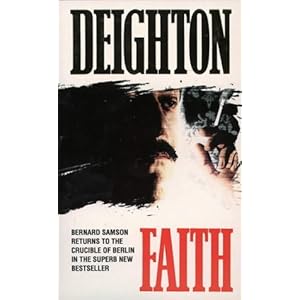
Len Deighton: Faith (1994)

Edition: HarperCollins, 1995
Review number: 1277

The third and final trilogy about Bernard Samson follos more or less straight on from the concluding moments of the preceding novels, skipping over only the months of recovery and debriefing on a remote Californian ranch that follow the escape of Bernard's wife Fiona from East Berlin where she has been a highly placed agent of the British Secret Service. (The setting is still in the days before the demolishing of the Wall.) The confusion left to be sorted out is immense - Bernard, for example, had been living with another woman, believing that Fiona was a defecting traitor; Fiona's sister Tess has apparently been killed in the fight on the autobahn linking Berlin to the West that was organised to cover Fiona's escape; rumours are flying round the Secret Service and no one has any idea what Fiona's role will be when and if she returns to work. Deighton left few loose ends at the end of London Match, the final novel in the first trilogy, but little is resolved in Spy Sinker, by contrast - it is much more obvious that the story would have to continue.

There are really two strands to Faith, one of which initially doesn't seem to be connected to the main narrative. This is a mission that Bernard is sent on to East Germany, to make contact with an officer who has secrets to sell to the West. The other is a private investigation into what happened on the night of the fight and to Tessa's body launched by her husband; this is clearly going to make waves by attempting to uncover secrets that others will want to keep hidden.

While the story naturally grows out of what has gone before, there are some changes of emphasis. We are back here with Bernard as a narrator, which works better than the third person used in Spy Sinker. More oddly, there has been an important change in emphasis which has been made without comment. Earlier, the point of the fight was to make it look as though Fiona had been killed, so that the East Germans and Russians don't know that she was working against them all this time. But now she and Bernard are openly living in the Mayfair flat that belonged to Tessa, and she is starting a high profile job in the London office - surely not something that will be overlooked by the Russian and East German agents still in London, no matter how much their respective countries are sliding into the economic chaos that was the penultimate stage in the fall of Soviet Communism.

Faith is one of the more downbeat Deighton novels, even in a series which focuses on betrayal. It is low key because, like Mexico Set in the first trilogy, it is about picking up the pieces after a trauma and starting again.

Wednesday, 10 November 2004

Len Deighton: Spy Sinker (1990)

Edition: Grafton, 1991
Review number: 1272

The final volume of the second Bernard Samson trilogy is absolutely and massively different from the five novels that precede it and the three that come after. Instead of narration by Bernard, with himself as the central character, we now get a (supposedly) objective third person narrative, which takes the setting back again to 1978 contemporary with that of Berlin Game and focuses on his wife, Fiona. (I say supposedly, because occasionally the objective mask is dropped, and remarks like one commenting that Fiona's public school background ideally prepared her for life as a double agent in East Germany are made.)

This sounds like a good idea; all along we have Bernard's not completely hones description of how he began to suspect his wife was a traitor, but then gradually discovered, following her defection, that she might be one of the most daring British agents of the Cold War. His position is as the victim of betrayal in both scenarios (as the husband of the agent, his particular difficulty is that he was left out of the secret). He is also not the central figure in his own drama, though the reader will tend to forget this because of the power implicit in being the narrator of the story. So how different is the picture from the point of view of the betrayer? This is Fiona's story, and it is perhaps to say something about her character that Deighton narrates in the third person, rather than producing a first person story from her side of things - more passive, perhaps.

In practise, it doesn't work as well as it sounds as though it should. Retelling the same story from a new point of view can work very well, when the new central character has something new to being to the tale (as in The Unbearable Lightness of Being, for example). Here, however, most of what we read either repeats what Bernard has said or is something the reader probably guessed from reading his account. (For example, we don't need to be given an explicit account to know that there must have been a high level meeting at which it was decided to keep the operation secret from Bernard.)

Another problem is that Fiona Samson is not as interesting or as believable a character as her husband. Of course, a large number of Deighton's earlier novels have central characters very similar to Bernard, so he had lots of practise before creating him, while Fiona is his only attempt at a female viewpoint character (barring short stretches from Only When I Larf). He may have been aware that she was less successful, and that is perhaps the reason why a fair amount of Spy Sinker concerns other characters - which in turn is a good reason why Fiona isn't given a first person narration.

As I have said before, to read Berlin Game is almost certainly enough to inspire you to go on and read the rest of the series, and there is certainly some interest here with the gaps that are filled in. But Spy Sinker is definitely the poorest of the Bernard Samson novels.

Tuesday, 26 October 2004

Len Deighton: Spy Line (1989)

Edition: Grafton, 1990
Review number: 1269

The start of this novel, second in the Hook, Line and Sinker trilogy, marks the lowest point of the career of British spy Bernard Samson, at least during the period documented by Deighton. The first scene is set in a seedy nightclub, from which Bernard goes to the squat where he is living in one of the most sordid areas of Berlin, a derelict housing estate up against the Wall. Here he is hiding from his employers, who have a warrant out for his arrest on suspicion of treason - all part of the events following his wife's defection to the Communists. As it turns out, Bernard is safer on the run than when he returns to the department, to be immediately sent out on a poorly organised and dangerous mission to Austria.

Though this seems to be a typical mid-trilogy novel, just keeping the plot ticking over, it has a huge shock in store. It also contains the beginning of Deighton's response to the changes brought by glasnost. The thawing of the Cold War was obviously a momentous event in the life of anyone who made a living from it, whether the spies who are the characters in Deighton's novels or the writer himself. At the start, he is not too impressed; he has a Berliner tell Bernard a joke in the very first scene of Spy Line - the only difference glasnost has brought to the Wall is that the frontier guards now shoot with silenced guns.

Bernard portrays himself as at the mercy of the machinations of others throughout the entire series (though his self image is clearly not entirely accurate), and this is particularly true in Spy Line. This is presumably because he is not at all happy with his own role at this point in the saga; the time has come when the betrayals are his own and when he has to make a decision that will be hurtful to those close to him whatever he does.

As I have said before in discussing other Bernard Samson books, this is a series to read from the beginning; do not start here, but with Berlin Game.

Friday, 24 September 2004

Len Deighton: Spy Hook (1988)

Edition: Grafton, 1989
Review number: 1266

Three years after the events of London Match, and Bernard Samson returns, to begin narrating the second trilogy of novels about himself and his wife. With Fiona firmly established in the KGB hierarchy in Berlin after her defection, and his gradual return to being trusted in his own work for British Intelligence, and with his continuing affair with a much younger woman, everything seemed more or less settled at the end of that novel; but now something happens which beings to unravel all the loose ends that the reader thought had been tied up.

The novel begins this process in the first chapter, which takes place in Washington DC. One of the interesting things about the Game, Set and Match trilogy is the remarkably small part played by the American intelligence agencies, especialy considering the post-war relationship between the US and British governments. The few American characters are either connected to British intelligence in some way or (appear to be) freelance information gatherers. Now, though, the US begins to be involved (though the office of the opening chapter belongs to an Englishman, a former colleague of Bernard's who is a financial expert). Nevertheless, the real focus is still Berlin; everything in this series of novels revolves around the city that was the symbol of the Cold War.

Spy Hook is very much a character based thriller - as Deighton's novels often tend to be. There is no action "for the sake of it" in his novels, and this is more cerebral than most of them. Bernard still has an overwhelming desire to understand why his wife not only defected but abandoned him and the children. The question that the reader has to ask - if they have followed the series of novels so far - is whether the discrepancies he sees are really there, or alternatively that he's clutching at these tiny loose ends hoping that the whole tangle will fall apart. And, of course, this is only the first novel in a new trilogy, so we're not likely to find out anything other than how far Bernard is able to put other people's backs up.

Tuesday, 7 September 2004

Len Deighton: London Match (1985)

Edition: Grafton, 1986
Review number: 1263

The third novel in the Game, Set and Match trilogy continues the story of how Bernard Samson copes with the aftermath of his wife's defection to the Soviet Union, the event which provided the climax to Berlin Game. KGB officer Erich Stinnes has in his turn defected - the central action of Mexico Set. And now it appears, from what London's intelligence services learn from Stinnes and other agents, that there is another KGB agent in a senior position in the Secret Intelligence Service. This time the novel is not so much concerned with the identity of the traitor, as the first part of the trilogy had been, but with whether the person pinpointed by the allegations is guilty or not. It certainly quickly becomes in the personal interests of many of the characters to support and exaggerate the rumours going round - this is office politics on a large scale.

The importance of the city of Berlin to this trilogy is hard to exaggerate. As a symbol of the Cold War it is unsurpassed, and so this is frequently true of spy fiction of that era. The divided city with its crazy town planning that resulted from being split makes an atmospheric background for these tales of betrayal. Mexico Set and London Match may use the names of other locations from Bernard's story for their titles, but Berlin is more important in the novels than either of them. So it is fitting that the final scene of the whole trilogy takes place in Berlin (though enough loose ends are left that it must have seemed unlikely that this was the last novel featuring Bernard Samson even before the appearance of Spy Hook.

Berlin Game is the best of these three novels, and indeed of all nine stories featuring Samson as the central character. But no one who has read that novel will fail to want to read the others, and they are rewarding too; Deighton is one of the best of thriller writers even when not at the absolute peak of form.

Tuesday, 24 August 2004

Len Deighton: Mexico Set (1985)

Edition: Grafton, 1986 (Buy from Amazon)
Review number: 1261

I don't think it would be possible to write sensibly about the second novel in the Game, Set and Match trilogy without giving away an important part of the plot of Berlin Game, the first one. So I'm not even going to try. Mexico Set is all about how Bernard Samson copes when his wife defects to the Russians after he uncovers the fact that she is a KGB agent (they were both senior members of the British secret service). So the novel is about Bernard's personal and professional difficulties; he has to try to work out how much of their marriage was a sham, t otry and be there for his children (which he fails miserably to do) and to deflect the questioning of his own loyalty by his colleagues - surely, they say, he should have suspected Fiona long ago, if he himself was innocent.

The plot of Mexico Set is about Bernard trying to persuade a KGB officer - Stinnes, who appeared at the end of Berlin Game and who works for Fiona- to defect. Once again, the narrative is cleverly done so that it doesn't just given an impression of Bernard's feelings, but also conveys something of how much he isn't saying. (How has this man, who views himself as reasonable and professional, come to be so feared by his colleagues?) The various backgrounds, from the sleaze of Mexico City to the paranoia of Berlin, are atmospheric and tightly integrated into the feelings that the novel produces as it is read - treachery is just so much more plausible in the settings Deighton provides for it. Everything about the novel fits together efficiently, and is about enhancing its effectiveness.

Mexico Set is mainly concerned with Bernard's character, which makes it seem a little low key for a modern thriller. Although the reader has the impression that there is not a great deal of action, in fact there is a fair amount of violence, all of it the consequence of some betrayal - by Fiona, or the deskbound officials in London (both of Bernard), or of one Russian agent by another. Betrayal is of course the main theme of the whole trilogy, but Mexico Set is remarkable for the number of different acts of bad faith.

Anyone who reads Berlin Match is very likely to read on through the rest of the trilogy (and quite probably through the other seven novels relating to Bernard Samson); together, they form one of the premier classics of the thriller genre. I am not quite sure how well Mexico Set would work by itself, having only every read it immediately following its predecessor, but I would certainly advise prospective readers to start at the beginning with Berlin Game.

Saturday, 14 August 2004

Len Deighton: Berlin Game (1983)

Edition: Grafton, 1984 (Buy from Amazon)
Review number: 1259

While no one who read The Ipcress File could deny that Len Deighton was one of the great spy fiction writers, several of his other novels seem quite tired. With Berlin Game, and indeed the whole of the Game, Set and Match trilogy, everything came together once again; this story would no doubt join Deighton's debut in many fans' lists of the absolute top spy stories. It is not surprising that Bernard Samson dominated the rest of Deighton's output in the same way that Harry Palmer did in the sixties.

From a plotting point of view, there are a lot of points of similarity between the two novels. Both are supreme examples of the "which of my colleagues is a traitor" storyline, and both are told by a world weary, cynical narrator. Both are set mainly in London, but with a second focus elsewhere - in each case, somewhere crucial to the unravelling of the treachery: Berlin here (obviously) and an American nuclear testing facility in The Ipcress File; the London scenes are mainly about office politics. Like Palmer, Samson doesn't quite fit in; twenty years after The Ipcress File, the secret service is still full of Oxbridge types who look down on someone who never went to university at all; both narrators have a serious chip on their shoulder about this, and the attitude is something of a constant theme in Deighton's writing about the secret service as part of the British establishment.

The main difference between the two narrators is in the situations of the narrators in the two novels. Bernard Samson is considerably older, and he is married (to another senior official from "the Department") with two youngish children. Harry Palmer's career began during the Second World War, Bernard grew up in post-war Berlin. These two changes make considerable difference; Bernard is willing to attribute more complex motives to those around him, and recognises shades of grey in treachery which would never occur to Harry. Bernard is so world weary that each betrayal just adds its bit to the total sadness in the world; there is nothing to be surprised about, no real blame to award, for treachery is only to be expected. And yet, even so, those around him describe Bernard as an optimist.

So Bernard Samson is an older, more settled character, and that affects every aspect of Berlin Game, from the amount of action to his analysis of motivations. Even without many of the traditional thrills of the genre, the novel keeps the reader enthralled from beginning to end. It is the characterisation of the narrator which does this - Deighton is subtle enough that we don't just get Bernard Samson as described by himself, but are able to see through that to a real character underneath. The Ipcress File might be more original (Berlin Game being very much derived from it), and it might have had more influence on other writers; but in Berlin Game Deighton has created not just another classic thriller, but one which is in my opinion better than its model.

Thursday, 17 June 2004

Len Deighton: Twinkle, Twinkle, Little Spy (1976)

Edition: Book Club Associates, 1977
Review number: 1245

At the start of this novel, the main characters (Major Mann of the CIA and the narrator, a British agent) pick up a Soviet defector in the middle of the Sahara Desert. This is an unusual start for a spy novel, where it would be more common for the plot to work up to the retrieval of the defector. But here the point of the novel is the investigation of some leaks of US research to the Russians, and it is this which makes Professor Bekuv valuable, as he was one of the beneficiaries before becoming disenchanted with the system and receiving a punishment appointment as a scientific advisor in Mali.

The title is an acknowledgement that this style of spy story was becoming old fashioned (even though Deighton continued writing them for another twenty years); it is the riposte given by the narrator to Major Mann's observation that in a few years the sky will be full of spy satellites, with the implication that this will render the old style of espionage obsolete. Even a quarter of a century later, though, I have never read a thriller which has a satellite as a major character; today's fictional spies may make far more use of computers and electronic surveillance, but they are still human.

Twinkle, Twinkle, Little Spy is not ashamed to be old fashioned - in fact it revels in it. It's exciting all the way, right up to the ending when the scene returns to the Sahara. Len Deighton's plots are usually quite complicated; Twinkle, Twinkle, Little Spy is a more straightforward thriller than most of his novels. Even so, it is excellently done, far better written than most of the genre. This is the Len Deighton to read if you are a fan of, say, Colin Forbes or Helen MacInnes, for those who think his other novels are too convoluted. To me, being someone who really enjoys working through the complexities, the novel is lacking something, entertaining though it is.

Friday, 11 June 2004

Len Deighton: Yesterday's Spy (1975)

Edition: Warner, 1976
Review number: 1243

The plots of a fair proportion of the novels Deighton has set contemporary to the date of writing involve something left over from the Second World War. There is an obvious reason why this happens, other than that the Cold War itself could be viewed as arising from the Second World War; many of the spies and spy masters of the seventies were still people who had had their greatest successes at that time. Deighton also does this kind of plot superbly; it lends itself to the kind of questioning cynicism which is the trademark of his novels. (The particular question which lies in the background of Yesterday's Spy is: are those who fought side by side thirty years earlier still comrades in arms?)

Steve Champion was a wartime hero, a British agent who organised a resistance cell in the south of France, though he was eventually captured and tortured by the Germans. After the war, he had made the most of his contacts to become a very rich, but decidedly shady businessman, used occasionally by British intelligence. But now he has some scheme of his own in mind, and growing closeness to the Egyptian government (more radical in the mid seventies than since) has made him a dangerous man to know.

The narrator was Champion's second in command during the war, and has continued to work for "the Department" ever since. So he seems the obvious person to use to infiltrate Champion's scheme, though he is not keen to do it and the fact that he is the obvious choice makes it harder for him to convince Champion of his sincerity. (And, once he has done so, to ensure that his employers still believe he is on their side.) Generally this is familiar Len Deighton territory; the narrator's character is little different from that of the narrator of Spy Story. (He actually has the same boss, though he doesn't seem to work in the same branch of intelligence at all.)

This familiarity is something of a problem with Yesterday's Spy. It is basically Deighton by numbers, more like the product of a good imitator than of Deighton himself - lacking in truly original inspiration. It has interesting ideas - the involvement of Champion's young son, part of a subplot in which the boy is kidnapped from his mother after a divorce, for example, but not enough is made from them.

Friday, 21 May 2004

Len Deighton: Spy Story (1974)

Edition: Triad, 1975
Review number: 1238

After a sequence of novels which are each in some way different from everything else he had written, Spy Story is Len Deighton's return to basics. It could almost be another sequel to The Ipcress File - it even shares several characters. (It is actually listed on Fantastic Fiction as one of the Harry Palmer novels, but the narrator is named, and isn't Palmer.)

Pat Armstrong, the narrator, works in wargaming, using the latest intelligence about Soviet military deployment with the help of what are now extremely primitive computers. When his car breaks down at night and he is unable to find a phone, he uses a key he still has to let himself into his old flat to make the call from there - only to find he has apparently continued to live there: and his family photos around the flat now show him with a slightly altered appearance. He is clearly at the centre of an elaborate plot of some kind, but the question is what, exactly?

This is by now familiar territory to readers of spy fiction - hence the throwaway title - but few writers have ever covered this ground as expertly as Deighton. The tone is bleaker than the earlier Harry Palmer novels, but then the optimistic sixties have long passed. There is still humour here, though; less of it and less obvious, but still present. For a thriller, there isn't a great deal of action and a lot of what there is happens off stage. Spy Story is more subtle than most spy thrillers; Deighton's interest isn't in staging stunts but in the relationships between agents of various types and the politics of the interactions between different agencies, British and American, which is perhaps a slight shift from his earlier writing in the genre. This is a chance to lie back and relish vintage Len Deighton, at a slightly slower pace.

Saturday, 31 January 2004

Len Deighton: An Expensive Place to Die (1967)

Edition: Jonathan Cape, 1967
Review number: 1218

The fifth Len Deighton novel narrated by Harry Palmer is in some ways more like The Ipcress File than Billion-Dollar Brain (its predecessor) is. The cynical dark humour returns, and this gives the novel a similar atmosphere. It is, though, a more sordid novel, its subject being a high class Parisian brothel which has a sideline in blackmail, but it also shares the impression that the narrator has very little idea of what is actually going on - something which enables Deighton to spring surprises on the reader.

There is actually very little more to the plot than the existence of the brothel; all that really concerns the reader is to work out which of the characters in the novel is involved in investigating, protecting or running it. This is not very satisfactory from the point of view of the action in the story, something important in the thriller genre; it remains too unmotivated.

Harry Palmer continues to be anonymous, identified only as "the Englishman" by the other characters. In a new departure, his is not the only narrative voice. This is presumably so that the scenes can be rather more varied, with descriptions of events outside the Englishman's viewpoint. However, the scenes narrated from the point of view of other characters do not work so well; Deighton seems to have problems imagining how they will respond to the events they witness.

The novel, whose title comes from an Oscar Wilde quip about Paris, is something of a mixed bag. As a thriller, it isn't really exciting enough, but makes up for this in atmosphere. The plot is too diffuse, but it can be interesting guessing exactly who is on which side. While its predecessor Billion-Dollar Brain is really only for those who want to read everything Deighton wrote, An Expensive Place to Die would probably interest any fan of spy thrillers who picked it up.

Friday, 23 January 2004

Len Deighton: Billion-Dollar Brain (1966)

Edition: Jonathan Cape, 1966
Review number: 1214

The fourth Harry Palmer novel (in which he is still an unnamed narrator; the name was given him for the films) is the most dated of all of them. It relies on a plot device straight from James Bond or even The Man From UNCLE - the network of agents run by a computer. The novel begins with a Finnish journalist making waves when he starts investigating what he thinks is a massive British Secret Service operation in Finland - but there isn't one, so Palmer and his superiors want to find out just what he has stumbled across. The trail leads to a private army, assembled by a rabidly anti-Communist American billionaire, whose technicians have built the computer (in typical sixties style, one which fills several floors of a large building) to run the group's operations.

In the end, the computer is relatively unimportant, but it certainly does mark out Billion-Dollar Brain as a product of its time. As a spy thriller, though, the novel is something of a let-down for other reasons, which may well be why Deighton abandoned his Palmer character at this point. Indeed, it seems as though he has already, because almost all the quirkiness which marks the earlier novels is by now missing. By comparison with the earlier writing, it fails to be more than a run of the mill spy thriller. While still of the opinion that this is Deighton's poorest novel, it doesn't seem as bad this time around as I remember it (the computer plays a smaller part than I recalled, which may be part of the reason that this is the case). Nevertheless, it is still at least as good as its forgotten contemporaries - of which it would probably have been one without Deighton's name attached.

Tuesday, 6 January 2004

Len Deighton: Funeral in Berlin (1964)

Edition: Penguin, 1966 (Buy from Amazon)
Review number: 1209

Because it is the main focus of the Bernard Samson novels, Berlin might appear to be something of an obsession with Deighton. It actually features remarkably rarely in his other novels, particularly considering its unique position during the Cold War as a bastion of the West surrounded by the Soviet bloc. It does, however, feature heavily in the third Harry Palmer novel, as the title obviously indicates.

The plot of Funeral in Berlin is apparently the mirror image of The Ipcress File, with Palmer trying to arrange the reception for a Russian scientist defecting via West Berlin. But it soon becomes obvious that this isn't quite what is going on - why, for example, are those involved so insistent that the scientist's fake papers should be in a particular name when any would do for what they are claiming to want them for?

The whole of this novel, like Deighton's first two, revolves around things not being quite what they seem, right up to the ending with its particularly surprising revelations. (This was not the first time I'd read the novel; I'd forgotten the details but remembered the gist - and still found it exciting.) Deighton's novels do tend to be designed around this kind of misdirection, and it is of course a style particularly appropriate to the spy novel.

The setting of Berlin is atmospheric, more because it is full of nervous, posturing tough guys (both would-be and really tough); the descriptions are not as fully developed as they became in later years when Deighton's novels increased in length (Funeral in Berlin is less than half as long than Berlin Game, for instance). The most sympathetic character, as far as Palmer is concerned, is a Russian KGB colonel; for him, the distinction in the espionage business is between professionals and amateurs, rather than between friends and enemies.

The world of the spy as documented by Deighton continued to be a male dominated one through his entire career, and in fact never completely loses the old boy network feel that Palmer is so cynical about in The Ipcress file (Bernard Samson complains about this twenty years later on). Here, the two female characters are good looking young women, one Palmer's secretary and lover who does most of the routine work assigned to him, and the other a rather naive agent for some other power, whose seduction of Palmer seems to have slipped out of a James Bond story. Having mentioned Ian Fleming's famous spy in this context, though, I should point out that Deighton has moved on from Fleming's insistent misogyny. (Palmer is a much brighter but less flamboyant character than Bond, too.)

Apart from The Ipcress File, Funeral in Berlin is the best of the Harry Palmer novels, sharing its best quality - an ability to surprise even after all these years.

Wednesday, 17 December 2003

Len Deighton: Horse Under Water (1963)

Edition: Penguin, 1965
Review number: 1205

When The Ipcress File was such a huge success - it became an instant classic, and almost immediately a hit film - there must have been a great deal of interest in the follow-up. In fact, it plays safe, and is more of the same - a straight sequel. Indeed, throughout his career, despite occasional experimentation in novels such as Bomber and SS-GB, Deighton tended to return again and again to the disillusioned spy story of the type which made his name.

Harry Palmer is once again the narrator, of a story of treachery which has its roots in Oswald Mosley's British Union of Fascists and the activities of several of its members during the war as well as the international drug trade (the "horse" of the title being, of course, heroin). Many things are much the same (down to Palmer's continued ineptitude for crosswords). But Horse Under Water is no Ipcress File; it is slower and more obvious, giving the reader time to wonder about things they shouldn't think about when reading a thriller (such as why a senior figure like Palmer, an expert in international financial dealings, is the operative sent on a diving course so he can search a sunken U-boat off the coast of Portugal - surely a job for an experienced diver and a more junior officer). There is something of afeeling of a lost age, too - a time when the best known fact about Málaga was its bombardment during the Spanish Civil War. Even so, Horse Under Water is not as dated as many other spy novels of the sixties and seventies.

It is not really to be expected that Deighton's second novel would be equal to such an explosive début as The Ipcress File, and Horse Under Water is constantly good enough not to be a disappointment.

Thursday, 4 December 2003

Len Deighton: The Ipcress File (1962)

Edition: Hodder & Stoughton, 1965
Review number: 1201

In today's thrillers, we have come to expect that the heroes are likely to be flawed, disillusioned characters. Go back a few decades, and all that was different. I'm talking straight thrillers, here, not detective stories; a significant source for the change to the the thriller genre was the hardboiled detective school of fiction. Graham Greene was probably the writer who introduced this style to the spy story, but Len Deighton was not far behind. followed in his turn by John le Carré.

Spies also tended to be upper class (think James Bond), and it was really Deighton who popularised the alternative. Harry Palmer (the narrator, not actually named in this novel) is a bright man with a good war record, who has had a successful postwar career in intelligence (at the beginning of the novel, he is about to become second in command of a powerful department). Yet he has an obvious chip on his shoulder; he says things like "Ross was a regular officer [i.e. a gentleman]; that is to say he didn't ... hit ladies without first removing his hat." The whole of the novel - and its sequels - makes the narrator's constant sneering at the upper classes a major feature, something which must have seemed quite revolutionary in the Britain of 1962. (It was, after all, the year in which the prosecuting lawyer in the Chatterley trial could say, "Is this a book you would want your servants to read?")

The plot seems at the start to be standard sixties spy thriller fare, as Palmer starts investigating some mysterious defections and strange behaviour among senior British scientists. It turns into an attempt to frame Palmer as a traitor, a charge which in those post-Burgess and MacLean days he can only refute by uncovering the colleague who is really in the pay of the other side. The Ipcress File is one of the earlier spy novels with a betrayal scheme, even if it is an extremely familiar plot to readers of Deighton and Le Carré's later novels.

While many of the positive features of The Ipcress File became staples of the spy thriller genre, making them now seem less innovative, it still has nice touches all of its own. The ironic chapter headings, supposedly Harry Palmer's newspaper horoscope for the day, form one which I particularly liked. The Ipcress File is a paramount classic of the genre, establishing the mould for hundreds of imitators ever since, both as novels and in film.

Wednesday, 29 August 2001

John le Carré: The Secret Pilgrim (1991)

Edition: Coronet, 1991
Review number: 927

The last Smiley novel is unique in le Carré's output. It is very episodic, and in many places reads like a collection of short stories. It has a regretful, valedictory tone, but is one of the easiest of le Carré's novels to read.

The narrator is Ned, the former head of the Russia House in the novel of that name, now running a secret service training course. He invites the long retired, legendary George Smiley to talk to the group, to find that the discussion that follows sparks memories of his own past.

Like most of le Carré's spy fiction, the episodes which come to Ned's mind do not reflect much credit on the British secret service and, being arranged neatly chronologically, demonstrate his growing disillusion with the job he is doing. Even so, the tone is light, perhaps a response to Ned's retirement, the vantage point from which he is writing. It is also, presumably, from le Carré's point of view part of giving Smiley a proper send off; it is made very clear that no more is to be written about him (he even asks, at the end of the evening, not to be asked back again, so that the new generation can move on from his influence).