Showing posts with label humour. Show all posts

Friday, 3 November 2017

Paul Beatty: The Sell Out (2015)

Edition: Farrar, Straus and Giroux (2015)
Review number: 1510

The Sell Out is a novel which divides opinion. If you look at online reviews, ones which give it very high ratings are common, but so are ones which give it very low ratings. The style and the content of Beatty's novel are responsible for both these extreme reactions, and I can really understand why people think of it in both ways.

I started out as a fan. The first part of the book is a tour de force of satirical humour: this is I think the only Booker Prize winner I have ever laughed out loud when reading. Basically the book starts with the ending. The narrator ends up before the US Supreme Court, basically for actions which call the comfortable assumption of white people that there is no longer any racial divide in the United States, which is the first chapter, with the rest of the book leading up to this appearance. The early parts of the book are an extended, vitriolic, riff on what it means to be black in twenty-first century America, full of references both literary and otherwise, and also full of language which may well shock.  It's kind of like the illegitimate child of Joseph Heller, Kurt Vonnegut and John Barth. Strong stuff, and although I was enjoying it, I didn't want to read more than a few pages at a time.

As the book goes on, the tone settles down somewhat, and this is actually a problem. The actually story is less interesting than the set pieces and jokes - things like a parody of The Charge of the Light Brigade, or a stand-up comedian making jokes in the format of academic reports on psychological experiments. Without the energy present at the start, The Sell Out reading experience becomes an impatient wait for the next extended joke.

If you don't get many of the references (and I'm sure I missed some, not being into gangsta rap), the jokes won't be as funny. If the language offends, you will find The Sell Out unreadable. It made a difference to me that the book was written by a black writer; I think I would have been offended if it had been written by anyone else. The first part is really love or hate; the second half is so much less successful that it was just mainly average. Overall, my rating for the book is 7/10.

Tuesday, 3 January 2017

Patrick Dennis: Auntie Mame (1955)

Edition: Pan, 1958
Review number: 1504

I'm a big fan of Patrick Dennis, although the difficulty of finding his books nowadays means I haven't read all that many of them - three out of sixteen (all published under various pseudonyms, his real name being Edward Everett Tanner III). Even the normally reliable Fantastic Fiction only lists the two Auntie Mame books.

This is the third of his books, the first under this name, and was hugely successful in the fifties, made into a play and then an Oscar nominated film with Rosalind Russell as the title character. The trailer for the film describes it as "the one you've been waiting for", and expects the watcher to guess the name of the title character. So this was a huge phenomenon at the time, and yet it seems to be almost forgotten today. (It later became a stage musical and another film.)

It is a parody of an autobiography, scenes from a bizarre Bohemian childhood. The narrator, named as Patrick Dennis, is sent as a nine year old to be brought up by his aunt after the death of his father. This catapults the boy into a completely different world - one which many today would still consider unsuitable for the raising of a child. In her company, he expands his vocabulary, meets a lot of strange people, and gets involved in many scrapes, as he becomes an integral part of his vivacious aunt's life. The last scene in the book depicts Patrick, now married and respectable, being persuaded by Mame to let his seven year old son join her on a trip to India: although the book's chronology would indicate that she was by this point in her seventies, she had not changed a bit. This also sets up Dennis' second novel, Around the World with Auntie Mame.

Auntie Mame and its sequel are lit up by the  larger than life character of Mame. I can easily imagine that she would be tiresome in the long term in real life. Indeed, the portrayal by Rosalind Russell in the film is wearingly strident to me, even in the short dose of the trailer. The literary version of the character has a lot more charm, and her dominance of the book makes liking Mame crucial to enjoyment of the humour.

It's easy to see why it was so popular. It's still immensely funny, and bears comparison with the best comic fiction ever written. Why, then, is it so much less well known today? Dennis himself stopped writing and became a butler before his death in 1976, but already by then his books were out of print. It is possible that revelations about the author's lifestyle (he was bisexual and was involved in the Greenwich Village gay community) made publishers less keen to promote his work. Indeed, a number of publishers rejected Auntie Mame, presumably because of its endorsement of an unconventional lifestyle, tame though much of it seems today. Maybe it was the opposite: in the liberated 1970s, did people no longer feel shocked enough by Dennis' writing to want to read it? I don't know what happened, but whatever it was, Patrick Dennis was too good a writer to deserve it.

My rating: 10/10.

Monday, 29 December 2014

Dodie Smith: The New Moon with the Old (1963)

Edition: Corsair, 2012
Review number: 1492

The New Moon and the Old must have seemed old-fashioned in the early sixties when it first appeared. It is the story of four upper class siblings, forced to leave their home and find work for the first time in their lives when their father flees the country after being accused of fraud. The adventures of each of the brothers and sisters are described in each of the parts of the novel. It is apparently a fairly gentle tale, but it does have some barbs under the surface. Their adventures are summed up towards the end of the novel: "England's overflowing with eccentric people, places, happenings. Indeed, you might say eccentricity's normal in England." Eccentric, maybe, but the principals are likeable and charming - the latter, as I have said in the past, a hard quality to depict in a literary character.

Indeed, each of the sibling's stories is gently satirical: all of them start seeming to be typical romantic tales, but then take an unexpected turn - dislike does not have to turn into love, as in Pride and Prejudice; the powerful older man for whom you work as a dependent does not have to become the tormented romantic hero of your dreams, as it does for Jane Eyre. As well as this, Smith is poking fun at the comfortable certainties of upper class life, just as the life where live-in servants were affordable became out of reach except for the super-rich.

The title surely references this: "the old moon in the new moon's arms" is a real astronomical phenomenon, also known as Earthshine, but here must be a symbol for the changing lives of the old and new generation, the new having different aims, morality, and expectations from the old. The phenomenon was also considered a portent of bad weather to come (as in the traditional ballad Sir Patrick Spens) - suggesting that the younger generation will not have an easy time.

Funny, readable, with a clever side - what is there not to like about The New Moon with the Old? Well, the one really jarring note in this edition is the cover. It's clearly meant to evoke a naive style, but succeeds only in appearing amateurish - uneven calligraphy, strange colour choices, and very little to do with the novel either literally (there are no moonlit garden scenes, and the reality of Earthshine is not depicted in the moon in the picture), or in tone (it's a smooth, professional piece of writing). So a thumbs down for the cover, but this is an excellent novel - my rating, 9/10.


Friday, 9 May 2014

Connie Willis: To Say Nothing of the Dog (1997)

Edition: Gollancz, 2013
Review number: 1485

To Say Nothing of the Dog is a time travel novel, a farce around the idea of a professional time traveller sent to a time which is not his specialist historical period - Victorian England instead of the Second World War. A powerful and rich woman is trying to recreate the original Coventry cathedral destroyed in the Blitz after the sixties replacement is turned into a shopping centre. She is able to monopolise the services of the Oxford time travellers, retrieving items believed destroyed by the bombing at the last moment (so their removal doesn't create a paradox). But there is one ornament which is supposed to be there on the night of the bombing, but which can't be found - so operative Ned Henry is sent further back than 1940 to find out what happened to it.

In the 1880s, Henry gets involved with eccentric Oxford dons, a trip down the Thames, an upper class houseparty, and a manic attempt to introduce the right pair of lovers to each other so that the future is saved, even though Henry only knows the identity of one of them and the initial letter of the name of the other.

On top of this manic plot, Willis piles on a huge variety of references to other literature: a wide selection of the more popular English language writers from Jane Austen to PG Wodehouse and Robert Heinlein via Dorothy Sayers are either directly referenced or are clear influences. The book as a whole is a homage to Three Men in a Boat - the title To Say Nothing of the Dog is the subtitle to Jerome's comic classic. (I want to point out that the ending of The Moonstone is given away - so anyone planning to read Wilkie Collins' novel who doesn't want to know what happens beforehand should read that first.) Few of the references need to be familiar in order to follow To Say Nothing of the Dog; the most important after Three Men in a Boat is probably Gaudy Night. However, the more of them which the reader picks up, the more they will enjoy the game. This is a type of meta-novel which appeals to me greatly, and I would put several of them into my all time favourites list, of which To Say Nothing of the Dog is now also one.

Very funny, fantastically clever: To Say Nothing of the Dog leaps straight into my list of favourite science fiction novels. I'm a little surprised I hadn't read it before, as it's a Hugo winner and I have been avidly reading the genre since well before it was published, but now I am very glad I have done - 10/10.

Monday, 18 November 2013

John Scalzi: Redshirts (2012)

Edition: Gollancz (2013)
Review number: 1482

Redshirts is based on a fairly simple but effective idea. In bad science fiction television shows - and the original series of Star Trek was especially notorious for this - there are frequent missions in which the dramatic tension is racked up by killing off one of the characters, almost always an ephemeral one with no back story played by an unknown actor. In Star Trek, these individuals usually wore red shirts. Scalzi's idea is to look at these events from the point of view of the low ranking, inexperienced officers who would be likely candidates for death by the writers' pens.

What makes Redshirts more than a fan-fiction style parody is Scalzi's use of multiple levels of irony, as his characters gradually become aware that they are living in a fictional universe, when, in fact, they and the writer of the TV show are fictional products themselves. Not only that, he manipulates the plot to use this in a variety of ways, some more subtle than others. For instance, he invents an episode of The Adventures of the Intrepid, part of the novel's back story, in which an encounter with a black hole sends the characters back to 2010 (the date at which the episode is supposed to have been broadcast), which is, as the characters point out, a science fiction cliché which makes it possible to comment on contemporary society as well as (in a low budget TV show) saving on production costs. The ironic twist is that when Ensign Dahl and his companions use the same trick in order to complain to the show's writers about their treatment, they travel back in time to 2012, when Redshirts was published.

There is a widely circulated stereotypical view that Americans don't understand irony. This is something which Scalzi disproves with ease. When, therefore, we notice that, in his effort to highlight the absurdities in the cliché of the expendable extra, Scalzi has fallen into another common recourse of the lazy genre writer, the apparent weak character who turns out to be the hero of the story, we might well suspect that something else is going on. That this is common (good examples include stories by J.R.R. Tolkien, Robert A. Heinlein and Lois McMaster Bujold) is almost an understatement - it is something which is part of the appeal of science fiction and fantasy to the teenager and especially the stereotypical type of fan, the geeky social outcast. To some extent the use of this trope is n inevitable consequence of the premise of Redshirts: by concentrating on the minor characters, he is promoting them to central status. I am sure that Scalzi is aware that he has done this, and that it is therefore another ironic twist in the novel's construction.

John Scalzi's work is frequently compared to that of Robert A. Heinlein, partly because the military science fiction of his debut Old Man's War reminded people of of Starship Troopers. In a recent blog post, he asked people to suggest writers that his work might be compared to, and he specifically said that there was no point in answering, "Heinlein". Here, though, two other writers came to my mind. James Blish is an obvious point of comparison, as the writer of many Star Trek novelisations, though it is far too long since I read any of them for me to pick out specific similarities (and I think that TV science fiction, including Star Trek itself, is a far more important influence anyway). A more obscure writer, though, has touched on a similar theme, with the same kind of humour but without the irony: James Alan Gardner's League of Peoples series is about the role of ECMs (expendable crew members) in space exploration.

In my view, Redshirts is Scalzi's best fiction so far. I enjoyed Old Man's War and Agent to the Stars, but found The God Engines unreadable. I've generally found his blogging more interesting: I would urge everyone to read the fabulous collection of his blog posts in book form, Your Hate Mail Will Be Graded (almost worth reading from the title alone). Enjoyable, funny, approachable, yet with clever irony, I rate Redshirts at 9/10.

Thursday, 20 June 2013

Nick Harkaway: Angelmaker (2012)

Edition: William Heinemann, 2012
Review number: 1476

Harkaway's first book, The Gone-Away World, is one of my favourite new novels of the last few years, so I have been eagerly waiting to read his second, Angelmaker.

The central character, Joe Spork,  is a craftsman who works on clockwork mechanisms, deliberately following in the footsteps of his grandfather rather than his father, an East End gangster. But when he is asked to repair an enigmatic device, he draws the attention of a shady government agency as he races to prevent the use of a doomsday weapon.

There are, unsurprisingly, many similarities between Angelmaker and The Gone-Away World. The style is the same, the frenetic pop culture tropes are used as effectively. Here, the references include such things as Kim, sixties London gangsterism, a hidden London which most inhabitants never see (Neverwhere without the fantasy elements - including a market held near HMS Belfast), and so on. Like Angelmaker, it reminded me strongly of Thomas Pynchon, though perhaps in this case Vineland is a closer fit than Gravity's Rainbow. It's lighter, with more concentration on the humour, but is certainly no less enjoyable.

This type of wildly whimsical storytelling always appeals to me, but if it isn't your cup of tea, you are unlikely to enjoy Angelmakeras much as I did. And since the cleverness of the silly side to the book is such an important part of it, it's probably not worth picking up if that is so. But to those of us who do like this, Nick Harkaway's second novel is as much a treat as his first. My rating: 9/10.

Saturday, 4 August 2012

Liz Jensen: My Dirty Little Book of Stolen Time (2006)

Edition: Bloomsbury, 2007
Review number: 1461


If the title did not warn the reader, the first sentence's appropriation of the famous opening to Rebecca would make it clear that My Dirty Little Book of Stolen Time is not going to be entirely serious. It is a personal history, told by Charlotte, a prostitute from late nineteenth century Copenhagen. When times are hard, she manages to inveigle her way into a respectable house as a maid, only to be accidentally catapulted into twenty-first century London bye the HG Wells-style time machine hidden in the basement.

My Dirty Little Book is broad comedy, sometimes even cruel (Charlotte's treatment of the dim overweight woman who accompanies her is a case in point). But it is still very funny. In fact, I was reading it alongside a P.G. Wodehouse I hadn't read before (The Girl in Blue), and Liz Jensen held her own even in this company. Few indeed will be those readers who follow Charlotte's exhortation in a time of adversity to return the book in disgust to the shop or library from which it was obtained.

I have tagged this review as science fiction because of the time travel element, though one of the reviews quoted on the cover describes it as "less science fiction than fairy tale", which is in many ways true. I don't have a tag for fairy tale currently, but I actually think that science fiction is the right genre in which to place this book (subsidiary to humour, which is obviously its main point). My feeling is that Tom Holt and Terry Pratchett are readily filed under science fiction or fantasy, because the genre themes and ideas are important elements in the structure of their books, provide much of the humour, and are the subjects of parody. Not only that, but the detailed nature of the genre elements is frequently given in some detail and is important to the story: dragons in The Colour of Magic (to pick one example) are not just fairy story beasts with no explanation, but projections of a human belief in dragons and a parody of Anne McCaffrey's Pernese dragons. And I think that all these criteria hold for Liz Jensen's book as well. Time travel is essential to the plot and the humour; there are moments of genre parody, particularly of H.G. Wells; the time machine itself is analysed further (there is even some discussion of the famous grandfather paradox). In fact, the nature of the fuel which propels the time machine is the closest that My Dirty Little Book comes to having a serious point, consisting as it does of three liquids embodying the struggle of history (blood, sweat, and tears), mixed with that more comical essential lubricant, strong alcoholic spirits.

The plot of My Dirty Little Book is farcical and not particularly important, except as the means by which the humour is generated. This mainly takes the form of Charlotte's observations of the worlds of both time periods. She is a most lively storyteller, occasionally a little too keen to address the reader directly, perhaps, but certainly an individual and entertaining voice. The amoral narration and humorous twists and turns of Charlotte's exploits made me think of Harry Flashman, not a bad model for this sort of comic novel.

My rating: 8/10.

Wednesday, 20 April 2011

Kage Baker: The Anvil of the World (2003)

The name of Kage Baker was not unfamiliar to me, as I had read several encomiums produced when she died last year. They were sufficiently positive that I tried reading one of her books, without enjoying it much, and being left feeling somewhat mystified by the praise she had received. I did eventually try again, and found The Anvil of the World truly delightful, one of the funniest fantasy novels I have ever read.

Though perhaps it is not really a novel, as it consists of three episodes which are just about independent of each other, sharing characters but readable without reference to the others. The main character is a retired assassin who has taken the name Smith, a common name shared by several of the others in the The Anvil of the World. In the first  story, he takes a job as master of a caravan passing through dangerous country where travellers are at risk from demon bandits; in the second, he is running an inn in the resort of Salesh-by-the-Sea; and in the third, he is kidnapped by one of the passengers from the caravan, who is also the owner of the inn, who wants Smith to help him rescue his sister.

The humour is built around absurdities, particularly literal minded misunderstandings, and owes debts to L. Sprague de Camp (novels like A Planet Called Krishna and the Harold Shea series) and, to a lesser extent, Terry Pratchett (the Igors, particularly). Despite The Anvil of the World being laugh out loud funny, Baker also manages to be more serious, with major themes in the novel including racial intolerance and the nature of heroism. She manages to be interesting in the latter, though it could be argued that it is the major theme of the whole fantasy genre.

Being the first of a series, it naturally leads on to the next, not called (as the trailer at the end of this edition has it) The Life of the World to Come, but (less pretentiously) The House of the Stag.

An excellent novel which makes me really pleased to have tried Kage Baker's writing again - 8/10.


Edition: Tor, 2004
Review number: 1419

Monday, 28 March 2011

Robin Jenkins: Dust on the Paw (1961)

A truly superb but apparently forgotten novel, Dust on the Paw is set in Afghanistan in the fifties, when the seeds of that troubled country's current problems were already apparent.

Set in the consular community in Kabul, with most of the characters being staff of the British Embassy, the story describes the complications which occur when a marriage between an English civil servant and an Afghani science teacher is taken up by an important member of the Afghani royal family to promote as part of the cultural progress made by the country. The problems arise from the extremes of the cultural differences between the two countries - Afghanistan was a conservative Moslem nation even then - and through the racist attitudes, conscious or not, of the British.

This may not sound like an ideal environment for humour. Jenkins uses sly, cynical comments on the pomposity of the British consular staff and the clash between two very different cultures - particularly in their treatment of women - to amuse. The humour does not use race as its basis. (It is perhaps important to say this because of the age of Dust on the Paw). Instead, the butt of the humour is the racism of the characters, like a subtler version of the ridicule of Rigsby in seventies sitcom Rising Damp. This mostly works extremely well, though for me it dips in the first of the three big set pieces of the novel (two parties, one informal and one formal, and a military parade), as the focus is on one Englishman's failure to come to terms with the racism which he has just become aware of within himself, and the unpleasant behaviour it provokes in him. In fact, he is so unprovokedly unpleasant that this is easily the least enjoyable part of the novel.

The background of Afghanistan in the fifties is very atmospheric, and (according to the preface to this edition) accurate. Clearly, it was a country which Jenkins loved, even if he did not like everything about it. He is particularly unhappy about the shaddry - his now old-fashioned Anglicisation of chadari, the enveloping garment now better known in the West as a birqa. Even fifty years ago, progressives wished to abolish the garment, and the women who wore them were known as "shuttlecocks" because of their appearance. The sexism of Afghan life is portrayed as the counterpart to the racism of the British.

The title is a quotation from a medieval Persian poet, who described the poor as the dust on the paw of the rich and powerful; Afghan politics is portrayed by Jenkins as rife with corruption, even without the meddling of the external powers which was going on since the clandestine machinations of the British and Russians imperial powers in the nineteenth century and which continues today with the war to defeat militant Islamic terrorism in the country.

The impression which Dust on the Paw makes is something between Lawrence Durrell's Antrobus stories and the Balkan Trilogy of Olivia Manning. The consular background has got something to do with this, but I think that Jenkins' novel will appeal to admirers of either, within certain limits - the themes are a lot more serious than in the Lawrence Durrell.

This is a forgotten masterpiece by a writer I didn't know before the title caught my eye. My rating: 10/10.


Edition: Polygon, 2006
Review number: 1417

Thursday, 28 October 2010

Tom Holt: Blonde Bombshell (2010)

Tom Holt's latest novel seems to follow in well trodden footsteps. An advanced alien civilization finds itself threatened by the Earth's broadcasts through space, as music (not a concept previously known to them) is addictive to the Ostar. They send an intelligent bomb  to destroy the Earth, only to loose contact; Blonde B ombshell concerns their second attempt,  to find out what the Earth's hidden technology which put paid to the first bomb could possibly be, and carry out the destruction mission. All gung ho, the second bomb arrives, and sends down a probe, putting a copy of its mind in a human body created for the purpose. While it realises that "Mark Two" would not be an acceptable name for human culture, it decides that "Mark Twain" would be - a slight variation on the choice of "Ford Prefect" as the name used by the alien guide researcher in The Hitch Hiker's Guide to the Galaxy (albeit one which is likely to go out of date less quickly).

Holt's writing generally relys on characters who are fish out of water to provide much of the humour, and Blonde Bombshell is no exception. Here, there are both machines trying to pass as human and the Ostar relationship with people: they are shaped like dogs, and keep pets who are like humans, and the inversion is a natural source of jokes. But the jokes are all essentially the same, and this lack of variety palled for me quite quickly. In essence, the problem I had with Blonde Bombshell is that I didn't find it very funny. Some Tom Holt books do strike me this way, including Wish You Were Here. This one is not as bleak, being instead a tired repeat.

I like Holt's work, but not in this case: my rating - 4/10.


Edition: Orbit, 2010
Review number: 1410

Tuesday, 20 July 2010

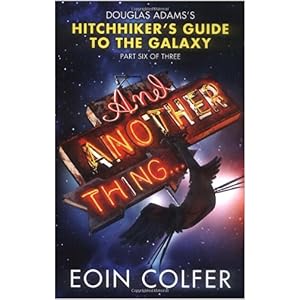
Eoin Colfer: And Another Thing... (2009)

Edition: Michael Joseph, 2009
Review number: 1405

I borrowed this book from the library expecting to hate it. Even though I didn't like the end of the Hitchhiker series as it stood at Douglas Adams' death, I couldn't imagine anyone else continuing it in the way that he might have been able to (if he'd overcome the blocks he experienced in the later part of his writing career). I'd also read Artemis Fowl, which made Colfer's name, and didn't think much of it.

And, when And Another Thing... came out, it was serialised on BBC Radio 4 as an audiobook, and I listened to that and did indeed hate it. Hitchhiker was always hilarious, and the abridged version - 340 pages in 75 minutes which I'd estimate means leaving out 75% of the text - failed to raise a smile. Of course, that could have been the cuts ("let's leave out the jokes to keep the plot comprehensible"), or the way it was read (not Steve Mangan's finest hour and a quarter), or some of the plot decisions (the way Colfer got out of the problems caused by the ending of Mostly Harmless seemed trite and unconvincing to me). Would the book itself be more worth reading? Friends who might have read it turned out not to have done. So, there was only one way to find out...

Initially, my reaction was positive. At greater length, the unravelling of the finality of the ending of Mostly Harmless, while still not very imaginative, worked better and contained some amusing touches. But things do go downhill from there. Some of the issues are with the characters as created by Douglas Adams. I have always found Zaphod Beeblebrox verging on being more irritating than funny, and Colfer makes him a particularly important character here and he becomes an annoying manipulator of the plot: more self-centred than ever. Wowbagger, the immortal being who is insulting every being in the universe in alphabetical order, also turns up and is made a major character: Colfer's attempts to make him more than the brief joke he is for Adams make him at least as unsympathetic and irritating as a dealmaking Zaphod. And finally, Colfer seems to share Adams' interest in Norse myth, and a lot of the book (even more in the radio abridgement) is about Zaphod's dealings with Asgard - all very dull compared to the meeting with Thor at a party in Mostly Harmless.

All this could be forgiven if And Another Thing... had turned out to be as funny as the first few Hitchhiker books were on first reading. In this aspect, I got the impression that Colfer didn't work too hard, settling for the obvious and poor pun rather than thinking hard about exactly what would be funny. (Apparently Douglas Adams used to agonise about individual words for ages, and this shows in the inventive quality of the first three books in particular.) The way that the book-within-the-book of the actual Guide is handled here is partly to blame for the lack of laughs. The "Book" extracts are among the highlights of the original stories, being extremely funny and often explaining how the bizarre situations Arthur and Ford find themselves in arose. Here, they are intrusive, irrelevant and humourless asides (though it is fairly obvious that Colfer thinks them hilarious). Some attempt has been made to make them stand out typographically, something I don't think Adams ever did, and this, like so much else about And Another Thing... is depressingly unimaginative: the entries are printed in italics. So much more could have been done here to indicate their peripheral nature and liven up the presentation of the book.

Colfer is obviously a fan, and this makes him a good choice as a writer of a sequel. But he is not really very funny at all, even when writing his own books. (I've read Artemis Fowl, and it seems like a good idea - a child evil genius - let down by a lack of imagination and lazy writing, though many people seem to think it extremely funny.) In the end, And Another Thing... reads like a not very wonderful piece of fan fiction, of the sort published in vast quantities on the Internet: and I feel sure that there are likely to be better sequels to Hitchhiker available free at fanfiction.net. My rating - 2/10.

Friday, 28 May 2010

Kurt Vonnegut: Breakfast of Champions (1973)

Edition: Vintage, 2000 (Buy from Amazon)
Review number: 1402

Even today, Breakfast of Champions is a strange novel, and it would have seemed odder in 1973. It is perhaps even misleading to call it a novel, given the way it is written. Such plot as it has is revealed in the first few pages. It concerns the influence failed science fiction writer Kilgore Trout ends up having on the world. The other main character, Dwayne Hoover, is gradually going mad through the novel, which ends when he and Trout meet. Trout appears in many of Vonnegut's works, including his most famous novel Slaughterhouse Five, and is often the character used to express of the author's ideas - but here Vonnegut also makes himself a character. The plot is not only minimal, it is clearly not the point of the novel.

An immediately noticeable feature of Breakfast of Champions is its format, which is a major part of why it isn't a normal narrative novel. It consists of (mainly) short chapters, each a series of bullet points, rather like an extended Powerpoint presentation. In many of these, Vonnegut ironically describes the writing process for the book, comments on the actions and thoughts of the characters, and what he is trying to do; in others, Kilgore Trout's views and summaries of the science fiction stories are given. As if this isn't unusual enough, Vonnegut has provided a large number of illustrations, few of them particularly to the point; the text will in passing mention the Egyptian pyramids, say, and then continue, "they looked like this", followed by the author's line sketch. The effect, along with the quirky and satirical explanations of references which will be clear to any twentieth century human, is to make it seem that Breakfast of Champions is addressed to an alien race who know nothing of Earth culture. The writing style adopted by Vonnegut for the novel uses very basic and direct English, which reinforces this impression.

So what is the point? Breakfast of Champions is a satirical attack on the culture, ideas, and concerns which shaped America in the seventies; that is clear from the opening pages, which consist of an attack on the American national anthem, described as "gibberish sprinkled with question marks". This may sound like nothing more than a deliberate attempt to offend or shock, and I would agree that the placing of this passage at the very opening of the novel seems to be just that. There must have been many Americans who did not read past page two because of this onslaught. But Vonnegut is making the point that a song abut a flag is not really a sound basis for pride in a nation: without other achievements, the stars and stripes are completely meaningless except to arrant sentimentalists. Throughout the novel, nostalgia, optimism, and even rationalism are attacked.

Vonnegut deals with the major concerns of Breakfast of Champions more conventionally, and to my mind more convincingly elsewhere. The idea that our actions are fixed and meaningless is a major part of Timequake, while here it is conveyed by the continual interjections about the how the author has made the decisions which determine the actions of his characters combined with speculation about whether our actions are similarly controlled by our Creator. Similarly, Galapagos examines the idea that the human capacity for rational thought does not make us happier or the world a better place.

Breakfast of Champions has been compared to Voltaire's Candide, and there are many parallels between the two novels. Both are satirical, attacking prevalent optimistic ideas about the world - in Voltaire's case with the memorable phrase, "All the for the best in the best of all possible worlds", which is the teaching of Candide's tutor's Pangloss. By contrast, Trout thinks that "there was only one way for the Earth to be: the way it was": a pessimistic justification for the same thought, that the world cannot be improved.

In both cases, liberties are taken with narrative: in Candide, terrible things happen to the characters, including death, only for them to appear later apparently unscathed. Both Candide and Trout are quite passive, as the philosophies they hold suggest they should be, Trout relegating himself to a life as a passive observer of the follies of seventies America, from the adult movie theaters of New York, to the signs reminding those entering Philadelphia that its name makes it the city of brotherly love, to the devastation of West Virginia by mining. Both authors use a distinctly ironic style, Vonnecgut more overtly than Voltaire. The biggest difference is that there is no major character in Breakfast of Champions with the naivete of Candide himself, and this ultimately makes Vonnegut's novel far less appealing and amusing.

This is the sort of book which by its idiosyncratic nature and satirical ambitions attempts to walk a narrow path between black comedy and irritating eccentricity for the sake of it. Even though, as a non-American apart from anything else, there is nothing in Breakfast of Champions I would personally consider offensive, I generally found it much more irritating than funny. I like Vonnegut generally, but not this time - 3/10.

Thursday, 4 February 2010

Winifred Watson: Miss Pettigrew Lives for a Day (1938)

Edition: Persephone, 2008
Review number: 1396

This wonderful novel nearly disappeared without trace; the introduction to Miss Pettigrew Lives for a Day explains how, after being a big success when first published, it was forgotten until eventually a reader requested a reprint. Persephone publishes books on the suggestion of readers, mainly to promote forgotten female writers. This sort of enterprise, it seems to me, relies quite heavily on second hand book stores: browsing, which has never been convincingly implemented in online sellers to my mind, makes it possible to be attracted to items which have never been heard of before, or to see something that sparks a glimmer of recognition ("that was one of my mother's favourite books", for example). While it is still true that just about every book which - like Miss Pettigrew - sold a reasonable number of copies in the last 150 years or so will be represented by a physical copy in some second hand bookshop in the UK, more of these wonderful places are disappearing in response to the online competition every month; even towns like Cambridge don't have as many as they did only five years ago.

Miss Pettigrew is a somewhat unsuccessful nursery governess, whose first name (Guinevere) is the only romantic thing about her. On the day in question she is sent for a new job by an agency, but when she arrives, she finds not a harassed mother with small children but a beautiful, worldly young lady, a dancer and actress who is clearly not the sort of person Miss Pettigrew is used to working for, nor the sort of person her upbringing suggests she should associate with or like. And there are no children in sight, though it quickly becomes clear that Delysia La Fosse (a stage name, obviously) is seeing at least three men.

Miss Pettigrew quickly accumulates new experiences: standing up to people, having an alcoholic drink, going to a cocktail party, visiting a night club, and so on. Not at all the life she is used to and mostly things that a conventional nursery governess should have had neither the opportunity or the desire to do. But she doesn't feel out of place, and is accepted, and enjoys herself immensely, while her position a outsider gives her an ability to see what is going on under the surface and then act - in a very nursery governess sort of way - to bring about the changes she judges best for those around her.

In short, Miss Pettigrew Lives for a Day is a version of the Cinderella story. It is funny and enchanting. It might be considered rather on the light side; if it came out today, it would probably be considered "chick lit". This particular edition adds  an interesting introduction and some delightful, stylish and appropriate illustrations (though I don't like the way the one used on the cover has been coloured - it looks rather garish to me). All in all a most enjoyable experience - 9/10.

Thursday, 24 September 2009

David Lodge Deaf Sentence (2008)

Edition: Penguin, 2009

The title by itself makes a lot of what Deaf Sentence is about clear. That it is about deafness, how it feels to gradually lose hearing, how deafness imprisons the sufferer in a solitary world where old pleasures become impossible or difficult; how there will be humour in the story; and even that the grim pun deaf/death (also, of course, a pair of words a deaf person would find hard to distinguish) will be revisited throughout. The use of part of the definition of the word "sentence" from one of the Oxford English dictionaries in the front matter to the novel also indicates before starting that the various different meanings highlighted in the quotation will form themes in the story.

Desmond Bates, narrator of Deaf Sentence, was a professor of linguistics who took early retirement when a good offer from his university co-incided with the realisation that encroaching deafness was causing obvious and embarrassing difficulties with lecturing and teaching. In the first chapter, he has an entire conversation at an art gallery party with a young woman, Alex, even though he is hears only a tiny part of what she says over the background noise of the party - distinguishing foreground from background being one of the problems which deafness brings. Later, he discovers that he appears to have agreed to supervise Alex's work on a doctoral thesis on suicide notes as a genre of linguistic utterance. But each meeting he has with her is increasingly bizarre, and she seems increasingly unstable...

Deaf Sentence is a typical David Lodge novel (unlike his previous work, Author, Author): funny, clever, full of satirical observation of academic life. There is also sadness, partly because of Desmond's feelings about his deafness, and partly because of his relationship with his irascible nonagenerian father. This is not a novel which paints a pleasant picture of what it is like to be old.

The centrepiece of the novel is not really up to his usual standard, however. This is a set piece description of the ordeal of the family Christmas, made worse by Desmond's hearing difficulties. This seems, unfortunately, to have escaped from a seventies sitcom and is not really imaginative enough to hold the novel together as it should given its prominence.

The main observation that Lodge makes about deafness through the novel is that it's tragic for the sufferers, but can often be comic for those around them, because of the misunderstandings it generates. He makes the contrast with blindness, which evokes pity and sympathy from onlookers, rather than laughter, embarrassment and irritation. And there is something undignified about even the most modern battery powered hearing aids (especially as users find it difficult to ensure that they have replacement batteries and do not let those in use drain too quickly), which there is not to the white stick or guide dog.

Not Lodge's best (Changing Places, Paradise News, or, on a more serious note, Thinks... would be my choices there). But Deaf Sentence is still thought provoking and funny: well worth a read. My rating: 7/10.

Thursday, 15 May 2008

Douglas Adams: The Salmon of Doubt (2002)

Published: Pan, 2002
Edited: Peter Gazzardi

I remember when I heard about Douglas Adams' death, but I was surprised to realise that it was now seven years ago that it happened. I didn't want to pick up this book when it came out, less than a year later, for several reasons, and it is only now that I am finally reading and enjoying it.

The main reason for not wanting to acknowledge the existence of The Salmon of Doubt before is that I just didn't want Douglas Adams to be dead. I was just old enough to appreciate The Hitchhiker's Guide to the Galaxy when the novel first appeared (I missed the original broadcast of the first radio series, but caught repeats). By the time I went to university, I could quote large chunks and still can, and own copies of the books, recordings of the radio and TV series and Neil Gaiman's guide. The Hitchhiker's Guide to the Galaxy played a important role in my life, quite similar to Adams' own discovery of the Beatles which is described in one of the pieces included in The Salmon of Doubt.

The one exception to this is Mostly Harmless. As pretty much the last writing by Adams I read before The Salmon of Doubt, I found it very off putting and didn't want to read more of the same. (Mostly Harmless is now the only book by Douglas Adams which I do not possess.) It was so wilfully downbeat, not just ending unhappily, but seemingly revelling in undoing previous happy endings (notably the relationship between Arthur and Fenchurch). According to information in the Salmon of Doubt, it reflects a bleak time in Adams' own life, and I gathered when I listened to the radio version that he later wanted to change the ending, a wish that was carried out when it was dramatised. Relatively little of The Salmon of Doubt is fiction, so there is little chance that the book overall will give the same impression as Mostly Harmless, but even the fiction that is there clearly reflects a happier time.

The other reason that I didn't rush to read Salmon of Doubt is because some of what I heard about it suggested that it was scraping the barrel. Apart from the incomplete fiction, which always has the potential to be frustrating, the idea of resurrecting a letter sent by the twelve year old Adams to Eagle comic seemed bizarre. (In fact, it is probably the most amusing letter ever written to a comic by a twelve year old.) Fragmentary the pieces in The Salmon of Doubt may be, but they are all uniformly well written (with one exception), often thought provoking, and mostly pretty funny.

The book is divided into three sections: Life, containing autobiographical fragments, The Universe, about Adams' wide-ranging interests, and Everything, fiction. The first section is perhaps the most successful. The second includes a lot of Apple Mac related material, which had to be included because that computer system was one of Adams' best known obsessions, but which is now (and would have been five years ago) rather out of date; at least this means that the Douglas Adams fanatic doesn't need to hoard quite so many back copies of Mac User. His own favourite of his books was Last Chance to See, about endangered animals, and that is well worth reading in his memory, and there is more here from his interest in ecology for those who enjoyed that.

The first fictional piece, Young Zaphod Pulls it Off, was previously published in book form in a collected edition of the Hitchhiker's novels and is a poor piece of political satire, clichéd and obvious. However, the story which gives its title (or, more strictly speaking, one of its titles) to the whole collection is much better. It is one of the most confusing pieces in the whole book, however, as it was put together from three very different incomplete drafts of the story: although the main one used here is a Dirk Gently story, not even this was finalised. For me, the middle draft, which is definitely Dirk Gently, works best. I like the idea that Dirk's philosophy that all things are interconnected leads him to try to solve a case by tailing random people. It's the longest piece in the book, and because it is so incomplete, the most frustrating; Adams' drafts were obviously finely finished and perfectly readable (no notes to self, for example), but he obviously kept getting so far and then becoming stuck and the only indication of how the story would continue is a one paragraph fax to his agent which is not very illuminating.

While it was inevitable that there would be both the desire to produce a book containing Adams' odds and ends, and a desire from fans to read it, The Salmon of Doubt cannot be considered the true legacy of Douglas Adams. It raises the profile of important aspects of both his personality and his writing which were not accessible to most of his fans, particularly the computing articles, but there is nothing in the book to match the classic status of The Hitchhiker's Guide in its many forms.

Wednesday, 1 August 2007

J.K. Rowling: Harry Potter and the Deathly Hallows (2007)

Published: Bloomsbury, 2007

This blog entry is not so much a review as a reaction as I read the early chapters (the first ten or so) of the most eagerly anticipated novel of all time. So there are not going to be spoilers for anything later than these chapters. I may return to this post later and add a comment about the later sections of the novel.

Over eleven million copies of Harry Potter and the Deathly Hallows were ordered in advance of its release. The only literary events I can think of that rivalled the publication of The Deathly Hallows are the appearances of the serial parts of Dickens' novels in the nineteenth century. While there are obvious differences (Dickens released his novels in a large number of individual parts, rather than Rowling's complete novels making up a series; and Dickens' plots were a lot more predictable in broad outline, so there wasn't speculation about, for example, whether the hero might die). Does the fanaticism mean that Rowling's work last as long as Dickens'? Plenty of old bestsellers have gone completely from the public consciousness - Marie Corelli, for example, was one of the biggest sellers of the early part of the twentieth century, but it would be unusual to see her books even in second hand shops. Will Rowling turn out to be the Corelli or the Dickens of our time?.

All three have social themes in their books which make them more than just escapism, though Rowling's concerns in the Harry Potter books - racism and the rise of Neo-Nazism, and the excesses of the press and its manipulation by government - are more like the social campaigning of Dickens than Corelli's theme of the relationship between spiritualism and Christianity. The first is more explicit from the beginning of The Deathly Hallows, as Voldemort and the Death Eaters are described in ways which show them to be closer to Hitler and his followers than was seen in the earlier novels. Rowling's other major social concern is more modern and is unlikely to have occurred to Corelli at all. Dickens, on the other hand, was extremely upset by attacks on him in American newspapers after he published articles critical of some aspects of life in the United States, just as Rowling has indicated that she feels that press interest in her personal life was unwarranted. So this too is a similarity to Dickens.

Speculation has been rife about how the series will end, and an intensive security operation was (more or less) successful in keeping details from getting out before the release date. Even following this, spoilers have generally (as far as I have seen) been well signposted; it's quite remarkable on today's Internet how polite people who have posted something about the novel have been to those who are yet to read it. The main information that was widely disseminated, revealing that at least two major characters would be killed, came from Rowling herself, and this left a lot open (the ending could have the rest of the cast living happily ever after, or a bloodbath on the scale of a Jacobean revenge tragedy - or anything in between).

More important to me than the issue of what might happen in the novel is whether it would be a satisfactory ending to the series as a whole. I found Harry Potter and the Half-Blood Prince the least involving novel in the series so far, and I was almost expecting to be disappointed by The Deathly Hallows.

And then I read the first chapter, which describes Voldemort plotting with the Death Eaters. This seemed to confirm my worst fears - dull, predictable, lacking in any kind of atmosphere. One thing it does make clear (even if Rowling's revelations about character deaths hadn't) is that The Deathly Harrows is going to continue with the darkening of the series that's been apparent since the arrival of the Dementors in Harry Potter and the Prisoner of Azkaban.

But then, in the second chapter, Rowling seemed to return to her best form. Harry's relationship with the Dursley family is an integral part of the whole series, and has gradually been revealed as more subtle than the bullying and abuse which characterised it at the beginning of Harry Potter and the Philosopher's Stone. The chapter also indicates that no matter how dark things become, the humour of the series will still be part of the final volume.

Saturday, 26 May 2007

Mike Ripley: Angel in the House (2005)

Published: Allison & Busby Ltd, 2006

This was my first read of one of the Angel novels, though it is in fact the twelfth featuring the feckless detective. In Angel in the House, Angel is faced with something that he has always tried to avoid: he has to get a job. Luckily (though not from his point of view) his partner Amy May buys a stake in a private detective agency, so that is where he goes to work. Soon he becomes involved in a bizarre case involving suspected missing Botox, as well as investigating potentially haunted mansions in South Cambridgeshire.

Most comic crime fiction is heavily indebted to Hammett and Chandler, whose hard boiled style is easy to parody (though not so easy to parody well). The Agatha Raisin books parody Christie and other stalwarts of the traditional murder mystery, but I find them unbearable. Angel is not really a detective from either school; in fact, he'd much rather not be a detective at all, and just be supported by Amy. So he blunders around, making inappropriate jokes, and getting into awkward situations. Generally, this is funny, though he is sometimes exasperatingly feckless. The balance is towards the right direction, however.

As a crime novel, the plot is not terribly difficult to untangle, particularly the hauntings. The mechanism behind the botox thefts is ingenious, however, and the central characters will keep even the most cynical genre fan happy through the novel. I wouldn't want to read several of them in quick succession, but I will look out for them in future, after a suitable interval.

Saturday, 19 May 2007

Paul Magrs: Never the Bride (2006)

Published: Headline Review 2006

Since Bram Stoker's Dracula, Whitby has become indelibly associated with gothic horror. It is a town quite well suited to the role, with the popularity of Whitby jet for Victorian funeral and mourning jewellery, and the atmospheric ruined abbey on the cliff top which dominates the time. At the same time, Whitby is a part of the British seaside holiday tradition - which has opposing resonances of the old fashioned and safe. All this makes it an ideal setting for Magrs' debut, a comic gothic fantasy.

Brenda has recently taken over a bed and breakfast in Whitby, which seems to her to be the ideal place for her to live a quiet life. This is something that has not often been possible for her, as her lack of a surname and scarred features suggest. (Anyone who has watched any classic horror films will guess who she is long before Magrs makes it explicit.) But strange forces are at work, and soon she and her neighbour have to deal with demonic beauty treatments, fake Christmas cheer at a Whitby hotel, spiritualist TV programmes and other bizarre incidents. The general outlines of the plot are shared with many horror satires (the supernaturally unusual trying to live a normal life is, for example, the basic premise of Buffy the Vampire Slayer), but of course it's the inventiveness of the specific incidents that matters: and here they are very good indeed. The novel reminded me of other writers of comic fantasy who I like, notably Robert Rankin (particularly the Brentford Trilogy) and Tom Holt.

Generally, Never the Bride is very enjoyable, probably the funniest debut I have read since Jasper Fforde's The Eyre Affair.

Tuesday, 18 October 2005

J.K. Rowling: Harry Potter and the Half-Blood Prince (2005)

Edition: Bloomsbury, 2005
Review number: 1306

Most of the Harry Potter books so far have begun with tales of the mistreatment of Harry by the Dursleys during the summer holidays, which provide a comic note even as the novels as a whole become darker. The first exception is The Goblet of Fire, which begins a quite chilling scene featuring Voldemore himself. The Half-Blood Prince is the second, and it begins with a very different scene: the introduction of the new Minister of Magic (the incomptencies of Cornelius Fudge having finally led to his replacement) to the British Prime Minister, who is the only Muggle in the country permitted to know about the existence of magic. It is an odd beginning to the novel, especially when you compare it to The Goblet of Fire - what happens in Voldemort's ancestral home is of great importance to the plot, but the scene with the Prime Minister seems only to be used to introduce the new Minister of Magic, who is a comparatively minor character in the novel, before being completely forgotten. Of course, the two of them may turn out to be more important later on - Rowling has proved to be quite good at picking up details later, and there are several examples of the way that she does this in The Half-Blood Prince.

The plot this time is more to do with Dumbledore's attempts to help Harry understand Voldemort's background rather than the machinations of Voldemort attempting to kill Harry - the focus of the earlier stories. A crucial part is played by memory - Harry watches several episodes from Voldemort's early life which are either Dumbledore's own memories or ones he has collected. They do this because Dumbledore is convinced that these memories are key to understanding what has happened to Voldemort since his attack on Harry's parents: why had his failure to kill Harry as well led to his disappearance and a shadowy half-existence?

However, the main theme of the novel is not so much its plot as the evolvution of the relationships between the characters established earlier in the series, as contrasted to the cold calculation that marks out the manipulation that is the only way that Tom Riddle (the young Voldemort) seems to relate to those around him. This novel is in fact a six hundred page exposition of something Dumbledore tells Harry, that the important difference between him and Riddle is the role that love plays in his life, from the sacrifice his parents made of their own lives trying to protect him to the way he works with his friends as contrasted with the subservient obedience Voldemort demands of his Death Eaters. It also plays to one of Rowlings' strengths as a writer, her characters. Harry at sixteen is not the same as Harry at eleven; growing up and his experiences have developed Rowling's central character. By concentrating on relationships, both he and the lesser characters become rounded out; even Draco Malfoy becomes more than an arrogant bully.

A lot of what happens in The Half-Blood Prince fits in with the things I had guessed would occur or was widely predicted by fans, but the one important event I didn't expect at ll (which occurs near the end, so I won't say anything that gives it away) is possibly not what it seems to be on the surface: in the last magical confrontation, think about what Harry is prevented from doing, and what this may mean.


The intention behind The Half-Blood Prince is sufficiently different from the earlier books that it is not easy to compare its quality with the rest of the series. We learn a lot of background, and this is handled very well indeed; so often this sort of thing becomes a boring interlude between the scenes of action. It has a serious tone, which is reasonable considering the events it follows at the end of The Order of the Phoenix, not least in their effects on Harry's own life. The adventures of Harry Potter have been moving in this direction since The Goblet of Fire, and in this book Harry is being prepared, as he, the other charadcters, and the readers all know, for the most serious confrontation he will ever face. In the end, The Half-Blood Prince is much more dependent on its place in the series than the others, and is the only one (so far) that would really suffer from being read out of context.

Thursday, 28 October 2004

Robertson Davies: Tempest-Tost (1951)

Edition: Penguin, 1980 (Buy from Amazon)
Review number: 1270

In some ways, the staging of an amateur theatrical event must seem to be an ideal focus for a satirist. The inflated egos, naked ambition displayed over so small an achievement is an obvious tool to dissect the vanities of the world. Its very obviousness is the problem: how do you use this subject without coming across as trite? Here, then, we see that to choose this as the background for his debut novel Robertson Davies was actually showing a high level of self-confidence. (This was perhaps to be expected in a writer who was already an experienced journalist and playwright.)

So what does Davies do to make Tempest-Tost an interesting variation on the amateur dramatics as satire theme? It's sharper than most, for a start - full of acid yet subtle jokes at the small mindedness of the Canadian provincial. (It would be just about possible to read Robertson Davies without realising that it is meant to be funny.) The majority of the jokes are character based; each member of the cast is exposed in some shortcoming, which usually arises because they are not as good at something as they think they are; in the Aristotelian manner, their downfall comes from hubris and yet this is not made tragic. (This is something which changes somewhat in Davies' later novels. In A Mixture of Frailties, the third novel of the Salterton trilogy of which this is the first, Solly Bridgetower, whose problem is his devotion to a demanding, suffocating and ungrateful mother, has his life made miserable after her death by the malicious provisions of her will.) Bringing in the director of the production - The Tempest, by the way, hence the title (even if it is quoted from Macbeth), from outside also makes this different. Valentine Rich is a native Saltertonian, who has gone to New York and become a success there as a theatre director. She returns as a favour to an old schoolfriend, and causes a great deal of tension because of her outlook, her refusal to admit that things cannot be arranged in Salterton's amateur theatre as they could be in professional New York productions. She has no truck with the idea that some people must be asked to do things for political reasons rather than because of their suitability. The clash between her values and the cosy traditional ideas of the amateur group enhance the satire enormously.

The third way that Davies moves Tempest-Tost out of the common is by the power of his characterisation. Though the various Saltertonians in the novel initially seem to be rather clichéd stereotypes - the popular, pretty young girl, the stuffy schoolmaster, the pedantic university lecturer, the tomboy, the taciturn gardener, and so on - they are almost all gradually revealed to be more complex than that with complicated interactions. Then there is the time and place - the sexual hangups of the mid twentieth century play a big part (especially the innocence of young men and women compared to their successors only a few years later), as do the special insecurities of a backwater town in Ontario (fiction Salterton's greatest claim to fame is that it was at one point considered as a possible capital for the Dominion of Canada). Like the inhabitants of Sinclair Lewis' even more bitter Main Street, the small mindedness of Salterton's inhabitants is quite amazing, and is (paradoxically) greatest amongst those who consider themselves the town's sophisticated elite.

Tempest-Tost is a wonderfully witty satire, full of barbed humour and, more than that, it is a novel full of memorable characters.