Showing posts with label E.R. Eddison. Show all posts

Saturday, 22 June 2002

E.R. Eddison: A Fish Dinner in Memison (1941)

Edition: Del Rey, 1978
Review number: 1100

The second of Eddison's Zimianvian trilogy is the most difficult of his novels to read, though it is well worth the effort. It has much more to do with the aims of his writing than Mistress of Mistresses, where the hinds about what is being done can easily be ignored, and the unfinished and in many parts skeletal nature of The Mezentian Gate make the underlying ideas far more obvious. The trilogy as a whole has an extremely unusual and rather disconcerting structure, in that it is more or less in reverse chronological order, with much overlap between the events in the second and third novel (the central event which provides the title here also occurs in The Mezentian Gate).

The fact that the opening chapter contains phrases in French, Italian, Greek and Latin might put a fair number of readers off, but more difficult in actuality is not so much Eddison's theme (time and eternity) as what he wants to say about it. (Eternity is also the theme of Eddison's less obviously related and most famous novel, The Worm Ouroboros, as the worm is a symbol for the concept.) The philosophical introduction won't clarify matters for anyone who hasn't read at least one of the novels in the trilogy already. Eddison could have written an allegorical fantasy, which would have been more familiar as a form to many readers of the genre, but he felt that it would be too easy to do this and would diminish his subject; instead of personifying eternity, he wanted to use all his characters to hint at different aspects of his ideas about time, in the same way that he felt that real world individuals did.

Eddison conveys his ideas as well through the parallels he makes between the real world and Zimiamvia, and by making several of his characters incarnations of gods and goddesses (or, perhaps more accurately speaking, of the ideas behind the characteristics of Zeus and Aphrodite). These ideas, present in the other two novels, appear here in more complicated forms which are explained in less detail, as the earthly story is intertwined intimately with the Zimiamvian, as Lessingham's courtship of Lade Mary Scarnside parallels Duke Barganax's of Fioranda. Then there is the "fish supper" itself, where discussion of how the gods create worlds for their own amusement leads to the act itself, as our "real" world is exhibited as a fantasy of a dinner party in Memison.

The structure is a bit confusing, at least on first reading, but A Fish Dinner in Memison contains much which is inventive and still fresh (especially the idea of our world being a temporary diversion, one which has recently been re-used in The Science of the Discworld as a way to explain scientific ideas through Terry Pratchett's popular fantasy series). It is a philosophical and, like all of Eddison's writing, a poetic novel - the language of the chapter "Night Piece: Appassionato" in particular seemed to me to invoke the eternal. Recommended to anyone with an interest in the more philosophical fantasy novel.

Thursday, 4 April 2002

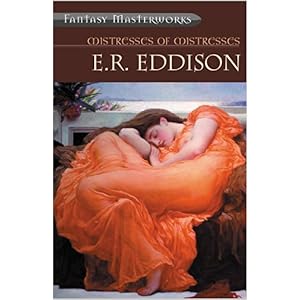
E.R. Eddison: Mistress of Mistresses (1935)

Edition: Gollancz, 2001
Review number: 1078


To read Tolkien and Eddison in close succession is to realise just how much the latter is the better writer. This is his second fantasy novel, loosely connected to the first and best known, The Worm Ouroboros, and beginning a trilogy ending with the unfinished The Mezentian Gate. Although the earlier novel is better known, this is the better one and Eddison's talent clearly developed in the nine years since the publication of The Worm Ouroboros.

When strong king Mezentius of the Three Kingdoms dies, his heir Styllis is a weak young man, unable to handle two particularly powerful subjects, his illegitimate brother Barganax and the sinister Honorius Parry. Styllis soon dies, poisoned, leaving a will guaranteed to sow further discord in the vagueness of the terms by which Parry is appointed guardian of his sister Antiope, now queen. The other major character is Parry's cousin, Lessingham, whose honour makes him someone that Barganax can trust as long as he can keep Parry from breaking the agreements he makes.

This plot is closely modelled on the themes from real medieval history, one of which is the continual rivalry between monarchs and their most eminent subjects. A regency presented lots of opportunities to the unscrupulous, as so much of the state consisted in the person of the ruler, and could be guaranteed to disturb the balance between these groups. This could even happen in England, one of the most stable states in Western Europe, as when John of Gaunt was guardian to Richard II. Most fantasy is based on Tolkien's ideas, which in turn come from the literature of the medieval period in which quests undertaken by individuals or small groups with a spiritual dimension are common; in using real life as his source, Eddison prefigures modern authors with an interest in politics, such as George R.R. Martin, though Martin's brutal setting from his Songs of Ice and Fire series is replaced with something more gentle, a dreamlike medieval world as seen through a pre-Raphaelite lens.

People often admire the descriptions in Tolkien's novels, but to me Eddison is superior in this as in many other aspects of his work. What he describes is not so definite, perhaps, but it is infinitely more poetic and suggestive. To me, this invitation to use my imagination is much more satisfying than merely acquiescing in that of the author. Eddison natually also scores in areas where Tolkien is weak: his characters are much less stereotyped, and he can portray interesting women; he introduces a sexuality which is truly erotic; and even includes a hint of homoeroticism.

There is a spiritual side to the stories too, which is more of the things not being the way they seem variety than the overt magic more common in fantasy. The way that this is done is rather reminiscent of George MacDonald, even though it lacks the Christian allegory of, say, Lilith.

Mistress of Mistresses should be more widely recognised as a classic of the genre, but for some reason it remains little known.

Friday, 16 February 2001

E.R. Eddison: The Worm Ouroboros (1922)

Edition: Ballantine, 1971
Review number: 755

Often touted as a rival to The Lord of the Rings, Eddison's epic fantasy has more in common with the large scale of The Silmarillion. Eddison wrote four loosely linked novels while working as a civil servant, of which The Worm Ouroboros is the first and best known. Its subject is a war between the Demons and Witches, the latter aided by a willingness to act dishonourably and by the dread sorcery of their king, Gorice XII.

The flaws in The Worm Ouroboros are fairly obvious, particularly at the beginning of the novel. The strangest is a narrator, who is very dull and who is even forgotten by Eddison after a couple of chapters. It is symptomatic of a more general fault, which is a lack of revision. Unlike Tolkien's writing, The Worm Ouroboros is clearly not the product of years of obsessive rewriting, background notes and singleminded vision. It reads far more as though it were written down in one sitting. There are problems with details of the background. Like Tolkien, Eddison uses familiar names from folklore for his peoples; there are Demons, Witches, Imps and so on. However, with the exception of the Ghouls, these all appear to be nations of human beings, and the result is that the reader is torn between the traditional ideas conjured up by these names and the way in which Eddison portrays them. Tolkien's dwarves and elves are far more like their traditional namesakes, and this is a lead which has been followed by just about every fantasy writer since.

The whole story of the novel, we are told, is set on the planet Mercury, and this also gives a bizarre feeling; a magical realm works much metter in a mythical setting like Middle Earth.

There is one aspect of the way in which Eddison uses pieces of the real world which works extremely well. In most fantasy novels, when poetry occurs, it is usually a poor imitation of some sort of heroic sage, derived via models like William Morris and Tolkien from medieval sources. What Eddison does is to find poetry which fits with the style of his writing and the situation; this means that it is written by poets like Shakespeare and Spenser and is a pleasure to read rather than something to skip.

The Worm Ouroboros has many excellent qualities; once you get into to it, it is quite compelling. It is imaginative and literary, if a bit lacking in planning and structure. However, it did not grip the world's imagination as the less poetic Tolkien did, and so did not provide the inspiration to hundreds of imitators that The Lord of the Rings has, with the result that it remains something of a curiousity in a forgotten corner of the fantasy genre.