One of Le Guin's shortest novels is also one of her most effective. The Word for World is Forest is a telling description of the ecological and moral atrocities committed by a group of human colonists on a peaceful world covered in forest, and how their barbaric treatment of the apparently passive Athshean natives provokes a bloody uprising, leaving the natives changed forever, fallen, as it were, from their state of innocence.
The Word for World is Forest was not quite long enough to qualify for the best novel category in the Hugo awards (which she won twice), but it won the best novella category, before appearing in stand alone book format in 1976 (it originally formed part of the famous anthology sequel, Again, Dangerous Visions).
Like much of Le Guin's work, this novel is inspired by her knowledge of anthropology. Indeed, there is little of the novel which demands a science fictional setting: the "world" could fairly easily be some remote part of Africa or New Guinea. The point of using science fiction, other than Le Guin's established reputation in the genre, is that it enables the writer to create her own background, one which emphasises the points she wishes to make. As a result, the story does sometimes seem rather one sided, but the spiritual effects on the Athsheans which result from their espousal of violence are in the end striking: by becoming as vicious as the humans, they destroy a precious part of their culture forever, knowing that this will be the outcome of their actions.
In one way, Le Guin does undermine the point she is trying to make, as far as I am concerned: she adds a feminist element. The culture of the colonists as she depicts it is extremely male-dominated; human settlements are basically logging camps filled with macho lumberjacks where the only women are prostitutes and concubines. These women have no voice in the story: they don't even have names, being referenced by their measurements; they are objects used by the men for stress relief. They do show that the men can behave bestially towards people far more like them than the Athsheans. In the end, unless her overall point is less than I think it is - unless Le Guin is saying that a culture in which women are less than equal with men is capable of terrible crimes - the women are a distraction and dilute the impact of the story.
In the author's note at the beginning of Knowledge of Angels, Jill Paton Walsh wrote: "A fiction is always, however obliquely, about the time and place in which it was written." The Word for World is Forest is not really about aliens and the future, but about us, here and now - at least, as much as the world has not changed in the last forty years. It is an attack on colonialism, both as practiced in the past and in our own time, as rich western nations grind the so-called third world in poverty and hopelessness - and it could well be intended as a warning to the complacency of the western world. It obviously exaggerates for effect, as no earthly culture has ever been as innocent as the one portrayed here. There is also an underlying criticism of science fiction in general. The theme of the colonisation of an alien planet by humans is a commonn theme in the genre, and usually the author is put firmly on the side of the plucky colonists. But, Le Guin tells the seventies SF community, that is not the only imaginable side of the story. There are often clear parallels between tales of colonisation and westerns, and Le Guin is putting the side of the American Indians.
Re-reading The Word for World is Forest, I was struck by just how much it seems to have influenced a film made almost forty years after the story was published: Avatar. The Athsheans are not hugely similar to the Naavi, but much about the setting and the ecological parts of the message are really close. I'd recommend the book to anyone who enjoyed the film.
Though others might choose The Lathe of Heaven or The Left Hand of Darkness, my choice as Le Guin's greatest work would be this compact story. Even so, it has never inspired the affection I still feel for the first of her books I ever read, the Earthsea trilogy. The Word for World is Forest is Ursula K. Le Guin writing uncompromisingly an unpalatable message for adults; it is not a novel the reader is meant to like, but one which is meant to hammer home its point. My rating for one of the most effective uses of science fiction: 9/10.
Edition: Tor, 2010
Review number: 1424
Showing posts with label Ursula K Le Guin. Show all posts
Saturday, 4 June 2011
Tuesday, 15 January 2008
Ursula K Le Guin: The Lathe of Heaven (1971)
Published: Panther, 1974
This short novel by Ursula Le Guin - over 850 pages less than the other book I was reading alongside it, Peter F. Hamilton's Pandora's Star - is quite untypical of the work for which she is best known: her anthropologically based examinations of alien societies such as The Left Hand of Darkness, or the young adult fantasy of The Wizard of Earthsea. While most of Le Guin's science fiction is original and unusual, particularly for its time, The Lathe of Heaven directly recalls two authors that one would not necessarily associate with her. These are Philip K. Dick and Roger Zelazny, both interested in the mind and the nature of reality.
The two major characters in The Lathe of Heaven are psychiatric patient George Orr and his therapist, Dr Haber. Orr believes that his dreams sometimes alter reality, and the effects of dreams produced under Haber's post-hypnotic suggestion convinces the psychiatrist that this is not a delusion. Haber sets out to improve the world, admittedly an unpleasant place: overpopulated, polluted, and violent. Orr becomes increasingly reluctant to dream under Haber's direction, mainly because of the guilt caused by some changes (such as his response to a suggestion that over-population be solved, which leads to the deaths of billions in a plague of environmentally related cancers: an event that only he and Haber remember not occurring some years earlier). He was involuntarily referred to Haber in the first place, so he can't just ask to stop the treatment.
This could very easily be an idea used by Philip K. Dick, touching on his common theme of the nature of reality. This is particularly important here, as the suggestion that the whole of Orr's dreaming might itself be a dream, as the end of the original dystopian world approaches. The lack of the profusion of secondary ideas that fill Dick's work is the main difference.
Zelazny's influence is more obvious, but perhaps more superficial: there is a clear relationship with The Dream Master, which also deals with psychiatric therapy using directed dreaming. However, Zelazny's story is less about the nature of reality - though the psychiatrists are effectively creating their own worlds to share with their patients. The points of view of patient (in The Lathe of Heaven) and therapist (in The Dream Master) make the novels quite different in emphasis. The Lathe of Heaven ends up feeling more like Dick than Zelazny - or, indeed, Le Guin. This last is because it isn't as different from the mainstream of the genre as Le Guin's Hainish novels: it is unusual in her output by not being particularly unusual.
This short novel by Ursula Le Guin - over 850 pages less than the other book I was reading alongside it, Peter F. Hamilton's Pandora's Star - is quite untypical of the work for which she is best known: her anthropologically based examinations of alien societies such as The Left Hand of Darkness, or the young adult fantasy of The Wizard of Earthsea. While most of Le Guin's science fiction is original and unusual, particularly for its time, The Lathe of Heaven directly recalls two authors that one would not necessarily associate with her. These are Philip K. Dick and Roger Zelazny, both interested in the mind and the nature of reality.
The two major characters in The Lathe of Heaven are psychiatric patient George Orr and his therapist, Dr Haber. Orr believes that his dreams sometimes alter reality, and the effects of dreams produced under Haber's post-hypnotic suggestion convinces the psychiatrist that this is not a delusion. Haber sets out to improve the world, admittedly an unpleasant place: overpopulated, polluted, and violent. Orr becomes increasingly reluctant to dream under Haber's direction, mainly because of the guilt caused by some changes (such as his response to a suggestion that over-population be solved, which leads to the deaths of billions in a plague of environmentally related cancers: an event that only he and Haber remember not occurring some years earlier). He was involuntarily referred to Haber in the first place, so he can't just ask to stop the treatment.
This could very easily be an idea used by Philip K. Dick, touching on his common theme of the nature of reality. This is particularly important here, as the suggestion that the whole of Orr's dreaming might itself be a dream, as the end of the original dystopian world approaches. The lack of the profusion of secondary ideas that fill Dick's work is the main difference.
Zelazny's influence is more obvious, but perhaps more superficial: there is a clear relationship with The Dream Master, which also deals with psychiatric therapy using directed dreaming. However, Zelazny's story is less about the nature of reality - though the psychiatrists are effectively creating their own worlds to share with their patients. The points of view of patient (in The Lathe of Heaven) and therapist (in The Dream Master) make the novels quite different in emphasis. The Lathe of Heaven ends up feeling more like Dick than Zelazny - or, indeed, Le Guin. This last is because it isn't as different from the mainstream of the genre as Le Guin's Hainish novels: it is unusual in her output by not being particularly unusual.
Saturday, 25 February 2006
Ursula K. Le Guin: The Telling (2001)
Edition: Gollancz, 2002
Review number: 1311
All through here career, Le Guin has been known for her thoughtful social science fiction, as far removed from the "hard" SF which focuses on engineering and physics as anything in the genre. While her earlier novels like The Left Hand of Darkness are classics which helped establish that science fiction doesn't have to be about technology, the more recent The Telling is a comparitively minor novel in much the same vein.
The setting is a technologically primitive planet - a favourite choice of location for Le Guin. Using a familiar device from earlier Hainish tales, the central character is an anthropologist-like observer named Sutty. She is sent to this planet, only to discover it has radically changed from the information she read before her journey (which took seventy years, local time, because of relativistic effects). The society she studied, made up of peaceful beings who had no real concept of foreigner (or at least, so the narrative states, though there is also a suggestion that one group was regarded as "barbarians"), has been overthrown in what must be a deliberate reflection of the effects of the Chinese invasion of Tibet. The old books, and even the writing and some of the language are banned as reactionary. Sutty thinks at first that she, an alien, might be the only person on the planet able to read the old letters until she goes away from the cities into the mountain foothills where the remnants of the culture are still clandestinely preserved.
Why is this a minor Le Guin? The main reason is that it re-visits themes previously explored with greater subtlety. It is all too obvious that the reader is meant to sympathise with those trying to preserve the remnants of the old culture, and the details put in to explain why the authorities want to stamp it out are perfunctory and unconvincing. (This is partly because the main motive for doing so is kept for a surprise until the end, which is something of a plotting mistake.) The ideas used in The Telling could have been the basis for something more interesting; theere is more to the real world events than is picked up by the author, and there are additional reasons for cultures to die out in the face of new technology which we see all around us in the world today that could have filled out the somewhat perfunctory plot. No one ever suggests that the (to me rather dull) folk tales that make up the oral culture at the centre of The Telling (and provide the name for the novel) are boring or irrelevant - yet that has been the fate of many traditional ideas in the MTV generation. Those on the side of the authorities are portrayed as humourless ideologues, straight out of Orwell; one of them does have a change of heart, but it turns out that he was brought up in the old ways. There are reasons that persuade people to embrace technology, and to be a fully rounded person does not necessarily mean rejecting anything new; but that is Le Guin's implication here.
There are other aspects of The Telling which could be criticised; too much space is given to expounding the traditions at the expense of plot and character: an equivalent to being a hard SF novel which concentrates on the technical gimmicks at great length and a fault that Le Guin has always tended towards. But I did not actually dislike The Telling. It is beautifully written on a sentence-by-sentence level, and captures the attention. What is frustrating is that it could be much better.
Review number: 1311
All through here career, Le Guin has been known for her thoughtful social science fiction, as far removed from the "hard" SF which focuses on engineering and physics as anything in the genre. While her earlier novels like The Left Hand of Darkness are classics which helped establish that science fiction doesn't have to be about technology, the more recent The Telling is a comparitively minor novel in much the same vein.
The setting is a technologically primitive planet - a favourite choice of location for Le Guin. Using a familiar device from earlier Hainish tales, the central character is an anthropologist-like observer named Sutty. She is sent to this planet, only to discover it has radically changed from the information she read before her journey (which took seventy years, local time, because of relativistic effects). The society she studied, made up of peaceful beings who had no real concept of foreigner (or at least, so the narrative states, though there is also a suggestion that one group was regarded as "barbarians"), has been overthrown in what must be a deliberate reflection of the effects of the Chinese invasion of Tibet. The old books, and even the writing and some of the language are banned as reactionary. Sutty thinks at first that she, an alien, might be the only person on the planet able to read the old letters until she goes away from the cities into the mountain foothills where the remnants of the culture are still clandestinely preserved.
Why is this a minor Le Guin? The main reason is that it re-visits themes previously explored with greater subtlety. It is all too obvious that the reader is meant to sympathise with those trying to preserve the remnants of the old culture, and the details put in to explain why the authorities want to stamp it out are perfunctory and unconvincing. (This is partly because the main motive for doing so is kept for a surprise until the end, which is something of a plotting mistake.) The ideas used in The Telling could have been the basis for something more interesting; theere is more to the real world events than is picked up by the author, and there are additional reasons for cultures to die out in the face of new technology which we see all around us in the world today that could have filled out the somewhat perfunctory plot. No one ever suggests that the (to me rather dull) folk tales that make up the oral culture at the centre of The Telling (and provide the name for the novel) are boring or irrelevant - yet that has been the fate of many traditional ideas in the MTV generation. Those on the side of the authorities are portrayed as humourless ideologues, straight out of Orwell; one of them does have a change of heart, but it turns out that he was brought up in the old ways. There are reasons that persuade people to embrace technology, and to be a fully rounded person does not necessarily mean rejecting anything new; but that is Le Guin's implication here.
There are other aspects of The Telling which could be criticised; too much space is given to expounding the traditions at the expense of plot and character: an equivalent to being a hard SF novel which concentrates on the technical gimmicks at great length and a fault that Le Guin has always tended towards. But I did not actually dislike The Telling. It is beautifully written on a sentence-by-sentence level, and captures the attention. What is frustrating is that it could be much better.
Saturday, 11 August 2001
Ursula K. le Guin: Tehanu (1990)
Edition: Bantam, 1991
Review number: 902
It is rare for a sequel written many years later to match up with a famous original, and Tehanu is not an exception to this rule. In time it follows on immediately from the end of The Farthest Shore, and it continues the story of Tenar, one-time priestess of the Nameless Ones in The Tombs of Atuan. Rejecting the fame she could have had, she married a farmer from the island of Gont, birthplace of Sparrowhawk, the central character of all the Earthsea books. She is now a widow whose grown up children have left home, and she takes in a small girl, victim of extreme abuse - rescued from a fire in which she was put by her father, she is terribly scarred.
Tehanu is much more aimed at adults than the original trilogy, even if they had a dark side which would make them unsuitable for younger children. Its intended audience is probably those who, like myself, had enjoyed the first three novels at the appropriate age and who had grown up by the time Tehanu came out. Even so, it is a disappointment.
Review number: 902
It is rare for a sequel written many years later to match up with a famous original, and Tehanu is not an exception to this rule. In time it follows on immediately from the end of The Farthest Shore, and it continues the story of Tenar, one-time priestess of the Nameless Ones in The Tombs of Atuan. Rejecting the fame she could have had, she married a farmer from the island of Gont, birthplace of Sparrowhawk, the central character of all the Earthsea books. She is now a widow whose grown up children have left home, and she takes in a small girl, victim of extreme abuse - rescued from a fire in which she was put by her father, she is terribly scarred.
Tehanu is much more aimed at adults than the original trilogy, even if they had a dark side which would make them unsuitable for younger children. Its intended audience is probably those who, like myself, had enjoyed the first three novels at the appropriate age and who had grown up by the time Tehanu came out. Even so, it is a disappointment.
Labels:
children's fiction,
Earthsea series,
fantasy,
fiction,
Ursula K Le Guin
Tuesday, 24 July 2001
Ursula K. le Guin: The Farthest Shore (1973)
Edition: Puffin, 1974
Review number: 883
The third, and for many years, final, volume of le Guin's Earthsea series is again a bleak novel. It is more explicitly about death than the earlier two - that is what the title refers to - though it is treated in a less personal way here and so The Farthest Shore may be a novel suitable for younger children than The Tombs of Atuan.
Sparrowhawk is now an old man by Earthsea standards (about fifty), and is Archmage of the wizard's isle of Roke. There, the wizards begin to hear rumours from the farthest reaches of Earthsea that magic is ceasing to work. A prince from the West Reach comes with a definite message to this effect, and Sparrowhawk sets off with him on a quest to find out what is happening.
This turns out to be, in fact, people giving up their power for a promise of eternal life. The life they then have is only a pale reflection of real living, and brings a grey world without emotion or joy - or magic. It is possible that there is a subtext here about the way in which Puritan Christianity suppressed the practice of magic, but this may be reading rather too much into le Guin's writing.
While The Farthest Shore was a satisfying conclusion to the series when it was a trilogy, the first two novels are more memorable; the characters of A Wizard of Earthsea and the setting of The Tombs of Atuan make each of these books stick in the mind. This is probably a reason behind the eventual composition of Tehanu, though that too has a lesser impact.
Review number: 883
The third, and for many years, final, volume of le Guin's Earthsea series is again a bleak novel. It is more explicitly about death than the earlier two - that is what the title refers to - though it is treated in a less personal way here and so The Farthest Shore may be a novel suitable for younger children than The Tombs of Atuan.
Sparrowhawk is now an old man by Earthsea standards (about fifty), and is Archmage of the wizard's isle of Roke. There, the wizards begin to hear rumours from the farthest reaches of Earthsea that magic is ceasing to work. A prince from the West Reach comes with a definite message to this effect, and Sparrowhawk sets off with him on a quest to find out what is happening.
This turns out to be, in fact, people giving up their power for a promise of eternal life. The life they then have is only a pale reflection of real living, and brings a grey world without emotion or joy - or magic. It is possible that there is a subtext here about the way in which Puritan Christianity suppressed the practice of magic, but this may be reading rather too much into le Guin's writing.
While The Farthest Shore was a satisfying conclusion to the series when it was a trilogy, the first two novels are more memorable; the characters of A Wizard of Earthsea and the setting of The Tombs of Atuan make each of these books stick in the mind. This is probably a reason behind the eventual composition of Tehanu, though that too has a lesser impact.
Labels:
children's fiction,
Earthsea series,
fantasy,
fiction,
Ursula K Le Guin
Thursday, 5 July 2001
Ursula K. le Guin: The Tombs of Atuan (1972)
Edition: Puffin, 1974
Review number: 860
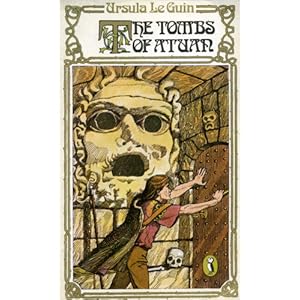
Of the three novels making up the original Earthsea trilogy, The Tombs of Atuan is most obviously aimed at children. This is not so much because of its content (like the others, it's unusually dark for a children's story) but because of what might have been its content; if it had been written for adults, there are several areas which le Guin would probably have explored more thoroughly.
The central character of The Tombs of Atuan is a young girl, believed to be the reincarnation of the Priestess of the Tombs, a centre for the power of primordial dark spirits, the Nameless Ones. At the age of six, she is taken to the Temple where her name is ceremonially taken from her (names are of extreme importance in the trilogy), so that she becomes Arha, the Eaten One. After some years, she suddenly discovers that a man has broken into the Labyrinth beneath the Temple, the place where no one but her is permitted to go. This man is Sparrowhawk, the central character of the trilogy, who is searching for a lost magical item.
The depiction of the ritual of the Temple an the dark fear which is the general attitude to the Nameless Ones is an important part of the novel, and the former clearly owes something to anthropological descriptions of rituals and Jungian ideas about them. (Le Guin's father was an anthropologist.) It is all very convincing. This could have been more developed in an adult novel, whose readers would be less impatient to move on with the story. The political rivalry between the various priestesses is another area which could have been made more of; Arha is nominally most important, but the middle-aged High Priestess of the newer cult of the Godking is a more dominant personality, and it is her temple, of the deified ruler of the empire in which the island of Atuan is situated, which receives rich gifts and patronage.
The obsession which Arha feels about Sparrowhawk definitely seems to have a sexual side, the fascination of a young teenage girl for the first man she has seen since she was brought to the Temple except her eunuch slaves. This is hinted at quite clearly, but it is another aspect of the novel which might have been made more explicit if it had been aimed at adult readers. In fact, it is picked up in Tehanu, the novel later added to the trilogy, which is meant to be read by adults.
It is common for the middle volume in a trilogy to be the poorest; though this is true of The Tombs of Atuan it is not for the usual reasons (and is, of course, a judgement only relative to the others). Still an excellent young adult fantasy story, it could have formed the nucleus of a greater adult novel.
Review number: 860
Of the three novels making up the original Earthsea trilogy, The Tombs of Atuan is most obviously aimed at children. This is not so much because of its content (like the others, it's unusually dark for a children's story) but because of what might have been its content; if it had been written for adults, there are several areas which le Guin would probably have explored more thoroughly.
The central character of The Tombs of Atuan is a young girl, believed to be the reincarnation of the Priestess of the Tombs, a centre for the power of primordial dark spirits, the Nameless Ones. At the age of six, she is taken to the Temple where her name is ceremonially taken from her (names are of extreme importance in the trilogy), so that she becomes Arha, the Eaten One. After some years, she suddenly discovers that a man has broken into the Labyrinth beneath the Temple, the place where no one but her is permitted to go. This man is Sparrowhawk, the central character of the trilogy, who is searching for a lost magical item.
The depiction of the ritual of the Temple an the dark fear which is the general attitude to the Nameless Ones is an important part of the novel, and the former clearly owes something to anthropological descriptions of rituals and Jungian ideas about them. (Le Guin's father was an anthropologist.) It is all very convincing. This could have been more developed in an adult novel, whose readers would be less impatient to move on with the story. The political rivalry between the various priestesses is another area which could have been made more of; Arha is nominally most important, but the middle-aged High Priestess of the newer cult of the Godking is a more dominant personality, and it is her temple, of the deified ruler of the empire in which the island of Atuan is situated, which receives rich gifts and patronage.
The obsession which Arha feels about Sparrowhawk definitely seems to have a sexual side, the fascination of a young teenage girl for the first man she has seen since she was brought to the Temple except her eunuch slaves. This is hinted at quite clearly, but it is another aspect of the novel which might have been made more explicit if it had been aimed at adult readers. In fact, it is picked up in Tehanu, the novel later added to the trilogy, which is meant to be read by adults.
It is common for the middle volume in a trilogy to be the poorest; though this is true of The Tombs of Atuan it is not for the usual reasons (and is, of course, a judgement only relative to the others). Still an excellent young adult fantasy story, it could have formed the nucleus of a greater adult novel.
Labels:
children's fiction,
Earthsea series,
fantasy,
fiction,
Ursula K Le Guin
Wednesday, 27 June 2001
Ursula K. Le Guin: A Wizard of Earthsea (1968)
Edition: Puffin, 1971
I enjoy Le Guin's writing much more when it is not being used to promote a particular agenda; this is not because of disagreement with what she is trying to say, but because the serious nature of her intention tends to overshadow the story itself. Even after more than twenty years since I first read this novel, and despite it being aimed at (older) children, A Wizard of Earthsea still holds my imagination more than any of her other stories.
Le Guin's story seems at first to be a retelling of one of the stock scenarios of young adult fantasy, the story of a young magician coming into his power. However, at least two things make the novel stand out. The first is the use which is made of the contrast between the noble, courtly and lettered, and the simple, folky and illiterate. Sparrowhawk, born in a poor village, yearns for the nobility that his magic gifts could bring; but as he grows he takes knowledge from the noble but must learn wisdom - in particular, patience, humility and self-control - from those closer to his own background. Even today, and despite Tolkien's example, most fantasy almost exclusively concentrates on the very highest levels of feudal society, at the expense of the less glamourous commoners.
The other important element is the nature of Sparrowhawk's struggle. This is not a story of a battle against evil in the world or of other men's devising (though he does fight dragons). In a foolish, forbidden duel with another student wizard, Sparrowhawk sets free a shadow, an evil presence from the world of the dead; he himself has to overcome it. It is against the consequences of his own pride that he fights, and le Guin gives the shadow an evil spirituality which is quite frightening. more so than purely phsyical dangers would be.
Through the battle with the shadow le Guin is trying to make a point, but it is kept more in check than usual and is sufficiently general that it doesn't overwhelm the story. This point is that it is often ourselves who are our own greatest enemies when it comes to growing up, to becoming who we could be at our best.
When this slightly deeper than usual storyline is presented in a well imagined and realised background with good characterisation, the result is a classic, and that is what A Wizard of Earthsea and its sequels have become.
I enjoy Le Guin's writing much more when it is not being used to promote a particular agenda; this is not because of disagreement with what she is trying to say, but because the serious nature of her intention tends to overshadow the story itself. Even after more than twenty years since I first read this novel, and despite it being aimed at (older) children, A Wizard of Earthsea still holds my imagination more than any of her other stories.
Le Guin's story seems at first to be a retelling of one of the stock scenarios of young adult fantasy, the story of a young magician coming into his power. However, at least two things make the novel stand out. The first is the use which is made of the contrast between the noble, courtly and lettered, and the simple, folky and illiterate. Sparrowhawk, born in a poor village, yearns for the nobility that his magic gifts could bring; but as he grows he takes knowledge from the noble but must learn wisdom - in particular, patience, humility and self-control - from those closer to his own background. Even today, and despite Tolkien's example, most fantasy almost exclusively concentrates on the very highest levels of feudal society, at the expense of the less glamourous commoners.
The other important element is the nature of Sparrowhawk's struggle. This is not a story of a battle against evil in the world or of other men's devising (though he does fight dragons). In a foolish, forbidden duel with another student wizard, Sparrowhawk sets free a shadow, an evil presence from the world of the dead; he himself has to overcome it. It is against the consequences of his own pride that he fights, and le Guin gives the shadow an evil spirituality which is quite frightening. more so than purely phsyical dangers would be.
Through the battle with the shadow le Guin is trying to make a point, but it is kept more in check than usual and is sufficiently general that it doesn't overwhelm the story. This point is that it is often ourselves who are our own greatest enemies when it comes to growing up, to becoming who we could be at our best.
When this slightly deeper than usual storyline is presented in a well imagined and realised background with good characterisation, the result is a classic, and that is what A Wizard of Earthsea and its sequels have become.
Labels:
children's fiction,
Earthsea series,
fantasy,
fiction,
Ursula K Le Guin
Subscribe to:
Posts (Atom)