Edition: HarperCollins, 1997
Review number: 1283
This is the concluding novel not just of the long running Bernard Samson saga but of Len Deighton's fiction as a whole. It brings to a close a series of attempts to deal with the ending of the Cold War - an event with a big impact for an author of spy fiction: different settings tangential to the genre in MamISTA, City of Gold, and Violent Ward, and the story of the downfall of Communism itself in the last trilogy of Samson novels. I suspect that the difficulty Deighton experienced in finding a new theme appropriate to the times was a contributing factor to his stopping fiction writing when he did.
The reader's expectation with Charity is that it will wrap up the remaining loose ends, and leave Bernard and Fiona's future sorted out. Having read Spy Sinker, followers of the series know more about what really happened on the day of Fiona's return to West Berlin than Bernard does - so the big question is really how much does he find out, and how much pain does he bring on himself and those around him by his investigations?
Although Charity is set before the end of Soviet control over Eastern Europe, Deighton makes sure we know what happens after the end of the novel with little ironic reminders - such as describing a falling person as looking "like a toppling statue of a tyrant". The ending itself is rather abrupt; the last chapter comes with something of a jerk. It is really about new beginnings for the characters, starting relationships over again - entirely appropriate, given the huge changes about to impact their world.
Three series characters dominate British spy fiction: James Bond, George Smiley, and Bernard Samson. They are all quite different from each other, even if you could argue that Bernard is very similar to Deighton's earlier Harry Palmer character and something of a mix of the other two. Smiley is all subtle intellectual; James Bond is all brute force action. Bernard does both parts, and this makes him both more exciting to read about than Le Carré's character and more interesting and certainly less unpleasant than Ian Fleming's. More is revealed about Bernard's inner character than about either Smiley or Bond, even though his narration (and neither Smiley or Bond is every allowed the luxury of telling their own story) is written in such a way that it is clear that Bernard is hiding quite a lot. This of course makes him more believable as a character, as does the way that his powers as an intellectual spy master and an action hero are both carefully limited by Deighton, presumably to this end. The series (ten novels in all, including a prequel not involving Bernard personally) is a substantial body of work, intimately connected to the fall of Communist East Germany and thus a major fictionalisation of some of the most important historical events of the last half century.
Showing posts with label Cold War. Show all posts
Tuesday, 25 January 2005
Tuesday, 14 December 2004
Len Deighton: Hope (1995)
Edition: HarperCollins, 1995
Review number: 1279
The Bernard Samson story continues, as the waves thrown up by his brother in law George Kosinski's attempts to investigate the death of his wife (Bernard's wife's sister) continue to threaten to reveal all kinds of unwelcome facts about the actions of British Intelligence in the closing months of the Cold War. (Tessa Kosinski had been killed during her sister's escape from East Germany where she had been working undercover - a British agent who was a senior official in the Stasi secret police.) Now George has himself disappeared, apparently either escaping from or kidnapped by Stasi agents. Bernard undertakes a mission to George's family home, a big house in a remote part of Poland, protected from appropriation by the Communists by a series of compromises made with the regime over the years.
While it is clear when thinking about it dispassionately that the whole of the Bernard Samson series is to say the least unlikely, this is the first of the novels where the improbabilities mount up to the point where the reader takes notice before reaching the end. There is a feeling that Deighton has by this point rather run out of steam, that the third re-interpretation of the story behind Fiona Samson's apparent defection has just too little material to work on. The third trilogy was written rather longer after the events it describes than the earlier novels - Hope is set in 1987, but not published until 1995 - and so lacks the immediacy that they had. (This is apparent even reading them years later - Deighton obviously got fired up about describing the Cold War as it happened.) This also means of course that most readers will know what happens next: the rapid collapse of the Soviet bloc at the end of the eighties hangs over this third trilogy (I suspect it was written because Deighton felt that the reactions of a veteran intelligence officer familiar with Berlin to the demolition of the Wall would make interesting reading). Hope is the poorest novel in the whole sequence and what I have said about several of the others applies with more force here: start at the beginning with Berlin Game and you will want to read the whole Bernard Samson story; do not start in the middle or near the end.
Review number: 1279
The Bernard Samson story continues, as the waves thrown up by his brother in law George Kosinski's attempts to investigate the death of his wife (Bernard's wife's sister) continue to threaten to reveal all kinds of unwelcome facts about the actions of British Intelligence in the closing months of the Cold War. (Tessa Kosinski had been killed during her sister's escape from East Germany where she had been working undercover - a British agent who was a senior official in the Stasi secret police.) Now George has himself disappeared, apparently either escaping from or kidnapped by Stasi agents. Bernard undertakes a mission to George's family home, a big house in a remote part of Poland, protected from appropriation by the Communists by a series of compromises made with the regime over the years.
While it is clear when thinking about it dispassionately that the whole of the Bernard Samson series is to say the least unlikely, this is the first of the novels where the improbabilities mount up to the point where the reader takes notice before reaching the end. There is a feeling that Deighton has by this point rather run out of steam, that the third re-interpretation of the story behind Fiona Samson's apparent defection has just too little material to work on. The third trilogy was written rather longer after the events it describes than the earlier novels - Hope is set in 1987, but not published until 1995 - and so lacks the immediacy that they had. (This is apparent even reading them years later - Deighton obviously got fired up about describing the Cold War as it happened.) This also means of course that most readers will know what happens next: the rapid collapse of the Soviet bloc at the end of the eighties hangs over this third trilogy (I suspect it was written because Deighton felt that the reactions of a veteran intelligence officer familiar with Berlin to the demolition of the Wall would make interesting reading). Hope is the poorest novel in the whole sequence and what I have said about several of the others applies with more force here: start at the beginning with Berlin Game and you will want to read the whole Bernard Samson story; do not start in the middle or near the end.
Labels:
Bernard Samson,
Cold War,
fiction,
Len Deighton,
spy fiction,
thriller
Friday, 10 December 2004
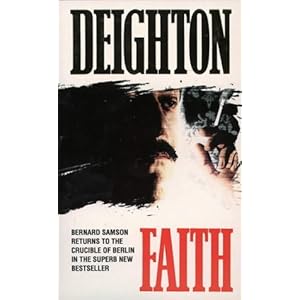
Len Deighton: Faith (1994)
Edition: HarperCollins, 1995
Review number: 1277
The third and final trilogy about Bernard Samson follos more or less straight on from the concluding moments of the preceding novels, skipping over only the months of recovery and debriefing on a remote Californian ranch that follow the escape of Bernard's wife Fiona from East Berlin where she has been a highly placed agent of the British Secret Service. (The setting is still in the days before the demolishing of the Wall.) The confusion left to be sorted out is immense - Bernard, for example, had been living with another woman, believing that Fiona was a defecting traitor; Fiona's sister Tess has apparently been killed in the fight on the autobahn linking Berlin to the West that was organised to cover Fiona's escape; rumours are flying round the Secret Service and no one has any idea what Fiona's role will be when and if she returns to work. Deighton left few loose ends at the end of London Match, the final novel in the first trilogy, but little is resolved in Spy Sinker, by contrast - it is much more obvious that the story would have to continue.
There are really two strands to Faith, one of which initially doesn't seem to be connected to the main narrative. This is a mission that Bernard is sent on to East Germany, to make contact with an officer who has secrets to sell to the West. The other is a private investigation into what happened on the night of the fight and to Tessa's body launched by her husband; this is clearly going to make waves by attempting to uncover secrets that others will want to keep hidden.
While the story naturally grows out of what has gone before, there are some changes of emphasis. We are back here with Bernard as a narrator, which works better than the third person used in Spy Sinker. More oddly, there has been an important change in emphasis which has been made without comment. Earlier, the point of the fight was to make it look as though Fiona had been killed, so that the East Germans and Russians don't know that she was working against them all this time. But now she and Bernard are openly living in the Mayfair flat that belonged to Tessa, and she is starting a high profile job in the London office - surely not something that will be overlooked by the Russian and East German agents still in London, no matter how much their respective countries are sliding into the economic chaos that was the penultimate stage in the fall of Soviet Communism.
Faith is one of the more downbeat Deighton novels, even in a series which focuses on betrayal. It is low key because, like Mexico Set in the first trilogy, it is about picking up the pieces after a trauma and starting again.
Review number: 1277
The third and final trilogy about Bernard Samson follos more or less straight on from the concluding moments of the preceding novels, skipping over only the months of recovery and debriefing on a remote Californian ranch that follow the escape of Bernard's wife Fiona from East Berlin where she has been a highly placed agent of the British Secret Service. (The setting is still in the days before the demolishing of the Wall.) The confusion left to be sorted out is immense - Bernard, for example, had been living with another woman, believing that Fiona was a defecting traitor; Fiona's sister Tess has apparently been killed in the fight on the autobahn linking Berlin to the West that was organised to cover Fiona's escape; rumours are flying round the Secret Service and no one has any idea what Fiona's role will be when and if she returns to work. Deighton left few loose ends at the end of London Match, the final novel in the first trilogy, but little is resolved in Spy Sinker, by contrast - it is much more obvious that the story would have to continue.
There are really two strands to Faith, one of which initially doesn't seem to be connected to the main narrative. This is a mission that Bernard is sent on to East Germany, to make contact with an officer who has secrets to sell to the West. The other is a private investigation into what happened on the night of the fight and to Tessa's body launched by her husband; this is clearly going to make waves by attempting to uncover secrets that others will want to keep hidden.
While the story naturally grows out of what has gone before, there are some changes of emphasis. We are back here with Bernard as a narrator, which works better than the third person used in Spy Sinker. More oddly, there has been an important change in emphasis which has been made without comment. Earlier, the point of the fight was to make it look as though Fiona had been killed, so that the East Germans and Russians don't know that she was working against them all this time. But now she and Bernard are openly living in the Mayfair flat that belonged to Tessa, and she is starting a high profile job in the London office - surely not something that will be overlooked by the Russian and East German agents still in London, no matter how much their respective countries are sliding into the economic chaos that was the penultimate stage in the fall of Soviet Communism.
Faith is one of the more downbeat Deighton novels, even in a series which focuses on betrayal. It is low key because, like Mexico Set in the first trilogy, it is about picking up the pieces after a trauma and starting again.
Labels:
Bernard Samson,
Cold War,
fiction,
Len Deighton,
spy fiction,
thriller
Wednesday, 10 November 2004
Len Deighton: Spy Sinker (1990)
Edition: Grafton, 1991
Review number: 1272
The final volume of the second Bernard Samson trilogy is absolutely and massively different from the five novels that precede it and the three that come after. Instead of narration by Bernard, with himself as the central character, we now get a (supposedly) objective third person narrative, which takes the setting back again to 1978 contemporary with that of Berlin Game and focuses on his wife, Fiona. (I say supposedly, because occasionally the objective mask is dropped, and remarks like one commenting that Fiona's public school background ideally prepared her for life as a double agent in East Germany are made.)
This sounds like a good idea; all along we have Bernard's not completely hones description of how he began to suspect his wife was a traitor, but then gradually discovered, following her defection, that she might be one of the most daring British agents of the Cold War. His position is as the victim of betrayal in both scenarios (as the husband of the agent, his particular difficulty is that he was left out of the secret). He is also not the central figure in his own drama, though the reader will tend to forget this because of the power implicit in being the narrator of the story. So how different is the picture from the point of view of the betrayer? This is Fiona's story, and it is perhaps to say something about her character that Deighton narrates in the third person, rather than producing a first person story from her side of things - more passive, perhaps.
In practise, it doesn't work as well as it sounds as though it should. Retelling the same story from a new point of view can work very well, when the new central character has something new to being to the tale (as in The Unbearable Lightness of Being, for example). Here, however, most of what we read either repeats what Bernard has said or is something the reader probably guessed from reading his account. (For example, we don't need to be given an explicit account to know that there must have been a high level meeting at which it was decided to keep the operation secret from Bernard.)
Another problem is that Fiona Samson is not as interesting or as believable a character as her husband. Of course, a large number of Deighton's earlier novels have central characters very similar to Bernard, so he had lots of practise before creating him, while Fiona is his only attempt at a female viewpoint character (barring short stretches from Only When I Larf). He may have been aware that she was less successful, and that is perhaps the reason why a fair amount of Spy Sinker concerns other characters - which in turn is a good reason why Fiona isn't given a first person narration.
As I have said before, to read Berlin Game is almost certainly enough to inspire you to go on and read the rest of the series, and there is certainly some interest here with the gaps that are filled in. But Spy Sinker is definitely the poorest of the Bernard Samson novels.
Review number: 1272
The final volume of the second Bernard Samson trilogy is absolutely and massively different from the five novels that precede it and the three that come after. Instead of narration by Bernard, with himself as the central character, we now get a (supposedly) objective third person narrative, which takes the setting back again to 1978 contemporary with that of Berlin Game and focuses on his wife, Fiona. (I say supposedly, because occasionally the objective mask is dropped, and remarks like one commenting that Fiona's public school background ideally prepared her for life as a double agent in East Germany are made.)
This sounds like a good idea; all along we have Bernard's not completely hones description of how he began to suspect his wife was a traitor, but then gradually discovered, following her defection, that she might be one of the most daring British agents of the Cold War. His position is as the victim of betrayal in both scenarios (as the husband of the agent, his particular difficulty is that he was left out of the secret). He is also not the central figure in his own drama, though the reader will tend to forget this because of the power implicit in being the narrator of the story. So how different is the picture from the point of view of the betrayer? This is Fiona's story, and it is perhaps to say something about her character that Deighton narrates in the third person, rather than producing a first person story from her side of things - more passive, perhaps.
In practise, it doesn't work as well as it sounds as though it should. Retelling the same story from a new point of view can work very well, when the new central character has something new to being to the tale (as in The Unbearable Lightness of Being, for example). Here, however, most of what we read either repeats what Bernard has said or is something the reader probably guessed from reading his account. (For example, we don't need to be given an explicit account to know that there must have been a high level meeting at which it was decided to keep the operation secret from Bernard.)
Another problem is that Fiona Samson is not as interesting or as believable a character as her husband. Of course, a large number of Deighton's earlier novels have central characters very similar to Bernard, so he had lots of practise before creating him, while Fiona is his only attempt at a female viewpoint character (barring short stretches from Only When I Larf). He may have been aware that she was less successful, and that is perhaps the reason why a fair amount of Spy Sinker concerns other characters - which in turn is a good reason why Fiona isn't given a first person narration.
As I have said before, to read Berlin Game is almost certainly enough to inspire you to go on and read the rest of the series, and there is certainly some interest here with the gaps that are filled in. But Spy Sinker is definitely the poorest of the Bernard Samson novels.
Labels:
Bernard Samson,
Cold War,
fiction,
Len Deighton,
spy fiction,
thriller
Tuesday, 26 October 2004
Len Deighton: Spy Line (1989)
Edition: Grafton, 1990
Review number: 1269
The start of this novel, second in the Hook, Line and Sinker trilogy, marks the lowest point of the career of British spy Bernard Samson, at least during the period documented by Deighton. The first scene is set in a seedy nightclub, from which Bernard goes to the squat where he is living in one of the most sordid areas of Berlin, a derelict housing estate up against the Wall. Here he is hiding from his employers, who have a warrant out for his arrest on suspicion of treason - all part of the events following his wife's defection to the Communists. As it turns out, Bernard is safer on the run than when he returns to the department, to be immediately sent out on a poorly organised and dangerous mission to Austria.
Though this seems to be a typical mid-trilogy novel, just keeping the plot ticking over, it has a huge shock in store. It also contains the beginning of Deighton's response to the changes brought by glasnost. The thawing of the Cold War was obviously a momentous event in the life of anyone who made a living from it, whether the spies who are the characters in Deighton's novels or the writer himself. At the start, he is not too impressed; he has a Berliner tell Bernard a joke in the very first scene of Spy Line - the only difference glasnost has brought to the Wall is that the frontier guards now shoot with silenced guns.
Bernard portrays himself as at the mercy of the machinations of others throughout the entire series (though his self image is clearly not entirely accurate), and this is particularly true in Spy Line. This is presumably because he is not at all happy with his own role at this point in the saga; the time has come when the betrayals are his own and when he has to make a decision that will be hurtful to those close to him whatever he does.
As I have said before in discussing other Bernard Samson books, this is a series to read from the beginning; do not start here, but with Berlin Game.
Review number: 1269
The start of this novel, second in the Hook, Line and Sinker trilogy, marks the lowest point of the career of British spy Bernard Samson, at least during the period documented by Deighton. The first scene is set in a seedy nightclub, from which Bernard goes to the squat where he is living in one of the most sordid areas of Berlin, a derelict housing estate up against the Wall. Here he is hiding from his employers, who have a warrant out for his arrest on suspicion of treason - all part of the events following his wife's defection to the Communists. As it turns out, Bernard is safer on the run than when he returns to the department, to be immediately sent out on a poorly organised and dangerous mission to Austria.
Though this seems to be a typical mid-trilogy novel, just keeping the plot ticking over, it has a huge shock in store. It also contains the beginning of Deighton's response to the changes brought by glasnost. The thawing of the Cold War was obviously a momentous event in the life of anyone who made a living from it, whether the spies who are the characters in Deighton's novels or the writer himself. At the start, he is not too impressed; he has a Berliner tell Bernard a joke in the very first scene of Spy Line - the only difference glasnost has brought to the Wall is that the frontier guards now shoot with silenced guns.
Bernard portrays himself as at the mercy of the machinations of others throughout the entire series (though his self image is clearly not entirely accurate), and this is particularly true in Spy Line. This is presumably because he is not at all happy with his own role at this point in the saga; the time has come when the betrayals are his own and when he has to make a decision that will be hurtful to those close to him whatever he does.
As I have said before in discussing other Bernard Samson books, this is a series to read from the beginning; do not start here, but with Berlin Game.
Labels:
Bernard Samson,
Cold War,
fiction,
Len Deighton,
spy fiction,
thriller
Friday, 24 September 2004
Len Deighton: Spy Hook (1988)
Edition: Grafton, 1989
Review number: 1266
Three years after the events of London Match, and Bernard Samson returns, to begin narrating the second trilogy of novels about himself and his wife. With Fiona firmly established in the KGB hierarchy in Berlin after her defection, and his gradual return to being trusted in his own work for British Intelligence, and with his continuing affair with a much younger woman, everything seemed more or less settled at the end of that novel; but now something happens which beings to unravel all the loose ends that the reader thought had been tied up.
The novel begins this process in the first chapter, which takes place in Washington DC. One of the interesting things about the Game, Set and Match trilogy is the remarkably small part played by the American intelligence agencies, especialy considering the post-war relationship between the US and British governments. The few American characters are either connected to British intelligence in some way or (appear to be) freelance information gatherers. Now, though, the US begins to be involved (though the office of the opening chapter belongs to an Englishman, a former colleague of Bernard's who is a financial expert). Nevertheless, the real focus is still Berlin; everything in this series of novels revolves around the city that was the symbol of the Cold War.
Spy Hook is very much a character based thriller - as Deighton's novels often tend to be. There is no action "for the sake of it" in his novels, and this is more cerebral than most of them. Bernard still has an overwhelming desire to understand why his wife not only defected but abandoned him and the children. The question that the reader has to ask - if they have followed the series of novels so far - is whether the discrepancies he sees are really there, or alternatively that he's clutching at these tiny loose ends hoping that the whole tangle will fall apart. And, of course, this is only the first novel in a new trilogy, so we're not likely to find out anything other than how far Bernard is able to put other people's backs up.
Review number: 1266
Three years after the events of London Match, and Bernard Samson returns, to begin narrating the second trilogy of novels about himself and his wife. With Fiona firmly established in the KGB hierarchy in Berlin after her defection, and his gradual return to being trusted in his own work for British Intelligence, and with his continuing affair with a much younger woman, everything seemed more or less settled at the end of that novel; but now something happens which beings to unravel all the loose ends that the reader thought had been tied up.
The novel begins this process in the first chapter, which takes place in Washington DC. One of the interesting things about the Game, Set and Match trilogy is the remarkably small part played by the American intelligence agencies, especialy considering the post-war relationship between the US and British governments. The few American characters are either connected to British intelligence in some way or (appear to be) freelance information gatherers. Now, though, the US begins to be involved (though the office of the opening chapter belongs to an Englishman, a former colleague of Bernard's who is a financial expert). Nevertheless, the real focus is still Berlin; everything in this series of novels revolves around the city that was the symbol of the Cold War.
Spy Hook is very much a character based thriller - as Deighton's novels often tend to be. There is no action "for the sake of it" in his novels, and this is more cerebral than most of them. Bernard still has an overwhelming desire to understand why his wife not only defected but abandoned him and the children. The question that the reader has to ask - if they have followed the series of novels so far - is whether the discrepancies he sees are really there, or alternatively that he's clutching at these tiny loose ends hoping that the whole tangle will fall apart. And, of course, this is only the first novel in a new trilogy, so we're not likely to find out anything other than how far Bernard is able to put other people's backs up.
Labels:
Bernard Samson,
Cold War,
fiction,
Len Deighton,
spy fiction,
thriller
Tuesday, 7 September 2004
Len Deighton: London Match (1985)
Edition: Grafton, 1986
Review number: 1263
The third novel in the Game, Set and Match trilogy continues the story of how Bernard Samson copes with the aftermath of his wife's defection to the Soviet Union, the event which provided the climax to Berlin Game. KGB officer Erich Stinnes has in his turn defected - the central action of Mexico Set. And now it appears, from what London's intelligence services learn from Stinnes and other agents, that there is another KGB agent in a senior position in the Secret Intelligence Service. This time the novel is not so much concerned with the identity of the traitor, as the first part of the trilogy had been, but with whether the person pinpointed by the allegations is guilty or not. It certainly quickly becomes in the personal interests of many of the characters to support and exaggerate the rumours going round - this is office politics on a large scale.
The importance of the city of Berlin to this trilogy is hard to exaggerate. As a symbol of the Cold War it is unsurpassed, and so this is frequently true of spy fiction of that era. The divided city with its crazy town planning that resulted from being split makes an atmospheric background for these tales of betrayal. Mexico Set and London Match may use the names of other locations from Bernard's story for their titles, but Berlin is more important in the novels than either of them. So it is fitting that the final scene of the whole trilogy takes place in Berlin (though enough loose ends are left that it must have seemed unlikely that this was the last novel featuring Bernard Samson even before the appearance of Spy Hook.
Berlin Game is the best of these three novels, and indeed of all nine stories featuring Samson as the central character. But no one who has read that novel will fail to want to read the others, and they are rewarding too; Deighton is one of the best of thriller writers even when not at the absolute peak of form.
Review number: 1263
The third novel in the Game, Set and Match trilogy continues the story of how Bernard Samson copes with the aftermath of his wife's defection to the Soviet Union, the event which provided the climax to Berlin Game. KGB officer Erich Stinnes has in his turn defected - the central action of Mexico Set. And now it appears, from what London's intelligence services learn from Stinnes and other agents, that there is another KGB agent in a senior position in the Secret Intelligence Service. This time the novel is not so much concerned with the identity of the traitor, as the first part of the trilogy had been, but with whether the person pinpointed by the allegations is guilty or not. It certainly quickly becomes in the personal interests of many of the characters to support and exaggerate the rumours going round - this is office politics on a large scale.
The importance of the city of Berlin to this trilogy is hard to exaggerate. As a symbol of the Cold War it is unsurpassed, and so this is frequently true of spy fiction of that era. The divided city with its crazy town planning that resulted from being split makes an atmospheric background for these tales of betrayal. Mexico Set and London Match may use the names of other locations from Bernard's story for their titles, but Berlin is more important in the novels than either of them. So it is fitting that the final scene of the whole trilogy takes place in Berlin (though enough loose ends are left that it must have seemed unlikely that this was the last novel featuring Bernard Samson even before the appearance of Spy Hook.
Berlin Game is the best of these three novels, and indeed of all nine stories featuring Samson as the central character. But no one who has read that novel will fail to want to read the others, and they are rewarding too; Deighton is one of the best of thriller writers even when not at the absolute peak of form.
Labels:
Bernard Samson,
Cold War,
fiction,
Len Deighton,
spy fiction,
thriller
Tuesday, 24 August 2004
Len Deighton: Mexico Set (1985)
Edition: Grafton, 1986 (Buy from Amazon)
Review number: 1261
I don't think it would be possible to write sensibly about the second novel in the Game, Set and Match trilogy without giving away an important part of the plot of Berlin Game, the first one. So I'm not even going to try. Mexico Set is all about how Bernard Samson copes when his wife defects to the Russians after he uncovers the fact that she is a KGB agent (they were both senior members of the British secret service). So the novel is about Bernard's personal and professional difficulties; he has to try to work out how much of their marriage was a sham, t otry and be there for his children (which he fails miserably to do) and to deflect the questioning of his own loyalty by his colleagues - surely, they say, he should have suspected Fiona long ago, if he himself was innocent.
The plot of Mexico Set is about Bernard trying to persuade a KGB officer - Stinnes, who appeared at the end of Berlin Game and who works for Fiona- to defect. Once again, the narrative is cleverly done so that it doesn't just given an impression of Bernard's feelings, but also conveys something of how much he isn't saying. (How has this man, who views himself as reasonable and professional, come to be so feared by his colleagues?) The various backgrounds, from the sleaze of Mexico City to the paranoia of Berlin, are atmospheric and tightly integrated into the feelings that the novel produces as it is read - treachery is just so much more plausible in the settings Deighton provides for it. Everything about the novel fits together efficiently, and is about enhancing its effectiveness.
Mexico Set is mainly concerned with Bernard's character, which makes it seem a little low key for a modern thriller. Although the reader has the impression that there is not a great deal of action, in fact there is a fair amount of violence, all of it the consequence of some betrayal - by Fiona, or the deskbound officials in London (both of Bernard), or of one Russian agent by another. Betrayal is of course the main theme of the whole trilogy, but Mexico Set is remarkable for the number of different acts of bad faith.
Anyone who reads Berlin Match is very likely to read on through the rest of the trilogy (and quite probably through the other seven novels relating to Bernard Samson); together, they form one of the premier classics of the thriller genre. I am not quite sure how well Mexico Set would work by itself, having only every read it immediately following its predecessor, but I would certainly advise prospective readers to start at the beginning with Berlin Game.
Review number: 1261
I don't think it would be possible to write sensibly about the second novel in the Game, Set and Match trilogy without giving away an important part of the plot of Berlin Game, the first one. So I'm not even going to try. Mexico Set is all about how Bernard Samson copes when his wife defects to the Russians after he uncovers the fact that she is a KGB agent (they were both senior members of the British secret service). So the novel is about Bernard's personal and professional difficulties; he has to try to work out how much of their marriage was a sham, t otry and be there for his children (which he fails miserably to do) and to deflect the questioning of his own loyalty by his colleagues - surely, they say, he should have suspected Fiona long ago, if he himself was innocent.
The plot of Mexico Set is about Bernard trying to persuade a KGB officer - Stinnes, who appeared at the end of Berlin Game and who works for Fiona- to defect. Once again, the narrative is cleverly done so that it doesn't just given an impression of Bernard's feelings, but also conveys something of how much he isn't saying. (How has this man, who views himself as reasonable and professional, come to be so feared by his colleagues?) The various backgrounds, from the sleaze of Mexico City to the paranoia of Berlin, are atmospheric and tightly integrated into the feelings that the novel produces as it is read - treachery is just so much more plausible in the settings Deighton provides for it. Everything about the novel fits together efficiently, and is about enhancing its effectiveness.
Mexico Set is mainly concerned with Bernard's character, which makes it seem a little low key for a modern thriller. Although the reader has the impression that there is not a great deal of action, in fact there is a fair amount of violence, all of it the consequence of some betrayal - by Fiona, or the deskbound officials in London (both of Bernard), or of one Russian agent by another. Betrayal is of course the main theme of the whole trilogy, but Mexico Set is remarkable for the number of different acts of bad faith.
Anyone who reads Berlin Match is very likely to read on through the rest of the trilogy (and quite probably through the other seven novels relating to Bernard Samson); together, they form one of the premier classics of the thriller genre. I am not quite sure how well Mexico Set would work by itself, having only every read it immediately following its predecessor, but I would certainly advise prospective readers to start at the beginning with Berlin Game.
Labels:
Bernard Samson,
Cold War,
fiction,
Len Deighton,
spy fiction,
thriller
Saturday, 14 August 2004
Len Deighton: Berlin Game (1983)
Edition: Grafton, 1984 (Buy from Amazon)
Review number: 1259
While no one who read The Ipcress File could deny that Len Deighton was one of the great spy fiction writers, several of his other novels seem quite tired. With Berlin Game, and indeed the whole of the Game, Set and Match trilogy, everything came together once again; this story would no doubt join Deighton's debut in many fans' lists of the absolute top spy stories. It is not surprising that Bernard Samson dominated the rest of Deighton's output in the same way that Harry Palmer did in the sixties.
From a plotting point of view, there are a lot of points of similarity between the two novels. Both are supreme examples of the "which of my colleagues is a traitor" storyline, and both are told by a world weary, cynical narrator. Both are set mainly in London, but with a second focus elsewhere - in each case, somewhere crucial to the unravelling of the treachery: Berlin here (obviously) and an American nuclear testing facility in The Ipcress File; the London scenes are mainly about office politics. Like Palmer, Samson doesn't quite fit in; twenty years after The Ipcress File, the secret service is still full of Oxbridge types who look down on someone who never went to university at all; both narrators have a serious chip on their shoulder about this, and the attitude is something of a constant theme in Deighton's writing about the secret service as part of the British establishment.
The main difference between the two narrators is in the situations of the narrators in the two novels. Bernard Samson is considerably older, and he is married (to another senior official from "the Department") with two youngish children. Harry Palmer's career began during the Second World War, Bernard grew up in post-war Berlin. These two changes make considerable difference; Bernard is willing to attribute more complex motives to those around him, and recognises shades of grey in treachery which would never occur to Harry. Bernard is so world weary that each betrayal just adds its bit to the total sadness in the world; there is nothing to be surprised about, no real blame to award, for treachery is only to be expected. And yet, even so, those around him describe Bernard as an optimist.
So Bernard Samson is an older, more settled character, and that affects every aspect of Berlin Game, from the amount of action to his analysis of motivations. Even without many of the traditional thrills of the genre, the novel keeps the reader enthralled from beginning to end. It is the characterisation of the narrator which does this - Deighton is subtle enough that we don't just get Bernard Samson as described by himself, but are able to see through that to a real character underneath. The Ipcress File might be more original (Berlin Game being very much derived from it), and it might have had more influence on other writers; but in Berlin Game Deighton has created not just another classic thriller, but one which is in my opinion better than its model.
Review number: 1259
While no one who read The Ipcress File could deny that Len Deighton was one of the great spy fiction writers, several of his other novels seem quite tired. With Berlin Game, and indeed the whole of the Game, Set and Match trilogy, everything came together once again; this story would no doubt join Deighton's debut in many fans' lists of the absolute top spy stories. It is not surprising that Bernard Samson dominated the rest of Deighton's output in the same way that Harry Palmer did in the sixties.
From a plotting point of view, there are a lot of points of similarity between the two novels. Both are supreme examples of the "which of my colleagues is a traitor" storyline, and both are told by a world weary, cynical narrator. Both are set mainly in London, but with a second focus elsewhere - in each case, somewhere crucial to the unravelling of the treachery: Berlin here (obviously) and an American nuclear testing facility in The Ipcress File; the London scenes are mainly about office politics. Like Palmer, Samson doesn't quite fit in; twenty years after The Ipcress File, the secret service is still full of Oxbridge types who look down on someone who never went to university at all; both narrators have a serious chip on their shoulder about this, and the attitude is something of a constant theme in Deighton's writing about the secret service as part of the British establishment.
The main difference between the two narrators is in the situations of the narrators in the two novels. Bernard Samson is considerably older, and he is married (to another senior official from "the Department") with two youngish children. Harry Palmer's career began during the Second World War, Bernard grew up in post-war Berlin. These two changes make considerable difference; Bernard is willing to attribute more complex motives to those around him, and recognises shades of grey in treachery which would never occur to Harry. Bernard is so world weary that each betrayal just adds its bit to the total sadness in the world; there is nothing to be surprised about, no real blame to award, for treachery is only to be expected. And yet, even so, those around him describe Bernard as an optimist.
So Bernard Samson is an older, more settled character, and that affects every aspect of Berlin Game, from the amount of action to his analysis of motivations. Even without many of the traditional thrills of the genre, the novel keeps the reader enthralled from beginning to end. It is the characterisation of the narrator which does this - Deighton is subtle enough that we don't just get Bernard Samson as described by himself, but are able to see through that to a real character underneath. The Ipcress File might be more original (Berlin Game being very much derived from it), and it might have had more influence on other writers; but in Berlin Game Deighton has created not just another classic thriller, but one which is in my opinion better than its model.
Labels:
Bernard Samson,
Cold War,
fiction,
Len Deighton,
spy fiction,
thriller
Friday, 19 January 2001
Helena Osborne: The Joker (1979)
Edition: Hodder & Stoughton, 1980
Review number: 722
Susie Burke is an actress, one who obtains parts more for her
looks than her ability. She also carries out slightly shady jobs on
the fringes of the intelligence world, entertaining people who need
to be kept out of the way for one reason or another. She is also
having a clandestine affair with Home Secretary David Hallam.
The various threads of her life become entagled when she is
involved in the search for Eva Pech, a senior Hungarian official
who has disappeared in England - possibly kidnapped, possibly in
hiding before attempting to defect.
Written from Susie's point of view, The Joker is an
amusing thriller. Susie is not as dumb as she acts, but it does
take her a fair amount of time to work out exactly what is going
on. She does so just in time to provide quite a tense ending.
Enjoyable, undemanding, fun.
Review number: 722
Susie Burke is an actress, one who obtains parts more for her
looks than her ability. She also carries out slightly shady jobs on
the fringes of the intelligence world, entertaining people who need
to be kept out of the way for one reason or another. She is also
having a clandestine affair with Home Secretary David Hallam.
The various threads of her life become entagled when she is
involved in the search for Eva Pech, a senior Hungarian official
who has disappeared in England - possibly kidnapped, possibly in
hiding before attempting to defect.
Written from Susie's point of view, The Joker is an
amusing thriller. Susie is not as dumb as she acts, but it does
take her a fair amount of time to work out exactly what is going
on. She does so just in time to provide quite a tense ending.
Enjoyable, undemanding, fun.
Labels:
Cold War,
fiction,
Helena Osborne,
spy fiction,
thriller
Thursday, 18 January 2001
Helen MacInnes: Agent in Place (1976)
Edition: William Collins, 1977
Review number: 720
At its beginning, Agent in Place is about the leak of a NATO memo to the American press. However, it becomes clear that the Russians have orchestrated the leak of the comparatively innocuous first part of the memo to get hold of the second and third parts, which detail the reasoning behind the first part and so provide information which will enable them to unmask important Western agents.
As the investigation into the leak proceeds, and the action of the novel moves from New York to the Riviera resort of Menton, it keeps becoming clear that the situation is more serious than the reader and the investigators suspected. This is how MacInnes raises the tension and keeps up the suspense in what is a good Cold War thriller.
Review number: 720
At its beginning, Agent in Place is about the leak of a NATO memo to the American press. However, it becomes clear that the Russians have orchestrated the leak of the comparatively innocuous first part of the memo to get hold of the second and third parts, which detail the reasoning behind the first part and so provide information which will enable them to unmask important Western agents.
As the investigation into the leak proceeds, and the action of the novel moves from New York to the Riviera resort of Menton, it keeps becoming clear that the situation is more serious than the reader and the investigators suspected. This is how MacInnes raises the tension and keeps up the suspense in what is a good Cold War thriller.
Labels:
Cold War,
fiction,
Helen MacInnes,
spy fiction,
thriller
Saturday, 13 January 2001
Anne Stevenson: Turkish Rondo (1981)
Edition: Piatkus, 1981 (Buy from Amazon)
Review number: 715
A whirlwind romance ends in marriage for Frances Howard and Robert Denning, but when Robert disappears Frances starts to learn things about her new husband that she had never suspected. She follows him to Greece and then to the tense area around Van in eastern Turkey - near the Russian border, and home to rebellious Kurdish tribes.
In essence, Turkish Rondo is a standard Cold War thriller, but with the elements twisted around and the marriage given so much importance that it becomes more the centre of the novel than the usual parts of the plot. (This of course helps greatly for the characterisation of Frances.) Having a thriller begin with a marriage is quite unusual; as a result, Turkish Rondo is inventive and romantic.
Review number: 715
A whirlwind romance ends in marriage for Frances Howard and Robert Denning, but when Robert disappears Frances starts to learn things about her new husband that she had never suspected. She follows him to Greece and then to the tense area around Van in eastern Turkey - near the Russian border, and home to rebellious Kurdish tribes.
In essence, Turkish Rondo is a standard Cold War thriller, but with the elements twisted around and the marriage given so much importance that it becomes more the centre of the novel than the usual parts of the plot. (This of course helps greatly for the characterisation of Frances.) Having a thriller begin with a marriage is quite unusual; as a result, Turkish Rondo is inventive and romantic.
Tuesday, 10 October 2000
Helen MacInnes: The Snare of the Hunter (1974)
Edition: William Collins, 1975
Review number: 650
The Snare of the Hunter is a competent Cold War thriller with minor literary aspirations (one of the characters, at the centre of the plot even if he never appears on stage, is an amalgamation of Alexander Solzhenitsyn and Vaclav Havel). Successful American music critic David Mennery is on the point of packing to travel to the Salzburg festival when an acquaintance turns up whom he hasn't seen for a few years, with a strange request. As a student, David had travelled to Prage, where he had got to know Irina, daughter of dissident novelist Jaromir Kusak. In the intervening years, she has married a senior secret policeman, but now she has fled from Czechoslovakia, wanting to see her father again. (He is living in hiding somewhere in Western Europe.)
Because of her connection with the Czech secret police, she is considered too dangerous for any of the Western secret agencies to aid her, and so it has fallen to a group of amateurs to try to get her out of the flat in Vienna where she is hiding. This leads to a chase across Austria, Czech agents only just behind David and Irina, and it soon becomes clear that one of those supposedly trying to help her is in fact betraying their movements to her husband.
It's quite a complicated plot, but the main interest is the chase, and that is straightforward. More could have been made of character - resuming a relationship that had been abruptly terminated by the Russian invasion of 1968 could be far more interesting than it is here - but The Snare of the Hunter achieves suspense and excitement, precisely what a thriller is meant to do.
Review number: 650
The Snare of the Hunter is a competent Cold War thriller with minor literary aspirations (one of the characters, at the centre of the plot even if he never appears on stage, is an amalgamation of Alexander Solzhenitsyn and Vaclav Havel). Successful American music critic David Mennery is on the point of packing to travel to the Salzburg festival when an acquaintance turns up whom he hasn't seen for a few years, with a strange request. As a student, David had travelled to Prage, where he had got to know Irina, daughter of dissident novelist Jaromir Kusak. In the intervening years, she has married a senior secret policeman, but now she has fled from Czechoslovakia, wanting to see her father again. (He is living in hiding somewhere in Western Europe.)
Because of her connection with the Czech secret police, she is considered too dangerous for any of the Western secret agencies to aid her, and so it has fallen to a group of amateurs to try to get her out of the flat in Vienna where she is hiding. This leads to a chase across Austria, Czech agents only just behind David and Irina, and it soon becomes clear that one of those supposedly trying to help her is in fact betraying their movements to her husband.
It's quite a complicated plot, but the main interest is the chase, and that is straightforward. More could have been made of character - resuming a relationship that had been abruptly terminated by the Russian invasion of 1968 could be far more interesting than it is here - but The Snare of the Hunter achieves suspense and excitement, precisely what a thriller is meant to do.
Tuesday, 29 August 2000
Derek Lambert: The Yermakov Transfer (1974)
Edition: Arlington Books, 1974
Review number: 588
The Yermakov Transfer is unusal among Cold War thrillers in being entirely set in the Soviet Union, almost all of it happening on a journey along the Trans-Siberian Railway. It is a particularly significant journey, because one of the passengers is the Russian premier, Vasily Yermakov. A group of Jewish dissidents has come up with the idea of kidnapping him, demanding that several prominent Jewish scientists be granted exit visas so that they can emigrate to Israel.
With many Russian characters, The Yermakov Transfer is a novel infused with the fear of the gulag, and it clearly shows the influence of Solzhenitsyn's Day in the Life of Ivan Denisovitch. It is decidedly at the literary end of the thriller market, and, though its ending might be considered predictable, has plenty of excitement.
Review number: 588
The Yermakov Transfer is unusal among Cold War thrillers in being entirely set in the Soviet Union, almost all of it happening on a journey along the Trans-Siberian Railway. It is a particularly significant journey, because one of the passengers is the Russian premier, Vasily Yermakov. A group of Jewish dissidents has come up with the idea of kidnapping him, demanding that several prominent Jewish scientists be granted exit visas so that they can emigrate to Israel.
With many Russian characters, The Yermakov Transfer is a novel infused with the fear of the gulag, and it clearly shows the influence of Solzhenitsyn's Day in the Life of Ivan Denisovitch. It is decidedly at the literary end of the thriller market, and, though its ending might be considered predictable, has plenty of excitement.
Labels:
Cold War,
Derek Lambert,
fiction,
Russia,
thriller
Thursday, 24 September 1998
John le Carré: The Looking Glass War (1965)
Edition: Pan, 1975
Review number: 118
The Looking Glass War, classic John le Carré, is a damning indictment of an amateur attitude in a professional world. It is about a small intelligence agency, a left-over from the war that by the late sixties had been over for more than twenty years, which is virtually defunct but valued for its archives. A rumour of odd troop movements in East Germany prompts it to an overflight by a pilot of a commercial aircraft to take photographs while pretending to go off course. The man from the agency trying to collect the film he has taken is killed, apparently from a hit and run accident, though the film has been taken from the body.
His death prompts Leclerc, in charge of the agency since the war, to consider running an agent for the first time in twenty years. This agent is prepared and equipped in the fashion appropriate in 1945; no one has any idea that things have changed. The equipment he is given includes a drastically obsolete radio transmitter. The agent is a bitter loner, himself left over from the war when he was betrayed to the Germans in its last days. The whole proceedings are watched by the naive Avery, new since the war; he is the centre of the book. His admiration for Leclerc and what he acheived during the war tuens to horror as he realises that the agent is being sent to his death. In their enthusiasm for a return to the operational days of the war, none of the others even begin to see this. The only person who does is Smiley, observing what is going on (from a distance) for the Circus; but Control will not let him interfere in what is bound to be a disastrous mission and which will probably bring an end to an agency which is (however ineffectually) in competition with the Circus.
This is one of le Carré's greatest novels, the air of impending doom so well done that it is a struggle to read. It is a book not just about cynicism and disillusionment but also about the dangers of misplaced enthusiasm and stupidity.
The title is a reference to the distance between the dreams of the spymasters and the reality of the sixties cold war by relating it to the adventures of Alice (Through the Looking Glass).
Review number: 118
The Looking Glass War, classic John le Carré, is a damning indictment of an amateur attitude in a professional world. It is about a small intelligence agency, a left-over from the war that by the late sixties had been over for more than twenty years, which is virtually defunct but valued for its archives. A rumour of odd troop movements in East Germany prompts it to an overflight by a pilot of a commercial aircraft to take photographs while pretending to go off course. The man from the agency trying to collect the film he has taken is killed, apparently from a hit and run accident, though the film has been taken from the body.
His death prompts Leclerc, in charge of the agency since the war, to consider running an agent for the first time in twenty years. This agent is prepared and equipped in the fashion appropriate in 1945; no one has any idea that things have changed. The equipment he is given includes a drastically obsolete radio transmitter. The agent is a bitter loner, himself left over from the war when he was betrayed to the Germans in its last days. The whole proceedings are watched by the naive Avery, new since the war; he is the centre of the book. His admiration for Leclerc and what he acheived during the war tuens to horror as he realises that the agent is being sent to his death. In their enthusiasm for a return to the operational days of the war, none of the others even begin to see this. The only person who does is Smiley, observing what is going on (from a distance) for the Circus; but Control will not let him interfere in what is bound to be a disastrous mission and which will probably bring an end to an agency which is (however ineffectually) in competition with the Circus.
This is one of le Carré's greatest novels, the air of impending doom so well done that it is a struggle to read. It is a book not just about cynicism and disillusionment but also about the dangers of misplaced enthusiasm and stupidity.
The title is a reference to the distance between the dreams of the spymasters and the reality of the sixties cold war by relating it to the adventures of Alice (Through the Looking Glass).
Labels:
Cold War,
fiction,
John le Carré,
spy fiction,
thriller
Subscribe to:
Posts (Atom)