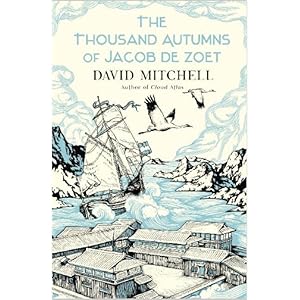
David Mitchell's fifth novel is his third to feature Japan as a setting, but does mark a new departure by being a historical novel. It is the story of Jacob de Zoet, a clerk working for the Dutch East India Company in the enclave on the island of Dejima near Nagasaki, in 1799 the only place where Europeans were permitted to trade with the Japanese (see the informative Wikipedia article on this here). The story starts when Jacob arrives in Japan, accompanying a new governor for the enclave, whose mission is to fight the endemic corruption among the Company traders, more interested in self-enrichment than the success of the Company as a whole. Jacob soon falls in love with an absolutely unattainable woman, a young girl of good breeding who is one of the students of a Western doctor on Dejima. (Her backstory is quite complicated, to explain how a woman who is neither a prostitute nor a concubine could meet a European, given that such women would normally neither be allowed on the island nor permitted to study Western medicine.)
The Thousand Autumns is a novel about culture clash, between two representatives of two countries effectively in decline. During the novel, the Netherlands is conquered by the French Revolutionary armies, after which its status as a colonial power is greatly lessened; the Japanese shoguns continue the policy of seclusion until 1853 (when the American navy forces the borders to be opened more fully) but even in 1799 it is pretty clear that this end is inevitable in the face of superior technology.
Like Ghostwritten, The Thousand Autumns has a supernatural element, in the doings of villainous abbot Enomoto. Through a bloody ritual involving the sacrifice of babies born to coerced and drugged nuns, he has gaind himself an unnaturally extended lifespan. It is tempting to believe that he is some kind of magic realist symbol, like the children in Midnight's Children, in this case an embodiment of the tyrannical and outdated isolationist regime of the Shogun. The picture of Japan on the cusp of the nineteenth century painted in this novel is pretty repellent, made up of fear, paranoia, and cruelty. Most of the European characters are not much better, either, being depicted as bigoted, uncultured, crude, and venal. Enomoto is not like most of the other Japanese characters, while the Europeans are less nasty but their vices are more widespread through the population.
With a historical novel, the question which is always asked is how accurate it is (though the answer does not necessarily make much difference to how enjoyable or interesting it is to read). Mitchell apparently went to a great deal of trouble to ensure that the details were accurate, but his own emotional reaction to the society may colour his writing about it; but even so, I would certainly not wish to have lived there and then. The attention to detail definitely makes the novel very convincing. This is not an episode of history I was particularly knowledgeable about, and it does make for a fascinating novel.
Not as good as Ghostwritten or numberNineDream, but more straightforward (and to my mind infinitely superior as a historical novel to Hilary Mantel's overrated Wolf Hall), I rate The Thousand Autumns of Jacob de Zoet at 8/10.
Edition: Sceptre, 2010
Review number: 1429
Showing posts with label David Mitchell. Show all posts
Saturday, 13 August 2011
Thursday, 26 October 2006
David Mitchell: Black Swan Green (2006)
Review number: 1316
With many considering Mitchell's previous novel, Cloud Atlas, to have been robbed of the Booker Prize a couple of years ago, and with Black Swan Green at one time the bookies' favourite from this year's long list, it was a big surprise when it was left off the short list entirely when it was announced in early September. Every year, I set out to try to read the half dozen novels on the short list, as they should include the best in literary fiction from the Commonwealth, and every year two or three of these novels are ones I find unreadable (or at least, unfinishable). The reasons for this can vary, but usually the problem is that I find them dull and unimaginative. Neither could be charges laid against Mitchell's work; his ideas are interesting, and the writing used to express them draws the reader into the world he describes.
Having said that, Black Swan Green is very different from Mitchell's first three novels. They all have some quirkiness about their narrative structure, like Iain Banks' early novels, that makes them not quite mainstream. Here, though, we have a straightforward first person narrative. In fact, the story of a thirteen year old boy in early eighties England reads like many first novels: it has a distinctly autobiographical feel to it. I don't know enough about Mitchell's life to decide whether or not it is based on his teenage years, but he is at least about the right age.
In fact, narrator Jason Taylor is almost exactly one year younger than myself; I was fourteen during 1982 not thirteen. Although I was also living in England, my circumstances were rather different from those of Jason Taylor, even though we actually shared experiences. While Jason was coping with bullying, learning about girls, discovering his talents as a poet and seeing the end of his parents' marriage, I was dealing with less subtle but more violent bullying (I still have scars on my back), learning about girls in the more restrictive environment of a single-sex school, discovering my talents in mathematics and music and learning to live with my father's disability (which followed a stroke a year earlier). These are fairly obvious similarities in our situations, which makes this book speak to me more strongly than it will to many other readers, but there were also differences. I was much more introspective than Taylor is made out to be, much less interested in popularity with others at school, for example. More of a geek, in other words. However, if I had written Black Swan Green, suspicions that it was semi-autobiographical would be well-founded.
So this is a well written, interesting novel with a believable central character. Why, then, has it been overlooked by the Booker jury? It is more conventional than Mitchell's earlier novels, but that should not matter when many of the books shortlisted in this and other years are as much, if not more, conventional. I have commented before on the attitude of the literary establishment to science fiction even today, but there are no genre elements in Black Swan Green at all. However, authors as well-regarded as Iain Banks have never been shortlisted at all, so it may be that just being a writer associated with science fiction can be enough to taint your name in the jury's eyes.
Labels:
David Mitchell,
English literature,
fiction,
literary fiction
Tuesday, 3 May 2005
David Mitchell: Cloud Atlas (2004)
Edition: Sceptre, 2005
Review number: 1292
Mitchell's third novel was the clear favourite for the Booker Prize in 2004, and when it didn't win, this seemed to catch many commentators by surprise. I like Mitchell's writing, and I have attempted to read several of the other novels which made up the rather lacklustre short list, and I echo this astonishment.
Like Ghostwritten and number9dream, Cloud Atlas shows Mitchell's delight in complex interlinked narratives, exactly the sort of literary puzzles which marked out Iain Banks' early novels. Here, there are six stories, arranged in layers - each one is available to the characters in the next in some literary form (journal, collection of letters, thriller in manuscript, film, recorded interview) moving from the late nineteenth century far into the future. There are other links between the tales, apart from this arrangement, which is rather reminiscent of The Arabian Nights (where tales are often interrupted while a character tells another story). There are hints that at least some of the central characters are reincarnations of others, though the chronology of the stories means that others of them have lives that overlap. A thematic link is much more important: the stories are all about resistence to unjust exploitation of the peaceful and weak by the strong, powerful and aggressive.
The best of the stories is the Michael Moore meets George Orwell dystopia, An Orison of Sonmi~415. Sonmi~451 is a clone, genetically engineered to be the perfect fast food restaurant server, who is "awakened" from her drug- and conditioning-induced acceptance of her life to an understanding of the horrows of the enslavement of a vast army of cheap workers in the service of rampant capitalism. But each of the stories could have been expanded into a full length novel in its own right, one which could have easily held the interest of readers (if not to the extent that Cloud Atlas does, where there is the additional attraction of the enigmas produced by the construction of the novel).
So the question is: why didn't Cloud Atlas win, if it is so good? Of course, not having been on the jury, I can't say for certain. There are several possible reasons that seem plausible to me, that together may have combined to spoil its chances. There is often something of a bias against the general favourite at these events, as people don't want to look as though they've just made the easy, obvious choice. There may have been a suspicion that the interlocking arrangement of the narrative is a bit facile (though certainly no more so than churning out another dull story of a dysfunctional family). There have been two quirkily different winners in the past two years (Life of Pi and Vernon God Little), and perhaps the jury felt that Cloud Atlas was a little too similar to these. Then there is a continuing snobbish attiude to novels (or, in this case, parts of novels) which seem to be genre fiction, no matter how well written: why is it, for example, that Iain Banks has never even been nominated? This applies particularly strongly to science fiction, but affects thrillers and crime fiction to an extent too. To write in a genre may bring popularity, but unless you are already part of the literary establishment will not bring critical success there, unless you are considered to write for children (like J.K. Rowling). If these are the reasons that caused Mitchell to miss out, it's a pity, for the imaginative range and dazzling technique shown in Cloud Atlas would have made it a deserving and memorable winner.
Review number: 1292
Mitchell's third novel was the clear favourite for the Booker Prize in 2004, and when it didn't win, this seemed to catch many commentators by surprise. I like Mitchell's writing, and I have attempted to read several of the other novels which made up the rather lacklustre short list, and I echo this astonishment.
Like Ghostwritten and number9dream, Cloud Atlas shows Mitchell's delight in complex interlinked narratives, exactly the sort of literary puzzles which marked out Iain Banks' early novels. Here, there are six stories, arranged in layers - each one is available to the characters in the next in some literary form (journal, collection of letters, thriller in manuscript, film, recorded interview) moving from the late nineteenth century far into the future. There are other links between the tales, apart from this arrangement, which is rather reminiscent of The Arabian Nights (where tales are often interrupted while a character tells another story). There are hints that at least some of the central characters are reincarnations of others, though the chronology of the stories means that others of them have lives that overlap. A thematic link is much more important: the stories are all about resistence to unjust exploitation of the peaceful and weak by the strong, powerful and aggressive.
The best of the stories is the Michael Moore meets George Orwell dystopia, An Orison of Sonmi~415. Sonmi~451 is a clone, genetically engineered to be the perfect fast food restaurant server, who is "awakened" from her drug- and conditioning-induced acceptance of her life to an understanding of the horrows of the enslavement of a vast army of cheap workers in the service of rampant capitalism. But each of the stories could have been expanded into a full length novel in its own right, one which could have easily held the interest of readers (if not to the extent that Cloud Atlas does, where there is the additional attraction of the enigmas produced by the construction of the novel).
So the question is: why didn't Cloud Atlas win, if it is so good? Of course, not having been on the jury, I can't say for certain. There are several possible reasons that seem plausible to me, that together may have combined to spoil its chances. There is often something of a bias against the general favourite at these events, as people don't want to look as though they've just made the easy, obvious choice. There may have been a suspicion that the interlocking arrangement of the narrative is a bit facile (though certainly no more so than churning out another dull story of a dysfunctional family). There have been two quirkily different winners in the past two years (Life of Pi and Vernon God Little), and perhaps the jury felt that Cloud Atlas was a little too similar to these. Then there is a continuing snobbish attiude to novels (or, in this case, parts of novels) which seem to be genre fiction, no matter how well written: why is it, for example, that Iain Banks has never even been nominated? This applies particularly strongly to science fiction, but affects thrillers and crime fiction to an extent too. To write in a genre may bring popularity, but unless you are already part of the literary establishment will not bring critical success there, unless you are considered to write for children (like J.K. Rowling). If these are the reasons that caused Mitchell to miss out, it's a pity, for the imaginative range and dazzling technique shown in Cloud Atlas would have made it a deserving and memorable winner.
Tuesday, 18 June 2002
David Mitchell: number9dream (2001)
Edition: Sceptre, 2001
Review number: 1097
It is, apparently, common for children who have never known a parent to weave fantasies about who they might be. Eiji Mayake is no exception, and as his twentieth birthday nears, he sets out for Tokyo to discover his identity through the only clue he has, the name of a lawyer. He is obsessed with John Lennon (which is one reason for the title) and his only skills are guitar playing and fruit picking, neither in much demand in the big city.
At the beginning, the novel is structured so that after a few paragraphs of reality, Mayake's fantasies take over, taking him, for example, into a James Bond world in which he stages a raid on the lawyer's office to get the name of his father. (This of course is another reason for the title.) After a while, it becomes much more difficult to distinguish "reality" and fiction. The nature of truth and fantasy is something which has fascinated many writers, possibly because of the irony inherent in any fictional treatment of the subject, but Mitchell manages to combine an experimental structure with an interesting readable story better (which includes several denunciations of the violence of the Yakuza) than many others who have tried to do this sort of thing. Mitchell has a fascination for playing with and subverting the forms of literature, part of a tradition which goes back to Tristram Shandy. (The final, ninth, section is precisely a case in point, as well as pointing back to the title and out from the story itself to what might happen afterwards.) While it doesn't seem derivative, nuber9dream reminds me of other writers as well as Sterne. I am sure that there are additional Japanese parallels I don't recognise, but I thought of early Iain Banks, John Barth and James Joyce (particularly in the Goatwriter stories) as I was reading number9dream.
Review number: 1097
It is, apparently, common for children who have never known a parent to weave fantasies about who they might be. Eiji Mayake is no exception, and as his twentieth birthday nears, he sets out for Tokyo to discover his identity through the only clue he has, the name of a lawyer. He is obsessed with John Lennon (which is one reason for the title) and his only skills are guitar playing and fruit picking, neither in much demand in the big city.
At the beginning, the novel is structured so that after a few paragraphs of reality, Mayake's fantasies take over, taking him, for example, into a James Bond world in which he stages a raid on the lawyer's office to get the name of his father. (This of course is another reason for the title.) After a while, it becomes much more difficult to distinguish "reality" and fiction. The nature of truth and fantasy is something which has fascinated many writers, possibly because of the irony inherent in any fictional treatment of the subject, but Mitchell manages to combine an experimental structure with an interesting readable story better (which includes several denunciations of the violence of the Yakuza) than many others who have tried to do this sort of thing. Mitchell has a fascination for playing with and subverting the forms of literature, part of a tradition which goes back to Tristram Shandy. (The final, ninth, section is precisely a case in point, as well as pointing back to the title and out from the story itself to what might happen afterwards.) While it doesn't seem derivative, nuber9dream reminds me of other writers as well as Sterne. I am sure that there are additional Japanese parallels I don't recognise, but I thought of early Iain Banks, John Barth and James Joyce (particularly in the Goatwriter stories) as I was reading number9dream.
Labels:
David Mitchell,
English literature,
fiction,
literary fiction
Wednesday, 4 July 2001
David Mitchell: Ghostwritten (1999)
Edition: Sceptre, 1999
Review number: 859
From the start, the narrative of a cult member directly responsible for a gas attack on the Tokyo subway, it is clear that Ghostwritten is an excellent and unusual novel. The characterisation - of distinctly varied individuals - and backgrounds are very well done. They draw the reader in, and pave the way for some of the more complex aims that the novel has.
The whole thing only comes together at the end, but on the way is a great deal of thought provoking entertainment. The novel is a sequence of barely related narratives - the links are things like the fanatic of the first part making a phone call to the Tokyo jazz record shop in which the central character of the first part works, thinking it is a number set up by the cult to help members in peril - spanning the globe and bringing in all kinds of ideas, from Mongolian folk stories to quantum mechanics.
The characters at the centre of the narratives include a ghost-writer and a ghost writing in the first person, but the title also refers to other concerns of the novel, such as the way in which things around us are built up from the ghostly world of quantum physics. Ghostwritten is both extremely clever and extremely well written; it is exciting to read and in places very funny. When you realise that it is a debut novel, the achievement becomes even more amazing.
Review number: 859
From the start, the narrative of a cult member directly responsible for a gas attack on the Tokyo subway, it is clear that Ghostwritten is an excellent and unusual novel. The characterisation - of distinctly varied individuals - and backgrounds are very well done. They draw the reader in, and pave the way for some of the more complex aims that the novel has.
The whole thing only comes together at the end, but on the way is a great deal of thought provoking entertainment. The novel is a sequence of barely related narratives - the links are things like the fanatic of the first part making a phone call to the Tokyo jazz record shop in which the central character of the first part works, thinking it is a number set up by the cult to help members in peril - spanning the globe and bringing in all kinds of ideas, from Mongolian folk stories to quantum mechanics.
The characters at the centre of the narratives include a ghost-writer and a ghost writing in the first person, but the title also refers to other concerns of the novel, such as the way in which things around us are built up from the ghostly world of quantum physics. Ghostwritten is both extremely clever and extremely well written; it is exciting to read and in places very funny. When you realise that it is a debut novel, the achievement becomes even more amazing.
Subscribe to:
Posts (Atom)
