Edition: Hodder & Stoughton, 1995 (Buy from Amazon)
Review number: 1095
This novel introduces Corvinus, who became the central character in Wishart's series of Roman detective stories. He is based on a real person, though Wishart has cut his age by about a decade and invented most of the details of his life and character. The setting is the early first century AD, during the reign of Tiberius (disrespectfully referred to by Corvinus as "the Wart").
Much of the plot is based on actual events, too; in fact, it centres around some of the best known parts of the history of the Empire. It seems to have a small beginning, when rich young patrician Corvinus is approached by the stepdaughter of poet Ovid; exiled by Augustus for immorality, Ovid has died abroad and his family want permission to bring his ashes back to Rome for burial. They approach Corvinus because his family have long been their patrons, and this exertion of influence on their behalf is precisely what a client got out of their relationship with a patron. It seems a reasonable request, but when Corvinus meets with a heavy handed flat refusal for no good reason, he begins an investigation into what is behind it, despite warnings that this is likely to prove extremely dangerous. These predictions are justified as Corvinus begins to dig into plots and treason among the Imperial family and into what really happened in the Teutoburger Forest, when the destruction of three legions commanded by Varus marked the end of Roman expansion into Germany and the natural boundary of the Elbe. Each new discovery made by Corvinus leads to a more outrageous interpretation of events and of how they might be connected to the exile of an apolitical poet.
The story itself is told in a camp and outrageous way, more like Wishart's novel about Petronius, Nero, than his later Corvinus tales. It's an entertaining read, though not to be relied upon as a guide to the history of the period unless you're into conspiracy theories. (From a historical point of view, it's most interesting for highlighting the patron-client relationship, which is quite different from the way that our own society claims to operate and which is rarely emphasised by historical novelists dealing with the period.) Its central characters (Corvinus and Ovid's stepdaughter Perilla) are convincing and easy to identify with, even for those of us who haven't lived the life of a pampered aristocrat. The background conveys a sense of the period despite inaccuracies introduced for the sake of the plot. In short, Ovid succeeds admirably as an escapist piece of light reading.
Showing posts with label David Wishart. Show all posts
Showing posts with label David Wishart. Show all posts
Thursday, 13 June 2002

Tuesday, 30 April 2002
David Wishart: Nero (1996)
Edition: Sceptre, 1996 (Buy from Amazon)
Review number: 1085
The first few Roman emperors have a real enduring fascination, having among them some of the most over-the-top characters in history. Writers from Suetonius and Tacitus onwards (and most famously in the last few decades Robert Graves) have recounted the scandals which surround their extravagances. Nero is of course one of the most notorious, scandals associated with him including murder, incest and arson (if he is indeed to blame for the burning of Rome), while on the other hand being artistic, passionate about music and the theatre.
One of the best known figures of Nero's reign was his advisor on taste, Petronius. When his favourites fell from grace, Nero had a tendency to suggest that they kill themselves, and this happened to Petronius two years before Nero's own death. The method he used (as described by Tacitus) was to gradually drain his blood by slitting his wrists and having slaves tighten and loosen tourniquets, while entertaining his friends and dictating an account of Nero's crimes, to be sent to the Emperor. The conceit of this historical novel is that it is that account, a no holds barred, behind the scenes description of the life of one of history's monsters, by a member of his intimate circle.
This intriguing idea is realised as a distinctly camp first person narrative, as Petronius catlogues being unwillingly drawn into the dangerous imperial circle. Most of the scandal is based on the accounts in surviving histories, Wishart's major additions being conferences between those close to Nero seeking ways to curb the world's most powerful man and diminish the unfortunate influences (as they see it) of Agrippina, Poppaea, and Tigellinus. Another addition is contact with Saint Paul.
Even before reading this novel, it had occurred to me to wonder how the Roman Empire survived the excesses of this period and being under an absolute ruler with no interest in government. Wishart doesn't answer this question, any more than Suetonius and Tacitus do. Instead, he gives an entertaining picture of Nero, with excellent writing using rapid changes of mood as a lighthearted humorous scene is given a sudden chill by Nero's unpredictable behaviour. The most chilling moment of all comes with Petronius' attendance at Nero's famous party lit by torches made of the bodies of burning Christians. Nero is perhaps best read in small doses, as the style given to Petronius quickly ceases to be amusing and begins to irritate. Since this is part of Wishart's characterisation of his narrator, it is not a reflection on the quality of the writing.
Wishart also makes a kind of psychological diagnosis of Nero through the observations of Petronius, seeing him as someone whose problem was an inability to separate life and drama. This is seen to manifest itself in a taste for theatrical display (as in the famous story, included by Wishart but, I think, considered likely to be apocryphal, of the fiddling during the burning of Rome), in an inability to understand the human cost of his actions particularly when ordering a killing and in a tendency to edit the past in his mind and believe that this version was what had actually happened. He comes across as a larger than life, "luvvy"-ish actor whose tragedy was his relationship with his mother and her ability to elevate him to the Imperial throne to which he was not at all suited. It seems convincing enough when reading the novel, though it is clearly extrapolation; there is definitely not enough detail in the historical records for a psychiatric diagnosis.
Review number: 1085
The first few Roman emperors have a real enduring fascination, having among them some of the most over-the-top characters in history. Writers from Suetonius and Tacitus onwards (and most famously in the last few decades Robert Graves) have recounted the scandals which surround their extravagances. Nero is of course one of the most notorious, scandals associated with him including murder, incest and arson (if he is indeed to blame for the burning of Rome), while on the other hand being artistic, passionate about music and the theatre.
One of the best known figures of Nero's reign was his advisor on taste, Petronius. When his favourites fell from grace, Nero had a tendency to suggest that they kill themselves, and this happened to Petronius two years before Nero's own death. The method he used (as described by Tacitus) was to gradually drain his blood by slitting his wrists and having slaves tighten and loosen tourniquets, while entertaining his friends and dictating an account of Nero's crimes, to be sent to the Emperor. The conceit of this historical novel is that it is that account, a no holds barred, behind the scenes description of the life of one of history's monsters, by a member of his intimate circle.
This intriguing idea is realised as a distinctly camp first person narrative, as Petronius catlogues being unwillingly drawn into the dangerous imperial circle. Most of the scandal is based on the accounts in surviving histories, Wishart's major additions being conferences between those close to Nero seeking ways to curb the world's most powerful man and diminish the unfortunate influences (as they see it) of Agrippina, Poppaea, and Tigellinus. Another addition is contact with Saint Paul.
Even before reading this novel, it had occurred to me to wonder how the Roman Empire survived the excesses of this period and being under an absolute ruler with no interest in government. Wishart doesn't answer this question, any more than Suetonius and Tacitus do. Instead, he gives an entertaining picture of Nero, with excellent writing using rapid changes of mood as a lighthearted humorous scene is given a sudden chill by Nero's unpredictable behaviour. The most chilling moment of all comes with Petronius' attendance at Nero's famous party lit by torches made of the bodies of burning Christians. Nero is perhaps best read in small doses, as the style given to Petronius quickly ceases to be amusing and begins to irritate. Since this is part of Wishart's characterisation of his narrator, it is not a reflection on the quality of the writing.
Wishart also makes a kind of psychological diagnosis of Nero through the observations of Petronius, seeing him as someone whose problem was an inability to separate life and drama. This is seen to manifest itself in a taste for theatrical display (as in the famous story, included by Wishart but, I think, considered likely to be apocryphal, of the fiddling during the burning of Rome), in an inability to understand the human cost of his actions particularly when ordering a killing and in a tendency to edit the past in his mind and believe that this version was what had actually happened. He comes across as a larger than life, "luvvy"-ish actor whose tragedy was his relationship with his mother and her ability to elevate him to the Imperial throne to which he was not at all suited. It seems convincing enough when reading the novel, though it is clearly extrapolation; there is definitely not enough detail in the historical records for a psychiatric diagnosis.
Saturday, 16 February 2002
David Wishart: The Lydian Baker (1998)
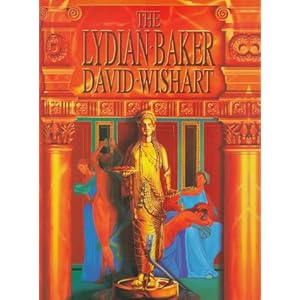
Review number: 1068
There is considerable competition in the field of historical crime fiction, which has blossomed in the last decade or so, and the Roman period seems to be among the most popular (following the medieval). Even so, it is odd that I have not already come across the novels of David Wishart, of which this is the fifth. Like Lindsey Davis' Falco novels, the style of these Corvinus stories is in imitation of Raymond Chandler. Wishart is more serious than Davis, though, and (having been a classics teacher) more academic. This means that his novels stand somewhere between those of Davis and Steven Saylor.
Corvinus, an upper class Roman living in Athens, is a rather different central
character from Falco and Gordianus, both of whom are professional investigators. In The Lydian Baker, he becomes involved in a series of murders related to a large solid gold statue, which Corvinus is bidding for as agent for his stepfather, a keen art collector. The statue really existed and is at the centre of a real mystery. Originally given by Lydian king Croesus to the oracle at Delphi, the 1.5m statue disappeared before the first century AD, fate unknown. It was probably stolen by one of the groups which sacked Delphi in the previous couple of centuries (these included Greeks, Gauls and Romans). The statue was probably of a Lydian goddess, but it was nicknamed the baker because it was in the form of a woman holding a loaf and a wheatsheaf.
The Lydian Baker is an interesting mystery, with a detailed and convincing background. The occasional point may be beyond the reader's knowledge (most people are unlikely to get asides dependent on knowledge of untranslated Greek names), but that doesn't really harm. A more serious problem is that Wishart's unrelenting Marlowe pastiche becomes irritating after a while, but that hasn't stopped me wanting to catch up on the earlier novels in the series.
Subscribe to:
Posts (Atom)

 Posts
Posts

