Published: HarperCollins 2006
The fourth volume in Martin's acclaimed A Song of Ice and Fire appeared after a lengthy hiatus, and the afterword acknowledges that he found it difficult to write. Not as long as the third volume (which had to be split in two when published as a paperback), it could have been much more so: much material originally intended to be part of A Feast for Crows will now make up the next instalment.
These structural matters aside, A Feast for Crows is basically the diffuse continuation of the many faceted narrative of the earlier novels in the series. Not only would it be incomprehensible to anyone who had not read these earlier novels, but I found it hard to get into because it is so long since I read its precursors. The principal strand tells of the high point in the career of the dowager Queen Cersei, whose ambition for her children, not in fact sired by the dead king but through incestuous adultery with her brother, proved one of the major causes of the terrible civil war. She starts A Feast for Crows as regent for her youngest son King Tommen and is determined to hang on to as much power as possible, despite the misgivings about her competency from man of those who have been her allies so far. Her character is basically an unpleasant combination of Lady Macbeth and Isabella (from 'Tis Pity She's a Whore), and the plotting at her court in King's Landing is very similar to the scenarios of Jacobean revenge tragedies.
Unpleasant as her machinations are, the real theme of A Feast for Crows is the horrific effect of the war on the lower classes. Most descriptions of medieval warfare, particularly as they are filtered through to the fantasy genre, concentrate on the leaders, the gallantry and the spectacle. Some semblance of reality has crept into the genre relatively recently, but few fantasy writers allow themselves to be as bleak about the anarchy, starvation and desperation that follows the brutal rape and pillage that was part and parcel of this style of warfare. While most readers point to the Wars of the Roses for real world parallels to A Song of Ice and Fire, it is not a war that is in my mind at least associated with widespread suffering (though writing that down immediately makes me think of the scene with the son who has killed his father and the father who has killed his son in Henry VI Part III). It seems to me to be more like the anarchic violence which virtually destroyed community life in much of France in the mid fourteenth century, as depicted in Jonathan Sumption's excellent history of this phase of the Hundred Years' War, Trial By Fire. Perhaps this is a little too much reality for the fantasy genre (even if Martin doesn't go into the tortuous financial issues which were an important cause of France's problems in the 1360s): it definitely makes for depressing rather than escapist reading, and really when it comes down to it is not as interesting as the real history.
The series takes a dip in interest here, but I would rate A Feast for Crows as good nonetheless. I will just add one more thing, which is fairly standard for any mid-series novel. If you have read the rest of A Song of Ice and Fire, you will have decided that the series as a whole is worth reading, and you will not be put off here. (A new novel by an author generally has to be pretty poor to alienate a fan.) On the other hand, this is neither the book by Martin to read first, nor is it going to gain new fans for the series - and those who have already tried this series and given up won't be reading it anyway.
Showing posts with label George R. R. Martin. Show all posts
Showing posts with label George R. R. Martin. Show all posts
Thursday, 14 June 2007

Saturday, 4 May 2002
George R.R. Martin: A Storm of Swords (2000)

Review number: 1087
By book three of A Song of Ice and Fire, the civil war across Martin's fantasy realm is not just well under way, but entering its second wind. It is very much like the second, A Clash of Kings, continuing the threads of plot begun in the first, A Game of Thrones. Its theme is once again the brutality of medieval style politics, acting as a corrective to decades of banality in the fantasy genre. There is no politics, for example, in Tolkien, as can be seen by the implausibility of Aragorn's acceptance as king. The romanticising of the pre-industrial world is less common than it used to be, having given birth to the genre, and Martin has moved further away from it than most fantasy authors.
In fact, at the great length of this series - each novel almost as long as the whole of The Lord of the Rings, the continuing chronicle of atrocities and betrayals becomes rather wearing. By this point, of course, the reader will have chosen their heroes and villains, almost certainly following Martin's clear signposts (even if the characterisation has subtler shades than plain black and white), and through this novel the heroes generally have seriously miserable times. What A Storm of Swords lacks is the impact of A Game of Thrones; as that novel had the advantage of novelty, this is hardly surprising, and is the common fault of series conceived as a whole. I'm also impatient to find out the end of A Song of Ice and Fire, especially as not all the characters on whose side Martin seems to be can win. From the plot point of view, the most important aspect of A Storm of Swords is that Martin does in fact begin to winnow down his cast, something which is sad for the reader who has begun to care about them. Attention to detail is as strong as ever, and is especially to be seen in the way that the growing anarchy makes communication difficult, so that characters are unaware of things the reader already knows.
Saturday, 20 October 2001
George R.R. Martin: A Clash of Kings (1998)

Review number: 966
At the beginning of this second novel in Martin's Song of Fire and Ice series, it is clear that the Seven Kingdoms are about to descend into anarchy. Following the death of Robert Baratheon, first ruler of his line, just about every one of his male relations has proclaimed himself king - both his brothers, and his supposed son Joffrey (actually the child of an incestuous relationship between the queen and her brother). In addition, the new head of the powerful Stark family has taken up their ancestral title of King in the North, and the exiled daughter of the king deposed by Robert Baratheon remains implacably determined to return in triumph.
As the second in a series, the narrative is less interesting than in A Game of Thrones, and the length of the novel is a bit much for it to sustain the reader's attention all the way through. The characterisation and the depiction of brutal political manoeuvring remain very well done (as each putative king has to face up to his desperate need for resources). Of particular note here is the way that Martin conveys the age of the characters. Adulthood comes early when life expectancy is low, and Martin manages to show both the enforced maturity and continued childishness of many of the characters, who are in their early teens.
Wednesday, 12 September 2001
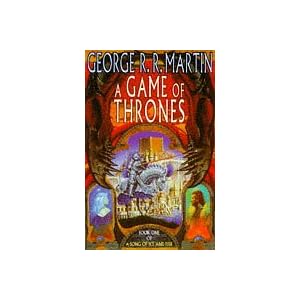
George R.R. Martin: A Game of Thrones (1996)
Review number: 942
Most fantasy novels ignore politics almost entirely, relying on devices such as magic to ensure, say, the succession of a long lost heir. Even when the political arena is portrayed, it is usually part of a background which is a sanitised version of medieval Europe and is made anodyne and unconvincing as a result. Martin's fantasy series A Song of Ice and Fire is different; it takes the savage and complex world of medieval politics and makes it the main theme of his story.
The Baratheon family has recently become the ruling dynasty of the Seven Kingdoms following a civil war which ended with the defeat and death of the previous, insane king and the decimation of his family. King Robert is far from secure, with Targaryen princes alive in exile and powerful families within the kingdoms making them hard to rule, especially as the tedious business of actually ruling is less to his taste than the fighting for the throne.
The politics here involve assassination, war, false accusation, political marriages, bribery and corruption. They are characterised strongly by the personalities involved - ruthless, honourable, timid, clever and stupid. This is typical of real world medieval politics where so much of the way that power worked was connected to the individual character and their reputation (being considered an unlucky commander, for example, made military failure more likely in the future as others became unwilling to ally themselves). The missing element is religion; this is far more a personal matter than it was in Christendom, and even the adherence of the northern Stark family to older gods is tolerated.
The novel has, like many fantasies, been compared to Tolkien, but the interest in politics makes it seem to me to be more like Frank Herbert's Dune. The writing of Machiavelli is also clearly an influence. The important quality of the writing in A Game of Thrones is that it is very well characterised, so that the reader cares about the political manoeuvring. It is an excellent piece of truly grown up fantasy.
Subscribe to:
Posts (Atom)

 Posts
Posts

