Showing posts with label Lindsey Davis. Show all posts

Thursday, 8 July 2010

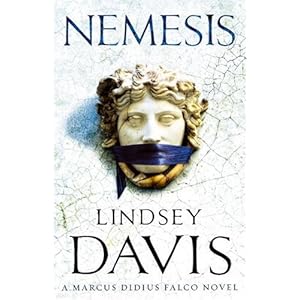
Lindsey Davis: Nemesis (2010)

Edition: Century, 2010
Review number: 1404

After the (to me) unreadable Rebels and Traitors, Davis returns to the Roman crime series which made her name, with the nineteenth Falco novel, Nemesis. But this addition to the series is much darker than most of them: this is not quite the wise-cracking Falco of old.

The darkness starts right at the beginning of the novel, which opens with the deaths of Falco's infant son and his father. The death of new born children has been a part of life throughout history. Take for example Queen Anne, who had the benefit of better medicine and all the care a British Queen could command at the turn of the eighteenth century, but none of whose fifteen children survived to adulthood. And the death of children plays an important part in novels by writers such as Charles Dickens. Yet it is something which is generally skipped over in modern historical fiction. With larger families and more infant mortality, death was a part of life in a way which, at least in the Western world, it is not today. That of course does not mean that parents then did not mourn the death of their children as much as parents today do.

So Nemesis is really about Falco's mourning for both his son and his father, even if in the latter case he doesn't want to show that he is strongly affected. The plot of the story concerns an investigation begun by Falco when he is looking into an unfinished business transaction of his father's. This spirals into a hunt for a family of serial killers, who seem to be protected by someone highly placed in the Roman government, and it becomes a case which pushes Falco onto a morally darker path than he has yet travelled - presumably because of the effects of his bereavement on his emotional state. He becomes a much more ambiguous hero than usual in this series; no  matter how bad his life became (the episode in which he went undercover as a slave in a mine is a prime example), he always previously seemed to be a basically good person. In hard boiled detective terms, the Falco of Nemesis is more Dashiell Hammett's tainted Continental Op than a wisecracking Philip Marlowe.

Pushing a character to do nasty things because of his own emotional pain is all very well, but after eighteen more or less humorous novels in a series it comes as something of a shock to readers. More points for literary quality, then, but fewer for enjoyment of the story. I'd give Nemesis 6/10 as a result - angst is not why I read Falco novels.

Wednesday, 22 August 2001

Lindsey Davis: Ode to a Banker (2000)

Edition: Arrow, 2001
Review number: 918

Recent novels in Davis' Falco series have tended to select a particular area of Roman life on which to concentrate; One Virgin Too Many, for example, has several plot strands concerned with religious ritual. In this novel, it is the literary establishment which she satirises. This makes for one of the funniest novels in the series, as Davis works jokes about the clichés of today's publishing world, critics and writers, into her first century setting.

It has already been established that Falco has aspirations as a poet, and at the start of the novel he has been persuaded to join a friend in a public reading. This brings him to the notice of a banker who runs a scriptorium - a sweatshop of slaves copying manuscripts - as a sideline. When this man is eventually murdered, Falco investigates. This is an intricately plotted mystery as well as a humorous historical novel; combining the two this successfully is a considerable achievement. Ode to a Banker is one of the best novels in the series.

Wednesday, 2 May 2001

Lindsey Davis: Venus in Copper (1991)

Edition: Arrow, 1992
Review number: 811

Re-reading this early Falco novel, I'm a bit surprised by how frivolous it is. I had the impression that they were becoming less serious as time progressed, but in fact the tone of this one is remarkably similar to that of the later novels.

Falco is employed by the business partners of parvenu Hortensius Novus to gather evidence against his fiancée, who has a history of marrying rich men who die soon after the ceremony, and ot help them buy her off. The problem is, though, that Novus is killed before the wedding takes place so that the inheritance cannot be the motive for his murder.

This story takes place against the usual background of Falco's chaotic personal life, at a bad patch in his relationship with his aristocratic girlfriend. This injects some seriousness into the novel, but it is mostly enjoyable, funny and very light.

Saturday, 10 February 2001

Lindsay Davis: One Virgin Too Many (1999)

Edition: Century, 1999
Review number: 750

By the first century AD, many of the traditional observances of Roman religion must have seemed silly and irrelevant. They were appropriate to the small farming village hundreds of years in the past, so they are about things like making crops grow, not the concerns of the largest and most cosmopolitan city in the world. Nevertheless, this feeling would have been accompanied by a certain reverence, for the cult practices were relics of a time seen as simple and virtuous. At the very least, an assumed reverence would have been politic in public. The cults were also an established path to political honours: Julius Caesar himself held the post of Pontifex Maximus.

In One Virgin Too Many, Davies' detective Falco becomes involved in several aspects of this, as one of the candidates for the lottery for a new Vestal Virgin comes to see him and tells him that one of her family has threatened to kill her, and a member of a corn cult, an Arval Brother, is killed at one of their ceremonies as though he were an animal sacrifice. These provide the crime side of the novel, and much of the humour comes from Falco's appointment to the fairly ridiculous office of the Procurator of the Sacred Poultry, responsible for the welfare of official birds including the sacred geese on the Capitol hill (descendants of geese who warned the city of an attack in the past).

This is one of the most amusing novels in the series, but it still has a fairly complex investigation; extremely satisfying.

Thursday, 18 January 2001

Lindsey Davis: Two for the Lions (1998)

Edition: Century, 1998
Review number: 721

It seems incredible that Davis' enjoyable Falco series could have already reached its tenth instalment, yet this is it. He has ended up working with one-time Empire Chief Spy Anacrites, whom he despises. The Emperor Vespasian is currently organising a tax census, and the two of them are given the job of investigating returns which seem too low, in return for a percentage of the extra they collect. They concentrate on a seedy but profitable industry, the supply of animals and gladiators for the circus. While they are carrying out an audit of one supplier, one of his lions is killed, and Falco becomes fascinated by the mystery of the animal's death.

Basically, if you like the other Falco novels, this one will please you too. It is amusing, and a well-constructed mystery. The background is not quite as well done as usual; this seems to be because Davies has smoothed out some of the rougher edges to counteract modern distaste for Roman popular entertainment. While Two For the Lions is not a good source of historical data on the circuses, it is fun, enjoyable and lightweight.

Tuesday, 27 October 1998

Lindsey Davis: Three Hands in the Fountain (1996)

Three Hands in the Fountain coverEdition: Century, 1997
Review number: 148


Three Hands in the Fountain is a slightly disappointing addition to the generally excellent series of Falco novels by Davis. Returning to Rome following an investigation in Spain and the birth there of his daughter (A Dying Light in Cordoba), Falco soon becomes involved in one of the most gruesome mysteries of his career when decomposing severed limbs begin to be found in Rome's drinking water supplies.

The mystery is to the same standard as in the other Falco novels, but to me the humour that was so enjoyable is missing here. This is partly because Falco's girlfriend, Helena, takes a far less prominent role in proceedings, being rather more taken up with the duties of motherhood in Roman society. It also perhaps indicates something of a "series fatigue" in Davis; maybe it is time for her to move on. (The problem is not, of course, unique to this series; it is a commonplace of genre fiction, where the financial incentives to continue recycling a proven formula often mean that it is used until after the author has anything new to say within it. Ngaio Marsh, for example, seemed to suffer from this problem every seven or eight books, though she solved it not by abandoning her well-worn characters but by introducing a new element.)

Wednesday, 1 July 1998

Lindsey Davis: Last Act in Palmyra (1994)

Edition: Century, 1994
Review number: 79

The sixth in Davis' Falco series about a first century private detective. Falco combines several investigations into one trip. Firstly, he's asked by the imperial household (the customer who expects to pay no fees) to take a look at the state of Nabatea, independent but only just over the edge of the empire. An old friend, the snake-dancer Thalia (now circus entrepeneur), asks him to look for a missing protege of hers, the water-organ player Sophrona; she is missing somewhere in the Decapolis, the Roman province north of Nabatea.

Falco travels to Nabatea with his "high class girlfriend" Helena, trying to pose as tourists. When they arrive, Falco discovers a body on one of the holy mountains; it is one of a company of travelling actors. Falco and Helena join the troupe, as they are told by the authorities that they need to leave Nabatea anyway. Falco takes over the dead man's position as writer, adapting classic Greek plays for contemporary audiences, and at the same time investigates the murder.

The whole plot, after some amusing digs at today's contemporary theatre (even then, managers were moaning about the imminent demise of live theatre) and the classics, comes to a climax in the Decapolitan city of Palmyra.

Once again, Davies produces an interesting and amusing dective story, and one which doesn't lay quite such an emphasis on the unsanitary aspects of ancient life as some of the earlier novels.

Monday, 15 June 1998

Lindsey Davis: The Course of Honour (1997)

Edition: Century, 1997
Review number: 67

The Course of Honour is, like most of Davis' novels, set in the Rome of the first century AD. Unlike these novels, its main character is historical, not the private detective Falco. Caenis was a slave to Antonia, who was related to most of the early emperors of Rome. She received her freedom, and became the mistress of an obscure young senator (a Sabine rather than a true Roman) named Vespasian.

Though the two of them find true love together, Caenis forces a parting for the sake of Vespasian's career. The book details the struggles to survive for both of them under the emperors from Tiberius to Nero, of varying degrees of insanity.

Then comes the year of the four emperors, AD 69, and the first major civil war of the Empire, followed by the victory of Vespasian and his enthronement as emperor.

As usual, Davis writes well and with a good sense of period; the subject matter of this novel (the comparative richness of the characters in particular) means that it is a good deal less nasty than the Falco series. It is also more constrained by the "real history" involved, which is caused both by having real historical people as major characters and by covering a much larger sweep of history (one which is also covered in some detail by several more or less contemporary historians). These restrictions don't seem to handicap Davis; this book confirms to me that she is a writer of some stature, not just someone who can write well in a limited field.