Showing posts with label books submitted for review. Show all posts

Saturday, 14 October 2017

G.K. Holloway: 1066 (2014)

Edition: Troubadour, 2014
Review number: 1509

What book could be more appropriate to review on 14th October, the anniversary of the Battle of Hastings!

1066 is clearly the defining date in British history, the one year everyone knows. It is probably the most important single date in English history. And it is also the end of a long series of complex events in English history, with roots in the renewed Viking attacks on England almost a century earlier. On top of this, the surviving contemporary documentation of what happened is scanty by modern standards, and some of the events as well as the details of characterisation are either disputed or recorded by biased sources. All of this makes the events of the year a challenging subject for a historical novel.

How as G.K. Holloway approached it? Well, for a start, neither the main title or what looks like a subtitle are entirely accurate. Holloway's narrative begins many years earlier than 1066, and doesn't reach that year until about two thirds of the way through the book. I would also have said that what happened during the year year is perhaps more driven by personalities than many historical events (particularly those of Edward the Confessor, Harold and William of Normandy). Despite the choice of quotation, Holloway's writing does suggest that these played a huge part - fates imposed remarkably little. (The source, by the way, is the moment in Shakespeare's Henry VI when Edward IV is offered the crown of the deposed Henry; another king overthrown by force, four hundred years or so later than Harold). Making the novel not quite as expected from the cover is not a big problem, though.

1066 is told from an apparently neutral third party perspective, as though it were a documentary - far more detailed, of course, than a historian could be with the available sources. Where sources disagree, or where they are biased or disputed by modern scholars, this means that Holloway has had to make a decision. So, for instance, the fictional version of Harold is killed by the arrow in the eye, though some historians would argue that the depiction in the Bayeux tapestry is at least ambiguous. More seriously, I find the character of Edward the Confessor not entirely convincing - the sources for this are works aimed at promoting the campaign to make him a saint, which are not going to present a rounded picture of an individual and which definitely use ambiguous word choices to do this (he is described a chaste using a Latin word which could either mean virginal - an important qualification for sainthood - or faithful within marriage, for instance). Holloway has clearly done a lot of work on researching the background, but it seems to me to be more trusting in the original sources than modern scholars think they deserve. Given the need to make choices, this is not entirely problematic, but a reader who has come across some of the debates will find it a little frustrating. I feel that the third party neutral narrative was a wrong choice; a first person account from an incidental figure (or multiple figures) might well have worked better.

The most important negative aspect for me in 1066 was the unleavened unpleasantness of the characters.  The men are mostly thugs or devious troublemakers, or  worse; the women are sex toys or helpless political pawns (with two exceptions, Harold's common law wife Eadgyth, and William's wife Matilda). There are some very unpleasant passages involving rape, torture and murder. To a large extent, this reflects the realities of life in eleventh century Europe, but it does become somewhat unrelenting. This was the main problem I had with the book, it was at times a chore to read.

However, there are many positive aspects to 1066. One difficulty with writing this novel is the large number of events which need to be described and put into context; here, Holloway succeeds admirably. It is easy to follow what's going on and who is who. The clear writing style helps with this, too. Of course, the astonishing events of the year make for a memorable tale. While this review may have spent more time on the negative aspects of the novel, they are outweighed in my opinion by the positive. My rating: 6/10.


Thursday, 29 December 2016

EXO Books: The Last Day of Captain Lincoln (2015)

Edition: Kindle, 2015
Review number: 1503

The title of this novel is a good summary of its content, if not its purpose. Captain Lincoln is a retired captain of a generation ship, on which a carefully designed and controlled society keeps the population exactly stable: each five years, a new generation is born, each older generation moves on to a new phase of their life, and those who are 80 die to make room for the new children. What the book is not about is the social and emotional ramifications of this idea, making me wonder how the society actually works -  there are no rebels, no dissidents, no calls for changes to allow a greater population. Very little is explained or used to power a plot (readers don't even get to know the precise reason for the space flight, though its aim is to colonise another world).


The sociological ramifications of the idea are not in any sense important to EXO Books (a pseudonym which I unfortunately find irritating, for no particular reason). The Last Day of Captain Lincoln is not really a novel at all; the scenario is a framing device for a series of short essays about society and death. These main part of this consists of transcripts of lectures given to younger inhabitants of the ship - a distinct oddity in a novel set in the future, to use a communication method which has been criticised as ineffective for years in universities.

Because of this structure, the reader's response to The Last Day of Captain Lincoln will be determined by what they think of the ideas presented in the essay-like sections.I was actually surprised by the lack of profundity - the general message is that life is good, the afterlife is unknown, and the transition is difficult for the people facing it and those who care about them. Other than that, it seems to me that giving lectures (while convenient for the book) is an odd thing to do when you know it's your last day of life. Is this the best idea for helping with the transition that this carefully designed future society could come up with?

It is possible that I'm not doing the book justice. If science fiction novels have a serious intent, their message is not usually about the future but about the present. The Last Day of Captain Lincoln may be intended as a commentary on the attitude to death in today's Western culture, and this possibility is made more likely by the use of the names of assassinated US presidents Kennedy and Lincoln for current and former captains of the ship.

The most interesting parts of The Last Day of Captain Lincoln, for me, were the quotations heading each section; EXO Books has collected some profound thoughts about death from a wide range of authors. One of these in particular, the somewhat unexpected Isaac Asimov, provides a summary of the book in his aphorism about life and death, and I found myself looking forward to these thoughts far more than the content they frame.

It is perhaps superfluous to add that I didn't like the illustrations - this is mainly a question of the style not appealing to me than anything else.

This is a missed opportunity - the basic idea could have been used to say something more profound, more involving and more affecting. As one of the major aspects of death in any human culture is its effect on those continuing to live, not making the reader care about the characters is a major flaw. (Writing this at the end of 2016, with its litany of celebrity deaths and the reactions of fans constantly seen on social media, this side of death has been rammed home to me more forcefully than it might have been to EXO Books writing The Last Day of Captain Lincoln last year.) My rating: 4/10.

Friday, 29 August 2014

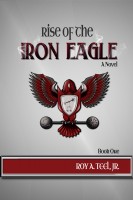
Roy A. Teel, Jr: Rise of the Iron Eagle (2014)

Edition: Narroway Press, 2014
Review number: 1487

Rise of the Iron Eagle is a thriller, first in a series, about vigilantism and serial killers. I was warned before I started it that was not for the faint-hearted, and it certainly is that. There are frequent scenes not for the squeamish, and, though I don't really mind that usually, there are lengthy descriptions of torture which I did find disturbing - sometimes gratuitously over the top. More on that later...

The first chapter introduces a character who initially appears to be going to be the the novel's principal viewpoint character, a retired alcoholic private detective, whose granddaughter is the latest victim of the Iron Eagle killer - only for him to be kidnapped and killed himself. This is an interesting opening, to say the least. But after this promising start, the story settles down into a more straightforward tale of the FBI hunt for the vigilante who targets serial killers.

Vigilantism is a popular theme in fiction, presumably because it plays into people's fantasies of besting those who have done them a perceived injustice. Few actually have the abilities needed to be a successful vigilante, of the solitary Iron Eagle type, anyway - able to find criminals as yet unknown to law enforcement, able to overpower and murder successful killers, and able to do this while taunting the FBI and remaining uncaught - like a rather dark comic book superhero. This is rather different from the types of vigilantism which seem to happen in the real world, which would include harassment of suspected paedophiles by groups of concerned citizens. The tragedy of vigilantism is of course the possibility of targeting someone innocent, either through mistaken identity or an incorrect assumption that the person attacked is indeed guilty of the offence. Of course, the police are not immune from this issue, as the Guildford Four would attest, but by carrying out their investigations in a system where there should be checks and balances, and where judicial punishment is separate from the search for the culprit, this is less likely to happen and more easily correctable. (I am not sure that the Guildford Four would agree with this sentence, but if they had been murdered by the police when they had become convinced of their guilt, they could not have been exonerated even 15 or more years later.) So there are two reasons not to go outside the system - you might be wrong, and you might not be good enough at it to survive attacking a murderer and getting away with it.

Rise of the Iron Eagle plays lip service to this, but I couldn't help but have the sneaking suspicion that the Iron Eagle was the real hero of the book, at least most of the way through. This included the feeling that I was meant to approve of the unpleasant torture the vigilante visited on his victims, in the name of retribution and obtaining a full confession, Confessions made under torture and undue pressure are, it should be noted, notoriously unreliable (see the Guildford Four again). This particular issue was not addressed at all; all the characters, law enforcement included, seemed to take the validity of the confessions as unquestionable. (The reader knows that they were accurate, because of other things mentioned which are not known to the police.) More moral ambiguity would have improved the literary quality of this thriller, as well as providing darkness which is not just derived from the extreme violence: this is why The Dark Knight Returns and The Watchmen were so much greater than the comic books around them when they appeared in the eighties. I was, to be honest, expecting this novel to be dark in a similar way to those comic books - morally ambiguous, gothic tales which have a serious point to make.

I have never watched the TV series Dexter, nor have I read any of the books. But the theme here of a serial killer who preys on serial killers is familiar from it even so, and I suspect there would be more similarities which I would notice if I was familiar with the series. There are points of some interest, and many readers of this type of fiction might enjoy it. But overall, I felt that Rise of the Iron Eagle was not to my taste, especially the way that the idea of vigilantism is treated. The tone of the violent scenes put me off, though they are clearly well written (there are a large number of different ways in which "x did something unpleasant to y and caused y a lot of pain" is expressed). Because of my personal dislike of the treatment, I feel I can only rate the novel at 5/10.

Thursday, 15 August 2013

Craig Stone: Life Knocks (2012)

Edition: Kindle ebook, 2012
Review number: 1479

I wasn't sure whether I would like Life Knocks or not before starting to read it, and I am still not sure.

The narrator, named Colossus, is at a low point in his life. He is living in a low quality bedsit, unable to connect with anyone he meets, with the exception of his unpleasant landlord (who is a Muslim version of Riggsby from seventies sitcom Rising Damp, with even less charm and fewer redeeming qualities.

This life forms one of two interwoven narrative streams, being labelled Present whenever it occurs. The other, labelled Past, describes an idyllic affair with a woman named Lily, and how Colossus basically this part of his life away. Lily is the only truly sympathetic character in the novel. The separate narratives work very well, and make Life Knocks read rather like an Iain Banks novel, Dead Air being the one which sprang to mind,, though without some of his quirkiness.

It is clear, even only from the quotations on the cover image, that Life Knocks is a novel which many of its readers find extremely funny. The humour here did not really appeal to me (which is one reason why I am not sure I liked the novel as a whole). Basically, it consists of watching Colussus finding more and more ways to mess things up - something which I found more excruciating than funny. But tastes differ...

Perhaps I invested more in the character than other readers have done, and so found his mistakes unbearable, but the fact that I did so was a tribute to the quality of Stone's writing. It is really easy to enter into the world in which Colossus lives, in both phases of his life. That is part of the problem - I didn't want bad things to happen.

In the end, I would say that I admired Life Knocks a lot more than I enjoyed reading it. If this kind of humour is your kind of thing, you will love it; if not, you will probably react much as I did. My rating - 6/10.

Tuesday, 2 July 2013

Wayne Williams and Darren Allan: I Know What You Did Last Supper (2013)

Edition: Piatkus, 2013
Review number: 1477

I initially hesitated about reviewing this novel when I was asked to do so, because of the subject matter, but decided that it is wrong to effectively condemn anything without experiencing at least part of it. I probably would not have picked it up, though, unless I'd been asked to review it (hence the introduction of a new tag for books submitted for review).


The basic premise of I Know What You Did Last Supper is that Judas Iscariot receives a threatening message after his betrayal of Jesus Christ, before his friends and family start being gruesomely murdered one by one. The title suggests an outrageously silly take on this, but that is not what the novel is: instead, it is a fairly standard thriller in terms of plot.(Others may find the way it is written funny, but I felt that the killings were really too gruesome for this.) To my mind, it has to succeed as a thriller before getting to the question of the content, which may well be offensive to some.

As a historical novel, it does rather come up short. There is little real atmosphere of first century Palestine, and many of the actions which happen are more or less transpositions of modern day actions to the period - when Judas goes out and buys a flashy black stallion with the money paid to him as the price of his betrayal, the transaction hardly differs from a purchase of a shiny black convertible in Los Angeles. There are events which don't really ring true, particularly in the portrayal of religion. For example, it seems unlikely that so many people would ignore the Sabbath at this time in Jerusalem. So, not convinced by the setting. I had the impression from somewhere that "Iscariot" is thought to be a nickname, from the Sicarii, a group of Jewish nationalists, not a surname in the sense that we use them, so that Judas' father is unlikely also to be known as Iscariot.

And as a thriller? I'm not entirely convinced here either.  The thriller plot, with Judas basically flailing around trying to work out who is killing people, is basic and unoriginal, though it does have a couple of interesting twists, which I will discuss as part of the religious content. The final revelation was, to me, long anticipated and unconvincing.

The Christian content seems, to at least a certain extent, designed to shock. Some of this is done at the expense of verisimilitude, as when, for example, Judas suspects that it is the resurrected Jesus who is using supernatural powers to kill those close to him as a punishment for his act of betrayal - not really likely in the sort of person that Jesus is otherwise portrayed to be in this novel as well as in the gospel narrative. Not validated by the quality of the treatment, the use of Christianity is just offensive for its own sake, which is the least excusable form of offensiveness. There are a couple of redeeming features. One - the one which is most important to me - is that the novel reminds its readers that the disciples portrayed in the Bible were people, even Judas. The other  is that the most interesting thing about Judas' character as depicted here is the motivation for his original betrayal, which is not considered important by the gospel writers, but which is something very important to modern readers of crime fiction. So Judas is given one, and it is because he wants to save his uncle from a vicious criminal boss who wants his gambling debts paid off.

In the end, the redeeming features were not enough for me to truly enjoy reading the novel. My rating - 3/10.