Showing posts with label young adult. Show all posts

Sunday, 28 August 2016

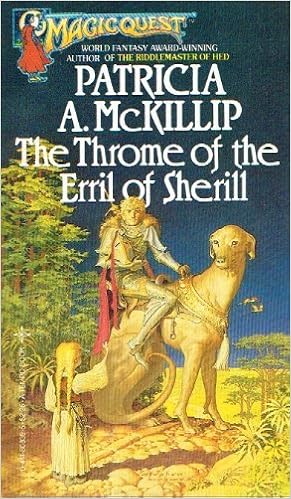
Patricia A. McKillip: The Throme of the Erril of Sherill (1973)

Edition: Tempo, 1984
Review number:1501

Unusual, poetic fantasy - the first Patricia A. McKillip which I have read, after many recommendations of her as a fantasy author.

This edition also includes The Harrowing of the Dragon of Hoarsbreath, and is still extremely short as books go: it could fairly easily be read in a single sitting. Of that short length, the title story makes up about two thirds. It is the story of a quest undertaken to win the hand of a King's daughter - the very hackneyed theme of fairy stories. The story is intended for a young adult audience, and could quite easily be read to or by children, though I think it is likely that they would miss a lot of what is really going on. To an adult well read in fantasy, it reads like a cross between Jack Vance and William Morris, with a playfulness with language which may be influenced by  Jabberwocky or possibly comes more from Vance.

The language is perhaps the most obvious of The Throme of the Erril of Sherill's unusual qualities. Apart from the title of the story itself, there are made up words (a monstrous "borobel" could be straight from Lewis Carroll), and words which look almost right - perhaps versions from an alternate world where modern English developed slightly differently ("cnite" for knight, "Damsen" for the name of the princess - a damsel, and so on). This could be irritating, but I found it atmospheric.

But strange things also happen in the story itself. The cnite starts with the standard equipment of a knight - horse, sword, shield, armour - and as the quest goes on, he is forced to exchange these for magical items, the horse for a fire-breathing dog, and so on. The people he meets are rarely what you would expect on a quest - he does not slay monsters, rescue innocent maidens. At one point, there is an adventure which made me wonder if the whole story was not meant to be an allegory of aging and death.

The Harrowing of the Dragon of Hoarsbreath is apparently much more straightforward. A strange young man visits a strange island, where winter lasts twice as long as on the mainland, twenty miles away. He claims that this is due to a dragon, which he wishes to remove. This is an action with unforeseen consequences. Though told in a normal narrative form, it still seems that there is more to the story than is visible on the surface; the reader wants to invest it with a hidden meaning. For instance, is it about the unwisdom of making unwanted "improvements" to communities - doing away with tradition in the name of progress?

Altogether, two fascinating pieces of fantasy, well worth reading at any age. My rating: 9/10.


Thursday, 30 November 2006

Terry Pratchett: Wintersmith (2006)

Published: Doubleday, 2006

This is the third of Terry Pratchett's stories about young witch Tiffany Aching, aimed at a younger readership than the main Discworld novels, with which they share a setting and several characters. This time, she interrupts a ritual in the forest in midwinter, and by doing so attracts the romantic attention of the Wintersmith, the elemental being who personifies the season. While it is flattering to have all the snow fall in flakes which shaped like your profile, having giant iceberg statues killing hundreds of sailors is not so enjoyable. And, worst of all, Tiffany accidentally took the place of the Summer Lady in the dance, and the seasons become so messed up that this winter might never end.

The plot is simple, and hardly original (with echoes of the Greek myth of Persephone at the far reaches of its ancestry). But that is not the point. Wintersmith is entertaining, funny and would cheer anyone up, no matter what age they are. There is not as much in it as Pratchett includes in the main Discworld stories, presumably to cater to the younger readers. In particular, there is virtually none of the parodic references to our own culture that are the source of a lot of the humour of the adult novels, and instead something of an emphasis on lessons to be learned while growing up. I found the latter a little too obvious, but then I am about three times the target age.

As I said, this is the third young adult novel centring on Tiffany Aching, and it gives away some of the plots of the first two, though not too seriously. It would be better to read them in sequence (starting with The Wee Free Men), but not essential. This is a book which would make an ideal Christmas present for a thirteen year old who reads, such as a Harry Potter fan waiting for the final book to appear.

Thursday, 9 March 2006

Greg Andrew Smith: The Pledge of Three (2005)

Edition: The Lucky Press, 2005
Review number: 1312

Zack Owens, a bored schoolboy waiting for his mother to finish work, is trying to amuse himself in the office of her employer. He picks up a book on medieval history, and a piece of paper falls out. This describes the Pledge of Three, which when recited by three friends together affects their futures: one will become rich and famous, one will be unchanged, and one will die. Rather unwisely, he takes the paper and shows it to one of his school friends, who is excited by the idea and wants to try it. It is only after some disturbing dreams and seeing an odd website that Zack agrees - a few days before his mother wins the state lottery.

Aimed at young teenagers, The Pledge of Three turns out to be quite an intriguing novel. While the idea of young people becoming involved in something they don't understand is hardly original (recent well-known examples including both Harry Potter and Buffy the Vampire Slayer), it is handled well, with an X Files-like unwillingness to decide whether it is describing magical events (putting in the fantasy genre) or a complex hoax (which would put it in the crime genre) that marks it out. The other reason why this novel is better than the average is the characterisation of Zack, who is made deeper by the way that his initial reluctance to become involved with the Pledge is overcome. Indeed, despite not being in the target age range by some two decades, I found myself keen to keep reading from chapter to chapter, and would certainly be interesting in reading sequels (The Pledge of Three being the first of a series, the Z.O. Chronicles).

The Pledge of Three is not faultless; there are occasional infelicities in the writing, particularly in the early chapters. For example, "soft-spoken" is not really the most common adjective to apply to people, but the first chapter uses it to describe two characters in the space of a few pages, which gives the reader a little jolt. I have not been a school pupil for a long time, and was never one in the US, but some details struck me as unlikely (is it really that easy to walk out of a class?) - basically, the plot and the setting could be better integrated. Once the reader is drawn into the story, which happens pretty quickly, this sort of issue ceases to matter.

Lucky Press are not a publisher I have come across before, and judging by their list, this kind of fiction, on the boundary between thriller and fantasy and aimed at the teen market, is a new departure for them. I hope that The Pledge of Three receives the success it deserves and that the Lucky Press won't be too strongly stereotyped as purveyors of lurid self-help books to get it into the shops.

Monday, 10 January 2000

Andre Norton: Dread Companion (1970)

Edition: Gollancz, 1970
Review number: 416

In this novel, aimed at a slightly older audience than most of her writing, Norton uses several themes from folklore and child psychology to create a disturbing story. Accepting a post as governess to get away from a world which has little to offer a woman of intelligence, Kilda soon comes to realise that there is something strange about her charges. Like Miles and Flora in A Turn of the Screw, Bartare and Oomark have an invisible companion who is rather unpleasant, and they start to play mind games with Kilda under the direction of the mysterious "She".

When they arrive at their destination, the planet Dylan, things get worse; Kilda follows the children through some kind of gateway into a very different world, woven by Norton from the legends of the land of Faery. Easily one of the best writers of science fiction for teenagers, Norton has managed to find new and very effective ways to combine well worn, psychologically telling elements.

Thursday, 14 October 1999

John Barnes: Orbital Resonance (1991)


Edition: Gollancz Millennium, 1998
Review number: 358

The front cover of this edition bears an endorsement from Orson Scott Card comparing Barnes to Robert Heinlein. On the basis of earlier Barnes novels, the John Brunner-like Mother of Storms and the brutal Kaleidoscope Century, this may seem rather a strange comparison to make. Yet Orbital Resonance is distinctly reminiscent of the best of Heinlein's books for teenagers, a tradition to which Card's own Ender's Game perhaps also belongs. (Orbital Resonance has a low-gravity game which is quite similar to that battle room in Ender's Game.

Set on a space station designed to aid the colonisation of Mars, the background to Orbital Resonance is a ruined Earth in only a few decades time. The satellite is the last bastion of the civilisation of mankind; there a group of gifted children are being conditioned to become the new elite of the human race. The novel takes the form of the journal of one of these children, Melpomene Murray, as they approach adulthood and a crisis in the form of a new arrival from Earth in their class.

Barnes also makes points about the way that the West lives today, by looking at how the relatively affluent children on the satellite see the lives of those remaining on Earth's surface, a place of continual famine and desperate want. Part of the school curriculum is a subject intended to enhance the children's understanding of and empathy for what is going on, yet they are virtually unaffected by the video footage, merely making such callous and stupid comments as "why don't they just grow more food?". They may be gifted, but they find it exceptionally difficult to understand any point of view different from the culture conditioned on them; another example is the complete incomprehension the narrator has as to why her word processor might possibly query the use of the word "clitoris" as "audience-inappropriate" (after all, girls on Earth must have them too).

Like Heinlein, Barnes manages to write convincingly as a bright teenage girl. (As a man in his thirties, I may not be the best judge of this, but he at least convinced me.) The sentimentality of Heinlein is absent, and Melpomene's crushing discovery of the years of manipulation at the hands of her parents is strongly handled.