Edition: Del Rey, 1988
Review number: 802
The Heechee series, which begins with Gateway and ends with The Annals of the Heechee, is a classic. It is very traditional science fiction, but the quality of the ideas and the writing raise it well above the commonplace. I remember reading the first three novels for the first time when this was published, which is when I bought it; for it to have left as strong an impression on me as that, I must have found it an inspiring read.
The other thing I can remember is that The Annals of the Heechee was comparatively disappointing. Re-reading it now (without re-reading the others first), I can see both why this was and what I found impressive about the series as a whole.
The plot is rather difficult to summarise without completely ruining the earlier novels. The central character and narrator, Robinette Broadhead, is in some ways dead; he is now a machine stored personality. A lot of the novel is about the interaction of human beings and computer programs, a relationship which is clearly going to become closer and closer as time goes on in the real world.
Another theme of the novel - and of much hard science fiction - is the nature of the universe, and quite a large proportion of it is given over to descriptions of the big bang and string theory. This is a little unhelpful for plot development, but is probably needed for many readers to understand what is going on. (The descriptions are very clear, and do not appear to have gone out of date particularly badly.)
The Annals of the Heechee is quite a slow novel - partly a deliberate effect to emphasise the difference between machine stored and "meat" people - and its ending is anti-climactic. However, it succeeds on the ideas and characters sides, and provides a definite conclusion to a great series.
Saturday, 21 April 2001

Friday, 20 April 2001
Lyndon Hardy: Secret of the Sixth Magic (1984)

Review number: 801
Having written his first novel around a carefully constructed theory of magic, Hardy undermines it in his second. It is set in a different country in the same world, with a new central character who is unfortunately very similar to the hero of Master of the Five Magics. (Having someone who studies all the different magic arts is of course a useful device for exposition of the theory.)
The plot of Secret of the Sixth Magic is based around a crisis, when the art of sorcery ceases to work. This spreads to magic - a serious problem when this art is used to guarantee major currencies. Finally, Jemidon works out what is happening - magic is not being destroyed; its laws are being changed by the mysterious Melizar. When Melizar's minions become the only people to know the new laws, they will have immense power, so Jemidon has to work out how to transform the laws back again.
The whole thing seems to be simultaneously contrived and unimaginative. It also undermines an interesting facet of Master of the Five Magics, the correspondence between the branches of the magic arts and our scientific disciplines; to change the laws of physics would have much more far reaching and interesting effects (probably fatal) than just putting physicists out of work. Repeating the same plot with essentially the same poorly drawn characters is dull, and the one really remarkable aspect of this novel is just how uninteresting Hardy can make a completely alien world (in which Melizar imprisons Jemidon) and how unalien its supposedly completely different inhabitants seem to be. There is a further sequel, but this novel has always quashed any desire I might have had to read it.
Michael Innes: The Man From the Sea (1955)
Edition: Gollancz, 1984 (Buy from Amazon )
)
Review number: 800
On a beach in northern Scotland, a night time assignation is interrupted by the emergence of a fugitive from the sea. This turns out to be one-time defector John Day, who claims to have returned to the country to see his wife again before he dies (a nuclear physicist, he has been fatally careless). The young man on the beach agrees to help him and they begin to try to travel south without being caught by Soviet agents or revealing Day's identity to the British authorities.
The novel is basically a latter day John Buchan thriller, with especial closeness to The Thirty Nine Steps. Being Michael Innes, the writing is frequently tongue in cheek, and so The Man From the Sea is a knowing homage. Even for a thriller, it has an abrupt ending, and could actually be improved by expanding the last three or four chapters by twenty pages or so. Fast paced and enjoyable, it sweeps the reader along for the most part, which is good; it is only if you stop and think that it becomes clear just how silly it all is.
)Review number: 800
On a beach in northern Scotland, a night time assignation is interrupted by the emergence of a fugitive from the sea. This turns out to be one-time defector John Day, who claims to have returned to the country to see his wife again before he dies (a nuclear physicist, he has been fatally careless). The young man on the beach agrees to help him and they begin to try to travel south without being caught by Soviet agents or revealing Day's identity to the British authorities.
The novel is basically a latter day John Buchan thriller, with especial closeness to The Thirty Nine Steps. Being Michael Innes, the writing is frequently tongue in cheek, and so The Man From the Sea is a knowing homage. Even for a thriller, it has an abrupt ending, and could actually be improved by expanding the last three or four chapters by twenty pages or so. Fast paced and enjoyable, it sweeps the reader along for the most part, which is good; it is only if you stop and think that it becomes clear just how silly it all is.
Thursday, 19 April 2001
David Eddings: The Losers (1992)
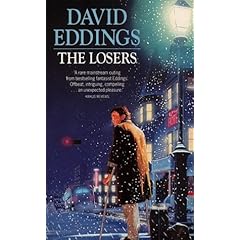
Review number: 799
Apart from his debut novel, thriller High Hunt, The Losers is Eddings' only attempt at something outside the fantasy genre. Interestingly, it has aspects in common with the much earlier novel, including the Washington state setting (though that is where Eddings lives) and a plot incorporating ideas about sibling rivalry (less literally here).
Raphael Taylor is bright, good-looking and athletic - a high school American football hero. When he goes to university, he meets the strange but fascinating Damon Flood, and is basically led astray. A drunken driving accident leads to the loss of a leg, and Raphael has to face up to life as a cripple.
Unable to face his friends, Raphael moves to a poor area of Spokane to begin his convalescence, only to become fascinated by the lives of those around him (in a Rear Windows kind of way). These people, living on the edge of crisis, unwillingly dependent on an institutionalised social services, are the losers of the novel's title.
The losers are really what the novel is about, and there are lengthy debates about what drives them and if (and how) they can be helped. A lot of what is said is criticism of the American social services, which, in Taylor's (and presumably Eddings') opinion, fails because it regards these people as a catalogue of problems to be matched against programs, rather than as individuals. It is, of course, an easy criticism to make of any enterprise of a large scale, and it is much more difficult to suggest anything which can
be done about it.
As a novel, The Losers is more interesting than successful, with the traces of arch humour characteristic of Eddings' fantasy novels seeming distinctly out of place. (This is particularly the case as some jokes are repeated word for word.) Raphael is not believable enough to hang the novel on; the loss of his leg has remarkably few psychological effects, and this combines with his role as observer to make him seem too detached from reality. Charles Dickens would have made wonderful characters out of the losers, and Eddings is no Dickens. The Losers is probably Eddings' most ambitious and least successful novel.
Wednesday, 11 April 2001
Michael Moorcock: The Transformation of Miss Mavis Ming (1977)

Review number: 798
Alternative title: A Messiah at the End of Time
The second title of this novel, used for the American edition (which is actually the one I read), is in fact rather better than the original one; it is much more apposite, and concerns the main interest of the novel. It begins with a short editorial explanation, detailing the way it fits into Moorcock's other novels; it draws on several scenarios, but the one series which really should be read before The Transformation of Miss Mavis Ming is The Dancers at the End of Time.
Mavis Ming is one of the many time travellers stranded at the end of time; overweight and not terribly bright, she isn't exactly one of the stars of that superficial society. But then the Fireclown, prophet from the past, arrives to judge the End of Time, and he chooses the unwilling Mavis Ming to be his great love.
The idea of confronting the hedonism of the End of Time with religious fanaticism is interesting, but Moorcock for once executes it poorly. The Fireclown is not one of his more convincing characters, and Mavis Ming is (deliberately) a dull one. In the end, the novel is a poor relation of the trilogy.
Charles Dickens: The Pickwick Papers (1836)
Edition: Heron
Review number: 797
The immense success if the story that launched Dickens' career is shown by the fact that the 400 copies of the first issue of the serial had become 40000 by the fifteenth. It has remained something of a favourite with readers ever since.
Unfortunately, I am not one of those people. I find the character of Mr Pickwick annoying, particularly at the start of the novel - at least until the introduction of Sam Weller; for someone who has lived to middle age he is unbelievably naive. The interpolated stories are dull and for the most part deserve to be skipped; one (Gabriel Grub) is interesting as a precursor to The Christmas Carol.
It is only really following the election at Eatonswill and Mrs Bardwell's breach of promise suit against Mr Pickwick that things pick up. Sam Weller and his father are good characters, even if the rendition of their accents now seems tediously affected rather than comic.
I like the later writings of Dickens better, when he had more discipline. The Pickwick Papers developed as its serial numbers were written, and it shows. (In fact, it was originally meant to be a set of pieces to accompany the illustrations, rather than the other way around, and the virtually unknown Dickens was not the first choice to write them.) There are elements which prefigure Dickens' strengths as a writer, but they are more enjoyable when more fully developed (in David Copperfield,say).
Review number: 797
The immense success if the story that launched Dickens' career is shown by the fact that the 400 copies of the first issue of the serial had become 40000 by the fifteenth. It has remained something of a favourite with readers ever since.
Unfortunately, I am not one of those people. I find the character of Mr Pickwick annoying, particularly at the start of the novel - at least until the introduction of Sam Weller; for someone who has lived to middle age he is unbelievably naive. The interpolated stories are dull and for the most part deserve to be skipped; one (Gabriel Grub) is interesting as a precursor to The Christmas Carol.
It is only really following the election at Eatonswill and Mrs Bardwell's breach of promise suit against Mr Pickwick that things pick up. Sam Weller and his father are good characters, even if the rendition of their accents now seems tediously affected rather than comic.
I like the later writings of Dickens better, when he had more discipline. The Pickwick Papers developed as its serial numbers were written, and it shows. (In fact, it was originally meant to be a set of pieces to accompany the illustrations, rather than the other way around, and the virtually unknown Dickens was not the first choice to write them.) There are elements which prefigure Dickens' strengths as a writer, but they are more enjoyable when more fully developed (in David Copperfield,say).
Leslie Charteris: The Saint Steps In (1944)
Edition: Hodder & Stoughton, 1944 (Buy from Amazon )
)
Review number: 796
This novel, written towards the end of the war, is a typical Saint plot - beautiful woman in danger because of innocent involvement in a criminal scheme - set against the background of one of the most important industries for the war effort, rubber production.
In many ways, The Saint Steps In could be considered a paradigm for Saint novels. It is an exciting thriller, and is also an uncompromising attack on the elements of society that Charteris despised - in this case, Nazis, fifth columnists, profiteers, and those who through stupidity allowed these people to operate. Not profound, perhaps, but certainly enjoyable.
)Review number: 796
This novel, written towards the end of the war, is a typical Saint plot - beautiful woman in danger because of innocent involvement in a criminal scheme - set against the background of one of the most important industries for the war effort, rubber production.
In many ways, The Saint Steps In could be considered a paradigm for Saint novels. It is an exciting thriller, and is also an uncompromising attack on the elements of society that Charteris despised - in this case, Nazis, fifth columnists, profiteers, and those who through stupidity allowed these people to operate. Not profound, perhaps, but certainly enjoyable.
Subscribe to:
Posts (Atom)

 Posts
Posts

