Edition: Ballantyne, 1986
Review number: 1280
David Eddings' first novel is very different from his other output, even from his later thrillers and from The Losers, which was written quite soon afterwards even if not published for almost twenty years. (The vast majority of his writing is in the fantasy genre, of course.) It is an extremely American novel, concerning a deer hunt in the Cascade mountains (later made famous worldwide as the location of Mount St Helens, but still one of the most remote parts of the United States). The narrator is an American soldier returned from the draft; this is during the Vietnam War, but Dan was posted to Germany. He rather reluctantly gets back in touch with his older brother, which leads to Dan accompanying a group of friends on a hunt, one complicated by bad feeling within the group (one man is committing adultery with two of the others' wives). Up in the mountains the tensions only increase, with a major rivalry brewing up over a rare white buck they see, and it starts to look as though deer will not be the only casualties of the hunt.
This covers familiar territory, even for the early seventies, but does it extremely well. The range of characters, for example, is wide and vivid, with both more varied and complex than occur in any other of Eddings' novels - a simplified style has obviously proved popular but I prefer this greater range. Some of the effects of High Hunt are obviously not intended: that the hunt begins on September 11th would be a clever ironic touch heightening the sense of foreboding - if the novel had been written thirty years later.
The obvious, and acknowledged influence on High Hunt is Hemingway. The idea of hunting as a rite of passage, as an activity which sorts the men from the boys, is not something I agree with, so that when this is made the basis for a story it has to be well enough done, as it is here, to provide other attractions to make the tale worth reading. There are other influences, some of which I suspect I do not see since the hunting genre is not one that has made its way across the Atlantic to the extent that the Western, its close relative, has. Rather more oddly, Robert Heinlein is clearly the source of the tone of some parts, particularly the scenes between Dan and his girlfriend. Glory Road is the closest novel to High Hunt in tone, even if it is from a completely different genre. Heinlein and Hemingway live together a little uneasily as influences, but High Hunt works.
Showing posts with label David Eddings. Show all posts
Showing posts with label David Eddings. Show all posts
Saturday, 18 December 2004

Wednesday, 4 June 2003
David and Leigh Eddings: Regina's Song (2002)

Review number: 1164
Most people are fascinated by the intimate relationship which exists between identical twins, and this forms the basis of the most recent novel from David and Leigh Eddings, one which edges into the horror genre - a new departure for the pair.
Regina and Renata Greenleaf were identical twins, who continued to use a private language between themselves long after most pairs have given it up - right through high school. (I was surprised not to find any references to this cryptolalia - use of a secret language - online; may be it's not as common a practice as the Eddings imply.) Then, on the point of graduation, their car broke down returning from a party and when one of them went to find a phone, she was attacked, raped and viciously murdered. The surviving twin is so traumatised by this, that she reverts to their secret language, and it is only following six months in an asylum that she recognises anyone or returns to speaking English. Even so, she cannot remember the past, making it impossible to tell even which twin she is (or even to tell her that she had a twin sister).
To the chagrin of her parents, the person she recognises is a family friend, Mark Austin - also the narrator of the novel. His is a graduate student at Washington University (the whole novel, like all of the Eddings' non-fantasy, takes place in Washington State). A major part of the novel is about Mark's attempts to help the surviving twin (now insisting on being known, rather nauseatingly, as Twink) rehabilitate to the real world by auditing some of the courses at the university, including the basic English one he teaches. This means that Twink moves away from her parental home to stay with an aunt, who has a job which means that she is out a large proportion of the time - surely a situation which a psychiatrist would be unhappy about for someone only recently released from a mental ward. And then strange things begin to happen...
The main idea is strong, though it could be the basis of a far more bleak novel offering more insight into how it feels to be a twin and the nature of mental illness. (This could be done most easily by improving the essays that Twink hands in, which Mark somewhat bizarrely thinks are brilliant - they're nothing like that good.) Such a tale would be a radical departure for the Eddings, and the impression I got was that his was something they kept moving towards and then shying away from to produce something more lightweight. (After all, they don't want to alienate all their fans.) This desire makes the second half of the novel poorer than the first, and also means that some of the cute phrases and ideas which fill so much of the Eddings' recent writing appear once more. It may also explain an interesting change of attitude: all of the Eddings' fantasy involves the killing or disabling of a god, but here the role of religion as represented by a Roman Catholic priest is overwhelmingly positive.
Regina's Song contains a crime investigation and a (rather unconvincing) courtroom drama as well as the twin psychology and horror elements, and this is something of a mistake from a structural point of view, as it makes the novel seem somewhat overcrowded with strands from different genres. Nevertheless, Regina's Song is consistently entertaining (if you can ignore the cute turns of phrase) and the use of identical twins at the centre of this kind of story is fascinating.
Saturday, 26 January 2002
David Eddings: The Sapphire Rose (1991)

Review number: 1053
The concluding part of the Elenium trilogy has three stories which are related only by events in the earlier novels and by the protagonists involved. The first is the return to Elenia with the recovered sapphire, Bhelliom, to cure the poisoned queen; the second is the opposition to the attempt of the corrupt Annias to gain the Archprelacy and become the head of the Elene church; and the third is the journey to confront the evil god Azash in his temple. It is in the third that Eddings' debt to The Lord of the Rings is most apparent, and it is the second that is the most interesting. The Sapphire Rose is competent, enjoyable fantasy, and it ties up the loose ends of the trilogy satisfyingly.
Wednesday, 23 January 2002
David Eddings: The Ruby Knight (1990)

Review number: 1049
The second volume of the Elenium trilogy carries the story forward from the discovery that the touch of the magic jewel named Bhelliom is the only thing which can save poisoned and dying Queen Ehlana of Elenia. It basically describes a quest to find the sapphire, which has been lost for hundreds of years. This is led by Sparhawk, champion of the throne of Elenia, and the novel is named for him and the ruby he carries as a token of his position.
While Eddings avoids the usual mid-trilogy trap of the fantasy genre (his series are carefully enough plotted that new developments appear throughout to maintain the interest), he does end up writing a poorer novel than those around it. For a start, there are unlikely coincidences: in The Diamond Throne, Sparhawk and his tutor in magic witness several people leaving a house in which they have participated in evil rites to gain power; now, they meet up with some of them as hindrances en route to their goal. As well as this, as Eddings describes the journey made by a small group of travellers, a stock situation in his fantasy novels (and in the genre as a whole), he falls back on some of the too often repeated stock elements of his writing, particularly the annoying arch humour.
The Ruby Knight may be the weakest link in Eddings' best series, but is remains an enjoyable and exciting piece of fantasy.
Tuesday, 22 January 2002
David Eddings: The Diamond Throne (1989)
Edition: Grafton, 1990 (Buy from Amazon)
Review number: 1047
The Elenium, Eddings' third series, is his best fantasy writing to date. Its hero, the grim Sir Sparhawk, helps keep him from the sentimentality and archness which mars much of his later writing, and it contains some powerful ideas and a well-realised background.
The story of this first part is concerned with church politics (medieval European style) in the kingdom of Elenia. Ambitious and corrupt Primate Annias has persuaded the weak king Aldreas to banish Sparhawk, hereditary champion of the throne and his opponent; The Diamond Throne opens when Sparhawk returns after Aldreas' death and the accession of his daughter Ehlana. But by the time he arrives in the Elenian capital Cimmura Ehlana has fallen ill with the same sickness as her father, and Sparhawk's colleagues in the Pandion order of church knights are sustaining her life by enclosing her in a magical field which makes her throne appear to be encased in diamond. (This is one of Eddings' most interesting images.) So Sparhawk sets out on a quest to find a cure for the illness while at the same time trying to foil some of Annias' schemes.
The best part in the novel (even if it is stolen from Hamlet) is when Sparhawk has Annias at his mercy but is unable to kill him because he is in agonised prayer. In general, though, the strength of the novel is its concentration on the political side of things rather than a quest with a small number of individuals which tends to become hackneyed even if it is Eddings' trademark.
Review number: 1047
The Elenium, Eddings' third series, is his best fantasy writing to date. Its hero, the grim Sir Sparhawk, helps keep him from the sentimentality and archness which mars much of his later writing, and it contains some powerful ideas and a well-realised background.
The story of this first part is concerned with church politics (medieval European style) in the kingdom of Elenia. Ambitious and corrupt Primate Annias has persuaded the weak king Aldreas to banish Sparhawk, hereditary champion of the throne and his opponent; The Diamond Throne opens when Sparhawk returns after Aldreas' death and the accession of his daughter Ehlana. But by the time he arrives in the Elenian capital Cimmura Ehlana has fallen ill with the same sickness as her father, and Sparhawk's colleagues in the Pandion order of church knights are sustaining her life by enclosing her in a magical field which makes her throne appear to be encased in diamond. (This is one of Eddings' most interesting images.) So Sparhawk sets out on a quest to find a cure for the illness while at the same time trying to foil some of Annias' schemes.
The best part in the novel (even if it is stolen from Hamlet) is when Sparhawk has Annias at his mercy but is unable to kill him because he is in agonised prayer. In general, though, the strength of the novel is its concentration on the political side of things rather than a quest with a small number of individuals which tends to become hackneyed even if it is Eddings' trademark.
Tuesday, 7 August 2001
David and Leigh Eddings: The Redemption of Althalus (2000)

Review number: 896
Although this stand alone epic fantasy has all the familiar ingredients that have characterised the Eddings' writing in the genre since Pawn of Prophecy, it does have some differences; the most obvious is of course that it is in a single, if lengthy, volume.
Althalus is a thief, hired to steal a book - an item rare enough that he doesn't know what it is - from the House at the End of the World. When he gets there, he doesn't expect what he finds: a talking cat. Slowly educated by her, Althalus eventually comes to understand something of what the book is about - the creation of the world. Time means little in the House, and Althalus is surprised to find that when he leaves with the cat, it is over two thousand years later; they set out to gather a group of companions to oppose the attempted destruction of the world by the people who originally wanted the book stolen.
The style of The Redemption of Althalus does not present any real surprises to readers of earlier fiction by the Eddings. It is written in the usual easy to read prose, with the trademark arch and sometimes slightly annoying humour. This is less of a problem than the characters, which are rather too similar to those of the Elenium and Tamuli series - time to move on!
Like all of the Eddings' fantasy, a central theme of the novel is the relationship between humans and their deities. The theological framework of the novel is less complex than any of the others; there are three deities, two male, one female, who basically represent creation, destruction and evolution respectively. This is quite an important difference from their earlier theological schemes, which tend to have titular deities for each major ethnic group. The overlap of and conflicts between their spheres of interest provides the background to the novel and could easily provide inspiration for a lot more than is used here; a virtue of the novel is that it doesn't exhaust the possibilities but leaves many others which are only hinted at, which makes the world seem more complete.
The Redemption of Althalus continues both the virtues and failings of earlier novels by David and Leigh Eddings (although Leigh's name has only been coupled with that of her husband in recent novels, David has acknowledged considerable involvement on her part before that). It is likely to appeal to all their fans but would probably not convert any who disliked an earlier novel.
Thursday, 19 April 2001
David Eddings: The Losers (1992)
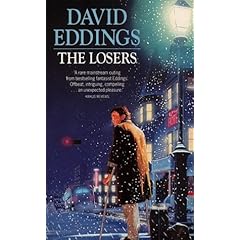
Review number: 799
Apart from his debut novel, thriller High Hunt, The Losers is Eddings' only attempt at something outside the fantasy genre. Interestingly, it has aspects in common with the much earlier novel, including the Washington state setting (though that is where Eddings lives) and a plot incorporating ideas about sibling rivalry (less literally here).
Raphael Taylor is bright, good-looking and athletic - a high school American football hero. When he goes to university, he meets the strange but fascinating Damon Flood, and is basically led astray. A drunken driving accident leads to the loss of a leg, and Raphael has to face up to life as a cripple.
Unable to face his friends, Raphael moves to a poor area of Spokane to begin his convalescence, only to become fascinated by the lives of those around him (in a Rear Windows kind of way). These people, living on the edge of crisis, unwillingly dependent on an institutionalised social services, are the losers of the novel's title.
The losers are really what the novel is about, and there are lengthy debates about what drives them and if (and how) they can be helped. A lot of what is said is criticism of the American social services, which, in Taylor's (and presumably Eddings') opinion, fails because it regards these people as a catalogue of problems to be matched against programs, rather than as individuals. It is, of course, an easy criticism to make of any enterprise of a large scale, and it is much more difficult to suggest anything which can
be done about it.
As a novel, The Losers is more interesting than successful, with the traces of arch humour characteristic of Eddings' fantasy novels seeming distinctly out of place. (This is particularly the case as some jokes are repeated word for word.) Raphael is not believable enough to hang the novel on; the loss of his leg has remarkably few psychological effects, and this combines with his role as observer to make him seem too detached from reality. Charles Dickens would have made wonderful characters out of the losers, and Eddings is no Dickens. The Losers is probably Eddings' most ambitious and least successful novel.
Wednesday, 23 September 1998
David & Leigh Eddings: Polgara the Sorceress (1997)
 Edition: Voyager, 1997
Review number: 117
Polgara the Sorceress is the second prequel to the Belgariad and Malloreon series. The different author attribution of this and Belgarath the Sorcerer apparently reflects not a change in how David Eddings' books are written, but is more an overdue acknowledgement. The story of the world of Belgarath and his family now occupies twelve books, though the two prequels match in length any two of the others.
The first prequel tells a first person narrative of the life of Belgarath, 'the Eternal Man'; this second one is the same, courtesy of his daughter, Polgara. There is naturally some overlap (as Belgarath has been alive through the whole of his daughter's life), but they concentrate on different aspects of the history of the Eddings' world.
Even though they come first chronologically, the prequels would not be a very interesting read before the remainder of the series. The place to start is with the first volume of the Belgariad, Pawn of Prophecy (which was published first). If you enjoy that series and the Malloreon, then come back to the two prequels. (Their scene-setting introductions follow on after the end of the main series.)
Myself, I would be pleased to see the Eddings abandon the arch tone that they take in the whole series, and which is particularly annoying in the prequels. There is a distinct sentimental vein to David Eddings - I once read an interview in which he referred to J.R.R. Tolkien rather nauseatingly as "Papa" - but he is able to jettison it when he desires to do so. His contemporary novels, High Hunt and The Losers, are much better written because in them he assumes a rather different style which works well. To sum up, Polgara the Sorceress is probably for fans only.
Subscribe to:
Posts (Atom)

 Posts
Posts

