Edition: Grafton, 1986 (Buy from Amazon)
Review number: 861
The immediately obvious strange fact about this collection is that three quarters of it is made up of a (short) novel length Jerry Cornelius story, and that The Alchemist's Question doesn't even provide the title. This comes from one of the other seven pieces, and is about a drug addict living in a dream world, and reads something like a bridge between the Jerry Cornelius stories and the novel Moorcock wrote a short while later celebrating the English capital, Mother London.
The other fiction consists of three below standard stories from the point of view of a Russian agent caught up in a future war; more interesting are the three political essays which round off the collection. The most substantial of these is a discussion of right wing politics in science fiction and fantasy, genres in which some of the most famous writers are in Moorcock's (anarchist, left wing) view extremists - Heinlein and Rand, for example, and, more unusually, Tolkien. I am not convinced that these writers are as pernicious as Moorcock makes out, partly because I don't think my politics have been changed by reading them, no matter how insidiously their views are promoted in their fiction.
One of the other essays is about censorship, and the kind of hypocrisy that destroys those who disagrees while pretending to tolerate disagreement (prosecutions of anarchist bookshops for obscenity), and that is part of the distaste Moorcock felt about Thatcher's Britain which is important in The Alchemist's Question, which is the last Jerry Cornelius story.
The story also draws upon the idea of the battle between Law and Chaos which is important in several of Moorcock's fantasy series, notably those involving Corum. Miss Brunner, who appears throughout the Cornelius chronicles, represents Law, rigidity and authoritarianism - to the extent that the desires to bring on a nuclear winter and make the world more uniform. She has become a figure not at all unlike an exaggeration of Margaret Thatcher. It looks as though the free spirited friends of Jerry Cornelius are about to be defeated, especially as Jerry himself is living in a semi-catatonic state. The ability to move between alternate universes is denied them, and they are trapped into trying a desperate alchemical ritual.
The story is much more pessimistic in tone than the earlier Jerry Cornelius novels; this has a great deal to do with the early eighties and how depressing Moorcock found Britain at that time. It is a savage attack on the pressure to conform, much stronger even then than fifteen years earlier when the quartet of novels was written. It ends up being less successful than its predecessors, mainly because Jerry, though always present, is rendered so ineffectual, so hopeless.
Thursday, 5 July 2001

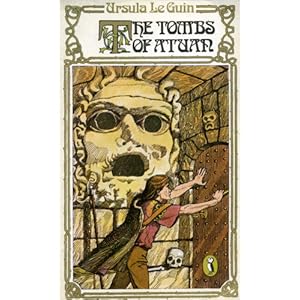
Ursula K. le Guin: The Tombs of Atuan (1972)
Review number: 860
Of the three novels making up the original Earthsea trilogy, The Tombs of Atuan is most obviously aimed at children. This is not so much because of its content (like the others, it's unusually dark for a children's story) but because of what might have been its content; if it had been written for adults, there are several areas which le Guin would probably have explored more thoroughly.
The central character of The Tombs of Atuan is a young girl, believed to be the reincarnation of the Priestess of the Tombs, a centre for the power of primordial dark spirits, the Nameless Ones. At the age of six, she is taken to the Temple where her name is ceremonially taken from her (names are of extreme importance in the trilogy), so that she becomes Arha, the Eaten One. After some years, she suddenly discovers that a man has broken into the Labyrinth beneath the Temple, the place where no one but her is permitted to go. This man is Sparrowhawk, the central character of the trilogy, who is searching for a lost magical item.
The depiction of the ritual of the Temple an the dark fear which is the general attitude to the Nameless Ones is an important part of the novel, and the former clearly owes something to anthropological descriptions of rituals and Jungian ideas about them. (Le Guin's father was an anthropologist.) It is all very convincing. This could have been more developed in an adult novel, whose readers would be less impatient to move on with the story. The political rivalry between the various priestesses is another area which could have been made more of; Arha is nominally most important, but the middle-aged High Priestess of the newer cult of the Godking is a more dominant personality, and it is her temple, of the deified ruler of the empire in which the island of Atuan is situated, which receives rich gifts and patronage.
The obsession which Arha feels about Sparrowhawk definitely seems to have a sexual side, the fascination of a young teenage girl for the first man she has seen since she was brought to the Temple except her eunuch slaves. This is hinted at quite clearly, but it is another aspect of the novel which might have been made more explicit if it had been aimed at adult readers. In fact, it is picked up in Tehanu, the novel later added to the trilogy, which is meant to be read by adults.
It is common for the middle volume in a trilogy to be the poorest; though this is true of The Tombs of Atuan it is not for the usual reasons (and is, of course, a judgement only relative to the others). Still an excellent young adult fantasy story, it could have formed the nucleus of a greater adult novel.
Wednesday, 4 July 2001
David Mitchell: Ghostwritten (1999)

Review number: 859
From the start, the narrative of a cult member directly responsible for a gas attack on the Tokyo subway, it is clear that Ghostwritten is an excellent and unusual novel. The characterisation - of distinctly varied individuals - and backgrounds are very well done. They draw the reader in, and pave the way for some of the more complex aims that the novel has.
The whole thing only comes together at the end, but on the way is a great deal of thought provoking entertainment. The novel is a sequence of barely related narratives - the links are things like the fanatic of the first part making a phone call to the Tokyo jazz record shop in which the central character of the first part works, thinking it is a number set up by the cult to help members in peril - spanning the globe and bringing in all kinds of ideas, from Mongolian folk stories to quantum mechanics.
The characters at the centre of the narratives include a ghost-writer and a ghost writing in the first person, but the title also refers to other concerns of the novel, such as the way in which things around us are built up from the ghostly world of quantum physics. Ghostwritten is both extremely clever and extremely well written; it is exciting to read and in places very funny. When you realise that it is a debut novel, the achievement becomes even more amazing.
Rudyard Kipling: Captains Courageous (1897)
Edition: Minster, 1967 (Buy from Amazon)
Review number: 858
The life of the Banks fisherman, chronicled in this novel, must have changed almost beyond recognition in the course of the last century. Technological innovations such as radar and GPS will have made the seas safer, telephone and the TV will have made the fishing communities less isolated and the big cities may well have lured many of the younger generation away.
At the time when Kipling wrote his tribute to the courage and hard work of these fishermen, the situation was very different. Much of the equipment would have been recognizable to the medieval sailor, though the boats would be stronger to cope with North Atlantic seas and the power would be steam (the latter the biggest advance). Captains relied on an encyclopaedic knowledge of the Banks, with simple instruments like the lead providing all the information they needed for navigation.
Admiration for these men - and hundreds of fishermen died each year - prompted the novel, and it is impossible not to feel the same when reading it. That is for more important than the simple plot, in which a spoilt rich boy is rescued by a fishing boat after being swept overboard from a steamer, and is forced to grow up and become a totally different person during the several months fishing before the return to the mainland.
The banal story makes this one of Kipling's less important novels, but it does still have the marvellous evocation of a foreign culture (which, even then, it would have been to the vast majority of his readership) which is part of his best work.
Review number: 858
The life of the Banks fisherman, chronicled in this novel, must have changed almost beyond recognition in the course of the last century. Technological innovations such as radar and GPS will have made the seas safer, telephone and the TV will have made the fishing communities less isolated and the big cities may well have lured many of the younger generation away.
At the time when Kipling wrote his tribute to the courage and hard work of these fishermen, the situation was very different. Much of the equipment would have been recognizable to the medieval sailor, though the boats would be stronger to cope with North Atlantic seas and the power would be steam (the latter the biggest advance). Captains relied on an encyclopaedic knowledge of the Banks, with simple instruments like the lead providing all the information they needed for navigation.
Admiration for these men - and hundreds of fishermen died each year - prompted the novel, and it is impossible not to feel the same when reading it. That is for more important than the simple plot, in which a spoilt rich boy is rescued by a fishing boat after being swept overboard from a steamer, and is forced to grow up and become a totally different person during the several months fishing before the return to the mainland.
The banal story makes this one of Kipling's less important novels, but it does still have the marvellous evocation of a foreign culture (which, even then, it would have been to the vast majority of his readership) which is part of his best work.
Tuesday, 3 July 2001
Leslie Charteris: Saint Errant (1948)
Edition: Hodder & Stoughton, 1960 (Buy from Amazon)
Review number: 857
This collection of Saint stories is a repeat of the idea of She Was A Lady. There are nine stories, each with a different woman at the centre whose name is the title of their story. There are in fact more similarities than this architectural one; in each book there is one woman who appears in several stories, who is a thief who is effectively hijacked by the Saint, but in a gentler way than is often the case with his victims.
The final story, Dawn, is however completely unique in Charteris' output. Most of the Saint stories are quite prosaic, whereas in this one the main idea is supernatural. Simon is staying alone in the mountains, when a fugitive arrives at his cabin. This man tells a fantastic if rather unimaginative story about rivalry to obtain a gem carved in the semblance of a beautiful face and a girl named Dawn who is the living version of the stone. The man also explains that the whole thing is a dream, that he is in fact asleep in Glendale, California. (This is the reason for the derivative nature of the scenario and aspects of it such as the villain's distinct resemblance to the actor Sidney Greenstreet.)
This story makes the collection one of the more interesting books in the series. The other tales are competent, enjoyable and well written, but remain comfortably within the usual parameters of Charteris' writing.
Review number: 857
This collection of Saint stories is a repeat of the idea of She Was A Lady. There are nine stories, each with a different woman at the centre whose name is the title of their story. There are in fact more similarities than this architectural one; in each book there is one woman who appears in several stories, who is a thief who is effectively hijacked by the Saint, but in a gentler way than is often the case with his victims.
The final story, Dawn, is however completely unique in Charteris' output. Most of the Saint stories are quite prosaic, whereas in this one the main idea is supernatural. Simon is staying alone in the mountains, when a fugitive arrives at his cabin. This man tells a fantastic if rather unimaginative story about rivalry to obtain a gem carved in the semblance of a beautiful face and a girl named Dawn who is the living version of the stone. The man also explains that the whole thing is a dream, that he is in fact asleep in Glendale, California. (This is the reason for the derivative nature of the scenario and aspects of it such as the villain's distinct resemblance to the actor Sidney Greenstreet.)
This story makes the collection one of the more interesting books in the series. The other tales are competent, enjoyable and well written, but remain comfortably within the usual parameters of Charteris' writing.
John le Carre: Smiley's People (1980)
Edition: Pan, 1980 (Buy from Amazon)
Review number: 856
Once again, the British intelligence service known as the Circus is unable to get on without George Smiley, who is recalled a second time from retirement to sort out a problem related to Russian spymaster Karla, controller of the high ranking mole in Tinker Tailor Soldier Spy.
The problem he is called in to sort out begins with the murder of one of the leaders of the community of Estonian refugees, at one time important parts of the Circus' network of agents, but now considered to belong to the past. What Smiley has to work out is what it is that the old man has discovered which has made the
Russians decide that suddenly he is worth killing.
Cleearly in the tradition of the detective early Smiley novels, Smiley's People is not as successful as Tinker Tailor Soldier Spy or The Honourable Schoolboy. In those novels, others are entrusted with th operational legwork; here Smiley himself investigates the death in England and Germany, and leads a group in Switzerland. Given his age, he makes an unlikely operative; he was a spy in the war, and this novel if contemporary with its setting (as it seems to be) is thirty five years later.
Review number: 856
Once again, the British intelligence service known as the Circus is unable to get on without George Smiley, who is recalled a second time from retirement to sort out a problem related to Russian spymaster Karla, controller of the high ranking mole in Tinker Tailor Soldier Spy.
The problem he is called in to sort out begins with the murder of one of the leaders of the community of Estonian refugees, at one time important parts of the Circus' network of agents, but now considered to belong to the past. What Smiley has to work out is what it is that the old man has discovered which has made the
Russians decide that suddenly he is worth killing.
Cleearly in the tradition of the detective early Smiley novels, Smiley's People is not as successful as Tinker Tailor Soldier Spy or The Honourable Schoolboy. In those novels, others are entrusted with th operational legwork; here Smiley himself investigates the death in England and Germany, and leads a group in Switzerland. Given his age, he makes an unlikely operative; he was a spy in the war, and this novel if contemporary with its setting (as it seems to be) is thirty five years later.
Ken MacLeod: Cosmonaut Keep (2000)

Review number: 855
Beginning a new series, Cosmonaut Keep has two independent storylines. The first takes place in a shattered Europe in about fifty years' time, in a Scotland which is a Socialist Republic and then in a space station; it is concerned with first contact with a bizarre alien species, a bacterial lifeform which forms colonies which are incredibly powerful computers.
The second story is set farther into the future, and in quite a distant part of the galaxy, populated (from a human point of view) by the descendants of people rescued from death by aliens, living alongside other hominids and reptilian intelligent lifeforms. The connection with the first story gradually becomes clear as the novel progresses, though to begin with it is a bit confusing and seems to be irrelevant.
The beginning of the novel is actually where most of its problems lie. It takes a fair amount of time to get going, especially the second storyline. It grows on you by the midpoint, but it sometimes feels as though it isn't worth the effort - maybe a more complex structure and greater integration of the stories would have helped, rather than the scheme of alternating chapters MacLeod uses.
The very end of the novel is interesting, introducing a note of ambiguity before the start of the second part of the series; a journey is undertaken, but it is not clear by whom or even exactly when. Though the novel as a whole is not as good as MacLeod's earlier work, it is intriguing enough to make me want to continue with the series.
Subscribe to:
Posts (Atom)

 Posts
Posts

