Friday, 7 December 2001

Andrew M. Greeley: Contract With An Angel (1998)

Edition: Tor, 1999
Review number: 1006

The Faust story is about a man who makes a contract with the devil, selling his soul for magic powers and the caresses of Helen of Troy. In this novel, unscrupulous businessman Raymond Needham makes a contract with an angel, who appears to him on a nearly disastrous plane journey, in which he undertakes to follow angelic guidance for the salvation of his soul. There is a tendency for stories involving angels to be rather sentimental (several films could easily be cited as support for this), and though Contract With an Angel is no exception, it is an enjoyable read.

Though Greeley is a Roman Catholic priest, his depiction of angels in his novels is not totally orthodox; but this has little direct effect on this particular story, even if his depiction of God as at least partially female might offend hidebound traditionalists. The angelic purpose is worked out almost entirely through Needham's attempts to restore broken relationships within his family; he is not successful in every case but manages to satisfy the demands of his guardians without much backsliding. (If neither of these statements were true, Contract With an Angel might have been a more literary novel, but probably less enjoyable.) Light and likely to leave a silly grin on the reader's face, Contract With an Angel makes an ideal pick-me-up.

Josephine Tey: Brat Farrar (1949)

Edition: Penguin, 1980
Review number: 1007

Tey's famous novel takes a theme common in Gothic fiction, impersonation of an heir, and creates a mystery story which more or less renders the idea unusable in the future without reference to her writing. Brat Farrar is a foundling who has been working on a ranch in the States; returning to the England where he grew up, he is accosted by a stranger. Alec Loding at first believed him to be his cousin Patrick Ashby, the heir to the family estate who had gone missing seven years earlier. Now he would be about to come of age, and once Loding believes that Brat (a corruption of Bartholemew) is not Patrick he comes up with an audacious plan to train him in every aspect of Patrick's life so that he could turn up and take the farm from his younger twin brother Simon.

While most of the Ashby family accept Brat as Patrick, Simon seems certain that he cannot be, not because of his resentment or because he has caught him out but for some other reason which seems to Brat to be not just menacing but slightly ominous, clearly connected to the reason for Patrick's disappearance. Brat's feelings about this are contrasted throughout the novel with his growing appreciation of becoming part of a family, and this is one of the reasons why Brat Farrar is so successful.

The reader knows from the start that Brat is an impostor, and so the interest of the novel lies in two areas: we want to know what happened to the real Patrick Ashby, and we want to know if Brat can carry off the deception. It is a far fetched story, but Tey makes it fascinating and believeable; and that is why this is a great thriller.

Thursday, 6 December 2001

Roger Zelazny: The Dream Master (1966)

The Dream Master coverEdition: iBooks, 2001
Review number: 1005


Psychiatric care in the future is not a particularly common theme in science fiction, possibly because even though it has developed rapidly through the twentieth century it seems that many of its fundamental precepts are not yet very strongly established - so how can we guess what ideas and techniques will be available in the future? One idea that does seem clear is that dreams play some vital role, both in diagnosis and as part of the mind's own healing process.

So Zelazny's central character, Charles Render, is a dream shaper: his therapy consists of participating in and controlling to an extent the dreams of his patients. Too strong a psychosis or abnormal desire in the subject can overwhelm the mind of the therapists, but he hardly hesitates before embarking on the greatest challenge of his career. Eileen Shallot is also a psychiatric doctor, who comes to him wanting to be trained to become a shaper herself. The problem is that she is congenitally blind, and is at least partly driven by a desire to share the vision of those she will treat. Render needs to giver her therapy to overcome her anxiety about vision, showing her the world, at the same time dealing with the resentment of her guide dog, a genetically modified Alsatian with greatly enhanced intelligence who thinks that his mistress will cease to need him.

The major strengths of the novel are the powerful theme of the desire for sight, the unusual concentration on psychiatry, and the depiction of the dreams shared by Render and Shallot. Only one of them fails to work well, a recreation of a Walt Whitman poem which is a rather dull catalogue of visual images. Even if it is always a little strange to read a science fiction novel set at a date now past (1998), The Dream Master remains unusual and a powerful classic of the genre.

Wednesday, 5 December 2001

Jean Anouilh: Colombe (1951)

Translation: Dennis Cannan, 1951
Edition: Methuen, 1959 (Buy from Amazon)
Review number: 1004

Like Ardèle, which accompanies it in this Methuen volume, Columbe is about the right to freedom of expression. The young woman in the title role seems content to be the wife of aspiring and penniless musician Jean, until his call-up papers arrive. Then they are forced to ask his estranged mother, a famous actress, for help, which she gives them by providing Colombe with a part in the production in which she is starring.

This act, and the absence of her husband, brings Colombe into contact with a completely different world, full of men paying her compliments, full of expensive gifts and, above all, full of fun. Is this more important than dutiful devotion to her husband, his art, and their baby (which she seems quite grateful to be able to afford to pass on to a childminder)? Her new life also includes Jean's half-brother Paul, who is the opposite of Jean and to whom she is strongly attracted.

Colombe is remarkable for the way in which the character of the mother is drawn so quickly and skilfully, even though like the others (in what is after all quite a short play) she contains liberal amounts of stereotype. It is not among Anouilh's more profound plays, but is no doubt extremely effective on stage.

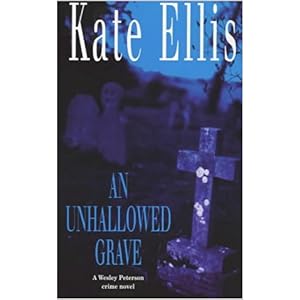
Kate Ellis: An Unhallowed Grave (1999)

Edition: Piatkus, 2000
Review number: 1003

There are, perhaps, a rather limited number of ways to connect archaeology to a murder mystery. You could have archaeologists discover a modern body, or a member of a dig could be killed, or be an investigator, or they could find an old body whose history parallels a modern crime, or they could be in the area where a completely independent crime takes place. I have read novels using all the first four ideas, if not the last. The way that Ellis' series of detective novels is set up means that they will quickly become repetitive, and she is not quite a good enough writer to ring the changes on the details.

This particular novel uses the fourth scenario, along with the use of the third, which is generic to the series, having as investigator an archaeologist turned policeman. In a Devon village, a woman is found dead, an apparent suicide hanging from the boughs of a yew tree in the churchyard. It is quickly established, however, that she had been at least partially strangled before the hanging - hands leaving a different pattern of marks on the neck from a rope. At about the same time, the skeleton of a medieval woman is found in a rescue dig at a potential housing development on the edge of the village; she had been rather more professionally hanged.

An Unhallowed Grave is enjoyable, even if the reader never loses the feeling that it is far fetched as the parallels between events now and in the fifteenth century are developed.

Tuesday, 4 December 2001

Jean Anouilh: Ardèle (1948)

Translation: Lucienne Hill, 1950 (original title Ardèle ou la Marguerite)
Edition: Methuen, 1959 (Buy from Amazon)
Review number: 1002

Ardèle is a tragic idea written in the form of a slightly absurdist French bedroom farce. Its central character is never seen or heard on the stage, which is another unusual feature. It is set in a château where a family conference has been called to discuss what can be done about Ardèle, the old maid of the family. A hunchback from her youth, she scandalises her relations when she and the new tutor, also a hunchback, fall in love.

This is an entirely hypocritical reaction, as every other family member is openly having an affair. (The exception is the General's wife, who never emerges from her room and whose periodic calling for her husband is dismissed as insanity.) Knowing that her future is under discussion, Ardèle has locked herself in her room and refuses to come out, despite the arguments made through the keyhole of her door.

The meaning with the play is connected to the right to have personal freedom, to love and be ones true self. Ardèle shocks the other characters not because of the social distance between her and the tutor, but because they have never considered her a fit person to love or be loved. Ardèle's passion is clearly far more deeply felt than the bedroom-shuffling antics of the rest of the family, and even evoked only through the words of the others she comes across the better deserving of the freedom to love.

Saturday, 1 December 2001

John D. Barrow: The Universe That Discovered Itself (1987, 2000)

Edition: Oxford, 2000 (revision of The World Within the World, 1987)
Review number: 1001

Barrow's book, an updated version of The World Within the World, is a philosophical look at the history of science and contemporary scientific ideas with a rather unusual slant. It takes a list of nine statements about the laws of science and how they relate to the underlying reality of the universe, and then sees a general trend up to the work of Newton to establish these statements, followed in the twentieth century by the opposite trend with the development of new theoretical frameworks very different from the Newtonian one. These statements are things like "Space and time exist" or "The world can be described by mathematics", and are a set of basic philosophical assumptions about the universe, informing scientists' attitudes to physical theories.

The Universe That Discovered Itself is aimed at the experienced reader of popular science. Even though brief explanations are given, it would be difficult to follow without a previous acquaintance with relativity, quantum mechanics, string theory, and the anthropic principle among other ideas. With a familiarity with these concepts and an interest in the philosophical, there is much pleasure to be obtained from the book. The title refers to the thought that we, as part of the universe, have discovered a great deal about it, and is particularly appropriate given the quite lengthy discussion of the role of the observer in quantum mechanics and particularly quantum cosmology.

The presentation is typical of Barrow, with each section enlivened by interesting and frequently amusing quotations, including the following anecdote. In an Oxford physics viva in the 1890s, a student was asked to define electricity. His response was that he did know but had forgotten, to which the examiner drily replied, "How very unfortunate. Only two persons have ever known what electricity is, the Author of Nature and yourself. Now one of them has forgotten".

I'm not sure how radical a revision was made to the earlier book, and there are some sections which seem to be less up to date than others, which is a pity. Still, I found The Universe That Discovered Itself a fascinating exploration of the philosophy behind modern physics.