Thursday, 15 August 2013

Craig Stone: Life Knocks (2012)

Edition: Kindle ebook, 2012
Review number: 1479

I wasn't sure whether I would like Life Knocks or not before starting to read it, and I am still not sure.

The narrator, named Colossus, is at a low point in his life. He is living in a low quality bedsit, unable to connect with anyone he meets, with the exception of his unpleasant landlord (who is a Muslim version of Riggsby from seventies sitcom Rising Damp, with even less charm and fewer redeeming qualities.

This life forms one of two interwoven narrative streams, being labelled Present whenever it occurs. The other, labelled Past, describes an idyllic affair with a woman named Lily, and how Colossus basically this part of his life away. Lily is the only truly sympathetic character in the novel. The separate narratives work very well, and make Life Knocks read rather like an Iain Banks novel, Dead Air being the one which sprang to mind,, though without some of his quirkiness.

It is clear, even only from the quotations on the cover image, that Life Knocks is a novel which many of its readers find extremely funny. The humour here did not really appeal to me (which is one reason why I am not sure I liked the novel as a whole). Basically, it consists of watching Colussus finding more and more ways to mess things up - something which I found more excruciating than funny. But tastes differ...

Perhaps I invested more in the character than other readers have done, and so found his mistakes unbearable, but the fact that I did so was a tribute to the quality of Stone's writing. It is really easy to enter into the world in which Colossus lives, in both phases of his life. That is part of the problem - I didn't want bad things to happen.

In the end, I would say that I admired Life Knocks a lot more than I enjoyed reading it. If this kind of humour is your kind of thing, you will love it; if not, you will probably react much as I did. My rating - 6/10.

Thursday, 4 July 2013

Jack Finney: The Body Snatchers (1955)

Edition: Gollancz, 2010
Review number: 1478

Jack Finney's most famous novel, filmed four times (and also known, like two of the films, as The Invasion of the Body Snatchers), is a masterclass in how to manage tension in a thriller.

The story is set in the small town of Santa Mira (oddly, wrongly named on the back cover of this edition) in northern California, a place where seemingly nothing ever changes. The narrator is the town's doctor, Miles Bennell, and begins when a patient comes to see him with a bizarre story: her uncle is no longer her uncle. Things escalate, and it soon appears that only a few humans are left in a town where everyone else has been replaced by aliens who look identical to the originals and even share their memories.

The way that the tension is built up is fairly obvious. Each chapter ends with a statement of increasing loneliness, as more and more possibilities are blocked off (the phone exchange is taken over, a friend in the army is unable to help, and so on).  It's a simple trick, but very effective.

There has been a fair amount of criticism of The Body Snatchers over the years. Its science is clearly suspect, though that is true of a lot of science fiction. Here, though, there is some self-contradiction (the pods from which the aliens come are said to be moved by light pressure, but then rise from the surface of the earth, for example). It has a straightforward plot, and the characters other than Miles are basically ciphers.

In the earliest film version, the alien interlopers are clearly signposted as a metaphor for Communist infiltration into the US of the fifties. As Graham Sleight points out in his introduction to this edition, this interpretation is not anything like as obvious in the novel: it is consistent with it, but not required. I would agree with him that what comes across more as the point of Finney's writing is related to the end of the innocent small town community portrayed in Santa Mira at the beginning of the story. Even in that now lost (and possibly never really existing) culture, did anyone really know their neighbours through and through?

But these issues do not prevent The Body Snatchers from  being a much loved genre classic, and the way that Finney constructs the story and carries the reader along into an increasingly paranoid and tense situation is the reason why. My rating: 9/10.

Tuesday, 2 July 2013

Wayne Williams and Darren Allan: I Know What You Did Last Supper (2013)

Edition: Piatkus, 2013
Review number: 1477

I initially hesitated about reviewing this novel when I was asked to do so, because of the subject matter, but decided that it is wrong to effectively condemn anything without experiencing at least part of it. I probably would not have picked it up, though, unless I'd been asked to review it (hence the introduction of a new tag for books submitted for review).


The basic premise of I Know What You Did Last Supper is that Judas Iscariot receives a threatening message after his betrayal of Jesus Christ, before his friends and family start being gruesomely murdered one by one. The title suggests an outrageously silly take on this, but that is not what the novel is: instead, it is a fairly standard thriller in terms of plot.(Others may find the way it is written funny, but I felt that the killings were really too gruesome for this.) To my mind, it has to succeed as a thriller before getting to the question of the content, which may well be offensive to some.

As a historical novel, it does rather come up short. There is little real atmosphere of first century Palestine, and many of the actions which happen are more or less transpositions of modern day actions to the period - when Judas goes out and buys a flashy black stallion with the money paid to him as the price of his betrayal, the transaction hardly differs from a purchase of a shiny black convertible in Los Angeles. There are events which don't really ring true, particularly in the portrayal of religion. For example, it seems unlikely that so many people would ignore the Sabbath at this time in Jerusalem. So, not convinced by the setting. I had the impression from somewhere that "Iscariot" is thought to be a nickname, from the Sicarii, a group of Jewish nationalists, not a surname in the sense that we use them, so that Judas' father is unlikely also to be known as Iscariot.

And as a thriller? I'm not entirely convinced here either.  The thriller plot, with Judas basically flailing around trying to work out who is killing people, is basic and unoriginal, though it does have a couple of interesting twists, which I will discuss as part of the religious content. The final revelation was, to me, long anticipated and unconvincing.

The Christian content seems, to at least a certain extent, designed to shock. Some of this is done at the expense of verisimilitude, as when, for example, Judas suspects that it is the resurrected Jesus who is using supernatural powers to kill those close to him as a punishment for his act of betrayal - not really likely in the sort of person that Jesus is otherwise portrayed to be in this novel as well as in the gospel narrative. Not validated by the quality of the treatment, the use of Christianity is just offensive for its own sake, which is the least excusable form of offensiveness. There are a couple of redeeming features. One - the one which is most important to me - is that the novel reminds its readers that the disciples portrayed in the Bible were people, even Judas. The other  is that the most interesting thing about Judas' character as depicted here is the motivation for his original betrayal, which is not considered important by the gospel writers, but which is something very important to modern readers of crime fiction. So Judas is given one, and it is because he wants to save his uncle from a vicious criminal boss who wants his gambling debts paid off.

In the end, the redeeming features were not enough for me to truly enjoy reading the novel. My rating - 3/10.

Thursday, 20 June 2013

Nick Harkaway: Angelmaker (2012)

Edition: William Heinemann, 2012
Review number: 1476

Harkaway's first book, The Gone-Away World, is one of my favourite new novels of the last few years, so I have been eagerly waiting to read his second, Angelmaker.

The central character, Joe Spork,  is a craftsman who works on clockwork mechanisms, deliberately following in the footsteps of his grandfather rather than his father, an East End gangster. But when he is asked to repair an enigmatic device, he draws the attention of a shady government agency as he races to prevent the use of a doomsday weapon.

There are, unsurprisingly, many similarities between Angelmaker and The Gone-Away World. The style is the same, the frenetic pop culture tropes are used as effectively. Here, the references include such things as Kim, sixties London gangsterism, a hidden London which most inhabitants never see (Neverwhere without the fantasy elements - including a market held near HMS Belfast), and so on. Like Angelmaker, it reminded me strongly of Thomas Pynchon, though perhaps in this case Vineland is a closer fit than Gravity's Rainbow. It's lighter, with more concentration on the humour, but is certainly no less enjoyable.

This type of wildly whimsical storytelling always appeals to me, but if it isn't your cup of tea, you are unlikely to enjoy Angelmakeras much as I did. And since the cleverness of the silly side to the book is such an important part of it, it's probably not worth picking up if that is so. But to those of us who do like this, Nick Harkaway's second novel is as much a treat as his first. My rating: 9/10.

Wednesday, 17 April 2013

Anicius Boethius: The Consolation of Philosophy (c. 524 AD)

Translation: V.E. Watts
Edition: Penguin Classics, 1969
Review number: 1475

There are a few books which have had a huge influence on the age in which they were written. However, few people today read The Consolation of Philosophy, which could be considered the foundation of medieval culture.

Boethius was a statesman in sixth century Italy, just after the final fall of the Western Roman Empire, but was disgraced and imprisoned; like many politicians in that situation, he maintained his innocence. But in prison, according to the account in this book, he underwent a mystical experience, being visited by a woman he eventually recognises as Philosophy, who goes on to teach him to treat his situation in what could nowadays be termed a "philosophical manner".

What appealed to the medieval mind about this? From the literature of western Europe over the next nine hundred or so years, it is partly the mystical element, and partly the allegorical flavour - the figure of Philosophy is a precursor of many later personifications. Not only that, but Boethius' distillations of classical philosophy, as well as his translations of Greek philosophers into Latin, were the main way in which their thought survived in an age of little literacy and where Greek scholarship was almost non-existent. Writers and thinkers influenced by The Consolation of Philosophy would include almost every notable figure from the best part of a thousand years of history.

The only book I can think of with a similar effect is Bunyan's Pilgrim's Progress, which has many points in common with The Consolation of Philosophy. The later work was basically a way to make it easier to understand Puritan ideas about Christian salvation, while the earlier was doing the same with classical philosophy;  both had allegorical elements, Bunyan's more so; both authors were imprisoned, with prison playing an important part in their books; both proved incredibly popular and influential. The influence of Bunyan continues to this day, and many of his figures of speech have entered the English language ("slough of despond", for example); Boethius was responsible for the popularity of the idea of a "wheel of fortune", though he did not invent it.

Essentially, what Boethius is doing is a popular exposition  of neo-Platonist thought. He was a Christian, and yet is pretty circumspect about his theology in the book, talking of "God" but never mentioning Jesus. Some readers have wondered whether he was a Christian in name only, as he would have needed to be to be a successful politician in sixth century Italy, but his approach to philosophy inspired the medieval mind because he is able to start bringing the pagan thought into a monotheistic context, a process which culminated in the elaborate systems of Thomas Aquinas celebrated in Dante's Divine Comedy.

In modern editions such as this one, The Consolation  of Philosophy is divided into books each made up of several sections, which each end with poetry. Boethius was famed for his Latin prose style, though Watts does admit that the poetry is uneven in quality. Not having ever read the original, I wouldn't know, and it is perhaps less apparent in this translation, which I would suspect is not as great as Boethius at his best nor as poor as his worst, but is more even throughout. This is also one of the most academic of the Penguin Classics translation in its presentation (the actual translation is clear and readable enough), with footnotes identifying references in learned articles throughout.

Ours is an age which has learnt from the romantics to value "originality". Perhaps less so now than a few years ago (after all, what is original in the albums of the latest winners of the X Factor). I suspect that this is part of the reason why Boethius' work fell out of favour. As a philosopher, he does not claim to have any new insights - just ways to put together old ones to appeal to modern (in his time) tastes. As a distillation of ancient philosophy, the alternating prose and poetry is perhaps harder to get into today when it is not the kind of writing commonly encountered; there are far better introductions for the modern reader, which would go on to later thought - for a philosophy beginner who wants a close modern equivalent, where fiction and philosophy mingle in an approachable manner, I would recommend Jostein Gaarder's Sophie's World, aimed at a young teen audience but with plenty of charm for older readers.

The Consolation of Philosophy appeals to me because I have long been interested in the medieval way of thought. Perhaps in itself it has less to offer than as a window into a very different, yet recognisable, world to the modern West. But in the end I rate it at 8/10.

Wednesday, 27 March 2013

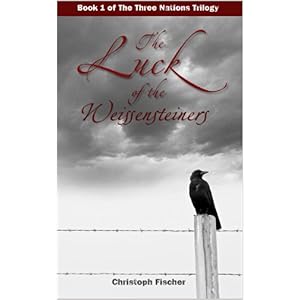
Christoph Fischer: The Luck of the Weissensteiners (2012)

Edition: ebook provided by author (2013)
Review number: 1474

The story of Slovakia in the thirties and forties is likely to be quite obscure to most British people, even those interested in the Second World War (which, as far as the histories commonly read in the UK are concerned, mainly happened in Western Europe, the North Atlantic, North Africa, and the Far East). Briefly, Slovakia was part of the Czechoslovakian republic which formed when Austria-Hungary collapsed at the end of the First World War, and had large German and Jewish minorities as part of its population. After Hitler gained power in Germany (the date at which The Luck of the Weissensteiners opens), Slovakia's German population became more powerful and nationalistic, until Czechoslovakia was split up, Slovakia becoming an independent republic which was a German ally (and effectively puppet state) during the war years, hard times to be a Jew in the area.

The central character of the novel, Greta Weissensteiner, is the book-loving daughter of a Jewish weaver, who falls in love with the German shop assistant Wilhelm in the town bookshop in 1933. Over the next few years, the story follows the increasing pressure on their relationship from the political situation in the country, leading to a spilt orchestrated by Wilhelm's rather unpleasant sister and the Weissensteiner family going into hiding.

The story itself and the way that the political changes going on around them affect the lives of the characters are fascinating. Fischer attempts to answer some difficult questions, such as why many people began to accept Nazi anti-Semitic propaganda: many people were fooled into believing that Jews were inferior beings, and didn't just go along with what they were told as a public necessity. Fischer portrays people who are just stupid, or who want to believe the lies for other, personal, reasons. Other aspects of The Luck of the Weissensteiners were less to my taste, however. One of the quirks of Fischer's writing is the way that the reader is frequently told the emotions and desires of the characters directly. Many paragraphs in this novel start with sentences like "Apart from the fear, she also felt guilty for hurting his feelings", chosen from a random page about half way through. This occurs so often that it begins to feel as though the narrative has a huge number of different viewpoints which are swapped between almost randomly. I often found the dialogue rather stilted, too, and so never really managed to suspend disbelief in the story. Other readers might well not be as finicky about this kind of stylistic point as I am, but for me these problems rather spoiled what was otherwise an interesting story with an interesting setting. My rating: 5/10.

Monday, 25 February 2013

Aldous Huxley: Ape and Essence (1948)

Edition: Vintage, 2005
Review number:1473

When I came across Ape and Essence in the local library, I was surprised. I like Huxley, and I have read a lot of science fiction, but here was a science fiction novel by Huxley I'd never heard of before, let alone read.

On reading it, the reason that Ape and Essence is comparatively obscure is pretty clear. It is, firstly, not a conventional novel. It purports to be a short description of the discovery of a film script in a Hollywood studio's reject file, followed by the script in question. Huxley himself worked in Hollywood as a script writer, unsuccessfully: the story, retold in David Bradshaw's short biography printed as the introduction to this edition, is that Walt Disney rejected a synopsis of Alice in Wonderland, explaining that he "could only understand every third word". The pairing of Disney and Huxley is incongruous in itself, without wondering what the eventual author of Doors of Perception might have made of Lewis Carroll - and what the children who watched a Disney cartoon using the script would have thought of the result. On the basis of the screenplay incorporated in this book, it would not have been one of the studio's greatest successes.

Ape and Essence, the screenplay, is a post-apocalyptic story, set in a devastated Los Angeles in 2108, decades after a nuclear war, on the occasion of the landing there of an exploratory mission from New Zealand, which was isolated enough to escape destruction. The savages who now inhabit the ruined city interpret the war as the time when Satan took control of the earth, and they are first encountered looting the graves in an exclusive cemetery. Their purpose in the story is almost too clearly satirical: there is no real subtlety here. The theology of the savages, who are portrayed at one point performing a ritual in praise of Satan, is something which would probably provoke protests even today if a film were ever made of this script.

Controversial material is not the only problem with Ape and Essence. The script has a large role for an off-screen narrator, who is very pretentious, almost to the point of parody, drawing conclusions about how the real events of 1948 lead into the world depicted as its future. The voice is similar to the best-skipped introductory essays which George Bernard Shaw added to many of his plays, especially that in Back to Methuselah, which also depicts the future of humanity. The narrator is irritating even in the script; in a cinema I think it would be unbearable, and makes me wonder whether Huxley had been to any films since sound came in. There's also a kind of masque forming the first section of the screenplay, a symbolic drama featuring baboons and multiple Albert Einsteins which is very dated, and might well have seemed so in 1948, even though its subject matter is firmly post-Hiroshima.

The title is picked up in the body of the script, most clearly on p. 55: "Only in the knowledge of his own Essence has any man ceased to be many monkeys." Huxley's point in Ape and Essence is to discuss the relationship between the bestial and civilised parts of human nature, and what he wants the reader to pick up is that it is only by understanding that he or she has a bestial side that it is possible to have any hope of overcoming it. It is a potentially pessimistic point of view, and motivates a thoroughly pessimistic tale. There are some good lines in the story, but generally, anything of interest in Ape and Essence has already been said better in Brave New World. My rating: 4/10.