Original US/Canadian title: Swann, A Mystery
Edition: Fourth Estate, 2000
Review number: 1398
Mary Swann was originally published simply titled Swann, and this UK edition clearly suffers from a degree of bizarre schizophrenia in this respect: Mary Swann on the front cover, Swann in the page headers.
Carol Shields' fifth novel continues to look at the concerns which informed much of her writing, principally the life stories of the kind of ordinary women who would often be dismissed as unimportant. But here Mary Swann is not herself a character in the novel; it is entirely about the way that other people think of her. For Mary Swann was a farmer's wife in deepest rural Ontario, who appeared perfectly ordinary in herself. She was married to a brutish husband who barely permitted her the only intellectual pleasure she had, access to the small collection at the nearest library, and who eventually murdered her. Yet she managed to write poems, on scraps of paper, good enough to be published. And, after she was killed (the most dramatic event in her life), one of the books of her poetry was picked up and read by an academic, who launches Mary's career in the world of English literature.
The novel is about the months preceding the first academic symposium on Mary Swann. The first four sections are written from the points of view of four people important to the study of her work: her discoverer, her (frustrated) biographer, her closest friend, and the man who published the poems in the first place. The final section abandons the standard narrative form, and purports to be the script of a film set at the symposium. In a book which is about how literary reputations are constructed, the introduction to the script explicitly makes the ironic point that all of these people, including Mary herself, are fictional: a deliberate ironic pin bursting the bubble of the reader's suspension of disbelief.
In a way, this has been clear all along. Mary Swann is really too good to be true, if the reader takes a minute to think about it. She embodies everything that the feminist academic community is searching for: a good poet, able to produce her work despite being downtrodden by the patriarchal system and her specific circumstances, a victim to the brutality of men. She wrote without the elitist requirement of a room of her own: no private study in a house in Bloomsbury for her. Mary fits the role too well for her to be believable. But it is clear that part of Shields' intention in Mary Swannn is to poke fun at the academic world, and to examine the way that the reputations, personalities, and even works and lives of the creators of literature are manipulated by those who claim to study them objectively. This means, incidentally, that there is considerable humour here, perhaps more direct than in any of Shields' other novels.
One very positive aspect of Mary Swann is the high quality of the poetry that Shields has written for her, encapsulating the descriptions given to it by the other characters in the novel. It is all too easy to describe a fictional character's literary work as outstanding, but to be unable to deliver quoted examples which live up to this standard. Not only must the quality be good, but the excerpts should also not be in the author's usual style, so that they should be distinct from the rest of the narrative. Shields gives the impression that she has managed to do all of this with ease, making the poetry a pleasure to read.
Carol Shields is also a superb prose stylist in her own right, as can be seen from any of her novels or short stories. Perhaps more so in the short stories, even, because they are often light on plot and concentrate on characterisation. However, here, the final film script section is less polished, probably because of the choice of form. Ending with the poorest part of the novel proves anticlimactic, even though it contains the climax of the plot. But even so, I enjoyed Mary Swann immensely - 8/10.
Showing posts with label Canadian literature. Show all posts
Showing posts with label Canadian literature. Show all posts
Thursday, 18 March 2010

Thursday, 28 October 2004
Robertson Davies: Tempest-Tost (1951)
Edition: Penguin, 1980 (Buy from Amazon)
Review number: 1270
In some ways, the staging of an amateur theatrical event must seem to be an ideal focus for a satirist. The inflated egos, naked ambition displayed over so small an achievement is an obvious tool to dissect the vanities of the world. Its very obviousness is the problem: how do you use this subject without coming across as trite? Here, then, we see that to choose this as the background for his debut novel Robertson Davies was actually showing a high level of self-confidence. (This was perhaps to be expected in a writer who was already an experienced journalist and playwright.)
So what does Davies do to make Tempest-Tost an interesting variation on the amateur dramatics as satire theme? It's sharper than most, for a start - full of acid yet subtle jokes at the small mindedness of the Canadian provincial. (It would be just about possible to read Robertson Davies without realising that it is meant to be funny.) The majority of the jokes are character based; each member of the cast is exposed in some shortcoming, which usually arises because they are not as good at something as they think they are; in the Aristotelian manner, their downfall comes from hubris and yet this is not made tragic. (This is something which changes somewhat in Davies' later novels. In A Mixture of Frailties, the third novel of the Salterton trilogy of which this is the first, Solly Bridgetower, whose problem is his devotion to a demanding, suffocating and ungrateful mother, has his life made miserable after her death by the malicious provisions of her will.) Bringing in the director of the production - The Tempest, by the way, hence the title (even if it is quoted from Macbeth), from outside also makes this different. Valentine Rich is a native Saltertonian, who has gone to New York and become a success there as a theatre director. She returns as a favour to an old schoolfriend, and causes a great deal of tension because of her outlook, her refusal to admit that things cannot be arranged in Salterton's amateur theatre as they could be in professional New York productions. She has no truck with the idea that some people must be asked to do things for political reasons rather than because of their suitability. The clash between her values and the cosy traditional ideas of the amateur group enhance the satire enormously.
The third way that Davies moves Tempest-Tost out of the common is by the power of his characterisation. Though the various Saltertonians in the novel initially seem to be rather clichéd stereotypes - the popular, pretty young girl, the stuffy schoolmaster, the pedantic university lecturer, the tomboy, the taciturn gardener, and so on - they are almost all gradually revealed to be more complex than that with complicated interactions. Then there is the time and place - the sexual hangups of the mid twentieth century play a big part (especially the innocence of young men and women compared to their successors only a few years later), as do the special insecurities of a backwater town in Ontario (fiction Salterton's greatest claim to fame is that it was at one point considered as a possible capital for the Dominion of Canada). Like the inhabitants of Sinclair Lewis' even more bitter Main Street, the small mindedness of Salterton's inhabitants is quite amazing, and is (paradoxically) greatest amongst those who consider themselves the town's sophisticated elite.
Tempest-Tost is a wonderfully witty satire, full of barbed humour and, more than that, it is a novel full of memorable characters.
Review number: 1270
In some ways, the staging of an amateur theatrical event must seem to be an ideal focus for a satirist. The inflated egos, naked ambition displayed over so small an achievement is an obvious tool to dissect the vanities of the world. Its very obviousness is the problem: how do you use this subject without coming across as trite? Here, then, we see that to choose this as the background for his debut novel Robertson Davies was actually showing a high level of self-confidence. (This was perhaps to be expected in a writer who was already an experienced journalist and playwright.)
So what does Davies do to make Tempest-Tost an interesting variation on the amateur dramatics as satire theme? It's sharper than most, for a start - full of acid yet subtle jokes at the small mindedness of the Canadian provincial. (It would be just about possible to read Robertson Davies without realising that it is meant to be funny.) The majority of the jokes are character based; each member of the cast is exposed in some shortcoming, which usually arises because they are not as good at something as they think they are; in the Aristotelian manner, their downfall comes from hubris and yet this is not made tragic. (This is something which changes somewhat in Davies' later novels. In A Mixture of Frailties, the third novel of the Salterton trilogy of which this is the first, Solly Bridgetower, whose problem is his devotion to a demanding, suffocating and ungrateful mother, has his life made miserable after her death by the malicious provisions of her will.) Bringing in the director of the production - The Tempest, by the way, hence the title (even if it is quoted from Macbeth), from outside also makes this different. Valentine Rich is a native Saltertonian, who has gone to New York and become a success there as a theatre director. She returns as a favour to an old schoolfriend, and causes a great deal of tension because of her outlook, her refusal to admit that things cannot be arranged in Salterton's amateur theatre as they could be in professional New York productions. She has no truck with the idea that some people must be asked to do things for political reasons rather than because of their suitability. The clash between her values and the cosy traditional ideas of the amateur group enhance the satire enormously.
The third way that Davies moves Tempest-Tost out of the common is by the power of his characterisation. Though the various Saltertonians in the novel initially seem to be rather clichéd stereotypes - the popular, pretty young girl, the stuffy schoolmaster, the pedantic university lecturer, the tomboy, the taciturn gardener, and so on - they are almost all gradually revealed to be more complex than that with complicated interactions. Then there is the time and place - the sexual hangups of the mid twentieth century play a big part (especially the innocence of young men and women compared to their successors only a few years later), as do the special insecurities of a backwater town in Ontario (fiction Salterton's greatest claim to fame is that it was at one point considered as a possible capital for the Dominion of Canada). Like the inhabitants of Sinclair Lewis' even more bitter Main Street, the small mindedness of Salterton's inhabitants is quite amazing, and is (paradoxically) greatest amongst those who consider themselves the town's sophisticated elite.
Tempest-Tost is a wonderfully witty satire, full of barbed humour and, more than that, it is a novel full of memorable characters.
Friday, 28 May 2004
Yann Martel: Life of Pi (2001)

Review number: 1240
There are several unusual aspects to the narrator of Life of Pi, Piscone Molitor Patel. The first and most obvious is his name - his father chose it because he was interested in swimming; it is a Parisian pool. Secondly, he lives in an Indian zoo where his father works as a keeper, and thirdly, he is simultaneously a devout Hindu, a devout Muslim and a devout Catholic. When his family emigrate to Canada, taking many of the zoo animals with them to new homes in American zoos, disaster strikes and their ship sinks in the middle of the Pacific, leaving Pi (as he is known) stranded in a lifeboat with a zebra, a hyena, and a tiger.
The Indian background, the religious aspects of the novel, and its air of unreality all bring to mind Salman Rushdie. Life of Pi is more genial than that suggests, as well as being full of useful tips on how to avoid being eaten if stranded on a small lifeboat with a hungry tiger. As time passes, it becomes clear that at least part of Pi's story is actually delusional, visions brought on by his ordeal; their onset is subtly introduced, so that even after the reader comes to realise that not everything Pi recounts is real (itself an ironic realisation in a novel reader), they are still unable to put their finger on when they began - possibly even right at the beginning: maybe there is no tiger.
Though the Indian background is a totally superficial reason to link this novel with Salman Rushdie, the other common ideas do suggest some kind of kinship. However, there is something missing from Life of Pi as compared to Midnight's Children and The Satanic Verses. In Rushdie's work, there is an underlying (satirical) purpose to the techniques he uses - the history of the Indian subcontinent since partition in one case, the author's feelings about Islam in the other. That sort of point to the novel is missing here (or at least I didn't pick it up), and so to me Life of Pi is lacking something in literary weight.
That doesn't mean that it's not worth reading. Another connection with Midnight's Children is that it won the Booker Prize, and it has been a big favourite with book groups since its publication. Adjectives used to describe this novel in reviews that I have seen commonly include "uplifting" or "heartwarming". That sort of description often seems to be a cover up for mawkishly sentimental, but that isn't the case here; I can't say I found it any of uplifting, heartwarming, or sentimental. Amusing and interesting, that is what I would say.
Tuesday, 20 January 2004
Margaret Atwood: Oryx and Crake (2003)

Review number: 1213
After fifteen years, Margaret Atwood has returned not only to science fiction, but also to post apocalyptic science fiction (The Blind Assassin has in the meantime included some science fiction elements. Like Offred in The Handmaid's Tale, the narrator of Oryx and Crake (The Snowman) contrasts life after a catastrophe with life before it. But in this case the change is much more apocalyptic than the fundamentalist revolution in Atwood's earlier novel - genetically manipulated plagues have destroyed the human race except for the Snowman and a tribe of innocents, post-humans engineered to live in closer harmony with the natural world (itself now home to escaped genetic experiments - enhanced pets, watchdogs and the pigoons designed as living organ banks for use in transplants).
The world before the catastrophe is not particularly pleasant, either; it is an exaggeratedly sordid version of the present day, rather like the backgrounds to John Brunner's wonderful dystopias, though not to my mind as well done. (It is an example of how much a ghetto a genre can be that Oryx and Crake is short listed for major literary awards while Brunner received no real recognition outside the genre for his major novels.) The pre-apocalyptic stuff is more interesting than the contaminated Eden that comes after it, and there is a lot more of it in the novel.
In The Handmaid's Tale part of the impact was due to the contrast between the normal life of Offred before the fundamentalist coup and the slavery she endures afterwards. By using both of The Snowman's futures (before and after the catastrophe) here as commentaries on the trends apparent in current society, the impact of both is diminished. The isolation of the Snowman and his exclusion from the utopian society of the Children of Crake (the bio-engineered noble savages - the implication being that the only way to achieve Rousseau's influential ideal is by making major changes to human biology) also diminishes the impact of the novel, though it makes possible a connection between the character and the role of the snake in the Eden story. The allusiveness of Oryx and Crake, or at least the way its allusions are handled, reduces its power as a science fiction novel. The Handmaid's Tale also benefits in comparison by having a scenario which remains rare in the genre; that of Oryx and Crake is much more a mirror of fairly obvious current concerns about issues of genetic engineering.
The ending - the description of the catastrophe itself - works well, though the main surprise will have been worked out long before by anyone who has wondered why the Snowman has turned out to be immune to the plague. The character of the Snowman is the key one in the novel, as that of Offred is to The Handmaid's Tale; but he is really too passive for the reader to identify with him. All in all, not as good as her earlier science fiction, but still of interest.
Thursday, 7 August 2003
Carol Shields: Unless (2002)

Review number: 1177
I have started several of last year's Booker Prize short-listed novels, but this is the first which I have felt a desire to read more than the first few pages. (I have not yet attempted Yaan Martel's Life of Pi, the winner.) The ones I put aside seemed no more than pale imitations of other writers, notably V.S. Naipaul, while Unless was able to speak to me with a voice of its own almost immediately. This is precisely why I was looking out for the half dozen short listed novels, in the hope of finding something new to enjoy. I read Unless and wrote this review before hearing of Shields' death; it made me feel that I had discovered her only just in time.
Every parent knows that eventually their child will leave them for a life of their own. For Reta Winters, middle aged author and narrator of Unless, the departure of her eldest daughter Norah has been more sudden, unusual and traumatic than most. For Norah has dropped out of life almost entirely, leaving her university course and boyfriend as well as her family to spend her days sitting on a street corner with a sign on her lap bearing the single word "GOODNESS". She won't talk to her family about her reasons for doing this, so they are left to speculate about what has gone wrong (something which comes fairly easily to the rather self-absorbed Reta) and what, if anything, can be done.
Unless is set in Toronto, something which (as Reta at one point remarks) is no longer expected to limit the market for a novel, and I was occasionally reminded of another first person narrative set in the city, Margaret Atwood's Catseye. Though both also share a feminist outlook (for some time Reta is convinced that Norah's withdrawal from the world is caused by a realisation that as a woman she won't ever get as good a deal from the world as an otherwise similar man.) Nevertheless is not as hard-edged as Atwood's writing, though it does have something of a similar air (possibly a consequence of the location and feminist sympathy already mentioned). Something which is different is that Atwood's style has the intention of convincing the reader of the sincerity of the narrator, while Sheilds makes you think that Reta manages to manifest contradictory emotions, as serene and self-observing prose proclaims violent distress and overwhelming concern for another. Nobody, of course, is completely consistent, and the contrast is obviously partly a coping strategy and partly due to guilt over her role in Norah's withdrawal, whatever that might be.
Unless has one feature which is extremely unusual. The headings of the chapters, like the novel's overall title, are single words, all prepositions and conjunctions rather than the nouns and verbs which would usually fill such a role. For me, this has the effect of giving the narrative a wistful note, though I'm not at all sure why this is. The novel generally feels similar to one of my other favourites of recent years, Arundhati Roy's The God of Small Things. Unless is magical to read - and makes me intrigued as to what The Life of Pi must have in order to have persuaded the Booker judges to choose it rather than this novel as the winner.
Tuesday, 11 March 2003
Margaret Atwood: The Handmaid's Tale (1985)
Edition: Seal Books, 1986 (Buy from Amazon)
Review number: 1147
It is not surprising that a high proportion of the science fiction novels which enjoy a high literary reputation outside the genre are dystopias. The fundamental reason for this regard is that the form enables the writer to make comments about their own time, more clearly and unambiguously than almost any other, by exaggerating certain trends to criticise the aspects of current society and culture. For this reason, they also tend to attract writers who have built up a reputation outside the genre, and it is a sad fact that mainstream literary recognition is still easier to receive if you are not perceived as a genre writer. The Handmaid's Tale follows in the tradition of Orwell and Huxley, and is an attack on the growth of fundamentalist American Christianity, particularly on its treatment of women.
After a coup, rights are quiclky removed from American women - their bank accounts are frozen and their employers forced to sack them, for example. They are re-educated to fit into the limited range of occupations permitted to women in the new state of Gilead, such as Marthas (household servants). The narrator of The Handmaid's Tale takes on a role based on the Biblical story of Jacob's wives; when they failed to conceive, he fathered children by their handmaids. In a world in which the fertility of both sexes has dropped dramatically, it is the role for which young women who have demonstrated their ability to bear children are destined, rather to the chagrin of the Wives who have to house them.
It is 1984 with which The Handmaid's Tale has most in common; in both novels, a totalitarian regime has reduced life to a constant dreary drabness against which the narrator, who can remember what it was like beforehand, longs to rebel. Offred (whose original name has been taken away; her identity is just as 'property of Fred') is given the opportunity to do so by the imperfections of those around her, by their failure to live up to the rules. (This is partly a device for Atwood to reveal more about Gilead's culture than Offred's closely confined existence should allow.) Many details are close relatives of their Orwellian equivalents - the exhibition of former traitors, the cathartic ceremonies intended to bind people together - but many, of course, like Orwell's versions, have been derived from the activities of real totalitarian regimes. The major difference between Offred's world and that of 1984 is that Big Brother's regime is asexual (at least on the surface), with little differentiation being made between men and women, while in the world of The Handmaid's Tale the subordinate role of women is of fundamental importance to the way in which things work.
While The Handmaid's Tale is an impressive undertaking, it does not rise to the level of the other dystopias I have mentioned, 1984 and Brave New World being among the greatest works of twentieth century literature. Too much of the mechanism by which Atwood reveals Gilead to the reader is apparent, which is a sign of a writer inexperienced in the genre (compare the dystopias of John Brunner, for example). The novel is also spoilt by a very poor postscript, a little parody of a presentation at an academic conference. On the other hand, The Handmaid's Tale has many strengths. In particular, it conveys the drabness of the regime in Gilead quite excellently (and it is up with Solzhenitsyn and Orwell in this respect) and easily makes its feminist and anti-fundamentalist points. It is not an enjoyable read (and it's not meant to be), and its literary reputation is perhaps over inflated, but it is a successful Orwellian dystopia.
Review number: 1147
It is not surprising that a high proportion of the science fiction novels which enjoy a high literary reputation outside the genre are dystopias. The fundamental reason for this regard is that the form enables the writer to make comments about their own time, more clearly and unambiguously than almost any other, by exaggerating certain trends to criticise the aspects of current society and culture. For this reason, they also tend to attract writers who have built up a reputation outside the genre, and it is a sad fact that mainstream literary recognition is still easier to receive if you are not perceived as a genre writer. The Handmaid's Tale follows in the tradition of Orwell and Huxley, and is an attack on the growth of fundamentalist American Christianity, particularly on its treatment of women.
After a coup, rights are quiclky removed from American women - their bank accounts are frozen and their employers forced to sack them, for example. They are re-educated to fit into the limited range of occupations permitted to women in the new state of Gilead, such as Marthas (household servants). The narrator of The Handmaid's Tale takes on a role based on the Biblical story of Jacob's wives; when they failed to conceive, he fathered children by their handmaids. In a world in which the fertility of both sexes has dropped dramatically, it is the role for which young women who have demonstrated their ability to bear children are destined, rather to the chagrin of the Wives who have to house them.
It is 1984 with which The Handmaid's Tale has most in common; in both novels, a totalitarian regime has reduced life to a constant dreary drabness against which the narrator, who can remember what it was like beforehand, longs to rebel. Offred (whose original name has been taken away; her identity is just as 'property of Fred') is given the opportunity to do so by the imperfections of those around her, by their failure to live up to the rules. (This is partly a device for Atwood to reveal more about Gilead's culture than Offred's closely confined existence should allow.) Many details are close relatives of their Orwellian equivalents - the exhibition of former traitors, the cathartic ceremonies intended to bind people together - but many, of course, like Orwell's versions, have been derived from the activities of real totalitarian regimes. The major difference between Offred's world and that of 1984 is that Big Brother's regime is asexual (at least on the surface), with little differentiation being made between men and women, while in the world of The Handmaid's Tale the subordinate role of women is of fundamental importance to the way in which things work.
While The Handmaid's Tale is an impressive undertaking, it does not rise to the level of the other dystopias I have mentioned, 1984 and Brave New World being among the greatest works of twentieth century literature. Too much of the mechanism by which Atwood reveals Gilead to the reader is apparent, which is a sign of a writer inexperienced in the genre (compare the dystopias of John Brunner, for example). The novel is also spoilt by a very poor postscript, a little parody of a presentation at an academic conference. On the other hand, The Handmaid's Tale has many strengths. In particular, it conveys the drabness of the regime in Gilead quite excellently (and it is up with Solzhenitsyn and Orwell in this respect) and easily makes its feminist and anti-fundamentalist points. It is not an enjoyable read (and it's not meant to be), and its literary reputation is perhaps over inflated, but it is a successful Orwellian dystopia.
Thursday, 30 August 2001
Timothy Findley: Pilgrim (1999)
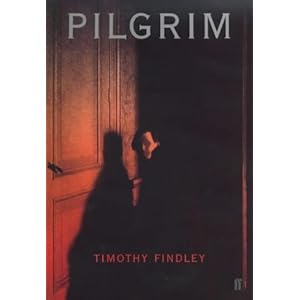
Review number: 929
What can you do with a man who persists in attempting to commit suicide, yet always comes back to life after doctors pronounce him dead? In this novel, set in pre-First World War Europe, the answer is to pack him off to the Burghölzi clinic in Zurich, a centre of the new science of psychiatry, where Jung is one of the medical staff.
The novel tells the story of Mr Pilgrim's treatment there, and the reader has to make the same decision as the characters: what should be made of his story, that he has been living for hundreds of years as a variety of people - the model for the Mona Lisa, a shepherd boy befriended by St Theresa of Avila, a craftsman at the construction of the windows of Chartres cathedral, and so on.
With its theme of long life and gender swapping, the obvious novel to compare Pilgrim to is Virginia Woolf's Orlando. Though the similarities are more than superficial, there is a profound difference. Orlando is about a particular personality (it is a portrait of Vita Sackville-West), but Pilgrim is about the mind. That, I think, is the reason for the different types of people he has been.
Another aspect of the interest in mind in the novel is the depiction of the Burghölzi. There, Pilgrim and some of the other patients seem happier than the doctors, all of whom, including Jung, are portrayed as understanding little of what they are doing.
Pilgrim is a fascinating novel, written in a style reminiscent of Jill Paton Walsh which gives it a magical air.
Subscribe to:
Posts (Atom)

 Posts
Posts

