Showing posts with label dystopia. Show all posts

Saturday, 29 March 2014

Ken MacLeod: Intrusion (2012)

Edition: Orbit, 2012
Review number:1484

Ken MacLeod is an author whose work I sometimes really like (the Star Faction books) but who at other times doesn't really connect with me (the Engines of Light trilogy). Intrusion falls into the second category.

It is one of several recent novels by MacLeod which are stand-alone near future dystopias, rather like the series of similar works produced by John Brunner in the 1970s. There are two main elements to Intrusion: an encroaching "nanny state", particularly concerned to make people live more and more healthy lifestyles; and the moral and social consequences of advances in genetic engineering.

These are given a human aspect through the central character, a pregnant woman who refuses to take "the fix", a pill which sorts out an embryo's genetic abnormalities. Although this refusal is not a crime, Hope is unwilling even to discuss the reasons behind her decision, and this makes her a person of interest to the police - rather in the way that attending a mosque seems to do in the West today. The issues soon become muddled, as the plot development is based on the possibility that Hope's husband might have the second sight, and this begins to take prominence over the elements which were important at the beginning.

My problem with this is that the second sight, by its nature more fantastical than the otherwise realistic seeming near future setting of the novel, just doesn't fit in to Intrusion. It feels like a device used to push the plot forward, without being integrated into the action in a meaningful way. It is given a pseudo-scientific explanation, but one with some pretty obvious holes in it to my mind.

In other areas, too, it feels that there is a certain laziness to the construction of Intrusion, as evidenced by the name of the protagonist. This may be intended to be an ironic gesture, but is neither so outrageously obvious to be fun (as Hiro Protagonist is in Snow Crash), nor sufficiently understated to be interesting.

The subject touches on issues at the very basis of how humans live in social groups. To do so necessitates giving up some individual freedom for the good of the group; the question is, where does the line between individual and state lie? Since the answer to this question differs radically from person to person, culture to culture, and subject to subject, it is not one which can be discussed in depth in a single book - indeed, I think it could be argued that the whole of political theory, and much of sociology and anthropology, deals with ways in which this question can be answered. So it is not surprising that even the relatively limited scope of the discussion in Intrusion merely scratches the surface of what might be said about health care and the government, but I did feel that more could be said - Intrusion seems to be more a statement of a fixed position (essentially, that Hope should have the right to refuse if she so wishes), than an analysis or a treatment in which the plot involves a developing portrayal of the issues. Brunner's dystopias were mainly about attempts to change society (or, more specifically, attempts to reform society to ameliorate problems caused by undirected sociological development), and this makes them much more satisfying if more depressing than this novel.

All in all, an unsatisfying novel which never really gripped my attention - 4/10.

Saturday, 1 December 2012

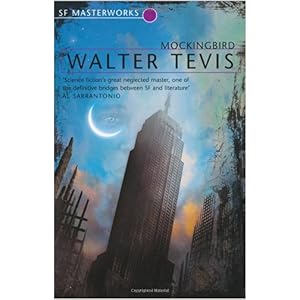
Walter Tevis: Mockingbird (1980)

Edition: Gollancz, 2007
Review number:1468

The best known novels by Walter Tevis are famous as films: The Hustler, The Man Who Fell to Earth, and The Color of Money - a trio which certainly demonstrates versatility. As a genre writer, he is also known for Mockingbird, here reprinted as one of Gollancz's "SF Masterworks" series.

One of TS Eliot's most famous lines, known to many who have no idea who wrote it (one online quotation search engine bizarrely attributes it to actor Vin Diesel) is "This is how the world ends, not with a bang but a whimper". It is almost a one sentence summary of Mockingbird, and is quoted at one point towards the end of the novel. Perhaps "human civilization" would be more apt than "world", but otherwise the mood and fit of the line is pretty much perfect.

The setting of Mockingbird is at the end, then, of the human history. With all tasks handled by robots, humans have sunk into a listless, drugged apathy, almost entirely of their own (or their ancestors') making. The main characters include one of the last, most advanced, robots to be made, named Spofforth, and one of the youngest remaining humans, named Bentley, who eventually realises the meaning of the demolition of his school once he and the rest of his year group leave: there are no more children.

The third major character is a woman named Mary Lou, who has been living an outsider's life in New York Zoo, inhabited otherwise only by the robots who manage it and who pretend to be children visiting - and which may well also be many of the exhibits. She has been surviving by eating sandwiches made available by a bug in the management system: a robot is provided with them to fill a vending machine, but always has five more than fit, and no instructions for what to do with them, so is effectively immobilised until May Lou takes them from it. She has managed somehow to escape from the system and is therefore free from the drugs taken by every other human. The robots have seen that humans are happier in general without high intelligence or dramatic events, so the drugs make their takers less excitable and less clever.

Once this is established, a strange thing happens, the most important event in the story, and one which almost knocks the whole novel off its mournful path. Spofforth denounces Bentley as a criminal - a true accusation, for Bentley, having worked out how to read from a book, teachers Mary Lou, and this is a crime because reading can distract from the bland happiness which humans are supposed to experience. Bentley is sent to prison, and Spofforth moves himself and Mary Lou into an abandoned apartment, following a rather atavistic prompting of a hidden part of his mind, which was not constructed but is based on a recording of the mind of a human being.

With the end of reading, of education, there is so much that people just don't know any more. Like a prehistoric inland dweller who has never seen the ocean, Bentley comments: "I did not know sea water was undrinkable. No one had ever told me." This, on top of the general apathy brought by the drugs, is really what is bringing the end; things break down, and no one knows how to fix them or how to get a robot to fix them, and no one cares to do either, anyway. Temporary measures, such as the one which added contraceptives to the drugs to curb population increase, are set in place, but then no one remembers to rescind them afterwards.

The title of the novel comes from a caption in a silent film watched by Bentley, who is put to recording the words of such films as no one can read the captions any more: "Only the mockingbird sings at the edge of the forest". Apparently, the Northern Mockingbird does indeed live and sing at the edge of forests during their breeding season, but Tevis' intention is to say something about his theme, but I found it hard to choose between several different interpretations of the phrase. The lives which are led by Bentley, Spofforth, and Mary Lou could be said to be a mockery of those who are living normal lives in the forest, and the mockingbird a symbolic outsider; the odd relationship between Spofforth and Mary Lou, while she is pregnant, is a mockery of twentieth century city life (as well as referencing the breeding season of the bird); or it could refer to Tevis' role as a commentator on the negative sides of the human drive to increase comfort and settle for the banal in experience as safer than living on the edge.

This is the kind of novel I would point to as a counter to those who think nothing with a science fiction genre label on it can be literary, or discuss real issues. Dealing with apathy, depression, and suicide as it does, Mockingbird is hardly cheerful reading, but is definitely recommended. My rating: 9/10.

Saturday, 16 October 2010

Henry Porter: The Dying Light (2009)

Henry Porter's fifth novel is intended, so the author tells us in the afterword, to fulfil three purposes. It is obviously a thriller readable as a standalone story, but is additionally intended as a contrast to his previous novel Brandenburg and as something of a political call to arms. It is set in a near future Britain, where high-powered lawyer (and former spy) Kate Lockhart returns to the country after several years working in the States for college friend David Eyam's funeral. Eyam, was a civil servant involved in security at the highest levels, but he resigned and hid himself in a tiny town on the Welsh borders before making a sudden trip to South America to be killed in a terrorist bomb attack. Kate is told that she is Eyam's heir, completely unexpectedly; and when Eyam's lawyer is killed by a sniper driving down an English country lane and she discovers that child pornography has been planted on Eyam's computer to discredit him, she realises that she has inherited not just his possessions but a dangerous secret worth many deaths to those who wish to keep it hidden.

From this point on, The Dying Light is a political thriller with a conspiracy theory at its centre, set in a dystopian Britain in which every move is watched by the authorities. The development of the systems which allow this and the accompanying erosion of civil liberties are Porter's main concern.He mentions the way in that events he was describing as he wrote the novel turned out to be true as he was writing, not a comforting prospect for someone writing a dystopia. Most of Porter's work has made me think him the natural heir to Len Deighton; but the campaigning nature of The Dying Light is more akin to John le CarrĂ©'s recent novels, such as A Most Wanted Man. The agenda may be different, but a similar sense of outrage comes through. The comparisons to le CarrĂ© and Deighton are not just thematic, too. Porter is one of the best thriller writers to emerge in the last decade.

The theme is personal freedom, and the way in which the British public  have allowed their politicians to whittle away at personal rights to an unprecedented degree: the United Kingdom is now the most heavily surveiled nation in the world, so that  our rulers know more about what we do (theoretically) than those of North Korea or China. As with the curtailment of liberty elsewhere in the Western world, the excuse used is the fight against terrorism, which is at first sight a reasonable idea but is less so when the possibility of emergency powers being abused (as has happened on a small scale with local councils using anti-terrorism powers to track down benefit fraud) or when it fails to halt attacks. The inquests into the deaths of those killed in the 7/7 bomb attack on the London underground are happening as I type: clearly the new powers and surveillance, almost all in place in 2005, were unable to save these lives. The bombers were identified on CCTV footage, but only after the attack itself took place. At the same time, the Guardian has reported that counter-terrorism would be kept safe from the government's massive programme of cuts: the UK will still be spending billions on surveillance of its citizens. (Most of the links in this post come from the Guardian not because of its political leanings, but because of its interest in civil liberties beyond that of much of the UK press.)

One legislative move which particularly concerns Porter is the Civil Contingencies Act 2004 (official description / critical assessment).This gives wide ranging powers over a thirty day period to the government in the event of a disaster (natural or otherwise), removing the right to assembly, allowing movement to be restricted to and from "sealed areas" and mobilising the armed services. It didn't originally define the emergencies in which it could be used very stringently, leading to accusations that events dealt with by the emergency services as part of their normal working would be possible triggers for the act; this has since been amended. It still doesn't provide any sanction for misuse (if the "emergency" turns out not to be one). It has been described as making it possible that "at a stroke democracy could be replaced by totalitarianism".

I have gone into detail about this partly because, as Porter points out, it is important and yet ignored by those it affects. I was already aware of the surveillance, but had never heard of the Civil Contingencies Act: this is a novel which made me want to write to my MP.

The relationship with Brandenburg is that the earlier novel is about the fall of the Soviet bloc communism, so is about the gaining of rights, while The Dying Light is about the extinction of rights. To me, the title and theme suggest Dylan Thomas' famous lines (about death):
Do not go gentle into that good night.
Rage, rage against the dying of the light
To give away our rights without protest is to gently acquiesce in the dying of the light of our civilisation.

Edition: Orion Books, 2009
Review number: 1408

Tuesday, 13 November 2007

Charles Stross: Glasshouse (2006)

Published: Orbit, 2006

Glasshouse (named from British army slang for a military prison) is basically a spy novel set in the future. The central character, Robin, starts the book recovering from memory surgery, a standard voluntary brainwashing technique which is part of psychiatric treatment: but he doesn't remember why he had memories removed, nor why the process was quite so drastic as it turned out to be. Then he is recruited for an experiment, in which he will live in a recreated environment from "the Dark Ages" (roughly, today) ostensibly to derive information and understanding lacking from the historical record (essentially because the knowledge required to understand our proprietary computer file formats has been lost). This sort of experiment has been done already: a famous attempt to get several families to live in a reconstructed Iron Age village in the late seventies was the earliest reality TV series I remember watching. When Robin wakes up in the experimental domain, he is no longer a man, but has been turned into a housewife in an environment distinctly reminiscent of the film Pleasantville. The undertones are even more sinister, as this isn't just a sitcom reflecting the attitudes of the fifties, but an experiment with a hidden purpose. This is made clear to Robin (or Reeve, as she is now known) when she realises that all the participants have been made fertile - this is normally a deliberate choice in their culture - and the aim appears to be to create a generation who know no other life than the experiment.

Using science fiction to satirise the attitudes of the present is hardly cutting edge science fiction. Even the use of time travel, re-enactment or simulation is common: it forms a major part of the film Star Trek IV, as well featuring in Pleasantville already mentioned. Other science fiction joins Stross in describing our age as psychotic or crazy (notably Robert Heinlein's Future History stories). Stross is at the edge end of this tendency in the genre, certainly more so than anything mentioned, but his writing here also contains much humour. (This is generally his writing style: dark but knowing.) The principal way in which Stross differs from many of the others who have satirised the present day in this way is that his future setting is very different from our own, even though the way in which it could have come about (apart from the unexplained cornucopia technology) is fairly believable as are continuing parallels with our own time (such as the detail that the cornucopia machines are subject to hacking and the equivalents of computer viruses) and people who are still recognisably human. To compare with Heinlein again, in his earlier works his future society is hardly distinguishable from that which he describes as crazy. Glasshouse also has a really good ending, after Reeve starts receiving messages that Robin had implanted deep into his subconscious before the memory surgery.

Glasshouse is publicised as a sequel to Accelerando, but this doesn't seem quite right to me. While dreaming of similar themes, much of the envisaged future here is different from that at the end of the earlier novel. It doesn't manage to be quite as interesting as Accelerando, which I feel is Stross' strongest work so far; nor is it as entertaining as the Merchant Princes series. However, it is still both interesting and enjoyable, and well worth reading.

Wednesday, 13 December 2006

Yevgeny Zamyatin: We (1924)

Published: Penguin, 1993
Translated: Clarence Brown, 1993

Before 1984, before Brave New World, the first great science fiction dystopia was Zamyatin's We. Written soon after the Bolshevik Revolution, before Soviet censorship became really brutal under Stalin, it was nevertheless impossible to publish in Russia, and first appeared in English translation in the States. This meant it became well known in the West, unusually for genre fiction in translation, and though not now as famous to the English-speaking reader as Huxley and Orwell, it was known to both writers and a strong influence on the latter in particular.

The narrator of We, D-503, is running the project to build a spaceship to carry the philosophy of OneState (previously translated as United State, a version rejected by Brown because of the obvious confusion it causes). He becomes obsessed with rebellious beauty I-330, even though love has been outlawed by OneState hundreds of years ago, and this leads him to doubt the certainties that once underpinned his life, until his erratic behaviour culminates in failing to take part in the last step in the scientific perfection of humanity: the surgical removal of the faculty of imagination.

The parallels with 1984 are obvious; the plots are even quite similar (substitute Winston and Julia for D-503 and I-330). However, Winston becomes a stronger dissident than D-503, who, even at the climactic moment believes that the secret police are a force for good, and that the torture they carry out is different from the work of the Inquisition of history because the OneState torturers are good, while the Inquisition was evil. This inability to ditch early condition seems to me to be entirely believable. However much conditioning is undermined, it will leave a trace, some parts of behaviour and belief will still be influenced or even determined by early training.

Additionally, class was important to Orwell in a way that was irrelevant to Zamyatin: Orwell makes Julia and Winston obsessed by the Proles (as opposed to party members, which is what they are) to make points of his own, while in OneState there appears to be no divide between citizens. This influences the way that they use something common to both writers, and to Huxley as well: the role of the outsider in their dystopia. Huxley's Savage is brought up in a Reservation. Beyond the Green Wall that forms OneState's border is a world populated by (it is believed) savages. It is possible to imagine dystopias where there are no outsiders, where rebellion is spontaneous in some way, but the only example that immediately comes to mind is the much less literary Earth of Blake's Seven, where injustice spurs Roj Blake into action. In 1984 and Brave New World the question of why such outsiders are permitted to exist is a little problematic, though it is less so in We; even here, it is a little odd that a culture that is building a space ship is unable to expand through the Green Wall.

The two topics, conditioning and outsiders, are closely related, as, generally, the seed that produces the idea in the hero which leads to rebellion comes from these people (who more easily prompt thoughts along the lines of "Things would be better if..."), a device which allows the author to concentrate on matters more directly relevant to the themes they wish to develop. The growth of this seed is of course the reason why the perfect citizen of OneState has hadtheir imagination surgically removed. What none of them foresaw, not even Orwell whose dystopia gave a major role to media manipulation, was a world like the West today, where imagination is not stifled but channelled, more interested in the minute details of today's top reality show than the politics driving a war in Iraq described as disastrous by one of its key supporters.

What is particularly powerful about We is the way that the poverty of D-503's life is depicted as the narrator himself moves towards knowledge of this state, and the way that he becomes confused when the basis of his deeply held (if artificially produced) inner convictions begins to crumble. He becomes separate from those around him - the "we" of the title is, as Brown points out in his introduction, not the people as a community, for they have no real community, but the "royal we" of the Benefactor, the ruler of OneState.

We is a fascinating novel, particularly to a Western reader more familiar with Huxley and Orwell.

NOTE: Edited 24/12/2006 to remove a small factual error.

Tuesday, 11 March 2003

Margaret Atwood: The Handmaid's Tale (1985)

Edition: Seal Books, 1986 (Buy from Amazon)
Review number: 1147

It is not surprising that a high proportion of the science fiction novels which enjoy a high literary reputation outside the genre are dystopias. The fundamental reason for this regard is that the form enables the writer to make comments about their own time, more clearly and unambiguously than almost any other, by exaggerating certain trends to criticise the aspects of current society and culture. For this reason, they also tend to attract writers who have built up a reputation outside the genre, and it is a sad fact that mainstream literary recognition is still easier to receive if you are not perceived as a genre writer. The Handmaid's Tale follows in the tradition of Orwell and Huxley, and is an attack on the growth of fundamentalist American Christianity, particularly on its treatment of women.

After a coup, rights are quiclky removed from American women - their bank accounts are frozen and their employers forced to sack them, for example. They are re-educated to fit into the limited range of occupations permitted to women in the new state of Gilead, such as Marthas (household servants). The narrator of The Handmaid's Tale takes on a role based on the Biblical story of Jacob's wives; when they failed to conceive, he fathered children by their handmaids. In a world in which the fertility of both sexes has dropped dramatically, it is the role for which young women who have demonstrated their ability to bear children are destined, rather to the chagrin of the Wives who have to house them.

It is 1984 with which The Handmaid's Tale has most in common; in both novels, a totalitarian regime has reduced life to a constant dreary drabness against which the narrator, who can remember what it was like beforehand, longs to rebel. Offred (whose original name has been taken away; her identity is just as 'property of Fred') is given the opportunity to do so by the imperfections of those around her, by their failure to live up to the rules. (This is partly a device for Atwood to reveal more about Gilead's culture than Offred's closely confined existence should allow.) Many details are close relatives of their Orwellian equivalents - the exhibition of former traitors, the cathartic ceremonies intended to bind people together - but many, of course, like Orwell's versions, have been derived from the activities of real totalitarian regimes. The major difference between Offred's world and that of 1984 is that Big Brother's regime is asexual (at least on the surface), with little differentiation being made between men and women, while in the world of The Handmaid's Tale the subordinate role of women is of fundamental importance to the way in which things work.

While The Handmaid's Tale is an impressive undertaking, it does not rise to the level of the other dystopias I have mentioned, 1984 and Brave New World being among the greatest works of twentieth century literature. Too much of the mechanism by which Atwood reveals Gilead to the reader is apparent, which is a sign of a writer inexperienced in the genre (compare the dystopias of John Brunner, for example). The novel is also spoilt by a very poor postscript, a little parody of a presentation at an academic conference. On the other hand, The Handmaid's Tale has many strengths. In particular, it conveys the drabness of the regime in Gilead quite excellently (and it is up with Solzhenitsyn and Orwell in this respect) and easily makes its feminist and anti-fundamentalist points. It is not an enjoyable read (and it's not meant to be), and its literary reputation is perhaps over inflated, but it is a successful Orwellian dystopia.

Friday, 24 August 2001

Paul Johnston: The Bone Yard (1998)

Edition: Hodder & Stoughton, 1998
Review number: 922

The bleak world of the Edinburgh of the future under a regime supposedly based on the ideas of Plato's Republic has already been explored through the eyes of maverick blues fanatic and private investigator Quintilian Dalrymple in Body Politic. The Bone Yard, set a couple of years later, is the story of another of his investigations, into the horrific murder and mutilation of a young man who had asked for protection. This quickly leads to the realisation that there are serious problems at a senior level in the regime, as it looks like someone is conniving at the development of a new and dangerous drug, set to sweep the city.

It takes some time for The Bone Yard to grip the reader, but its bleak story and background - Ian Rankin meets George Orwell - eventually do, and then don't let go. While not particularly original either as mystery or science fiction, it leaves the feeling that it is an impressive novel.

It is interesting that Johnston's vision of a fragmented Britain of the near future is very similar to that of his fellow Scot, Ken MacLeod. Maybe the idea has been inspired by Scottish devolution!

Friday, 28 July 2000

Aldous Huxley: Brave New World (1932)

Edition: Penguin, 1969

Review number: 553

One of the most important novels of the twentieth century, vital to the development of science fiction, Brave New World ranks with 1984 as a chilling dystopia. Huxley portrays a world, considerably further into the future than Orwell's, in which a eugenically preserved class system maintains a static society. Everyone is graded from Alpha to Epsilon, and malnourishment of the embryo in the machines which have replaced human motherhood is used to ensure that Epsilons, for example, are stunted and moronic, fitted for the menial tasks which form their lot. Conditioning through tapes played to dormitories of children at night ensures that people are happy with their position, and the euphoric drug soma banishes the need to feel anything unpleasant.

Even with the conditioning and the drug, there are still people who are unhappy, who do not quite fit in. These are usually from the top caste, the Alphas, for two reasons: their greater intelligence, and because the lower caste members usually come in large groups of artificially created groups of identical siblings, who all work together and whose company makes it difficult to feel isolated and different. One of these misfits, Bernard Marx, sets the events of the novel in motion, through a visit to a Savage Reservation.

The Reservation is more or less the flip side to the main society portrayed in the novel. In those parts of the world which had not been considered worth bringing the "benefits of civilisation" to, a primitive way of life has continued to survive. The impression given of these places is that they are a kind of exaggerated version of a rundown American Indian reservation. There is no escape from them or, indeed, to them. Bernard is drawn to them because he expects life there to be purer; instead, it is squalid. The Reservation is meant to be the way we live, as seen from the point of view of the brave new world.

The event which catalyses the rest of the novel is Bernard's discovery of a young man and his mother (an obscene concept to him); she had come to the Reservation on a visit and become lost, already pregnant because of a lack of care over contraception. This couple are brought back to London by Bernard, and the rest of the novel is about the way that the Savage reacts to his new environment and vice versa.

Huxley later felt that the extreme contrast he introduced with the Savage Reservation was a mistake (as he says in the foreword written in 1946) and it is certainly true that it is not necessary to the point of the novel. It might have made it more chilling to have presented the society without a strong disapproving voice like the one provided by the Savage, letting the reader draw his/her own conclusions.

The importance of Brave New World for science fiction as a genre is manifold. Most science fiction in the early thirties was purely escapist hack work - this was the era of the pulp magazines. It was extremely unusual for a respected literary figure to use it as a vehicle for social criticism. The only precedents I can think of (other than fantasy) are H.G. Wells, who was not as highbrow a figure as Huxley by a long chalk, and Samuel Butler, whose Erewhon is only marginally science fiction, being modelled on Swift. Wells was actually quite an influence on Huxley, Brave New World having definite traces of The Time Machine visible in it.

Huxley took the genre seriously as a vehicle for social criticism, and since his time it has become something of a tradition in science fiction. The idea behind much serious science fiction is to use the future to comment on the present. Brave New World is really about the ideas being debated in 1932 - by the date at which the book is set, the debate is long over. Huxley's main target is of course eugenics, an idea driven out of serious consideration by the Nazis but today increasingly returning to the agenda as advances in genetics make correction of smaller and smaller "faults" in the embryo possible.

The really chilling part of Brave New World is not the caste system, but the fact that people are generally happy. Would it be worth being conditioned into happiness? Where does the border lie between "feelgood" mass media and subliminal conditioning? Huxley's world has "feelies" - films with texture that can be experienced as a kind of virtual reality - with no content but incredible effects ("You can feel every strand of hair..."). The main leisure activities are sports which are specially designed to encourage spending on complex equipment. How far is that from designer football shirts?

Huley aims at other, lesser targets throughout the novel, including some interesting digs at religion. Though the society described in Brave New World is said by its members to have outgrown religion, it has a strongly religious centre, worship of the ideas of Henry Ford and Sigmund Freud (who are confused with one another). Ford is referred to as "Our Ford", and is the focus of a parody of Christianity, including a ceremony based on the eucharist in which much soma is consumed - and soma is Greek for body as well as being a hallucinogenic in Indian religious traditions - before an orgy. (This is one part of the novel which some might still consider offensive.) More humourously, there is a scene in which the Savage beats up a reporter from the (Christian) Science Monitor, who denies the existence of bodily suffering. The attack on religion is of course prompted by Huxley's general atheistic philosophy, though in view of what he thought of spirituality it is interesting that he considered Fordianism a necessary part of his future world.

Tuesday, 14 March 2000

John Brunner: Stand on Zanzibar (1969)

Edition: Arrow, 1971
Review number: 450

The most famous of Brunner's dystopian novels of the near future takes the overpopulation of the earth as its theme. The title comes from this: it was once said that the whole human race could stand on the Isle of Wight. This, Brunner says, may have been true in 1900 but by the time this novel was written, the Isle of Man would be needed instead, and by 2010 when it is set the seven billion people then living would fill the island of Zanzibar. (It is still quite conceivable that the population of the earth in 2010 will reach that figure, so Stand on Zanzibar is no less topical than it was thirty years ago.)

The world that Brunner depicts is disturbingly familiar. Set mainly in the US, Stand on Zanzibar features run down cities, lives dominated by television's holographic successor, vandalism, mass murders, random killings, and desperate unsafe neighbourhoods. A constant state of involvement in minor wars drains the economy - the novel was of course written during Vietnam. All these things are related to overpopulation, though the US has been lucky compared to parts of the third world where society has completely broken down.

It is the style of Stand on Zanzibar which is its most obvious feature. It is clearly derived from dos Passos' USA trilogy and Brunner went on to use variations of it in later novels. The table of contents reflects the structure with its division of the content into a variety of categories, such as "context", "close-ups" and "tracking". A large number of characters are dealt with briefly, the reader is presented with snippets of popular culture (song lyrics, excerpts from underground magazines, news programmes and so on), and comments from controversial, perceptive sociologist Chad Mulligan. Mulligan is perhaps the most important character, being used to argue the inevitability of the type of society portrayed in Stand on Zanzibar in an overpopulated world.

Compared particularly to The Sheep Look Up (a similar dystopia based around the theme of pollution), Stand on Zanzibar is a relatively optomistic novel. Its most chilling aspect is the sense that time is running out for the human race, which is provided by statements like "Around the coast of Zanzibar, thousands are now standing knee-deep".

Friday, 5 February 1999

George Orwell: 1984 (1949)


Edition: Penguin, 1970


Though it is the interrogation from 1984 which is the most memorable part of the novel, though there are phrases which have become part of the culture of the English-speaking world ("Big Brother is Watching You", "doublethink", "Room 101"), Orwell's book is principally about the way in which a totalitarian regime can succeed, the way that human beings can become subjugated to other human beings.

The interrogation itself takes up only a small portion of the novel; it is the briefly told story of Winston's "cure"; as O'Brien tells him, they do not torture him out of pleasure in inflicting pain or because they have anything to gain from his confession, but because they want everyone to love Big Brother. That is why he must believe that he hallucinated the evidence proving that the Party lies, that two and two make five when O'Brien tells him so (and despite what he wrote in his diary before his arrest, that freedom ultimately means the freedom to say that two and two are four). But intellectual belief is not enough for O'Brien; it is the emotions the party needs to control. That is why the final sentence of the novel, simply, "He loved Big Brother", is so chilling. Orwell showed the triumph of the totalitarian state over the free will of the individual. All that is left to the reader is the rather empty comfort of the thought that it couldn't happen here.

Friday, 23 October 1998

John Brunner: The Jagged Orbit (1972)

Edition: Arrow, 1972
Review number: 145

Brunner's four most famous novels take an aspect of today's society and exaggerate it, to create dystopias which are compelling because of the way they relate to our fears for the future. Stand on Zanzibar, the best known, is about the population explosion; The Sheep Look Up environmental pollution; Shockwave Rider computers and privacy; and Jagged Orbit race relations. They all use a similar technique, with news items interrupting the narrative and with a strong involvement from whistle-blowing academics. The Sheep Look Up and Jagged Orbit even share a character, the idiot US president Prexy, whom I have been told is an exaggerated picture of Ronald Reagan, then governor of California.

Of the four, Jagged Orbit perhaps works least well. It doesn't match the power of Stand on Zanzibar, the chilling realism of The Sheep Look Up or the narrative interest of Shockwave Rider. It has the interesting difference that as well as including fictional news stories from 2018, when it is set, it has chapters which are reprints of real news stories from 1968, concerning race riots and what might be done about them. Brunner's idea is that nothing is done to help the disadvantaged non-white population of America's innner cities, which leads to increasing militancy and eventually an arms race as arms dealers begin to exploit the market potential provided by individuals terrified by the threat of the other side of the racial divide.

The reason that Jagged Orbit is less successful is that the plot depends on the introduction of two far fetched elements, which are not given the meticulous background of the rest of the novel. These are a woman whose mind interferes with television broadcasts and a time-travelling computer. Neither would be impossible in a science-fiction novel, but the lack of justification given them compared to everything else is a big problem, making them appear to be random devices introduced only to provide an ending to an out-of-hand plot line.

Despite the careless plot, Jagged Orbit is worth reading for is mainly convincing background and its spirited attack on racism.

Wednesday, 15 July 1998

Alexander Solzhenitsyn: Candle in the Wind (1969)

Translation: Keith Armes, 1973
Edition: Penguin, 1976
Review number: 85

This play, whose original title translates as the New Testament quote The Light Which is in Thee, was written about the same time as the novel First Circle, in the early sixties. (As the Bible verse is quoted in the play, it seems rather perverse to re-title it.) It is set, unusually for Solzhenitsyn, in a fantastic world, a scientific dystopia rather like George Orwell's 1984 or Zamyatin's We.

The plot is concerned with the morality of institutionalised brainwashing. Alex, who's past is based closely on that of Solzhenitsyn himself, has returned home; he had been wrongly imprisoned for a murder he did not commit, and was released when the truth was finally discovered. He meets his cousin Alda on his return, and gets involved in the academic life of the town. This is polarised as far as he is concerned between the music of his uncle Maurice (who seems to represent the disappearing past) and the psychological research of Radagise. He is developing a method to ensure the stability of the personality, which he tries out on Alda at Alex's suggestion. The problem is that this stabilisation amounts to brainwashing; she is no longer the same personality.

A visiting general sees the potential this has to serve the state: a race of docile subjects can be created, ready to do whatever their rulers require of them. Alda is eventually shocked out of her bland mind-state by the death of her father. The really shocking thing, though, is that she wants to return to the stabilised condition; life is so much easier without worrying emotions and responsibilities. The horror this gives Alex is, I think, a large part of the point of the play.

Thus the theme of the play is the battle between individualism and the kind of corporate identity required in the modern totalitarian state, just as it is in the more famous dystopias already mentioned. I'm not sure that Candle in the Wind would work terribly well on stage, and on paper it's shortness means that it can't compete with a novel for examination of the issues in any depth. But it's well worth a read, for characterising the kind of person - whom I suspect to be in the majority - who would rather give up their personal freedom of choice to live an easy life.