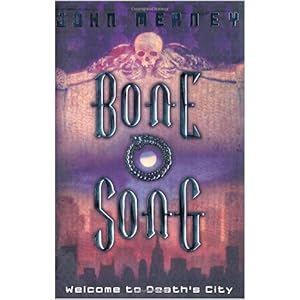
Back in February, I reviewed Absorption by John Meaney, wondering why the author of that somewhat tedious novel was described by Stephen Baxter as having "rewired SF". Bone Song, Meaney's début, is why.
While not as revolutionary as Baxter's praise suggests, Bone Song starts in a marvellously atmospheric and imaginative manner, evocatively written with a compelling central character. The setting is Tristopolis, not just the "city of sadness" its name suggests but somewhere where death is all important; ghosts and zombies are among the citizens, and wraiths power many machines, while a mystical process applied to bones provides the fuel in the city's power stations. Donal Riordan is a policeman in Tristopolis, assigned to protect a visiting opera singer: she is the next potential victim of a killer who is murdering creative people because their bones can be used to experience a "high".
The excellence of the first hundred pages is not maintained. Much of the middle of Bone Song seems to this reader to consist of dull running around by Riordan and his colleagues, provoking a tedium which perhaps makes it more true to life than many police procedurals. The interest does pick up again towards the end, and, while it never shows sufficient originality to justify Baxter's praise, Bone Song remains an intriguing novel.
In a further bout of hype, the back cover also describes Bone Song as "an extraordinary melding of visionary SF and dark horror". This might have been more convincing if China Miéville and Neil Gaiman (to pick two writers who came to mind while reading this story) had never published their fiction. While the background is more like Miéville, there is a stylistic influence from comic books which suggests Gaiman. There is even a paragraph where Meaney uses a common comic book technique where dialogue is interrupted by action but then continues as though nothing had happened: along the lines of three frames containing "Stop..." | THUD | "...that" as text.
As for a rating: I'd give the first and last thirds 9/10, and the middle 3/10, which averages to 7/10 overall.
Edition: Gollancz, 2008
Review number: 1427
Showing posts with label horror. Show all posts
Thursday, 7 July 2011
Saturday, 31 January 2009
Simon R. Green: Into the Nightside (2008)
Published: Solaris, 2008
Omnibus edition containing Something from the Nightside (2003) and Agents of Light and Darkness (2003)
I'm not sure why it is, or exactly when it happened, but the horror genre has changed. Possibly it's the influence of TV programmes like Buffy, which blended horror with other genres and made the scariness less of an integral part of the experience. But there are now lots of these genre crossover books around now, from the really bizarre (say, the chick-lit vampire of Mary Janice Davidson' Betsy series) to this more obvious pairing of hard boiled detective with horror. It is not even unique in choosing that combination, which is also used in the Harry Dresden series. In general, these work by taking well known horror ideas (such as vampire lore) and using them more as plot elements than for their frightening qualities. After all, it becomes much harder to be frightening with something as familiar to a modern reader and as frequently satirised as a vampire.
John Taylor is a sleazy private detective with a unique talent: he can find any object. But to do so he must go from the everyday London which holds his office into the Nightside, where his magic becomes a beacon attracting the enemies from which he fled five years earlier. So business is not good. Then a rich beautiful woman asks him to help find her daughter, lost in the Nightside, and he accepts the commission, charging only double his usual rates. Once into the Nightside, the tone changes, and there's much less of the hard boiled detective as the story becomes a more standard fantasy/horror tale, rather like a milder version of Anita Blake in a crossover with Neverwhere.
The Nightside series is not Green's only crossover of this sort; there is also The Man with the Golden Torc, which (as is obvious from the title) blends horror memes with James Bond. This, and the series which follows, is much less serious in tone than the Nightside stories, though both are amusing in places rather than fully satirical. But enjoy one and you'll enjoy the other. They are too good to be considered a guilty pleasure (unlike Anita Blake, which I find contains far too much dull sex), but not quite good enough to be in my novels of the year. Unusually for the fantasy genre today, Green's novels are quite short, which makes them ideal for an hour long train journey - light to carry, and fun to read.
I've decided that it would be a good idea to have ratings for the novels in these blog entries, starting here. I'd give Into the Nightside 7/10.
Omnibus edition containing Something from the Nightside (2003) and Agents of Light and Darkness (2003)
I'm not sure why it is, or exactly when it happened, but the horror genre has changed. Possibly it's the influence of TV programmes like Buffy, which blended horror with other genres and made the scariness less of an integral part of the experience. But there are now lots of these genre crossover books around now, from the really bizarre (say, the chick-lit vampire of Mary Janice Davidson' Betsy series) to this more obvious pairing of hard boiled detective with horror. It is not even unique in choosing that combination, which is also used in the Harry Dresden series. In general, these work by taking well known horror ideas (such as vampire lore) and using them more as plot elements than for their frightening qualities. After all, it becomes much harder to be frightening with something as familiar to a modern reader and as frequently satirised as a vampire.
John Taylor is a sleazy private detective with a unique talent: he can find any object. But to do so he must go from the everyday London which holds his office into the Nightside, where his magic becomes a beacon attracting the enemies from which he fled five years earlier. So business is not good. Then a rich beautiful woman asks him to help find her daughter, lost in the Nightside, and he accepts the commission, charging only double his usual rates. Once into the Nightside, the tone changes, and there's much less of the hard boiled detective as the story becomes a more standard fantasy/horror tale, rather like a milder version of Anita Blake in a crossover with Neverwhere.
The Nightside series is not Green's only crossover of this sort; there is also The Man with the Golden Torc, which (as is obvious from the title) blends horror memes with James Bond. This, and the series which follows, is much less serious in tone than the Nightside stories, though both are amusing in places rather than fully satirical. But enjoy one and you'll enjoy the other. They are too good to be considered a guilty pleasure (unlike Anita Blake, which I find contains far too much dull sex), but not quite good enough to be in my novels of the year. Unusually for the fantasy genre today, Green's novels are quite short, which makes them ideal for an hour long train journey - light to carry, and fun to read.
I've decided that it would be a good idea to have ratings for the novels in these blog entries, starting here. I'd give Into the Nightside 7/10.
Labels:
crime fiction,
fantasy,
horror,
Nightside series,
Simon R. Green
Wednesday, 4 June 2003
David and Leigh Eddings: Regina's Song (2002)
Edition: HarperCollins, 2002
Review number: 1164
Most people are fascinated by the intimate relationship which exists between identical twins, and this forms the basis of the most recent novel from David and Leigh Eddings, one which edges into the horror genre - a new departure for the pair.
Regina and Renata Greenleaf were identical twins, who continued to use a private language between themselves long after most pairs have given it up - right through high school. (I was surprised not to find any references to this cryptolalia - use of a secret language - online; may be it's not as common a practice as the Eddings imply.) Then, on the point of graduation, their car broke down returning from a party and when one of them went to find a phone, she was attacked, raped and viciously murdered. The surviving twin is so traumatised by this, that she reverts to their secret language, and it is only following six months in an asylum that she recognises anyone or returns to speaking English. Even so, she cannot remember the past, making it impossible to tell even which twin she is (or even to tell her that she had a twin sister).
To the chagrin of her parents, the person she recognises is a family friend, Mark Austin - also the narrator of the novel. His is a graduate student at Washington University (the whole novel, like all of the Eddings' non-fantasy, takes place in Washington State). A major part of the novel is about Mark's attempts to help the surviving twin (now insisting on being known, rather nauseatingly, as Twink) rehabilitate to the real world by auditing some of the courses at the university, including the basic English one he teaches. This means that Twink moves away from her parental home to stay with an aunt, who has a job which means that she is out a large proportion of the time - surely a situation which a psychiatrist would be unhappy about for someone only recently released from a mental ward. And then strange things begin to happen...
The main idea is strong, though it could be the basis of a far more bleak novel offering more insight into how it feels to be a twin and the nature of mental illness. (This could be done most easily by improving the essays that Twink hands in, which Mark somewhat bizarrely thinks are brilliant - they're nothing like that good.) Such a tale would be a radical departure for the Eddings, and the impression I got was that his was something they kept moving towards and then shying away from to produce something more lightweight. (After all, they don't want to alienate all their fans.) This desire makes the second half of the novel poorer than the first, and also means that some of the cute phrases and ideas which fill so much of the Eddings' recent writing appear once more. It may also explain an interesting change of attitude: all of the Eddings' fantasy involves the killing or disabling of a god, but here the role of religion as represented by a Roman Catholic priest is overwhelmingly positive.
Regina's Song contains a crime investigation and a (rather unconvincing) courtroom drama as well as the twin psychology and horror elements, and this is something of a mistake from a structural point of view, as it makes the novel seem somewhat overcrowded with strands from different genres. Nevertheless, Regina's Song is consistently entertaining (if you can ignore the cute turns of phrase) and the use of identical twins at the centre of this kind of story is fascinating.
Review number: 1164
Most people are fascinated by the intimate relationship which exists between identical twins, and this forms the basis of the most recent novel from David and Leigh Eddings, one which edges into the horror genre - a new departure for the pair.
Regina and Renata Greenleaf were identical twins, who continued to use a private language between themselves long after most pairs have given it up - right through high school. (I was surprised not to find any references to this cryptolalia - use of a secret language - online; may be it's not as common a practice as the Eddings imply.) Then, on the point of graduation, their car broke down returning from a party and when one of them went to find a phone, she was attacked, raped and viciously murdered. The surviving twin is so traumatised by this, that she reverts to their secret language, and it is only following six months in an asylum that she recognises anyone or returns to speaking English. Even so, she cannot remember the past, making it impossible to tell even which twin she is (or even to tell her that she had a twin sister).
To the chagrin of her parents, the person she recognises is a family friend, Mark Austin - also the narrator of the novel. His is a graduate student at Washington University (the whole novel, like all of the Eddings' non-fantasy, takes place in Washington State). A major part of the novel is about Mark's attempts to help the surviving twin (now insisting on being known, rather nauseatingly, as Twink) rehabilitate to the real world by auditing some of the courses at the university, including the basic English one he teaches. This means that Twink moves away from her parental home to stay with an aunt, who has a job which means that she is out a large proportion of the time - surely a situation which a psychiatrist would be unhappy about for someone only recently released from a mental ward. And then strange things begin to happen...
The main idea is strong, though it could be the basis of a far more bleak novel offering more insight into how it feels to be a twin and the nature of mental illness. (This could be done most easily by improving the essays that Twink hands in, which Mark somewhat bizarrely thinks are brilliant - they're nothing like that good.) Such a tale would be a radical departure for the Eddings, and the impression I got was that his was something they kept moving towards and then shying away from to produce something more lightweight. (After all, they don't want to alienate all their fans.) This desire makes the second half of the novel poorer than the first, and also means that some of the cute phrases and ideas which fill so much of the Eddings' recent writing appear once more. It may also explain an interesting change of attitude: all of the Eddings' fantasy involves the killing or disabling of a god, but here the role of religion as represented by a Roman Catholic priest is overwhelmingly positive.
Regina's Song contains a crime investigation and a (rather unconvincing) courtroom drama as well as the twin psychology and horror elements, and this is something of a mistake from a structural point of view, as it makes the novel seem somewhat overcrowded with strands from different genres. Nevertheless, Regina's Song is consistently entertaining (if you can ignore the cute turns of phrase) and the use of identical twins at the centre of this kind of story is fascinating.
Labels:
David Eddings,
fantasy,
fiction,
horror,
Leigh Eddings
Wednesday, 2 April 2003
Tom Holland: Deliver Us From Evil (1997)
Edition: Warner, 1998
Review number: 1150
Deliver Us From Evil, a historical horror novel, starts at the end of the Cromwellian Commonwealth in England, just before the restoration of the monarchy and the reign of Charles II. Captain Foxe, an officer in the militia based at Salisbury, begins an investigation into a series of ritual murders at ancient monuments (the cathedral and Stonehenge are the best known), and becomes convinced that they are connected to strange events in his home village of Woodton. There, the manor house has been abandoned, as many are, by exiled supporters of the king; but in Woodton the gentry were rumoured to have been involved in black magic.
When Captain Foxe and his wife are killed by the evil he has been seeking out, his teenage son Robert begins a quest to gain revenge, to be able to face and destroy the evil power which has taken over the manor and possessed the villagers of Woodton. To this end, he spends the remainder of the book travelling through a Europe beginning to recover from the Thirty Years' War and to the American colonies, and spends much of his time in the company of 'blooddrinkers' (vampires).
Though Deliver Us From Evil could never be described as a conventional historical novel, it quite naturally needs to excel in many of the same ways that a member of that genre does - notably in terms of its background. It must feel accurate once the horror elements are removed (and it is helpful if even the supernatural side respects seventeenth century ideas on the subject). Deliver Us From Evil succeeds admirably in this respect, particularly in the way it uses well known people of the time (the Earl of Rochester and John Aubrey are particularly prominent).
As a horror novel, it lies squarely within the traditions of the vampire story, particular debts being owed to Bram Stoker and Anne Rice. Holland rings enough changes to make Deliver Us From Evil original within the tradition, and he is also occasionally much nastier than eithe Stoker or Rice (for example in the description of the anal rape of Robert Foxe by a demon wrhich ends part one). If you can cope with the nastiness, Deliver Us From Evil is a fascinating novel, well worth reading.
Review number: 1150
Deliver Us From Evil, a historical horror novel, starts at the end of the Cromwellian Commonwealth in England, just before the restoration of the monarchy and the reign of Charles II. Captain Foxe, an officer in the militia based at Salisbury, begins an investigation into a series of ritual murders at ancient monuments (the cathedral and Stonehenge are the best known), and becomes convinced that they are connected to strange events in his home village of Woodton. There, the manor house has been abandoned, as many are, by exiled supporters of the king; but in Woodton the gentry were rumoured to have been involved in black magic.
When Captain Foxe and his wife are killed by the evil he has been seeking out, his teenage son Robert begins a quest to gain revenge, to be able to face and destroy the evil power which has taken over the manor and possessed the villagers of Woodton. To this end, he spends the remainder of the book travelling through a Europe beginning to recover from the Thirty Years' War and to the American colonies, and spends much of his time in the company of 'blooddrinkers' (vampires).
Though Deliver Us From Evil could never be described as a conventional historical novel, it quite naturally needs to excel in many of the same ways that a member of that genre does - notably in terms of its background. It must feel accurate once the horror elements are removed (and it is helpful if even the supernatural side respects seventeenth century ideas on the subject). Deliver Us From Evil succeeds admirably in this respect, particularly in the way it uses well known people of the time (the Earl of Rochester and John Aubrey are particularly prominent).
As a horror novel, it lies squarely within the traditions of the vampire story, particular debts being owed to Bram Stoker and Anne Rice. Holland rings enough changes to make Deliver Us From Evil original within the tradition, and he is also occasionally much nastier than eithe Stoker or Rice (for example in the description of the anal rape of Robert Foxe by a demon wrhich ends part one). If you can cope with the nastiness, Deliver Us From Evil is a fascinating novel, well worth reading.
Labels:
fiction,
historical fiction,
horror,
seventeenth century,
Tom Holland
Thursday, 16 January 2003
Dorothy K. Haynes: Thou Shalt Not Suffer a Witch (1949)
Edition: B & W Publishing, 1996
Review number: 1140
Dorothy K. Haynes was not a name I had come across before, my eye being drawn to this short story collection because it was illustrated by Mervyn Peake. It is easy to see why the stories captivated an initially reluctant Peake (to the extent that he produced an extra "illustration to an unwritten story by Dorothy Hayes" for which a tale was duly produced). The stories are about atmosphere, for the most part exploring the edges of the supernatural. The title story is typical: a Crucible-like tale of a young girl frightened into making accusations of witchcraft. Many of them take the point of view of a lonely small child, an echo of Haynes' own orphanage upbringing.
In this edition, the original collection is expanded about half again with some of Haynes' later stories. The standard is high, but the tales are very uniform; it is a collection to read in small doses. The apparent lack of development is quite surprising, given the inclusion of the later work. Though probably found in the horror section of a bookshop or library, Haynes' stories are not really frightening despite the occasional gruesome touch. This is partly because none of them have a formal plot, being more like a passage setting the scene for a novel than a conventional short story; and yet, they are complete enough in their creation of a dourly Scots world tinged with the supernatural that they are extremely satisfying.
Review number: 1140
Dorothy K. Haynes was not a name I had come across before, my eye being drawn to this short story collection because it was illustrated by Mervyn Peake. It is easy to see why the stories captivated an initially reluctant Peake (to the extent that he produced an extra "illustration to an unwritten story by Dorothy Hayes" for which a tale was duly produced). The stories are about atmosphere, for the most part exploring the edges of the supernatural. The title story is typical: a Crucible-like tale of a young girl frightened into making accusations of witchcraft. Many of them take the point of view of a lonely small child, an echo of Haynes' own orphanage upbringing.
In this edition, the original collection is expanded about half again with some of Haynes' later stories. The standard is high, but the tales are very uniform; it is a collection to read in small doses. The apparent lack of development is quite surprising, given the inclusion of the later work. Though probably found in the horror section of a bookshop or library, Haynes' stories are not really frightening despite the occasional gruesome touch. This is partly because none of them have a formal plot, being more like a passage setting the scene for a novel than a conventional short story; and yet, they are complete enough in their creation of a dourly Scots world tinged with the supernatural that they are extremely satisfying.
Labels:
Dorothy K. Haynes,
fiction,
horror,
short stories
Thursday, 8 November 2001
Bram Stoker: Dracula (1897)
Edition: Oxford, 1983
Review number: 988
The most famous vampire story of them all has become an enduring part of the mythology of our culture. Hundreds of books, films and TV programmes have been based on the ideas in this novel; its only rival as a Gothic myth is the story of Frankenstein.
The story is told in what I suspect was a new variation on the form of the epistolary or journal novel, being supposedly a collection of documents - letters, journals and newspaper clippings - that together tell the tale of Count Dracula's involvement with Jonathan Harker and his friends. There are three distinct parts to the story - Harker's visit to the Count's Transylvanian castle; the Count's arrival in Whitby and the death of Lucy; and the campaign against the Count under the direction of van Helsing.
The novel has obvious defects. The sensationalist prose may have set the standard for trash fiction, and certainly fits the subject matter, but it would hardly win prizes for literary merit. The contributions supposedly the work of different hands all read much the same - a common defect in this sort of structure. Some of the novel's most important events are unmotivated, particularly the decision of the Count to move to Whitby (with considerable inconvenience, given his need for the soil of his homeland and the difficulty he has in crossing water) after centuries of safety in Transylvania. His meeting with friends of Jonathan Harker, who has just escaped from him in Romania, is an unlikely coincidence, too.
The reasons that the story has succeeded so spectacularly despite these defects are also quite easy to see. Stoker has taken several existing traditions and made an exciting and atmospheric whole from them. This whole is clearly related to psycholgical ideas current at the time of publication. While it would be wrong to explain away the story as being about repressed sexuality - especially female sexuality - or the subconscious, these ideas are obviously present. (The principal victim of Dracula in England is a woman, and she is transformed from a pure angelic being into a predator.) By tapping into ideas that were around at the time, Stoker ensured the immediate popularity of his novel. The themes he picked have continued to fascinate through the twentieth century, and so the myth's continued success has some connection to the way that ideas of the irrational have shaped our own time.
There is indeed an interesting strand of anti-rationality in the story; van Helsing cannot fight Dracula by explaining him away or through the application of science (the only use he makes of technology is to journey to Romania by rail rather than sea to get there before the vampire). Instead, he must attack him with knowledge of religion, arcane lore and superstition - the crucifix, stake and garlic. This is a tradition which has continued right down to Buffy the Vampire Slayer.
There are repeated images of madness throughout the novel, with it being consistently used as a metaphor for the feeling experienced when under the control of the vampire. Van Helsing hypnotises Mina when she falls under Dracula's spell, and this was a technique used at the time for the treatment of the insane (by Freud, among others). There is also a character, Renfield, who is an inmate in an asylum and whose insanity, influenced by the vampire, takes the form of a need to consume animal flesh (flies, spiders, and small birds).
The vampire is in part a way to externalise this type of irrationality, just as in the past a poor farmer might blame witchcraft for failed crops. Today, people tend to blame their upbringing or the government for their own shortcomings rather than the supernatural, but the connection still makes the story compelling. Stoker has turned his psychological interests into an adventure story, and while lurid it is never so trashy as to be off-putting; those are the secrets of the success of Dracula.
Review number: 988
The most famous vampire story of them all has become an enduring part of the mythology of our culture. Hundreds of books, films and TV programmes have been based on the ideas in this novel; its only rival as a Gothic myth is the story of Frankenstein.
The story is told in what I suspect was a new variation on the form of the epistolary or journal novel, being supposedly a collection of documents - letters, journals and newspaper clippings - that together tell the tale of Count Dracula's involvement with Jonathan Harker and his friends. There are three distinct parts to the story - Harker's visit to the Count's Transylvanian castle; the Count's arrival in Whitby and the death of Lucy; and the campaign against the Count under the direction of van Helsing.
The novel has obvious defects. The sensationalist prose may have set the standard for trash fiction, and certainly fits the subject matter, but it would hardly win prizes for literary merit. The contributions supposedly the work of different hands all read much the same - a common defect in this sort of structure. Some of the novel's most important events are unmotivated, particularly the decision of the Count to move to Whitby (with considerable inconvenience, given his need for the soil of his homeland and the difficulty he has in crossing water) after centuries of safety in Transylvania. His meeting with friends of Jonathan Harker, who has just escaped from him in Romania, is an unlikely coincidence, too.
The reasons that the story has succeeded so spectacularly despite these defects are also quite easy to see. Stoker has taken several existing traditions and made an exciting and atmospheric whole from them. This whole is clearly related to psycholgical ideas current at the time of publication. While it would be wrong to explain away the story as being about repressed sexuality - especially female sexuality - or the subconscious, these ideas are obviously present. (The principal victim of Dracula in England is a woman, and she is transformed from a pure angelic being into a predator.) By tapping into ideas that were around at the time, Stoker ensured the immediate popularity of his novel. The themes he picked have continued to fascinate through the twentieth century, and so the myth's continued success has some connection to the way that ideas of the irrational have shaped our own time.
There is indeed an interesting strand of anti-rationality in the story; van Helsing cannot fight Dracula by explaining him away or through the application of science (the only use he makes of technology is to journey to Romania by rail rather than sea to get there before the vampire). Instead, he must attack him with knowledge of religion, arcane lore and superstition - the crucifix, stake and garlic. This is a tradition which has continued right down to Buffy the Vampire Slayer.
There are repeated images of madness throughout the novel, with it being consistently used as a metaphor for the feeling experienced when under the control of the vampire. Van Helsing hypnotises Mina when she falls under Dracula's spell, and this was a technique used at the time for the treatment of the insane (by Freud, among others). There is also a character, Renfield, who is an inmate in an asylum and whose insanity, influenced by the vampire, takes the form of a need to consume animal flesh (flies, spiders, and small birds).
The vampire is in part a way to externalise this type of irrationality, just as in the past a poor farmer might blame witchcraft for failed crops. Today, people tend to blame their upbringing or the government for their own shortcomings rather than the supernatural, but the connection still makes the story compelling. Stoker has turned his psychological interests into an adventure story, and while lurid it is never so trashy as to be off-putting; those are the secrets of the success of Dracula.
Wednesday, 14 March 2001
Jonathan Carroll: The Land of Laughs (1980)
Edition: Gollancz, 2000
Review number: 781
The narrator of The Land of Laughs is a young English teacher, unhappy at his job, who has been obsessed with children's author Marshall France since he was a boy. Thomas Abbey requests leave of absence from his school to write a biography of France, with the help of a young woman he meets in a bookshop when both want to buy a rare France volume. They have to travel to Galen, Missouri, where France lived for most of his life, and persuade his daughter to authorise the biography. Galen appears to be a typical mid-Western small town, but soon after Abbey's arrival, strange things start to happen.
As the novel proceeds, the fantasy elements gradually become stranger, until psychological horror takes over. To discuss the main point of the book requires important data to be given away. What Abbey discovers is that Marshall France had an incredible power - the characters he wrote about became real. He first realised this when the person on whom he had based a character died when he killed off the character. After his own demise, Galen had become entirely populated by his creations, their lives ruled by the outlines France had written.
The subject of the novel, then, is the nature of fiction, and the relationship between written characters and their author, given an ironic twist by being discussed through a work of fiction. In what sense is fiction real, and if we imagine that sense to be changed, what might happen? These issues could quickly lead into some deep philosophical waters, and Carrol avoids this, preferring to be thought provoking.
Review number: 781
The narrator of The Land of Laughs is a young English teacher, unhappy at his job, who has been obsessed with children's author Marshall France since he was a boy. Thomas Abbey requests leave of absence from his school to write a biography of France, with the help of a young woman he meets in a bookshop when both want to buy a rare France volume. They have to travel to Galen, Missouri, where France lived for most of his life, and persuade his daughter to authorise the biography. Galen appears to be a typical mid-Western small town, but soon after Abbey's arrival, strange things start to happen.
As the novel proceeds, the fantasy elements gradually become stranger, until psychological horror takes over. To discuss the main point of the book requires important data to be given away. What Abbey discovers is that Marshall France had an incredible power - the characters he wrote about became real. He first realised this when the person on whom he had based a character died when he killed off the character. After his own demise, Galen had become entirely populated by his creations, their lives ruled by the outlines France had written.
The subject of the novel, then, is the nature of fiction, and the relationship between written characters and their author, given an ironic twist by being discussed through a work of fiction. In what sense is fiction real, and if we imagine that sense to be changed, what might happen? These issues could quickly lead into some deep philosophical waters, and Carrol avoids this, preferring to be thought provoking.
Tuesday, 4 April 2000
William Hope Hodgson: The House on the Borderland (1908)
Edition: New English Library, 1996
Review number: 468
Of all the classics of early fantastic fiction, The House on the Borderland must rank as one of the strangest. The influences which formed it and the influence it had are much less clear cut than in its contemporaries. The afterword to this edition (by Iain Sinclair) cites the unlikely combination of John Buchan and Thomas de Quincy, among others; I was also reminded of Edgar Allan Poe and Olaf Stapledon.
Framed by a relatively conventional story about two travellers discovering a hidden manuscript while on holiday in the strange landscape of the Burren in the West of Ireland, the tale itself is a sequence of bizarre events which befall the owner of a now derelict house in the area. The grounds of this house include the quarry-like Pit, entrance to a complex system of caves. Without warning, the house is attacked by intelligent yet bestial creatures from the Pit. When the attack is beaten off, the house itself travels in time, the writer of the manuscript experiencing, as a detached observer, the death of the Solar System and other apocalyptic events at the end of time itself before suddenly returning to his own time. The apocalyptic descriptions are among the most atmospheric in all science fiction.
Even looking at this superficial summary, The House on the Borderland is a strange book, but it is possible to read far more into it. The other inhabitants of the house are the writer's sister and housekeeper, and there are indications that the events he records could be hallucinations brought on by guilt over an incestuous affair (the extreme and unexplained fear that his sister exhibits towards him after the attack of the swine beasts - a personification of the uncontrolled side of his nature? - for example). Then there is the similarity between the visions experienced by the writer and those caused by hallucinatory drugs, though there is no direct evidence for drug taking in the narrative. (This perhaps accounts for the great interest in the novel during the sixties.)
It is rare for a short novel to suggest so much so vividly, and this is why it is a classic. As a horror story, it has been eclipsed by later writers, but as a tale of the fantastic, of the borderlands between the inner and outer worlds, it remains effective.
Review number: 468
Of all the classics of early fantastic fiction, The House on the Borderland must rank as one of the strangest. The influences which formed it and the influence it had are much less clear cut than in its contemporaries. The afterword to this edition (by Iain Sinclair) cites the unlikely combination of John Buchan and Thomas de Quincy, among others; I was also reminded of Edgar Allan Poe and Olaf Stapledon.
Framed by a relatively conventional story about two travellers discovering a hidden manuscript while on holiday in the strange landscape of the Burren in the West of Ireland, the tale itself is a sequence of bizarre events which befall the owner of a now derelict house in the area. The grounds of this house include the quarry-like Pit, entrance to a complex system of caves. Without warning, the house is attacked by intelligent yet bestial creatures from the Pit. When the attack is beaten off, the house itself travels in time, the writer of the manuscript experiencing, as a detached observer, the death of the Solar System and other apocalyptic events at the end of time itself before suddenly returning to his own time. The apocalyptic descriptions are among the most atmospheric in all science fiction.
Even looking at this superficial summary, The House on the Borderland is a strange book, but it is possible to read far more into it. The other inhabitants of the house are the writer's sister and housekeeper, and there are indications that the events he records could be hallucinations brought on by guilt over an incestuous affair (the extreme and unexplained fear that his sister exhibits towards him after the attack of the swine beasts - a personification of the uncontrolled side of his nature? - for example). Then there is the similarity between the visions experienced by the writer and those caused by hallucinatory drugs, though there is no direct evidence for drug taking in the narrative. (This perhaps accounts for the great interest in the novel during the sixties.)
It is rare for a short novel to suggest so much so vividly, and this is why it is a classic. As a horror story, it has been eclipsed by later writers, but as a tale of the fantastic, of the borderlands between the inner and outer worlds, it remains effective.
Labels:
fantasy,
fiction,
horror,
William Hope Hodgson
Thursday, 11 June 1998
Paul Doherty: The Rose Demon (1997)
Edition: Headline, 1998
Review number: 271
It is rare to find a modern novel which takes medieval religious ideas and supernatural fears seriously. The Rose Demon is really a horror story set in a medieval world stalked by the demon-possessed, witches and the spirits of the dead.
The myth of the Rose Demon, or Rosifer, is (I think) Doherty's own addition to the complicated medieval system of demonology. Inspired by the knowledge that one day God would become incarnate in the human race, and enraptured by the beauty of Eve, the angel Rosifer tried to seduce her before the Fall, bringing her roses in the garden of Eden. Now one of Lucifer's chief servants, he is still looking for a human being to love him of there own free will. The closest he can come is to act as an incubus or succubus (demonic lovers usually associated with witchcraft) or through possession.
The novel itself concerns his relationship with Matthias Fitzosbert, the illegitimate child of a village priest, who as a child showed some affection to a hermit possessed by Rosifer. But as Matthias grows up, the demon's continued relationship with him causes all sorts of problems (such as accusations of witchcraft) and involves him in the great events of his time: the end of the Wars of the Roses, the imposture of Lambert Simnel, the Spanish conquest of Granada and the discovery of America. Everywhere he goes, the demonic presence nearby involves him with the supernatural: ghosts, Strigoi (vampires) and witches, all portrayed as they are in medieval chronicles. His realisation of what possession means - Rosifer always possesses those near him, not Matthias himself - as he grows older leads to a horror of those things which bring the demon near, despite his solicitude for Matthias.
Few writers take the supernatural seriously in historical novels; the best horror writers always do, from Edgar Allan Poe and Bram Stoker to Stephen King. (Note that I did not say that they have to believe in it.) You cannot frighten with your tongue in your cheek, with the little concessions to twentieth century materialism made when neither writer nor reader takes these things seriously. The horror that can be evoked by ideas of demon possession (in believers) is worse even than the similar, twentieth century, horror of mental illness, because demons are known to be evil while an illness has to be seen as morally neutral. That is what Doherty is seeking to convey, and he really manages to do so.
Review number: 271
It is rare to find a modern novel which takes medieval religious ideas and supernatural fears seriously. The Rose Demon is really a horror story set in a medieval world stalked by the demon-possessed, witches and the spirits of the dead.
The myth of the Rose Demon, or Rosifer, is (I think) Doherty's own addition to the complicated medieval system of demonology. Inspired by the knowledge that one day God would become incarnate in the human race, and enraptured by the beauty of Eve, the angel Rosifer tried to seduce her before the Fall, bringing her roses in the garden of Eden. Now one of Lucifer's chief servants, he is still looking for a human being to love him of there own free will. The closest he can come is to act as an incubus or succubus (demonic lovers usually associated with witchcraft) or through possession.
The novel itself concerns his relationship with Matthias Fitzosbert, the illegitimate child of a village priest, who as a child showed some affection to a hermit possessed by Rosifer. But as Matthias grows up, the demon's continued relationship with him causes all sorts of problems (such as accusations of witchcraft) and involves him in the great events of his time: the end of the Wars of the Roses, the imposture of Lambert Simnel, the Spanish conquest of Granada and the discovery of America. Everywhere he goes, the demonic presence nearby involves him with the supernatural: ghosts, Strigoi (vampires) and witches, all portrayed as they are in medieval chronicles. His realisation of what possession means - Rosifer always possesses those near him, not Matthias himself - as he grows older leads to a horror of those things which bring the demon near, despite his solicitude for Matthias.
Few writers take the supernatural seriously in historical novels; the best horror writers always do, from Edgar Allan Poe and Bram Stoker to Stephen King. (Note that I did not say that they have to believe in it.) You cannot frighten with your tongue in your cheek, with the little concessions to twentieth century materialism made when neither writer nor reader takes these things seriously. The horror that can be evoked by ideas of demon possession (in believers) is worse even than the similar, twentieth century, horror of mental illness, because demons are known to be evil while an illness has to be seen as morally neutral. That is what Doherty is seeking to convey, and he really manages to do so.
Labels:
fiction,
historical fiction,
horror,
medieval,
Paul Doherty
Subscribe to:
Posts (Atom)
