Showing posts with label Hitchhiker's Guide to the Galaxy. Show all posts

Tuesday, 20 July 2010

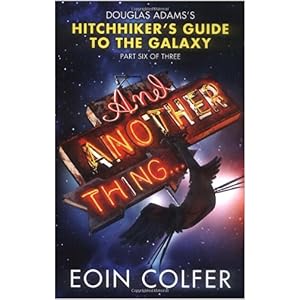
Eoin Colfer: And Another Thing... (2009)

Edition: Michael Joseph, 2009
Review number: 1405

I borrowed this book from the library expecting to hate it. Even though I didn't like the end of the Hitchhiker series as it stood at Douglas Adams' death, I couldn't imagine anyone else continuing it in the way that he might have been able to (if he'd overcome the blocks he experienced in the later part of his writing career). I'd also read Artemis Fowl, which made Colfer's name, and didn't think much of it.

And, when And Another Thing... came out, it was serialised on BBC Radio 4 as an audiobook, and I listened to that and did indeed hate it. Hitchhiker was always hilarious, and the abridged version - 340 pages in 75 minutes which I'd estimate means leaving out 75% of the text - failed to raise a smile. Of course, that could have been the cuts ("let's leave out the jokes to keep the plot comprehensible"), or the way it was read (not Steve Mangan's finest hour and a quarter), or some of the plot decisions (the way Colfer got out of the problems caused by the ending of Mostly Harmless seemed trite and unconvincing to me). Would the book itself be more worth reading? Friends who might have read it turned out not to have done. So, there was only one way to find out...

Initially, my reaction was positive. At greater length, the unravelling of the finality of the ending of Mostly Harmless, while still not very imaginative, worked better and contained some amusing touches. But things do go downhill from there. Some of the issues are with the characters as created by Douglas Adams. I have always found Zaphod Beeblebrox verging on being more irritating than funny, and Colfer makes him a particularly important character here and he becomes an annoying manipulator of the plot: more self-centred than ever. Wowbagger, the immortal being who is insulting every being in the universe in alphabetical order, also turns up and is made a major character: Colfer's attempts to make him more than the brief joke he is for Adams make him at least as unsympathetic and irritating as a dealmaking Zaphod. And finally, Colfer seems to share Adams' interest in Norse myth, and a lot of the book (even more in the radio abridgement) is about Zaphod's dealings with Asgard - all very dull compared to the meeting with Thor at a party in Mostly Harmless.

All this could be forgiven if And Another Thing... had turned out to be as funny as the first few Hitchhiker books were on first reading. In this aspect, I got the impression that Colfer didn't work too hard, settling for the obvious and poor pun rather than thinking hard about exactly what would be funny. (Apparently Douglas Adams used to agonise about individual words for ages, and this shows in the inventive quality of the first three books in particular.) The way that the book-within-the-book of the actual Guide is handled here is partly to blame for the lack of laughs. The "Book" extracts are among the highlights of the original stories, being extremely funny and often explaining how the bizarre situations Arthur and Ford find themselves in arose. Here, they are intrusive, irrelevant and humourless asides (though it is fairly obvious that Colfer thinks them hilarious). Some attempt has been made to make them stand out typographically, something I don't think Adams ever did, and this, like so much else about And Another Thing... is depressingly unimaginative: the entries are printed in italics. So much more could have been done here to indicate their peripheral nature and liven up the presentation of the book.

Colfer is obviously a fan, and this makes him a good choice as a writer of a sequel. But he is not really very funny at all, even when writing his own books. (I've read Artemis Fowl, and it seems like a good idea - a child evil genius - let down by a lack of imagination and lazy writing, though many people seem to think it extremely funny.) In the end, And Another Thing... reads like a not very wonderful piece of fan fiction, of the sort published in vast quantities on the Internet: and I feel sure that there are likely to be better sequels to Hitchhiker available free at fanfiction.net. My rating - 2/10.

Thursday, 15 May 2008

Douglas Adams: The Salmon of Doubt (2002)

Published: Pan, 2002
Edited: Peter Gazzardi

I remember when I heard about Douglas Adams' death, but I was surprised to realise that it was now seven years ago that it happened. I didn't want to pick up this book when it came out, less than a year later, for several reasons, and it is only now that I am finally reading and enjoying it.

The main reason for not wanting to acknowledge the existence of The Salmon of Doubt before is that I just didn't want Douglas Adams to be dead. I was just old enough to appreciate The Hitchhiker's Guide to the Galaxy when the novel first appeared (I missed the original broadcast of the first radio series, but caught repeats). By the time I went to university, I could quote large chunks and still can, and own copies of the books, recordings of the radio and TV series and Neil Gaiman's guide. The Hitchhiker's Guide to the Galaxy played a important role in my life, quite similar to Adams' own discovery of the Beatles which is described in one of the pieces included in The Salmon of Doubt.

The one exception to this is Mostly Harmless. As pretty much the last writing by Adams I read before The Salmon of Doubt, I found it very off putting and didn't want to read more of the same. (Mostly Harmless is now the only book by Douglas Adams which I do not possess.) It was so wilfully downbeat, not just ending unhappily, but seemingly revelling in undoing previous happy endings (notably the relationship between Arthur and Fenchurch). According to information in the Salmon of Doubt, it reflects a bleak time in Adams' own life, and I gathered when I listened to the radio version that he later wanted to change the ending, a wish that was carried out when it was dramatised. Relatively little of The Salmon of Doubt is fiction, so there is little chance that the book overall will give the same impression as Mostly Harmless, but even the fiction that is there clearly reflects a happier time.

The other reason that I didn't rush to read Salmon of Doubt is because some of what I heard about it suggested that it was scraping the barrel. Apart from the incomplete fiction, which always has the potential to be frustrating, the idea of resurrecting a letter sent by the twelve year old Adams to Eagle comic seemed bizarre. (In fact, it is probably the most amusing letter ever written to a comic by a twelve year old.) Fragmentary the pieces in The Salmon of Doubt may be, but they are all uniformly well written (with one exception), often thought provoking, and mostly pretty funny.

The book is divided into three sections: Life, containing autobiographical fragments, The Universe, about Adams' wide-ranging interests, and Everything, fiction. The first section is perhaps the most successful. The second includes a lot of Apple Mac related material, which had to be included because that computer system was one of Adams' best known obsessions, but which is now (and would have been five years ago) rather out of date; at least this means that the Douglas Adams fanatic doesn't need to hoard quite so many back copies of Mac User. His own favourite of his books was Last Chance to See, about endangered animals, and that is well worth reading in his memory, and there is more here from his interest in ecology for those who enjoyed that.

The first fictional piece, Young Zaphod Pulls it Off, was previously published in book form in a collected edition of the Hitchhiker's novels and is a poor piece of political satire, clichéd and obvious. However, the story which gives its title (or, more strictly speaking, one of its titles) to the whole collection is much better. It is one of the most confusing pieces in the whole book, however, as it was put together from three very different incomplete drafts of the story: although the main one used here is a Dirk Gently story, not even this was finalised. For me, the middle draft, which is definitely Dirk Gently, works best. I like the idea that Dirk's philosophy that all things are interconnected leads him to try to solve a case by tailing random people. It's the longest piece in the book, and because it is so incomplete, the most frustrating; Adams' drafts were obviously finely finished and perfectly readable (no notes to self, for example), but he obviously kept getting so far and then becoming stuck and the only indication of how the story would continue is a one paragraph fax to his agent which is not very illuminating.

While it was inevitable that there would be both the desire to produce a book containing Adams' odds and ends, and a desire from fans to read it, The Salmon of Doubt cannot be considered the true legacy of Douglas Adams. It raises the profile of important aspects of both his personality and his writing which were not accessible to most of his fans, particularly the computing articles, but there is nothing in the book to match the classic status of The Hitchhiker's Guide in its many forms.