Originally titled: Cefalû
Edition: Faber & Faber, 1964 (Buy from Amazon)
Review number: 1305
In all of Lawrence Durrell's novels, the author combines an apparently realistic story with psychological and spiritual allegroy, so that nothing necessarily means what it appears to signify on the surface. (I wouldn't class them as fully allegorical, because I can't come up with a meaning beyond the surface one for some aspects of each novel.) In The Dark Labyrinth, his first novel, the scaffolding which makes this structure work is much more obvious than in his later work, making it simultaneously easier to understand but less resonant because the cleverness registers consciously rather than being absorbed without noticing. This is basically because the central image - the mythical Cretan labyrinth in which the Minotaur lived - is so dominant.
The plot of the novel hinges round an incredible archaeological discovery on Crete - a complex maze of caves containing ancient artefacts of very high quality; this is immediately hailed as the original of the labyrinth from the myth in the same way that the ancient Cretan culture has been labelled Minoan after the king in the same myth. A group of British tourists become lost in the dark cave after a rock fall kills their guide; they are (with one exception, a man who found his way out) believed dead.
From the symbolic point of view, it is clear that the labyrinth represents a spiritual or psychological crisis in the lives of these people, some sort of difficulty that they need to find their way through. (Thus the labyrinth has three meanings: a set of Cretan caves, the mythological haunt of the monster, and a psychological crisis.) What happens to each of them in the maze after the guide's death has its own allegorical significance, especially clear for the couple who find themselves in a garden of Eden, a lost world - a plateau inaccessible from the rest of the island except through the maze, inhabited only by an elderly British archaeologist who found her way there years previously (importantly, she has not even been aware of the Second World War, and so the plateau has a sense of innocence that has been lost to the world at large).
This is not a Christian allegory, of course. I say this not because the illustration of religious ideas is the most frequent and best known reason for the use of allegory in literature, but because Durrell explicitly uses Biblical images like Eden alongside pagan Greek myth. One of the points of the labyrinth experience is that each person has to work out their own way to return to the outside world, not follow one unique path - compare The Dark Labyrinth with The Pilgrim's Progress, where those who do not follow the correct route to the Celestial City never get there. In fact, Durrell seems to assume that all the ideas that help the trapped tourists escape are true, which may in some cases annoy people. He was clearly extremely interested in mysticism and unusual religious ideas (whether or not he actually believed in them), and spiritualism is treated extremely sympathetically (though less laughably than Arthur Conan Doyle's later Professor Challenger novels); in this novel, real mediums, spirit guides and contact with the dead all exist.
The lack of the subtlety which I would associate with the later work of Lawrence Durrell (and which makes him, to my mind, one of the greatest English novelists of the second half of the twentieth century) marks The Dark Labyrinth as an early attempt at the themes and ideas which fill his mature work. It is not, therefore, his best, but it is definitely of interest to fans of his writing.
Showing posts with label Lawrence Durrell. Show all posts
Showing posts with label Lawrence Durrell. Show all posts
Wednesday, 12 October 2005

Tuesday, 26 July 2005
Lawrence Durrell: Mountolive (1958)
Edition: Faber & Faber, 1958 (Buy from Amazon)
Review number: 1302
The third novel of the Alexandria Quartet may cover the same events for a third time, but it is quite different from both Justine and Balthazar. Mountolive moves away from the first person narrative by a young poet (whose name, we learn, is Darley, significantly similar to Durrell). It is replaced by a third person tale which mainly follows the point of view of Mountolive, a much older man and British ambassador to Egypt just before the war - a man of huge influence after Egypt had been virtually a British colony for much of the preceding half century. The earlier novels concentrated on Darley's affair with Justine, wife of wealthy Coptic merchant Nessim. While this is almost incidental, Mountolive had a similar affair with Nessim's mother while he was a young man, and this is where this novel begins, with what is effectively a long prologue. However, though the memory of this time is still strongly emotive to Mountolive, his concern with Justine and Nessim is more political, for they are suspected of working with Zionist groups in Palestine in anti-British, anti-Arab terrorism there.
This overtly political side to the plot, which almost puts Mountolive into the thriller genre (the style is too slow moving to allow this), is new in the Quartet. Even the Antrobus stories, which are set in the diplomatic corps, have nothing of this sort (being mainly concerned with humour derived from protocol disasters). However, Durrell witnessed at first hand some of the debacles attendant on the dismantling of the British Empire (his experience in Cyprus being documented in Bitter Lemons), and it is not surprising that a book which appeared at the same time as the Suez Crisis, even if not set at the time, should bring to mind some of the political chaos of the period.
In the last fifty years, John le Carré, Len Deighton and a host of imitators have made careers as thriller writers through books about betrayal and how it feels to suspect a friend. Durrell does much the same, in a way, though his characters have no desire to investigate; they want to find out as little as possible, in the hope - and belief - that the suspicions will prove to be groundless. (This inactivity is one of the main reasons that Mountolive can never be classed as a thriller.) This, of course, also gives an insight into the events at the time a few years before the book was written, the days when the treachery of Philby, Burgess and Maclean became known.
As Justine (who was not a native Egyptian) is partly a symbol of Alexandria, so Nessim's mother in her turn is something of a symbol for Egypt as a whole. In this respect, Chapter XV, in which Mountolive finally meets Leila again, is really the key to the novel. The reality is that Leila's beauty, so vividly remembered, has been ravaged by small pox and age, to the extent that even close up he does not recognise her. The meeeting is immediately followed by a deliberate attempt on the part of Mountolive to re-establish the romantic mystique of Egypt in his mind - Leila's symbolic role is apparent even to the other characters in the novel.
Mountolive and Darley also have symbolic roles to play - Mountolive is British involvement in Egyptian affairs, and Darley is the literary interest in Alexandria. Once you begin to see characters as having wider significance, it is hard to stop assigning such roles to them; the answer is of course to always think about whether doing so adds to the interest of the novel. Characters like Pursewarden and Melissa only have parts to play in relation to Darley or Justine, so even though they are more important characters in terms of the Quartet as a work of fiction, they are not really symbols in the same way as the ones already mentioned.
The earlier novels both have interesting endpieces, as does the final part, Clea; Mountolive has none at all. This has the effect of underlining the finality of the novel: this is the last re-examining of these events (Clea picks up the story of the main characters again some years later), and there is no useful purpose in another collection of bons mots or impressionistic notes; Durrell no longer wants the reader to constantly re-evaluate what has gone before. In some ways, Clea is the end-paper to Mountolive, as well as rounding off the whole Quartet.
Review number: 1302
The third novel of the Alexandria Quartet may cover the same events for a third time, but it is quite different from both Justine and Balthazar. Mountolive moves away from the first person narrative by a young poet (whose name, we learn, is Darley, significantly similar to Durrell). It is replaced by a third person tale which mainly follows the point of view of Mountolive, a much older man and British ambassador to Egypt just before the war - a man of huge influence after Egypt had been virtually a British colony for much of the preceding half century. The earlier novels concentrated on Darley's affair with Justine, wife of wealthy Coptic merchant Nessim. While this is almost incidental, Mountolive had a similar affair with Nessim's mother while he was a young man, and this is where this novel begins, with what is effectively a long prologue. However, though the memory of this time is still strongly emotive to Mountolive, his concern with Justine and Nessim is more political, for they are suspected of working with Zionist groups in Palestine in anti-British, anti-Arab terrorism there.
This overtly political side to the plot, which almost puts Mountolive into the thriller genre (the style is too slow moving to allow this), is new in the Quartet. Even the Antrobus stories, which are set in the diplomatic corps, have nothing of this sort (being mainly concerned with humour derived from protocol disasters). However, Durrell witnessed at first hand some of the debacles attendant on the dismantling of the British Empire (his experience in Cyprus being documented in Bitter Lemons), and it is not surprising that a book which appeared at the same time as the Suez Crisis, even if not set at the time, should bring to mind some of the political chaos of the period.
In the last fifty years, John le Carré, Len Deighton and a host of imitators have made careers as thriller writers through books about betrayal and how it feels to suspect a friend. Durrell does much the same, in a way, though his characters have no desire to investigate; they want to find out as little as possible, in the hope - and belief - that the suspicions will prove to be groundless. (This inactivity is one of the main reasons that Mountolive can never be classed as a thriller.) This, of course, also gives an insight into the events at the time a few years before the book was written, the days when the treachery of Philby, Burgess and Maclean became known.
As Justine (who was not a native Egyptian) is partly a symbol of Alexandria, so Nessim's mother in her turn is something of a symbol for Egypt as a whole. In this respect, Chapter XV, in which Mountolive finally meets Leila again, is really the key to the novel. The reality is that Leila's beauty, so vividly remembered, has been ravaged by small pox and age, to the extent that even close up he does not recognise her. The meeeting is immediately followed by a deliberate attempt on the part of Mountolive to re-establish the romantic mystique of Egypt in his mind - Leila's symbolic role is apparent even to the other characters in the novel.
Mountolive and Darley also have symbolic roles to play - Mountolive is British involvement in Egyptian affairs, and Darley is the literary interest in Alexandria. Once you begin to see characters as having wider significance, it is hard to stop assigning such roles to them; the answer is of course to always think about whether doing so adds to the interest of the novel. Characters like Pursewarden and Melissa only have parts to play in relation to Darley or Justine, so even though they are more important characters in terms of the Quartet as a work of fiction, they are not really symbols in the same way as the ones already mentioned.
The earlier novels both have interesting endpieces, as does the final part, Clea; Mountolive has none at all. This has the effect of underlining the finality of the novel: this is the last re-examining of these events (Clea picks up the story of the main characters again some years later), and there is no useful purpose in another collection of bons mots or impressionistic notes; Durrell no longer wants the reader to constantly re-evaluate what has gone before. In some ways, Clea is the end-paper to Mountolive, as well as rounding off the whole Quartet.
Saturday, 18 June 2005
Lawrence Durrell: Balthazar (1961)
Edition: Faber & Faber, 1963 (Buy from Amazon)
Review number: 1298
The introduction to this novel, the second in the Alexandria Quartet, briefly explains one of the structural ideas behind the novels. I'm not sure of the extent to which this is meant to be tongue in cheek, because it is the sort of idea often found in satires of intellectual writers who don't understand much science. The explanation given for a quartet of novels the first three of which cover the same events from different perspectives is that they were inspired by the idea of spacetime most famously used in Einstein's theory of relativity - the first three novels corresponding to space dimensions, and the fourth to time.
I particularly like the way that Balthazar is set up, the reason that the narrator is persuaded to revisit the story of his affair with Justine. Having published his novel about the affair (the novel Justine, in other words), he received a packet of papers from his friend Balthazar. These basically tore the novel apart, explaining that although things appeared in one form to the writer, his view was not always terribly accurate, his passion for Justine making it impossible to read between the lines. This naturally prompts a re-examination of his memories - from which comes the novel Balthazar. The narrator is driven to find out to what extent Justine really loved him. What did their friends - and particularly her husband - really think about their relationship?
Since one of the interesting aspects of Justine is the way in which the woman is a symbol for the city of Alexandria, to reassess her and the affair is for Durrell to reassess his view of the Egyptian port. At least, that is apparently the case, because of course Durrell is perfectly aware of the ironies involved and is quite deliberately manipulating them. There are quite a few levels to the narrative, though it reads perfectly straightforwardly - particularly because the main interest in Balthazar is in the change derived from the narrator's altered feelings brought about by the letters which arose because of his fictional counterpart to the real novel Justine (and not forgetting that the real novel may not necessarily be identical to its fictional version) which he also narrated. But it is not all meant to be taken seriously; Balthazar is also meant to entertain the reader. As an endpiece to this novel like the notes that form Justine's afterword, Durrell includes some supposed quotations from novelist character Pursewarden in Wildean vein; among them is a little barb at those who take literature too seriously. This returns full circle to the suggestion that there is something tongue in cheek about the theory of relativity being the inspiration for the structure of the four novels - just one detail from a thought provoking novel.
Review number: 1298
The introduction to this novel, the second in the Alexandria Quartet, briefly explains one of the structural ideas behind the novels. I'm not sure of the extent to which this is meant to be tongue in cheek, because it is the sort of idea often found in satires of intellectual writers who don't understand much science. The explanation given for a quartet of novels the first three of which cover the same events from different perspectives is that they were inspired by the idea of spacetime most famously used in Einstein's theory of relativity - the first three novels corresponding to space dimensions, and the fourth to time.
I particularly like the way that Balthazar is set up, the reason that the narrator is persuaded to revisit the story of his affair with Justine. Having published his novel about the affair (the novel Justine, in other words), he received a packet of papers from his friend Balthazar. These basically tore the novel apart, explaining that although things appeared in one form to the writer, his view was not always terribly accurate, his passion for Justine making it impossible to read between the lines. This naturally prompts a re-examination of his memories - from which comes the novel Balthazar. The narrator is driven to find out to what extent Justine really loved him. What did their friends - and particularly her husband - really think about their relationship?
Since one of the interesting aspects of Justine is the way in which the woman is a symbol for the city of Alexandria, to reassess her and the affair is for Durrell to reassess his view of the Egyptian port. At least, that is apparently the case, because of course Durrell is perfectly aware of the ironies involved and is quite deliberately manipulating them. There are quite a few levels to the narrative, though it reads perfectly straightforwardly - particularly because the main interest in Balthazar is in the change derived from the narrator's altered feelings brought about by the letters which arose because of his fictional counterpart to the real novel Justine (and not forgetting that the real novel may not necessarily be identical to its fictional version) which he also narrated. But it is not all meant to be taken seriously; Balthazar is also meant to entertain the reader. As an endpiece to this novel like the notes that form Justine's afterword, Durrell includes some supposed quotations from novelist character Pursewarden in Wildean vein; among them is a little barb at those who take literature too seriously. This returns full circle to the suggestion that there is something tongue in cheek about the theory of relativity being the inspiration for the structure of the four novels - just one detail from a thought provoking novel.
Tuesday, 31 May 2005
Lawrence Durrell: Justine (1957)
Edition: Faber & Faber, 1961 (Buy from Amazon)
Review number: 1295
The Alexandria Quartet, Durrell's most famous work, begins with this story of an obsessive affair, between the young poet who narrates the novel and society woman Justine. The novel is more about the setting of postwar Alexandria, though, and Justine herself is to some extent a symbol of the city, which makes the novel extremely atmospheric even without lengthy passages of description. The groundwork is laid here for themes which become more important later in the series of novels (particularly since the first three cover the same events from different perspectives) - cabalism and gnosticism, for example - but Durrell is careful only to hint at what later volumes hold.
With this novel, Durrell's background as a poet is very clear, perhaps more so than in any of his other prose. There are certain kinds of literature where every word should have a purpose - thrillers are one, where the aim is to advance the action - but it is of poetry that this is most true, as it is an art form where words are almost everything, like the notes in music (rhythm being the most important other component). In most poetry, every word (with the possibly exception of particles like "the" - which may still contribute through rhythm) is there to contribute to an effect. Lawrence Durrell's prose has the same feeling: the position of every word in every sentence seems to be carefully thought out. Sometimes when writers do this, it can have the effect of making what they produce hard to follow: but this is not Finnegans Wake or The Wasteland. And while I'm thinking about Joyce and Eliot, it is clear that both are influences; but the novel's title also indicates a homage to an earlier writer with a different kind of notoriety: to de Sade, who also wrote a novel with the title Justine.
The novel ends with a fascinating little series of notes, apparently made as aids to composition (and I suspect designd to look like this) and entitled "workpoints"; these include translations of Cavafy, the poet of Alexandria whose work is a major influence, and three-word sketches of Justine's characters.
As well as being his most famous work, The Alexandria Quartet is the ideal introduction to Durrell. The Antrobus stories, while fun in a Yes, Minister vein, are more like his brother Gerald's writing and are not at all typical, and the travel writing is much more journalistic, as one might expect. It would be safe to say, though, that any reader who enjoys Justine will like the rest of The Alexandria Quartet, The Avignon Quintet and so on; but a reader who dislikes Justine will not find reading any of these other novels worthwhile. They are novels where the pleasure of reading them requires work from the reader; they are not meant to be read at speed but carefully, allowing each sentence to have its effect. I think the effort is well worth it; others may well not.
Review number: 1295
The Alexandria Quartet, Durrell's most famous work, begins with this story of an obsessive affair, between the young poet who narrates the novel and society woman Justine. The novel is more about the setting of postwar Alexandria, though, and Justine herself is to some extent a symbol of the city, which makes the novel extremely atmospheric even without lengthy passages of description. The groundwork is laid here for themes which become more important later in the series of novels (particularly since the first three cover the same events from different perspectives) - cabalism and gnosticism, for example - but Durrell is careful only to hint at what later volumes hold.
With this novel, Durrell's background as a poet is very clear, perhaps more so than in any of his other prose. There are certain kinds of literature where every word should have a purpose - thrillers are one, where the aim is to advance the action - but it is of poetry that this is most true, as it is an art form where words are almost everything, like the notes in music (rhythm being the most important other component). In most poetry, every word (with the possibly exception of particles like "the" - which may still contribute through rhythm) is there to contribute to an effect. Lawrence Durrell's prose has the same feeling: the position of every word in every sentence seems to be carefully thought out. Sometimes when writers do this, it can have the effect of making what they produce hard to follow: but this is not Finnegans Wake or The Wasteland. And while I'm thinking about Joyce and Eliot, it is clear that both are influences; but the novel's title also indicates a homage to an earlier writer with a different kind of notoriety: to de Sade, who also wrote a novel with the title Justine.
The novel ends with a fascinating little series of notes, apparently made as aids to composition (and I suspect designd to look like this) and entitled "workpoints"; these include translations of Cavafy, the poet of Alexandria whose work is a major influence, and three-word sketches of Justine's characters.
As well as being his most famous work, The Alexandria Quartet is the ideal introduction to Durrell. The Antrobus stories, while fun in a Yes, Minister vein, are more like his brother Gerald's writing and are not at all typical, and the travel writing is much more journalistic, as one might expect. It would be safe to say, though, that any reader who enjoys Justine will like the rest of The Alexandria Quartet, The Avignon Quintet and so on; but a reader who dislikes Justine will not find reading any of these other novels worthwhile. They are novels where the pleasure of reading them requires work from the reader; they are not meant to be read at speed but carefully, allowing each sentence to have its effect. I think the effort is well worth it; others may well not.
Friday, 9 January 2004
Lawrence Durrell: Nunquam (1970)
Edition: Faber & Faber, 1971 (Buy from Amazon)
Review number: 1210
The completion of The Revolt of Aphrodite begins, like its predecessor Tunc, with a section which is poetic and hard to read. Yet its purpose is the opposite; Tunc is intended to lure the reader with mystification while Nunquam illuminates what was previously obscure. So here the difficult prose has a rationale which is soon revealed to the reader: it is a kind of journal written by Felix Charlock (the narrator of both novels) while he is being treated in a mental hospital after killing his own son believing the boy to the the fruit of his wife's suspected infidelity with the mysterious Julian.
The sort of revealing detail that Durrell includes in Nunquam is exemplified by the moment when the narrator describes writing "Felix amat Benedicta", and the reader suddenly realises that this is not just a pretentious way for him to express his love for his wife but also a pointer to an allegorical role for these two characters, as it reminds him/her that their names mean "happy" and "blessed". It didn't occur to me to think of the characters in this way until this point (though arguably it should have done), and this it was a sentence which transformed my understanding of both novels. The two characters are unusual allegorical figures, of course, because their experiences and natures leave them in an almost permanent state of seeming neither happy nor blessed. The Revolt of Aphrodite is revealed to be a sardonic, cynical, symbolic drama.
The plot of Nunquam, once Felix is judged cured and able to return to his work for Merlin, is basically a retelling of Frankenstein. Felix's former lover, the film star Iolanthe, is dead, but Merlin decides to use her as a prototype in a project to create a mechanical being, aiming to recreate her appearance, memories and personality. This part of the story also clearly fits into some kind of symbolic and satirical picture of modern society, even if its precise meaning is not so clear. (The purpose of this section is more obviously satirical than most of the rest of the pair of novels, though the whole is about the emptiness of modern capitalism.) Durrell uses his update of the Frankenstein story to paint a pretty negative view of science; for example, Felix imagines the laboratory complex as looking rather like Belsen, and its name evokes the idea that the engineers are just playing (their motivation for recreating Iolanthe is indeed quite vague).
There was still a lot I didn't fully understand about The Revolt of Aphrodite (for three reasons: some things are deliberately left obscure; others will become clear only on a second or third reading; and others require background I do not have, particularly of Spengler's Decline of the West on which the novels are a commentary in fictional form). Nevertheless, Tunc and Nunquam have both had a deep effect on me, and are going to remain with me for a long time.
Review number: 1210
The completion of The Revolt of Aphrodite begins, like its predecessor Tunc, with a section which is poetic and hard to read. Yet its purpose is the opposite; Tunc is intended to lure the reader with mystification while Nunquam illuminates what was previously obscure. So here the difficult prose has a rationale which is soon revealed to the reader: it is a kind of journal written by Felix Charlock (the narrator of both novels) while he is being treated in a mental hospital after killing his own son believing the boy to the the fruit of his wife's suspected infidelity with the mysterious Julian.
The sort of revealing detail that Durrell includes in Nunquam is exemplified by the moment when the narrator describes writing "Felix amat Benedicta", and the reader suddenly realises that this is not just a pretentious way for him to express his love for his wife but also a pointer to an allegorical role for these two characters, as it reminds him/her that their names mean "happy" and "blessed". It didn't occur to me to think of the characters in this way until this point (though arguably it should have done), and this it was a sentence which transformed my understanding of both novels. The two characters are unusual allegorical figures, of course, because their experiences and natures leave them in an almost permanent state of seeming neither happy nor blessed. The Revolt of Aphrodite is revealed to be a sardonic, cynical, symbolic drama.
The plot of Nunquam, once Felix is judged cured and able to return to his work for Merlin, is basically a retelling of Frankenstein. Felix's former lover, the film star Iolanthe, is dead, but Merlin decides to use her as a prototype in a project to create a mechanical being, aiming to recreate her appearance, memories and personality. This part of the story also clearly fits into some kind of symbolic and satirical picture of modern society, even if its precise meaning is not so clear. (The purpose of this section is more obviously satirical than most of the rest of the pair of novels, though the whole is about the emptiness of modern capitalism.) Durrell uses his update of the Frankenstein story to paint a pretty negative view of science; for example, Felix imagines the laboratory complex as looking rather like Belsen, and its name evokes the idea that the engineers are just playing (their motivation for recreating Iolanthe is indeed quite vague).
There was still a lot I didn't fully understand about The Revolt of Aphrodite (for three reasons: some things are deliberately left obscure; others will become clear only on a second or third reading; and others require background I do not have, particularly of Spengler's Decline of the West on which the novels are a commentary in fictional form). Nevertheless, Tunc and Nunquam have both had a deep effect on me, and are going to remain with me for a long time.
Saturday, 13 December 2003
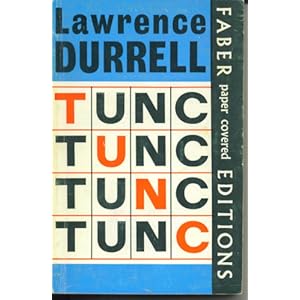
Lawrence Durrell: Tunc (1968)
Review number: 1204
The titles of the two novels which together are known as The Revolt of Aphrodite are taken from a Latin quotation familiar in translation - "It was then, or never". This fact is one which either you know or which you find out when you read the second, an action which generally makes Tunc rather clearer.
For here we are not staying in the relatively accessible territory of The Alexandria Quartet, Durrell's best known collection of novels. Indeed, the first seventy pages or so of Tunc are extremely difficult to read and through their concentration on words as words rather than as constituent parts of a narrative serves as a reminder that their author first made his literary name as a poet. The novel settles down a bit after this, though it is still possible to discern the influence of James Joyce and the techniques of stream of consciousness writing.
The narrator, Felix Charlock, is an inventor, who is involved in the early days of electronic engineering - at the start of the novel, he has developed a miniature sound recorder which he is using to tape voices for analysis on a primitive computer. While Cryptonomicon fans might be interested in this in itself, it is not particularly important to the story exactly what his inventions are, though the snatches of speech he records are used as an element of the novel's text. What is important is that he attracts the interest of the mysterious Merlin corporation, and falls for the daughter of one of its senior executives.
Charlock becomes involved with Merlin without knowing much about the company, and spends most of the second half of the novel trying to understand just what he has got himself into. He is confused by things like the executive always available by phone but completely elusive physically, or the company's involvement with one of his former mistresses, now a film star, or the possible reappearance of a former employee who had been reported dead. This gives the second half of the novel something of the air of an investigation into a secret society, like John Fowles' The Magus or even the Illuminatus trilogy.
Apart from Joyce, parts of this novel remind me of Iris Murdoch, or Durrell's own Alexandria Quartet. (The Avignon Quintet, which is even more similar, was written later, as was The Magus.) It is well worth making the effort to read the earlier sections, set in Athens and Istanbul; once the action moves to London, the more prosaic background is reflected in the less poetic writing. Without the sequel, there is much which doesn't get explained (the titles of both the books and the pairing for one thing, make little sense in relation to the content of this novel), so reading Tunc is likely to be quickly followed by reading Nunquam.
Subscribe to:
Posts (Atom)

 Posts
Posts

