Edition: Faber & Faber, 1971 (Buy from Amazon)
Review number: 1210
The completion of The Revolt of Aphrodite begins, like its predecessor Tunc, with a section which is poetic and hard to read. Yet its purpose is the opposite; Tunc is intended to lure the reader with mystification while Nunquam illuminates what was previously obscure. So here the difficult prose has a rationale which is soon revealed to the reader: it is a kind of journal written by Felix Charlock (the narrator of both novels) while he is being treated in a mental hospital after killing his own son believing the boy to the the fruit of his wife's suspected infidelity with the mysterious Julian.
The sort of revealing detail that Durrell includes in Nunquam is exemplified by the moment when the narrator describes writing "Felix amat Benedicta", and the reader suddenly realises that this is not just a pretentious way for him to express his love for his wife but also a pointer to an allegorical role for these two characters, as it reminds him/her that their names mean "happy" and "blessed". It didn't occur to me to think of the characters in this way until this point (though arguably it should have done), and this it was a sentence which transformed my understanding of both novels. The two characters are unusual allegorical figures, of course, because their experiences and natures leave them in an almost permanent state of seeming neither happy nor blessed. The Revolt of Aphrodite is revealed to be a sardonic, cynical, symbolic drama.
The plot of Nunquam, once Felix is judged cured and able to return to his work for Merlin, is basically a retelling of Frankenstein. Felix's former lover, the film star Iolanthe, is dead, but Merlin decides to use her as a prototype in a project to create a mechanical being, aiming to recreate her appearance, memories and personality. This part of the story also clearly fits into some kind of symbolic and satirical picture of modern society, even if its precise meaning is not so clear. (The purpose of this section is more obviously satirical than most of the rest of the pair of novels, though the whole is about the emptiness of modern capitalism.) Durrell uses his update of the Frankenstein story to paint a pretty negative view of science; for example, Felix imagines the laboratory complex as looking rather like Belsen, and its name evokes the idea that the engineers are just playing (their motivation for recreating Iolanthe is indeed quite vague).
There was still a lot I didn't fully understand about The Revolt of Aphrodite (for three reasons: some things are deliberately left obscure; others will become clear only on a second or third reading; and others require background I do not have, particularly of Spengler's Decline of the West on which the novels are a commentary in fictional form). Nevertheless, Tunc and Nunquam have both had a deep effect on me, and are going to remain with me for a long time.
Showing posts with label The Revolt of Aphrodite. Show all posts
Showing posts with label The Revolt of Aphrodite. Show all posts
Friday, 9 January 2004

Saturday, 13 December 2003
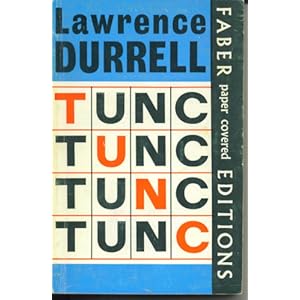
Lawrence Durrell: Tunc (1968)
Review number: 1204
The titles of the two novels which together are known as The Revolt of Aphrodite are taken from a Latin quotation familiar in translation - "It was then, or never". This fact is one which either you know or which you find out when you read the second, an action which generally makes Tunc rather clearer.
For here we are not staying in the relatively accessible territory of The Alexandria Quartet, Durrell's best known collection of novels. Indeed, the first seventy pages or so of Tunc are extremely difficult to read and through their concentration on words as words rather than as constituent parts of a narrative serves as a reminder that their author first made his literary name as a poet. The novel settles down a bit after this, though it is still possible to discern the influence of James Joyce and the techniques of stream of consciousness writing.
The narrator, Felix Charlock, is an inventor, who is involved in the early days of electronic engineering - at the start of the novel, he has developed a miniature sound recorder which he is using to tape voices for analysis on a primitive computer. While Cryptonomicon fans might be interested in this in itself, it is not particularly important to the story exactly what his inventions are, though the snatches of speech he records are used as an element of the novel's text. What is important is that he attracts the interest of the mysterious Merlin corporation, and falls for the daughter of one of its senior executives.
Charlock becomes involved with Merlin without knowing much about the company, and spends most of the second half of the novel trying to understand just what he has got himself into. He is confused by things like the executive always available by phone but completely elusive physically, or the company's involvement with one of his former mistresses, now a film star, or the possible reappearance of a former employee who had been reported dead. This gives the second half of the novel something of the air of an investigation into a secret society, like John Fowles' The Magus or even the Illuminatus trilogy.
Apart from Joyce, parts of this novel remind me of Iris Murdoch, or Durrell's own Alexandria Quartet. (The Avignon Quintet, which is even more similar, was written later, as was The Magus.) It is well worth making the effort to read the earlier sections, set in Athens and Istanbul; once the action moves to London, the more prosaic background is reflected in the less poetic writing. Without the sequel, there is much which doesn't get explained (the titles of both the books and the pairing for one thing, make little sense in relation to the content of this novel), so reading Tunc is likely to be quickly followed by reading Nunquam.
Subscribe to:
Posts (Atom)

 Posts
Posts

