Showing posts with label techno-thriller. Show all posts

Sunday, 16 December 2012

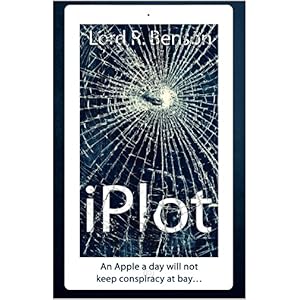
Lord R. Benson: iPlot (2012)

Edition: Marador, 2012
Review number: 1470

A simple but arresting idea sets off this thriller: a couple pick up the wrong iPad after an airport security check when travelling to Australia, and find that it is fill of files about terrorism, including copies of hate mail sent to the Australian Prime Minister Carla Moore. The documents are fairly swiftly erased, the iPad having a feature that makes it possible for the owner to delete documents on a lost device. When Carla Moore falls ill suddenly, they suspect that there might be a link between the event and this iPad, but, having nothing concrete to show the police, they need to investigate for themselves.

iPlot starts slowly, and I found the basic idea of the swapped iPads difficult to believe: surely it can't be the case that there is no security to stop unauthorised users accessing the content on an iPad without entering a password? I'd be surprised if there were no apps to add biometric authentication capabilities such as iris scanning to iPad authentication. I am not an iPad user, but the answer to both questions appears to be yes, from a quick search on google, though it seems to be possible to bypass iPad authentication; this is a list of biometric authentication apps. So the idea that it would be possible to pick another person's iPad and only realise it is not your own when you see it doesn't contain the film you planned to watch on your flight - especially as the iPad concerned contains seriously sensitive data. My doubts made it hard to accept the verisimilitude of the story from the beginning.

There were other flaws which did not help. There are some rather clunky passages of prose, including the second chapter, which consists of lengthy and dull extracts from the documents on the laptop, including information about the death of Alexander Litvinenko, which is likely to be fairly familiar to anyone who has followed the news over the last few years, at least in the UK. This material could have been better introduced, and there is no need for so much of it, just a few bits and pieces to establish the type of content which is stored in the iPad. Anyone who has watched shows like Spooks or Homeland will already have a pretty good idea of what these documents will be like, so it will feel like familiar territory which could be skipped to many readers. There is something of a tendency to over-explain the background throughout, especially as many of the topics involved (the iPads, the terrorist plotting, the science) are likely to be of interest and fairly well known to potential readers, who I suspect will be - I hesitate slightly to say - geeks like me, who will be drawn in by the iPad idea.

The characters are poorly drawn; they all seem to have the same personality, pretty much, and even their physical descriptions are similar in many cases - this is a world of good looking, intelligent, and basically nice people.

But there are good sides to iPlot too. The story builds to its climax well, and eventually the most cynical reader will be drawn in. In terms of the plotting, I would have liked to have seen more use made of the iPads after they set the plot in motion, but the finale of iPlot was good anyway. I liked the technological and scientific aspects of the novel, even if they were over-explained, but I wanted to enjoy iPlot as a whole more than I did. My rating - 6/10.

Wednesday, 1 February 2012

Mark Alpert: Final Theory (2008)

The quoted reviews of this novel almost all compare it to The Da Vinci Code, and that is probably as good a place as any for me to start mine. Alpert is clearly a far better writer than Dan Brown, which may seem like faint praise, but the idea behind Final Theory is so closely related to The Da Vinci Code that it needs to be said.

Alpert studied physics, and now works for Scientific American, and the secret which is at the heart of Final Theory is a physical theory rather than a religious idea. Towards the end of his life, Einstein spent a lot of time searching for a unified theory which would bring together the physical forces and provide an explanation for the results of quantum theory, something which he was uneasy with despite his involvement in its early stages. He never succeeded in doing this. Alpert has combined this idea with Einstein's belief in pacifism, and the secret in Final Theory is a unified theory which Einstein did find, only to conceal it because of his concerns at the military uses to which it could be put. However, Einstein ensured that the secret theory would survive, by telling parts of it to each of his three assistants, so that if the world became peaceable, the theory could be reconstructed and revealed.

Many years later, one of the assistants posts his portion of the theory online before killing himself, and then Einstein's worst fears begin to be realised as several groups including the American government start a hunt for the keepers of the rest of the secret. The central character of Final Theory, David Swift, is, like Alpert himself, a science journalist who was once a physics graduate student. He is summoned to the hospital bed of his former professor, who was one of the three assistants, to be told a series of apparently meaningless numbers, which is designated "the key" by the dying man. This was the secret for which he had been attacked in his apartment and which leads the FBI taskforce which to take over the investigation from the NYPD, and then to illegally detain David. When the detention centre David is taken to is attacked by a Russian mercenary, David goes on the run, trying to find the secret - not necessarily the best thing to do in the circumstances, I suspect, but this gives a direction to his flight.

The big problem with Final Theory, as have been gathered from this summary, is that even for a thriller the plot is extremely implausible. It hinges around the willingness of large numbers of government employees to act illegally on a minimal suspicion that David might know something about the secret, and that the secret will be something which can be used to create a devastating weapon (and if it were possible, the development process involved would be decades long);  but this is bread and butter to a conspiracy theory novelist. The problems arise more from David's escape and the ensuing chase across the United States, during which he and other amateurs consistently outwit or have superior skills to those of trained police and mercenary soldiers. Thrillers do not have to be plausible in these respects, but the action sequences in Final Theory do not distract the reader enough to stop holes in the plot being noticeable.

Unsurprisingly given Alpert's background, the physics used as the background is interesting and works well. His idea about how Einstein could plausibly have found a unified theory despite his rejection of quantum mechanical uncertainty is quite convincing, though  those readers who have never read popular explanations of relativity and quantum mechanics might find unexplained terms including "timelike closed curve" intimidating - and these people probably make up most of the intended readership for Final Theory. The periodic pauses in the action during which the physics is discussed is probably the reason why the holes in the plot are quite as evident as they are.

Entertaining for the most part, but generally unconvincing and unlikely to hold up for thriller fans not already interested in the science. My rating - 3/10.


Edition: Pocket Books, 2009
Review number: 1438

Tuesday, 19 December 2006

Justina Robson: Mappa Mundi (2001)

Published: Pan (2002)

After an odd, disjointed start before the plot proper gets going - fifty pages describing formative events in the lives of those to become major characters - Mappa Mundi settles down into familiar near future techno-thriller territory, rather like (say) Neal Stephenson's Zodiac. The NervePath projec is a psychological equivalent to the Human Genome Project: mapping out how the mind and brain structure relate to one another. Natalie Armstrong is interested in the obvious spinoff: software that can alter brain state, something she sees as a major tool in psychiatric treatment (she works in a clinic in York). But she is strangely unable to get funding for her Mappa Mundi project, and a series of bizarre crimes in the US suggests that someone else with a more sinister agenda may already be ahead of her.

The plot proceeds predictably enough - are the people who used the software to attack the village in the Native American reservation really good guys desperate to make it politically impossible for the work on the software as a weapon to continue? who can be trusted? Then, just before the halfway point, there is a huge surprise, the rug being pulled out from under the feet of the complacent reader who thinks that they have read it all before. The western rationalist approach to the mind expected in a hard(ish) science fiction novel is suddenly interrupted by ideas from Eastern religions: the patient who is a test subject for Armstrong's work is accidentally enlightened, and leaves the physical plane, or at least, this is what appears to happen. Such an event would be humorous if Robson had not spent so long persuading the reader that Mappa Mundi is a serious novel. From this point onwards, the novel picks up a gear, and it becomes much less predictable.

Mind altering viruses, akin to the scourges of today's computers, are increasingly common in science fiction. I have written about Amusica, from Alastair Reynolds' Century Rain, only recently. It's a frightening idea, that we might be as malleable as a zombie PC is in the hands of today's virus writers.

The difficulties with producing this kind of virus are many: it is quite some way beyond today's knowledge (unless one starts to entertain paranoid notions that of course "they" would want us to think that). It is possible to obtain access to parts of the mind from outside, for hypnotism clearly does just that. But hypnotism, psychoactive drugs and brainwashing do not provide the delicacy of control and the permanent re-conditioning that is required by science fiction writers. They eyes, closely connected to the human brain (indeed, I have read that some scientists consider them and the optical nerve essentially part of the brain) and a principal means by which we, as a species, obtain information about the world, are the obvious means to use to infiltrate commands and programs into the mind (rather in the way that psychedelic patterns were used in sixties TV such as The Avengers). The defences, the biological equivalents to firewalls and virus checkers, seem to be quite weak, as we already have these methods of influencing the mind through the optical system. Breaching the defences, though, is only the first stage.

In order to make it possible to carry out the sort of reprogramming described in Mappa Mundi, the way that the human mind handles abstract concepts needs to be understood in detail. It is not even clear that concepts such as patriotism are implemented in the same way in the brains of different people - after all, patriotism is closely connected to whatever it is you are patriotic about, and even testing individuals to see how such a concept is structured would be hard (how would you stimulate the brains of people from different cultures so that you could scan brain activity for patriotism?). Abstract concepts are quite vague, and hard to pin down; there is a good reason why we don't program computers to be loyal, or jealous even though we know precisely how a computer should work. (Simulating loyalty or jealousy is a slightly different idea.) On the other hand, this feeling that the theory that would underlie the software described in this novel is infeasible doesn't meant that it will never be correctly formulated: after all, a medieval theologian would have considered a single law of gravity describing the motions of the planets to be unlikely, given the belief that an individual angel was responsible for the movement of each one.

Whether or not the vision of the mind control software painted by science fiction is likely, it is a disturbing one. Scenarios like warring factions of zombies (John Barnes' Kaleidoscope Century), the musical deprivation of Alastair Reynolds' Century Rain, or Robson's government sponsored suppression of discontent are in no way comforting, pleasant pictures of the future. And yet some people think that science fiction is all about escapism!

Mappa Mundi would be thought provoking as a technological thriller even without the wonderful twists. Not a cheerful read, however, by any stretch of the imagination.

Tuesday, 15 October 2002

Jeffrey Deaver: The Blue Nowhere (2001)

Edition: Hodder & Stoughton, 2001
Review number: 1124

Jeffrey Deaver may usually be a writer of traditional thrillers, but with The Blue Nowhere he joins the small group of authors who can convincingly depict the world of the computer hacker (Neal Stephenson and William Gibson being the best known of the others).

The basic plot of The Blue Nowhere is a computerised version of the Eddie Murphy film 48 Hours; a hacker is let out of prison to help the LAPD Computer Crimes Unit track down another hacker, who has the screen name Phate, who has turned serial killer. The actual crime plot is pretty hackneyed, but the computing background means that the novel is more than just a run of the mill police procedural. (The style, by the way, is similar to Michael Connelly.)

The one part of the plot which seems unlikely, if not impossible, is the program used by Phate to target the victims, which is named Trapdoor. (Deaver admids in the acknowledgements that the experts he consulted were dubious about the way it is supposed to work.) Phate has cracked one of the major Internet routers, and uses a steganographic (and the proof reader of the novel should note the spelling of the word) method to infect the target machine, sending small sections of the Trapdoor program in individual IP packets which are part of the normal online communication. (Steganographic means "hidden writing" , and is the process of writing a secret message as part of an innocent one, say be using every twentieth character, or altering specified bits of an image file.) To put the information into IP packets, given control of a router, would not be particularly difficult. The problem is that once the data reaches the target computer, it needs to be separated out from the genuine information, re-assembled and then executed, and I can't see any way that this could be done barring serious bugs in the IP stack and operating system of the computer being attacked. This is essentially the same reason that a virus spread as an email attachment is not activated unless the user or operating system is conned into executing (opening) the attachment - computers need a reason to run a piece of software. The reasons that systems are vulnerable to cracking are generally attributable to human carelessness, such things as users writing down passwords or using obvious words, or bugs in software which can be exploited.

Since the Trapdoor program is important to the plot, this is something of a problem; yet the convincing nature of the rest of the setting makes it easy enough to suspend disbelief and enjoy the novel.

Wednesday, 13 February 2002

Leslie Charteris: Catch the Saint (1975)

Edition: Coronet, 1977
Review number: 1063

It is here that Leslie Charteris abandons, explicitly, the idea that Simon Templar's adventures are to be considered contemporary to the time of writing, though there is little in either which dates them to any particular period between the thirties and seventies.

Returning to the past fails to re-invigorate Charteris' writing, unfortunately. The two stories - The Masterpiece Merchant, about a kidnapped painter, and The Adoring Socialite, about a hunt for a hidden crime boss, are among the least imaginative of the whole series. Ideas are re-used from earlier tales, notably The Saint in New York, and even from other sources, one twist coming straight from the film Charade. The writing is competent, and as thrillers the stories work reasonably well; the paucity of original ideas is the only reason for rating them lower than most of Charteris' work.

Saturday, 17 March 2001

Neal Stephenson: Cryptonomicon (1999)

Cryptonomicon coverEdition: Arrow, 2000
Review number: 784

This novel is usually found in the science fiction section of bookshops, but it is entirely set in the present (more or less) or the past. Its subject matter is the reason for it to be placed in the genre; it is about computing. There is an assumption that books about computing, especially those that, like Cryptonomicon, show a reasonable technical knowledge, are at least going to appeal to the readers of science fiction. This is a bit of a stereotyped assumption, but it probably does make good marketing sense (or else it would soon stop being made).

The story is effectively in two parts. Randall Waterhouse is a computer engineer, engaged on a new project (and in a new company) with an old friend. The initial aim of Epiphyte Corp. is to lay a new data cable into the Philippines, but there is a more unusual and interesting hidden agenda.

The other story, which takes up most of the space in the novel, is about the work of Randy's grandfather Lawrence during the Second World War. Like Alan Turing (a friend), he was one of the cryptanalysts whose work paved the way for the development of the modern computer, as well as heading a unit which had the task of making it look to the Germans as though the Allies were very lucky indeed instead of their codes being broken.

These two strands are brought together skilfully at the end, but in this extremely long novel it is the detail which holds the interest, and the clarity with which quite complex mathematics is described. The characterisation is good, and the background is vivid, though the Second World War chapters sometimes feel as though they are descriptions at a remove from actual events, as if Stephen is describing a gritty war film rather than the war itself.

The review quoted on the cover of Cryptonomicon compare it to William Gilbson and Thomas Pynchon's Gravity's Rainbow. There is in fact little in common with Gibson, beyond an interest in computers and a similarity in writing style (and that is mainly the common currency of late twentieth century American fiction). The comparison with Gravity's Rainbow is more apt, though Cryptonomicon is less philosophical, far more prosaic. They share similar touches of humour and of course the Second World War engineering background.

While not attempting to touch on the larger questions of Gravity's Rainbow, Cryptonomicon is an excellent novel, one of the first I have read which seriously looks at contemporary cyberculture.

Wednesday, 21 June 2000

Alexander Kent: In Gallant Company (1977)

Edition: Hutchinson & Co, 1977
Review number: 528

Although written five years later, the events of In Gallant Company come immediately before those of Sloop of War, detailing the adventures of Richard Bolitho as a naval lieutenant during the American War of Independence.

In Gallant Company is extremely typical of the genre of naval novels set in the eighteenth century, complete with all the standard elements: a gallant hero, pig-headed superior officers, occasional scenes of brutality, and young men either disgracing themselves or proving themselves. It is perhaps slightly more episodic than usual, the periods of boring routine between moments of action being omitted between chapters which could stand on their own as short stories. It gives the impression of something dashed off without a great deal of effort by an author thoroughly at home in his chosen genre.