Showing posts with label Steven Saylor. Show all posts

Monday, 3 October 2011

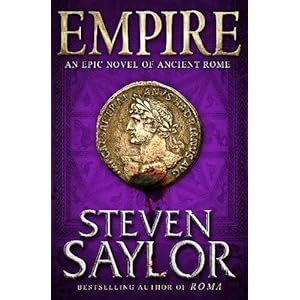
Steven Saylor: Empire (2010)


Why, when this is a sequel to Roma, is Empire given an English language title, rather than using, say, Imperium?

Empire follows on from the earlier novel, with a small gap (less than that between some of the individual chapters which make up the story). It describes the story of Rome from AD 14 to AD 141 - the years in which the Roman Empire became an established institution. Once again, the viewpoint characters are the various members of the (fictional) Pinarius family which was established at the beginning of Rome's history, according to Roma.

As Saylor points out in the afterword, this is one of the best documented periods of Roman history, but the surviving histories concentrate (with varying degrees of accuracy and/or bias) on the colourful figures of the emperors, who include some of the best and some of the most monstrous ruler of any nation. Saylor complains that contemporary historians were excessively emperor-centred, but then goes on to do the same thing himself: the novel is really about how successive generations of the Pinarii interacted with the emperors of their day, becoming intimately involved with most of the emperors from Tiberius to Hadrian. So Empire, too, centres on the emperors, and, to be honest, this does not work too well. I ended up feeling that it would be more fun to work through the histories for myself, or read some novels which concentrate on just part of the period, such as Robert Graves' I, Claudius. (Graves is a clear and acknowledged influence on Saylor's historical fiction.) The episodic nature of the story, as the focus moves from generation to generation, does not make a gripping novel (I felt much the same about Roma). Saylor is to my mind much better with the more focused detective stories he has written, whether set in ancient Rome or not.

The main lesson from the history as presented here is just how lucky you need to be to survive once you have attracted the attention of a Caligula, Nero or Domitian. Indeed, it becomes implausible that the family continues to exist after close contact with so many emperors.

It's worth reading, if you're vaguely interested in the history, but it's better to read the originals in a good translation - and they are generally available free online. My rating - 5/10.


Edition: Corsair, 2011
Review number: 1431

Wednesday, 4 February 2009

Steven Saylor: Roma (2007)

Published: Constable, 2007

Steven Saylor is best known for his series of ancient Roman detective novels featuring Gordianus the Finder, and his other works have also been crime fiction until now. Roma takes him out of the genre confort zone, being an ambitious attempt to contain the history of Rome from its earliest origins to the end of the Republic, a period of about a thousand years, within a single novel. Saylor makes his task more manageable by structuring the history as a series of episodes around the best known stories, and linking them by a simple device. The central character in each story, who is never the focus from the historical point of view, is the current owner of an amulet passed from generation to generation.

Writing a novel about the development of a great city is not a new idea. Peter Ackroyd's London comes to mind, though it's not a useful comparison for me as I haven't read it, but it shows that Saylor was not the only writer with this idea. But for there's one really important precedent for Roma: the histories of Livy. While not a novel in the modern sense, it is a highly dramatic version of the events covered in Saylor's book (and what went on in between). Livy added pro-Augustan spin to the disregard for evidence and acceptance of the supernatural common to most ancient historians, but makes up for this by the quality of his writing and the interest of his tales. In his acknowledgment of his debt to Livy in the afterword, Saylor describes his histories as "one of the great reading experiences of a lifetime", which is perhaps overdoing it a bit, but suggests just how difficult it would be for Saylor to live up to his source material. And that isn't even mentioning the other writers who have taken stories from Livy over the last two millennia, including Shakespeare, whose play Coriolanus and poem The Rape of Lucrece describe two of the same stories used by Saylor. (Julius Caesar and Anthony and Cleopatra take place off stage from two of the last tales).

The first stories are set before the city existed, and tell of the origin of the amulet. They juxtapose modern ideas of the reasons for the foundation of the settlement (on salt trading routes) with myths associated with the area of the seven hills (a fight between Hercules and the monster Cacus). As with other supernatural events throughout Roma, the latter is rationalised by Saylor, in line with modern sensibilities outside the fantasy genre about magic, monsters and demigods. Then each tale skips a couple of generations to end a millennium later in the reign of Augustus.

There's plenty of action, and the stories are good. Accuracy is another issue, but obviously problems in this area are more due to the sources than to distortion by Saylor, and he actually uses the form of Roma to show how oral history becomes altered within only a few generations, as people in later stories discuss the events that have already been covered more directly, and the timespan between the stories about Romulus and the lifetime of Livy is a lot greater than a century.

While the inspirational quality of Livy's materlel cannot be doubted, Saylor's versions do suffer from the episodic structure he has adopted. He doesn't really succeed in making the reader feel that this is one story, that of the city, rather than a collection of short stories about individual moments which happen to be arranged by their internal chronology, though he does his best with numerous back references and through the device of the inherited amulet. Perhaps reading Roma is best followed by finding a good translation of Livy, who didn't need to fit his work into a pre-existing form; for the restrictions of the novel - particularly those imposed by the length requirements made to fit in a single volume - have led Saylor to produce a gallant failure. So my rating for Roma is 5/10, though I'd rate most of the individual tales at about 7/10.

Wednesday, 6 February 2002

Steven Saylor: Honour the Dead (2000)

Alternative title: A Twist at the End
Edition: Constable, 2001
Review number: 1060

William Porter, better known as writer O. Henry, had a secret past which only came to light with his early death at the height of his fame. As a young man, he lived in the city of Austin, Texas, at a time when the state was moving away from its earlier Wild West lawlessness. There, he had embezzled money from the bank where he worked, and had run away to the Honduras, a country with which the US had no extradition treaty and which became the basis of Anchuria in Cabbages and Kings. When he was informed that his wife was dying from consumption, he returned, and after her death served a prison term. Even after he became successful, it is thought that he was the victim of a blackmailer, though it is not quite clear whether this was connected to his jail sentence (he was certainly afraid that revelation of his past would destroy his popularity) or whether some other secret was involved.

What Saylor has done is connect Porter's early life with a serial killing in Austin in the 1880s, while he was there, a sequence of horrific murders to rival Jack the Ripper's more famous Whitechapel killings at about the same time. Austin's police force used an investigation method which basically consisted of finding some black man with a connection to the victim, and asserting his guilt, something which even at the time began to cause something of a scandal. The obvious parallels with cases like that of Rodney King show that American law enforcement has not, however, advanced as much as might be hoped. (And the UK is hardly perfect, with the Guildford Four and Birmingham Six only relatively recently being officially exonerated.)

Many of the characters in Saylor's novel are real people; several of the ideas, including his solution to the mystery and, I suspect though he doesn't actually say, the mechanism of Porter's connection to it are fictional. Saylor's earlier Roman novels show that he is an expert in blending fact and fiction, a necessary quality in any successful historical novelist. Moving out of his familiar background while still remaining successful was quite a steep challenge (the work involved in research alone is not negligible), and so Saylor has shown considerable versatility.

Honour the Dead is a long novel, much longer than most of the Gordianus series, and it doesn't consistently hold the reader's interest. The case itself is fascinating, if repellent, and Saylor's conclusion feels satisfying once it is reached, but I never had any desire to read more than two or three chapters at a sitting. Good, but not Saylor's best.

Tuesday, 21 November 2000

Stephen Saylor: The Venus Throw (1995)

Edition: Robinson, 1999
Review number: 689

The Venus Throw is probably the best of Saylor's series of novels featuring Roman private detective Gordianus the Finder. Once again, its subject is one of the famous cases for which Cicero was an advocate at the trial. Rome in the first century BC was a fascinating place, full of interesting people and tumultuous events leading to the formation of the Empire. It is a good illustration of the Chinese curse about interesting times; it was a supremely dangerous place to be, as unscrupulous men and women played political games for really high stakes.

The particular trial in The Venus Throw involves some of the most colourful characters of the time, Clodia and her brother Clodius, immortalised as Lesbia and Lesbius in the poems of Catullus. Coming from a distinguished patrician family, the Claudii, they had changed the spelling of their name so that Clodius could sound more plebian, mark working class, and attract the popular vote in elections. The pair were famous for their licentiousness as well as for their beauty, and were rumoured to be incestuous lovers. The devotion and disgust Clodia in particular could inspire is one of the major inspirations in the greatest of Catullus' poems.

Gordianus is involved because part of the trial is connected with the murder of the Egyptian philosopher Dio. occurred on a night when Gordianus was leaving Rome to visit his son Meto, on the staff of Julius Caesar in Illyria; Gordianus feels personally involved not just because Dio was an old friend whom he had met in Alexandria in his youth, but because the philosopher had come to visit him that evening in fear for his life.

Investigating what happened to Dio at Clodia's instigation leads Gordianus in all kinds of directions, including wondering what Clodia's interest is. Dio was in Rome as part of a delegation from Egypt trying to influence Rome's interference in that country's affairs, but the members of this party have gradually been killed off, presumably at the instigation of exiled Egyptian king Ptolemy, now living in Rome. But the difficulties are to prove this, and to work out which of the various Roman political factions are involved.

The background, always one of Saylor's strengths, is particularly well drawn in The Venus Throw; the characterisation of Catullus is one reason for this. The sense that the reader has of being involved in events is one of the strongest of any historical novel I have ever read.The characters, the new ones in this novel (especially Clodia and the brilliant, disillusioned Catullus) as well as the established series ones, are vivid and believeable. The puzzle is difficult, well presented and sensibly thought out. This is historical detective fiction at its best.

Friday, 1 September 2000

Steven Saylor: Arms of Nemesis (1992)

Edition: Robinson, 1997
Review number: 594

The second novel to feature Gordianus the Finder takes place during the slave revolt led by Spartacus. The man with a reputation for being the richest in the world, Marcus Crassus, hires Gordianus to find the murderer of his cousin. This appears to be easy, since the body was found with the word "Sparta" scrawled on the floor next to it, as though the murderer had been disturbed while writing the name of Spartacus, and two slaves have gone missing. Pre-supposing their guilt, Crassus has ordered that all the household slaves are to be executed at the end of the funeral, the old fashioned punishment decreed when a slave kills his master. (By appearing to be a stern supporter of the old ways, Crassus hopes that the Senate will grant him a commission to lead an army to destroy Spartacus, thus making his name as a great general.)

The puzzle is difficult, the background impeccable, the characters three-dimensional; Arms of Nemesis is an excellent historical detective story.

Tuesday, 14 March 2000

Steven Saylor: Rubicon (1999)

Edition: Robinson, 1999
Review number: 451

In only seven novels together with a few short stories, Saylor has covered thirty years of the career of his detective, Gordianus the Finder, taking him into his sixties. This is quite rapid progress for a series of detective novels, which often have central characters who hardly age at all over thirty years' worth of writing. In Saylor's series, the character has been closely if sordidly involved in a datable sequence of historical events, which has forced him to age at a sensible rate. He is now reaching quite a formidable age for a Roman, and it will be interesting to see what Saylor does next.

Rubicon is concerned with the beginning of the civil war between Julius Caesar and Pompey, which would eventually lead to the end of the Republic and the establishment of the Empire. As Caesar crosses the Rubicon river into Italy with his troops - something a provincial general was forbidden to do - Rome succumbed to fear over his intentions, government and economy breaking down as thousands fled the city. Pompey also leaves, to organize his own troops, but pays a visit to Gordianus before doing so. He arrives at a rather awkward time, to discover the garrotted body of his nephew and heir Numerius Pompey in the garden. This naturally puts Gordianus in a difficult position, and he is forced to try to find the murderer.

This puzzle is quite difficult, but in fact much of the book is concerned with Gordianus' atttempts to rescue members of his family from the consequences of the civil war. Like all the Gordianus novels (I don't really like the Roma Sub Rosa title of the series), Roman politics is really what interests Saylor in Rubicon, and the puzzle takes a secondary place.

Tuesday, 2 November 1999

Steven Saylor: Catilina's Riddle (1993)

Edition: Robinson, 1998
Review number: 378

The third novel in Saylor's series about Gordianus the Finder - a series also including several short stories - tells of one of the most famous events of the last years of the Roman Republic, the Catiline Conspiracy. Now well into middle age, Gordianus has retired to a farm north of Rome, inherited from a friend in the teeth of opposition from the friend's family, who own all the farms surrounding Gordianus' new one.

Gordianus rejoices in leaving behind the corrupt politics of the city, but starts to find that there is something missing from his new life. Then he receives a visitor, who is an agent of Cicero, now consul of Rome, and also of Catilina, his populist opponent. Catilina is looking for somewhere to stay outside Rome, and Gordianus' farm would be an ideal location. Catilina has come up with a political riddle, about whether the current head of the Roman state is to be preferred to the headless body (the common people); Gordianus is to use this as the basis of a message to send to Rome to signify his acceptance or rejection of the proposition. But then a headless body is discovered in the stables. Gordianus takes this to be a threat from Catilina because of the riddle, and so, frightened for his family, he sends the message that he prefers the headless body, thus accepting the proposal.

The investigation in this crime novel is into the provenance of the headless corpse. This is in fact a fairly obvious mystery; Catilina's Riddle has one of the easiest to unravel plots that I have read. It is the political aspect of the story which is more interesting, and this is very well done indeed. It is common to regard the Roman Republic as virtuous by comparison with the Empire; Saylor reminds us that the last years of the Republic were hardly commendable. As well as the rather seedy machinations of the politicians, the way they flattered and manipulated, there are also more petty, private, sordid matters that Saylor highlights. The treatment of slaves, for example, often served as an outlet for both cruel and depraved appetites.

From a historical point of view, it is hard to know the true events of the Catiline conspiracy. The only accounts we have come from his political enemies and could hardly be said to be models of reporting, consisting to a large degree of rhetorical denunciations. Saylor has created a plausible story, with none of the historical characters painted as pure black or white.

Monday, 18 October 1999

Steven Saylor: Roman Blood (1990)

Edition: Robinson
Review number: 362

The third I have read (but the first in sequence) of Saylor's Roman detective stories about Gordianus the Finder gets him involved in one of the most famous trials in history. It's famous because it made the name of Cicero, whose speech from the trial still survives.

The murder victim, Sextus Roscius the elder, is a wealthy farmer who has retired to Rome to enjoy himself while his son (with the same name) runs the farm, its profits funding the old man's taste for the high life. The two men have never liked each other very much, and when the father is murdered in a back street - on his way to a brothel - during a visit by the son to Rome, the latter is suspected to be a parricide. This particular crime carried an extremely unpleasant penalty under Roman law (a most painful execution), and so the trial immediately assumed immense public interest, and so was likely to enhance Cicero's career if a successful defence was made.

Saylor has looked carefully at Cicero's speech - the prosecution speech does not survive, and has to be inferred from the rebuttal of points from it made by Cicero - and by reading between the lines has constructed an interesting mystery novel. (Cicero's speech aims to prove the innocence of his client, rather than to identify the guilty party.) This makes Roman Blood take a place in the top rank of historical crime novels.