Wednesday, 20 April 2011

Kage Baker: The Anvil of the World (2003)

The name of Kage Baker was not unfamiliar to me, as I had read several encomiums produced when she died last year. They were sufficiently positive that I tried reading one of her books, without enjoying it much, and being left feeling somewhat mystified by the praise she had received. I did eventually try again, and found The Anvil of the World truly delightful, one of the funniest fantasy novels I have ever read.

Though perhaps it is not really a novel, as it consists of three episodes which are just about independent of each other, sharing characters but readable without reference to the others. The main character is a retired assassin who has taken the name Smith, a common name shared by several of the others in the The Anvil of the World. In the first  story, he takes a job as master of a caravan passing through dangerous country where travellers are at risk from demon bandits; in the second, he is running an inn in the resort of Salesh-by-the-Sea; and in the third, he is kidnapped by one of the passengers from the caravan, who is also the owner of the inn, who wants Smith to help him rescue his sister.

The humour is built around absurdities, particularly literal minded misunderstandings, and owes debts to L. Sprague de Camp (novels like A Planet Called Krishna and the Harold Shea series) and, to a lesser extent, Terry Pratchett (the Igors, particularly). Despite The Anvil of the World being laugh out loud funny, Baker also manages to be more serious, with major themes in the novel including racial intolerance and the nature of heroism. She manages to be interesting in the latter, though it could be argued that it is the major theme of the whole fantasy genre.

Being the first of a series, it naturally leads on to the next, not called (as the trailer at the end of this edition has it) The Life of the World to Come, but (less pretentiously) The House of the Stag.

An excellent novel which makes me really pleased to have tried Kage Baker's writing again - 8/10.


Edition: Tor, 2004
Review number: 1419

Saturday, 16 April 2011

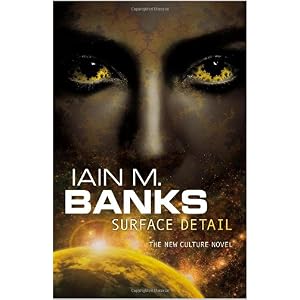
Iain M. Banks: Surface Detail (2010)

Another Banks novel sticks to a formula which he has now used many times. Perhaps this is not a shock, but for someone who was praised for his inventiveness at the beginning of his career, it is disappointing to read another failure to produce something new. That is not to say that Surface Detail is not well written and enjoyable to read; it is just too much like the other Culture novels, without a spark of special inspiration.

The background to the plot does in fact introduce a new (as far as I can remember) element to the Culture. There have been enhanced humans, and intelligent machines, but here in Surface Detail we also have virtualised humans. One of the galaxy's cultures runs virtual hells, into which its inhabitants are loaded on death. This is a practice widely condemned in the galactic community, and a virtual war has been going on for some time between pro- and anti-hell factions.

The descriptions of the hells owe a lot to Dante's Inferno and, more directly, the paintings of Hieronymus Bosch. The torments of the damned seem to me to be more effectively portrayed by Banks' models, as the details of the nastiness of the torture are blunted by their extremity: it is hard to be affected by an account of someone who has been flattened and used to pave a road, because the experience is just so alien and cartoonish. It is hard to accept it as real enough to empathise. Banks is no stranger to the portrayal of the unpleasant and violent, as can be seen from his very first novel, The Wasp Factory.

Against this background, the main action is about revenge. The book starts with a tycoon from a relatively backward world, Veppers, killing a slave who has bitten off his nose. She finds herself not dead, but with her conscious mind transmitted at the moment of death to a Culture ship, courtesy of an unexpected present from a Culture citizen for whom she had done a favour. Equipped with a new body, Lededje sets off on a mission to kill Veppers, which becomes enmeshed into the complex machinations which surround the war over the future of the hells - a war which the Culture is not officially involved, though sympathetic to the anti-hell side.

It is this plot which is infuriatingly similar to previous Culture novels. The idea of a personal quest is an extremely common way to drive a plot, because the concentration on the desires of a single individual makes the story more likely to grip the reader, who is after all an individual human being. But for the Culture, parts of the background make this more difficult to accept than usual: why would the immensely powerful machines, who can create superhuman avatars at will, manipulate human beings into taking the central roles in their schemes? Banks also has a tendency to dilute the effectiveness of the personal quest through the use of multiple viewpoints, which doesn't help. Usually, this hasn't affected my enjoyment of Banks' writing too much (though I've never enjoyed the Culture novels as much as his others), but here it does seem particularly problematic.

Given that I often take space in these reviews to criticise a book's production (appearance, proof reading, gushing blurbs, etc.), it is nice to be able to say that I really liked the design of this edition of Surface Detail, which uses fractal images (specifically the Mandelbrot set) effectively and evocatively in the cover image. And, most importantly, the picture used is relevant to both the title and the content of the novel.

All in all, Surface Detail is a well executed but ultimately disappointing Iain Banks novel - 6/10.


Edition: Orbit, 2010
Review number: 1418

Monday, 28 March 2011

Robin Jenkins: Dust on the Paw (1961)

A truly superb but apparently forgotten novel, Dust on the Paw is set in Afghanistan in the fifties, when the seeds of that troubled country's current problems were already apparent.

Set in the consular community in Kabul, with most of the characters being staff of the British Embassy, the story describes the complications which occur when a marriage between an English civil servant and an Afghani science teacher is taken up by an important member of the Afghani royal family to promote as part of the cultural progress made by the country. The problems arise from the extremes of the cultural differences between the two countries - Afghanistan was a conservative Moslem nation even then - and through the racist attitudes, conscious or not, of the British.

This may not sound like an ideal environment for humour. Jenkins uses sly, cynical comments on the pomposity of the British consular staff and the clash between two very different cultures - particularly in their treatment of women - to amuse. The humour does not use race as its basis. (It is perhaps important to say this because of the age of Dust on the Paw). Instead, the butt of the humour is the racism of the characters, like a subtler version of the ridicule of Rigsby in seventies sitcom Rising Damp. This mostly works extremely well, though for me it dips in the first of the three big set pieces of the novel (two parties, one informal and one formal, and a military parade), as the focus is on one Englishman's failure to come to terms with the racism which he has just become aware of within himself, and the unpleasant behaviour it provokes in him. In fact, he is so unprovokedly unpleasant that this is easily the least enjoyable part of the novel.

The background of Afghanistan in the fifties is very atmospheric, and (according to the preface to this edition) accurate. Clearly, it was a country which Jenkins loved, even if he did not like everything about it. He is particularly unhappy about the shaddry - his now old-fashioned Anglicisation of chadari, the enveloping garment now better known in the West as a birqa. Even fifty years ago, progressives wished to abolish the garment, and the women who wore them were known as "shuttlecocks" because of their appearance. The sexism of Afghan life is portrayed as the counterpart to the racism of the British.

The title is a quotation from a medieval Persian poet, who described the poor as the dust on the paw of the rich and powerful; Afghan politics is portrayed by Jenkins as rife with corruption, even without the meddling of the external powers which was going on since the clandestine machinations of the British and Russians imperial powers in the nineteenth century and which continues today with the war to defeat militant Islamic terrorism in the country.

The impression which Dust on the Paw makes is something between Lawrence Durrell's Antrobus stories and the Balkan Trilogy of Olivia Manning. The consular background has got something to do with this, but I think that Jenkins' novel will appeal to admirers of either, within certain limits - the themes are a lot more serious than in the Lawrence Durrell.

This is a forgotten masterpiece by a writer I didn't know before the title caught my eye. My rating: 10/10.


Edition: Polygon, 2006
Review number: 1417

Monday, 21 March 2011

Greg Egan: Zendegi (2010)

Science fiction is associated with prediction of the future in the minds of many. Few writers in the genre would feel that this is the main point of what they produce, but sometimes their work can be eerily prophetic. Zendegi is a near future SF novel (written in 2010, with the first part set in 2012), so it is perhaps less surprising that it is reasonably accurate; but actually its portrayal of a popular uprising in Iran has a huge number of similarities to the current spate of pro-democracy demonstrations in North Africa and the Middle East. (The afterword indicates that the events were inspired by the Iranian elections of 2009, which may well have also been part of the inspiration for the demonstrations in Egypt and elsewhere.)

There are two main viewpoint characters, the Western journalist Martin, sent to Iran to cover the 2012 elections, and computer scientist Nasim, who left Iran for the United States with her mother some years earlier, and who is working on a cognitive science project, aiming towards replicating human brain function in computers. Martin ends up staying in Iran afterwards, and this leads to a connection to the two characters when he marries Nasim's cousin. Her work becomes more important in the second part, which is really about the gradual development of artificial intelligence. This is set fifteen years later, and things have changed remarkably little in terms of technology - somewhat surprising, to my mind. Think how much things have changed since 1995, when the Internet was still something that people in general were just beginning to hear about (I worked for an ISP then, and marketing involved explaining what the Internet was to prospective customers).

The thriller like nature of the first part works better than the more speculative virtual reality oriented science fiction in the second. But by then the reader is interested in the characters, so becomes involved in Nasim's work and Martin's life in Iran. It is very odd: for a science fiction writer particularly famous for the hard science in his novels, Greg Egan has produced a story in which the best parts are near contemporary and character based.

This is not at all the sort of story I would associate with Greg Egan, who sticks in my mind mainly for novels like Schild's Ladder, which have far future settings and which deal with ideas based on the more bizarre current cosmological speculation. Mind you, the other Greg Egan novel I have reviewed here, Teranesia, is also set on Earth in the relatively near future, so it's not really a departure: he just doesn't fit into the pigeonhole into which I have mentally put him. Zendegi is more the sort of novel I would associate with Robert J. Sawyer - and would, in fact, make an excellent follow up for anyone who has enjoyed his WWW trilogy.

An interesting thriller, with science fiction elements not quite so good: my rating 7/10.


Edition: Gollancz, 2010
Review number: 1416

Thursday, 3 March 2011

China Miéville: Kraken (2010)


Fantasy is full of strange and alien gods, from H.P. Lovecraft's Chthulu onwards. Kraken is in this tradition, telling the story of Billy, a scientist in the Natural History Museum's Darwin Centre haplessly caught up in the occult when the complete giant squid specimen which he preserved disappears from its case without the glass being broken. A police investigation seems surprisingly perfunctory, concluding with an injunction not to tell anyone; but Billy is able to overcome the strange reluctance he has to talk and this just gets him deeper into a world of kraken worshippers, occult knacks and violent fundamentalist cults, a world hidden from the London most of the city's inhabitants know.

Kraken is not a new departure for Miéville. It reads like a cross between children's book UnLunDun and the New Crobuzon novels, the background being a nastier version of the first (the Knuckleheads are perhaps the most obvious detail) and the style and tone coming from the second. It is brutal, dark, and extremely well written. The characters are well drawn, particularly Billy, his friend Dale and policewoman Kathy.

The darkness is leavened to a certain extent by little flashes of wit, often almost Pratchettesque jokes. Typical is the idea of an artistic movement calling itself "the Exhausted"; artists who do similar work without being full members are described as "the Somewhat Tired". These moments were for me the best parts of Kraken; like Pratchett's humour, they do not seem contrived but just fit.

But... I didn't enjoy reading Kraken much. Of his other novels, I found The City and the City fascinating, and Un Lun Dun one of the best children's fantasy novels I have ever read. All the others, including Kraken, are writing I want to admire from a distance, but don't particularly enjoy close up acquaintance with. Overall rating: 7/10.

Edition: Pan, 2010
Review number: 1415

Friday, 11 February 2011

John Meaney: Absorption (2010)

When does hype become unbelievable? John Meaney, according to Stephen Baxter (as quoted on the cover of Absorption), "has rewired SF. Everything is different now".  Absorption also had nothing but five star reviews on Amazon at the time of writing. So this is a book which should be spectacularly good: this is the sort of praise associated with classics of the genre such as Neuromancer. In Absorption's case, the hype is somewhat at odds as the rather pulp style cover, which suggests that the contents will be more E.E. "Doc" Smith than William Gibson. It's a lazy piece of design which will hardly do the book any favours, no matter how good it is.

Absorption is a fragmented narrative, with chapters concentrating on characters from the eighth century AD to the twenty seventh. These are people living more or less normal lives, for their times, until they discover something which they have in common and they are mysteriously brought together. It's quite slow, and it takes about 150 pages for the reader to find out anything about what it is, which makes the story quite an unfocused read. I suspect that anyone who isn't a fan of the genre will give up fairly quickly and consider Absorption incomprehensible and boring (it is certainly rather slow moving in places, and the fragmentation doesn't help Meaney move things along). It does eventually make more sense, though it is clear that there will still be unanswered questions right to the end: this is, after all, volume one of a trilogy. However, I don't think that Meaney chooses the best way to reveal information; stories in which everything seems to be revealed only for deeper secrets to become apparent work better for me than ones in which we keep on being told that there are secrets, but details are revealed extremely slowly: much of Absorption seems to tantalise for the sake of it, and this is irritating as well as dull.

Another aspect which is surprising, given the description by Steven Baxter, is just how much is owed to older genre classics. There is some distinctly Heinleinesque banter in places, while the use of the name Jed for one of the characters makes it particularly easy to pick up Star Wars similarities, which (perhaps unfortunately) are mainly apparent in the dialogue. The main feature of Absorption which is derivative is the plot, which is basically a "superheroes-discover-their-powers" one, with the twist that the group of superheroes is separated by time and distance. The elements of the novel have appeared before in the genre, and have been better done; however, I can't think of any other book which combines these ideas in this way, so there is at least originality in that.

Most of what I have said suggests that I didn't like Absorption. I found it hard to get into, enjoyed the middle, and was frustrated by the ending. I object more to the way it has been over-hyped than to the book itself. I might go on to read Meaney's earlier books, but I don't think I'll bother with the rest of the trilogy. Interesting, more or less readable; but not especially significant and certainly not worthy of the praise it has garnered, is my verdict. My rating: 5/10.


Edition: Gollancz, 2010
Review number: 1414

Saturday, 5 February 2011

Iain Pears: Stone's Fall (2009)

Iain Pears has to be one of my favourite crime authors. The magnificent An Instance of the Fingerpost is an incredible historical thriller, with three different solutions to the mystery being presented by different narrators, while the Jonathan Argyll series is an entertaining and amusing romp through the Italian art world. The two are very different sides to Pears' talent, and his newest novel, Stone's Fall is cut from the same cloth as An Instance of the Fingerpost.

Indeed, it uses quite a lot of the same structure. Stone's Fall is divided into three main parts, with a short introduction; they are arranged in reverse historical order. All are concerned with Edwardian financier John Stone, whose death falling from a window prompts his widow to employ a young journalist (Matthew Braddock) to investigate the strange bequest in his will to a child that neither she nor the will's executor knew existed, under the guise of researching an autobiography of Stone. The investigation becomes entangled with the finances of the companies owned by Stone, which are mainly armaments firms, with international politics, and with Braddocks infatuation with Stone's widow. He does eventually find a solution which convinces him, but that is only the end of the first part.

In the second part, we go back thirty years, and the narrator is now Henry Cort, a spy from the first part, now at the beginning of his career in Paris in the years after the Franco-Prussian war. This again involves Stone's (future) wife, and a plot to destabilise the Bank of England by discrediting Barings Bank, one of the biggest Victorian investment banks. This sheds further light on the personalities involved in the first part, and suggests that the convenient solution for Stone's death may not actually be correct. The narrator of the final part is Stone himself, as a young man in Venice in the 1860s; characters include Cort's father. Here we find out the origins of Stone's fortune - Braddock had wondered how someone without the training of an engineer had been able to set up a company to produce a revolutionary torpedo from a design he provided. And, again, new light is shed on Stone's death; he wrote the memoir just before his fall.

I did feel that the re-use of the tripartite structure, with a similar purpose to that in An Instance of the Fingerpost, reduced its impact. On the other hand, Agatha Christie finishes many of her novels with scenes where Poirot confronts the murder suspects as a group, and these scenes are so similar they almost follow the same script as each other (Poirot describes the evidence against someone innocent, they protest, Poirot agrees and skewers the real killer). That is not the case here; Stone's Fall is a very different thriller from An Instance of the Fingerpost, not just because it has a later historical setting. It just seems a repeat because of the striking nature of the concept. While in Pears' earlier novel, it seems as though the use of the device is making the point that it is possible to come up with multiple solutions as convincing as those most crime novels have, here his little reminder to the genre is that the kind of clear cut solution common in murder fiction are not the way that things really are; the truth behind most killings is more complex than just who did what when, and it can be the case that the roots of the death of a man like Stone could run many years back into the past. It is perhaps fair to say that Stone's Fall is concerned with emotional depth, while An Instance of the Fingerpost is about glittering cleverness. But in the end, the earlier novel was always clearly destined to be a classic of the genre, while Stone's Fall is just very good indeed. My rating: 8/10.


Edition: Vintage, 2010
Review number: 1413