Showing posts with label Iain Banks. Show all posts

Wednesday, 14 January 2015

Iain M. Banks: The Hydrogen Sonata (2012)

Edition: Orbit, 2013
Review number: 1493

The Hydrogen Sonata is the final Culture novel. It is tempting to see some synergy in the themes explored in the story with this fact, for it is about beginnings and endings. However, this is not the case: the rise and fall of civilisations is a theme common across the Culture series, and in the brief author interview included at the end of The Hydrogen Sonata, Iain Banks states that he had another novel's worth of Culture ideas (and that this was usual at the end of writing one).

The Gzilt race is of interest to the Culture (more than usual - the Culture is perhaps characterisable by its rampant nosiness) because they were involved in the discussions which led to the Culture's foundation, but decided not to join. They are now planning to Sublime, to move out of what is considered the real universe into a fairly vaguely defined afterlife for scientifically advanced alien races - something of a cross between a humanist afterlife/Nirvana complete with a rapture event and an inaccessible retirement home (the details are unknown even to the most powerful Culture Minds). However, there are rumours of a secret from the very earliest days of the Gzilt race, one which might cause sufficient unease that its members might not be able to sublime, and this is something the Minds can look into.

 I felt that parts of the plot didn't quite hang together; much of it is concerned with the search for someone who was around in the early days of the Culture and is still alive, who can be asked about the secret (which was known to those involved in the discussions out of which the Culture was born. It really felt to me like there was a lot of fuss being made about quite a minor issue. The details of the story are interesting and entertaining enough that this doesn't seem to matter too much, but the central motivation of the plot is lacking. Like several other of Iain Banks' later novels, The Hydrogen Sonata lacks something of the ambition of his early work.

As I said, the interest is maintained in the small scale details in the plot, and this is one of Banks' most overtly humorous novels. I particularly liked the insect-like aliens, the Ronte, whose fleets of starships engage in ceremonial dances - an idea which somehow manages to combine the alien with the familiar in a way which is really one of the distinguishing features of good space fiction. It also makes The Hydrogen Sonata an entertaining read, among Banks' lightest novels. I enjoyed reading it a lot (more than some of the other Culture novels) - my personal rating is 8/10.

Wednesday, 15 October 2014

Iain Banks: The Quarry (2013)

Edition: Abacus, 2014
Review number: 1489

It felt like a significant, sad, occasion when I started to read The Quarry. This is the last time I will be able to read a book by one of my favourite authors for the first time, and it is a book which is infused with the news of his final illness and death in 2013, even though the similarities between the terminal cancer of the major character of Guy and the sudden final illness of his creator are apparently accidental, the book being written before Banks' own diagnosis. The awareness of this makes it tempting to either write about how it feels when a cultural figure of importance in your life dies, or to give the book a good review whether or not it deserves it, more a tribute to the person than an honest look at the quality of this particular work (as happened with Double Fantasy, the album which was released almost coinciding with John Lennon's murder, leading to the retraction of at least one prominent poor notice). I might give in to the first temptation a little (you may notice that in fact I already have), but I will definitely try to avoid the second: I hope that this will be an honest account of what I thought of The Quarry.

The first thing which strikes a reader of The Quarry is the narrative voice. The story is told by Kit, who is Guy's son. That there is something unusual about Kit is immediately obvious - he is autistic, basically, and thus his world view is pervaded by the way his mind works (for instance, the importance of the number of steps taken on the journeys he regularly makes on foot). It immediately reminded me, for obvious reasons, of Mark Haddon's The Curious Incident of the Dog in the Night-time, which is narrated in a similar fashion. Another, perhaps more apposite, comparison would be with William Faulkner's The Sound and the Fury, because the use of a narrator with an unusual way of looking at the world becomes of importance. How the reader feels about Kit's narration will effectively colour their response to the book as a whole.

The plot revolves about the resolution of three questions of importance to Kit and the group of Guy's friends who make up most of the rest of the characters. First, who was Kit's mother? Second, what will happen to him when Guy dies? And third, what has happened to the missing video - one of a series of parodies made by Guy's friends while reading film studies, this particular one has content which is potentially very embarrassing to some of the participants, and they are reluctant to explain why. The story is about these questions to the extent that the answers will pretty much determine the level of satisfaction that a reader feels at the end.

While making the reader wait to find out the answer to these questions (unless they skip to the end), Guy and his friends reminisce, take drugs, argue and rant about the state of the world. I found the rants in particular a little wearing on the patience - Guy's in particular being more similar to those of Ken Nott in Dead Air than perhaps is good for the individuality of the character. Some readers may find the pretty constant bad language hard to take, though Banks is probably not a writer you will read for very long if you are offended by swearing.

The static nature of the setting - almost all of The Quarry is set in a couple of rooms in a single house in a small town - and the nature of the plot - lots of lengthy discussions which go nowhere - makes for a less than engaging read in comparison to some of the more accessible Banks novels which precede it  (for instance, Espedair Street, The Crow Road or The Business). Neither does the use of Kit as a narrator match up to the more extreme experimentation of Banks' early career (Walking on Glass, The Bridge, etc). It's still enjoyable, just not great by Banks' standards. My rating: 7/10.

Friday, 11 July 2014

Iain Banks: Stonemouth (2012)

Edition: Little, Brown, 2013
Review number: 1486

Stewart Gilmour returns to his home town of Stonemouth after years away, following an event which earned him the enmity of the closest that a small town north of Aberdeen has to a gangster family. He has been granted permission to return for a funeral, but do all the family members know (or care) about this? What about the other relationships which were affected by what he did - how will other people react when he returns?

Like many Banks novels, Stonemouth is told with multiple timelines presented simultaneously, though it is one of the simplest versions of this, as Stewart's current visit has his past life in the town interleaved as a series of flashbacks. This is why I've been careful not to say precisely what the event was which led to him being exiled, even though most readers are likely to have guessed well before it is revealed. The biggest problem with this sort of thing is usually that the secret to be revealed near the end of the novel is well known to all the characters throughout, and in the hands of lesser writers leads to some awkward dialogue, as people steer clear from what they would naturally say so that the author doesn't reveal his secret to the readers.

The bridge over the Stoun is an important part of Stonemouth, and bridges have played major roles in Banks' novels before now - obviously in The Bridge, but also in Canal Dreams, where the Panama Canal is like an inverse bridge joining two oceans together across the intervening land. The function of a bridge (or canal) is to connect two things otherwise unconnected, but in the earlier novels the action takes place on the structure itself, which places the characters in a kind of limbo. Here, though, the purpose of the bridge is to act as a transition from one world to another, whether through death (much is made of the bridge as a jumping off place for suicides) or by overcoming the separation between the two sides of Stewart's life. In the outside world, he is successful, and works at a job which brings light to the world, in a literal sense. In Stonemouth, he is a former insider who is now separated from the townspeople by his actions many years ago. So the bridge links to his past, to another world he has been forced to abjure, away from the light. That the gangsters in the town appear to be powerless outside it (they tried to track him down in London) is part of this. Is the novel itself some kind of metaphor for growing up? For leaving the past behind? Or is it even a suggestion that Stewart didn't survive to live his own life, but, like the suicides, crossed the bridge to death?

As well as avoiding the obvious pitfalls, Banks does a good job of winding up the tension until the denouement. Stonemouth is a literary novel structured like a thriller - Banks has always written novels which at the very least flirt with genre fiction, and this is no exception.

The characters are well drawn, the plot is believable, and the background is convincing. So why did I end up feeling that this was not Banks at his absolute best? It's partly that this has been done before by Banks; the prodigal son returning to his roots is the basis of several of his novels, with differences mainly deriving from the nature of the welcome expected. Stonemouth has a particularly stony reception for the returnee, which is perhaps one reason for the name of the town and the title of the novel. The Scottish setting, too, is common to most of Banks' non-genre fiction - superbly well done, but not breaking any new ground. The other problem I had here is that, to me, the characters fail to take off, apart from Stewart, and he himself is pretty similar to other narrators - notably Prentice McHoan in The Crow Road. So it's a good book, but not top class - my rating, 8/10.

Saturday, 16 April 2011

Iain M. Banks: Surface Detail (2010)

Another Banks novel sticks to a formula which he has now used many times. Perhaps this is not a shock, but for someone who was praised for his inventiveness at the beginning of his career, it is disappointing to read another failure to produce something new. That is not to say that Surface Detail is not well written and enjoyable to read; it is just too much like the other Culture novels, without a spark of special inspiration.

The background to the plot does in fact introduce a new (as far as I can remember) element to the Culture. There have been enhanced humans, and intelligent machines, but here in Surface Detail we also have virtualised humans. One of the galaxy's cultures runs virtual hells, into which its inhabitants are loaded on death. This is a practice widely condemned in the galactic community, and a virtual war has been going on for some time between pro- and anti-hell factions.

The descriptions of the hells owe a lot to Dante's Inferno and, more directly, the paintings of Hieronymus Bosch. The torments of the damned seem to me to be more effectively portrayed by Banks' models, as the details of the nastiness of the torture are blunted by their extremity: it is hard to be affected by an account of someone who has been flattened and used to pave a road, because the experience is just so alien and cartoonish. It is hard to accept it as real enough to empathise. Banks is no stranger to the portrayal of the unpleasant and violent, as can be seen from his very first novel, The Wasp Factory.

Against this background, the main action is about revenge. The book starts with a tycoon from a relatively backward world, Veppers, killing a slave who has bitten off his nose. She finds herself not dead, but with her conscious mind transmitted at the moment of death to a Culture ship, courtesy of an unexpected present from a Culture citizen for whom she had done a favour. Equipped with a new body, Lededje sets off on a mission to kill Veppers, which becomes enmeshed into the complex machinations which surround the war over the future of the hells - a war which the Culture is not officially involved, though sympathetic to the anti-hell side.

It is this plot which is infuriatingly similar to previous Culture novels. The idea of a personal quest is an extremely common way to drive a plot, because the concentration on the desires of a single individual makes the story more likely to grip the reader, who is after all an individual human being. But for the Culture, parts of the background make this more difficult to accept than usual: why would the immensely powerful machines, who can create superhuman avatars at will, manipulate human beings into taking the central roles in their schemes? Banks also has a tendency to dilute the effectiveness of the personal quest through the use of multiple viewpoints, which doesn't help. Usually, this hasn't affected my enjoyment of Banks' writing too much (though I've never enjoyed the Culture novels as much as his others), but here it does seem particularly problematic.

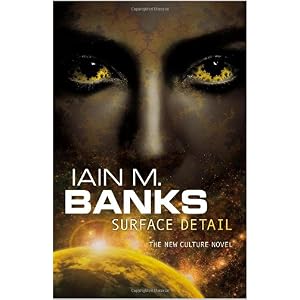
Given that I often take space in these reviews to criticise a book's production (appearance, proof reading, gushing blurbs, etc.), it is nice to be able to say that I really liked the design of this edition of Surface Detail, which uses fractal images (specifically the Mandelbrot set) effectively and evocatively in the cover image. And, most importantly, the picture used is relevant to both the title and the content of the novel.

All in all, Surface Detail is a well executed but ultimately disappointing Iain Banks novel - 6/10.


Edition: Orbit, 2010
Review number: 1418

Tuesday, 6 April 2010

Iain Banks: Transition (2009)

Edition: Little, Brown, 2009
Review number: 1399

The idea behind Transition is not one particularly new in science fiction: there are millions of alternate Earths, and it is possible to travel between them through the use of a special drug; septus works rather like the sixties perception of the action of psychedelics, letting the mind transfer to a new body in a different world. However, a secret society, the Concern, acts in all the accessible worlds to ensure that history develops in a particular direction. To those it recruits, Concern claims to act to improve the lot of humanity, by eliminating (assassinating) those who will cause large scale suffering if their actions remain unchecked. Not everyone believes in the benevolence of the Concern, and the novel tells the story of one group which sets out to subvert the organisation and its shadowy leadership.

One of the things I like about Iain Banks is that its not that easy to suggest names of other authors who might be considered major influences. His novels tend to remind me of others of his novels. (At least, that applies to the non-Culture novels; the hyped-up space opera of the books for which he uses his middle initial has rather more obvious debts to earlier science fiction.) But here, in his twenty-fourth novel, I was almost immediately and strongly reminded of Michael Moorcock, particularly the Jerry Cornelius and Oswald Bastable novels.

The parallel worlds are what makes me think of Oswald Bastable: a fairly mundane link. (Jerry Cornelius is more similar in style and feeling.) However, Moorcock's worlds are much less similar to each other than Banks', and the people in them less important in comparison to those who are able to travel between the worlds. In the Bastable novels, following the careers of alternate versions of real people from Mick Jagger to Stalin is a large part of the interest, but few such people are mentioned by Banks. The alternate realities are barely more than just a mechanism to end a scene, like a punch line in a sketch show. The main difference between most of the alternates and reality is that the perceived terrorist threat to the Western world comes mainly from radical Christian extremists in the worlds Banks constructs.

The Concern is akin to the Business, from Banks' novel of that name, but seen in a darker light. (Though Kate, the heroine of The Business, eventually rejects them, too.) But, all in all, Transition is not much like the rest of Banks' writing. When reviewing The Steep Approach to Garbadale, I complained that it was too much a rehash of ideas from his other novels, but Transition goes too far the other way, throwing the baby out with the bathwater.

Transition is told using multiple viewpoints (some in the first person, some in the third). Each chapter advances the personal stories of several, but not always the same ones. Only one is constant, Patient 8262, who is apparently hiding from the Concern in a mental hospital. Other viewpoints include a hedge fund manager, a torturer, an assassin, and a member of the Concern's ruling council. It is these central characters which are Transition's major weakness, as none of them are consistently interesting or enjoyable to read about.

Warning is given at the very beginning of the novel that the words on the page should not necessarily be believed. The title page tells us that Transition is "based on a false story", and the first words of the prologue are "Apparently I am what is known as an Unreliable Narrator". These gimmicks perhaps belabour the point rather too heavily, but it certainly sticks in the back of the mind while reading the novel. I personally would have preferred to have been left to work out the narrator's unreliability for myself, and start with the line from the third section of the prologue: "This is how it ends": a much more effective irony.

All the constructive effort of the multiple narrative threads (something of a favourite device for Banks) needs to be rounded off with a satisfying, rounded ending in which they are brought together. This is more or less done, though the details are undermined by the emphasis on the unreliable narrator. (I myself have probably rather over-emphasised it here, but that is because it does seem to be a cause of many of the negative aspects of Transition.)

I never expected to say of an Iain Banks novel that it was boring, but it was something of a struggle to get to the end of Transition. Maybe it will seem better on a second reading, but that is not an experiment I am looking forward to conducting. 4/10.

Sunday, 17 January 2010

Iain M. Banks: Matter (2008)


Edition: Orbit, 2009
Review number: 1394

Like several of its predecessors, Iain Banks' latest Culture novel begins on a comparatively primitive world which is not part of that galactic civilisation. There, traitorous plotters have murdered the warlord of the burgeoning empire of the Sarl, proclaimed the death of his eldest surviving son, and set their leader as regent for the younger son. The elder brother, Ferbin, is the central character of the novel, which is about his journey to seek refuge with the Culture, before attempting to gain his revenge. He chooses the Culture because his sister earlier joined them, in a move viewed by their father as the equivalent of a dynastic marriage, whereas in fact she has become an agent of Special Circumstances. an organisation which features in most of the other Culture novels. As described here, they are "practitioners of that ultimately dark art of always well meaning, sometimes risky and just occasionally catastrophic interference in the affairs of other civilisations": the ideal people for Ferbin to interest in the fate of the Sarl.

What is it about this scenario, that of an advanced race observing (and interfering in) the political manoeuvrings of a comparatively barbarous one, holds such an appeal for Banks? It is of course an enduring science fiction plot device, clichéd enough to appear in several episodes of the original Star Trek, hardly ground breaking even in its own day. One benefit used by Banks here and elsewhere in the Culture novels is that it enales the writer to combine ideas from the science fiction and fantasy genres (as Anne McCaffrey does in the Pern novels too, in a less literary manner). A more important general reason for its use in science fiction is that it enables ironic parallels to be drawn between the story and the way that superpowers have interfered in the affairs of other nations, from the development of European colonial empires to the present day war against terror.

The hidden interference with the Sarl and other races gives the plot of Matter several levels. The plotting of the Sarl nobility is influenced and motivated by plotting by the races which are meant to mentor the various nations on their world, while the more still more technological advanced civilisations like the culture look on from afar, with their interference limited by treaty and custom. The interwoven conspiracies make for entertaining reading, while their parallels with the activities of the real nations on Earth give a slightly uncomfortable edge to this entertainment.

 In this edition, the Appendix - a list of names and glossary - is between the last chapter and the Epilogue. So a reader who stops at the apparent last page of the narrative will most some of the tying up of loose ends. There is also another extra, a reprinted magazine interview with the author, which is worth reading for fans.

Matter is not as brutal as many of Banks' novels. It has fairly clear cut "good" and "bad" guys: the sympathies of the reader are clearly engaged by Ferbin and the Culture. This makes it one of the most conventional novels Banks has written, whether science fiction or not. Even so, there is room for plenty of invention. So not Banks' deepest novel, but I felt it was one of the most enjoyable entries in the Culture series: 8/10.

Monday, 10 March 2008

Iain Banks: The Steep Approach to Garbadale (2007)

Published: Little, Brown (2007)

My impression on reading The Steep Approach to Garbadale was that it was more a mixture of elements and ideas from Iain Banks' previous non-Culture novels (that is, those published without a middle initial) than a new story in its own right. The Wopuld family are rich on the back of a Victorian boardgame, now a successful computer game, but they are as dysfunctional as the Simpsons. When the novel opens, the protagonist, Alban, whose mother was a Wopuld, is estranged from the family and living on a Scottish council estate, not too close to the family's Highland estate at Garbadale. His problems with the family (and vice versa) started when his uncle and grandmother (the matriarch of the clan) found him having sex with his cousin Sophie, both being underage. The book, half flashback, tells how this happened and how the rest of Alban's life was affected (obviously Sophie's was too, but she is not the centre of the novel), up to the climactic event of the novel, an extraordinary general meeting of the Wopulds (as company shareholders) to decide whether to sell the company to an American corporation that wants to take over the game.

Comparing The Steep Approach to Garbadale to earlier novels, there is the anti-American-Imperialism, anti-Iraq War sentiment of Dead Air, with Spraight Corp perhaps partly a symbol of American domination: the real winner of the game of Empire!. There is a Scottish family with dark secrets, like the one in The Crow Road (and Alban is a very similar character to Prentice McHoan). The tone of the novel, the affluence of the characters and the corporate politics are like The Business. There are even links to Banks' first novel, The Wasp Factory.

There is a balance to be struck by any writer who has a career more than a few novels long, between offering something new each time and retaining the familiar elements which are part of his or her style. Usually, there is a fair amount of variation between Iain Banks' novels (ignoring for the moment the series of science fiction stories with a shared background published with-an-M: challenges for a writer who sticks with a single series are rather different); more at the beginning of his career perhaps, but still some change in recent years. This time, there is nothing really recognisably new, and the re-used old ideas seemed to me to be somewhat too intrusive, almost as though a lack of originality were being flaunted at the reader. One particular problem was that Alban failed to grab my attention as a protagonist: the biggest difference from Prentice McHoan is that he's not as interesting.

So The Steep Approach to Garbadale is likely to disappoint long term fans of Banks' work, but there is much to enjoy in the novel particularly if read in an uncritical spirit.

Tuesday, 4 October 2005

Iain M. Banks: The Algebraist (2004)

Edition: Orbit, 2004
Review number: 1304

Iain Banks latest is an addition to the growing list of his non-Culture science fiction, though it has the same flavour as those set in that universe. It is set far in the future, in a galaxy filled with many kinds of lifeforms. These are generally classified as either Quick (those who evolved mainly on rocky planets, including two kinds of humans) or Slow (those who live with much slower metabolisms who often developed in gas giants, which include the other major species we meet in The Algebraist, the Dwellers). The Dwellers are somewhat mysterious and incredibly long-lived beings (some individuals are older than entire races) who have a history dating back to very early in galactic history. They hardly communicate with members of other species, and those who are permitted to communicate with them, known as Seers, are often completely confused by what they are told, especially since the Dwellers are prone to jokes which mean that much of what they say can't be trusted. One persistent story which is widely disbelieved by the galaxy as a whole is that there is a key to a document known as the "Dweller List", which seems to describe a large number of portals (the instantaneous travel mechanism which makes Banks' galactic civilization possible), but which cannot be decoded.

The Dwellers seem to me to be the major conceptual link between The Algebraicist and the Culture novels. They take the insouciant, anarchic way of life of the Culture to an extreme. They are the highlights of the novel, the source of many humorous touches: they are the only aliens I have come across in the whole of the science fiction genre who are given convincing dialogue that is reminiscent of the tramps in Waiting for Godot.

The central character of the novel, Fassin Taak, is one of the most successful Seers, and it is he who brings back from one of his trips to the gas giant Nasqueron a work of literature which is later discovered to have a clue to the Dweller List hidden in an appendix. This is so important that it provokes an invasion of the planetary system by some really nasty villains, which in turn forces Taak to return to Nasqueron to try and persuade the Dwellers to give up the rest of the secret before the destruction of his home world.

The Algebraist is a fun novel, very enjoyable to read, though not really covering new ground for Banks despite the different setting. Indeed, it is now quite some time since Banks has produced anything as innovative as his early novels, and he is now apparently content to write polished variations on the themes that make up his mature style (perhaps this is something that can be said of most authors who have a career of any length). Maybe moving away from the Culture is an attempt to bring back some of the early originality, in which case it has not really succeeded. There are now of course many writers who have been influenced by Banks, particularly by his science fiction; The Algebraist reads in places almost like a novel by yet another admirer than by the man himself. Here we really have the novelist as craftsman rather than artist; very welcome, very satisfying, and only disappointing because the reader knows that Banks is capable of much more.

One very small point: when I studied mathematics, those who concentrated on algebra were known as "algebraicists" rather than "algebraists".

Tuesday, 18 May 2004

Iain Banks: Raw Spirit: In Search of the Perfect Dram (2003)

Edition: Century, 2003
Review number: 1237

Iain Banks' first book length non-fiction writing is on a subject which has little interest to me, and is certainly a book I would not have picked up had it not been for the author's name. The subject is whisky, and I have been a teetotaller for over fifteen years. So a book about scotch is not really one calculated to appeal to me, and indeed I did find the parts of Raw Spirit which are in fact about the drink rather dull (there is clearly a limit to the number of ways that even such an inventive writer as Iain Banks can find to describe the tastes of the different malts - "peaty" is a word rather lacking in synonyms). The book really only takes whisky as one theme among several, as it describes a series of journeys motivated by the idea of visiting every Scottish distillery; it is basically a travel book. So quite a large proportion of Raw Spirit - more than half - is about other things: Scottish scenery, Scottish roads, Iain Banks and his friends, his cars, and how he feels about the Iraq war. This is all much more interesting, if repetitive in places.

So what's in Raw Spirit for the reader? That depends very much on what the reader wants to get from it even more than is the case for most books. A whisky connoisseur would probably have more detailed and systematic information about single malts available from reference books they already own, even though here they have the information recorded in a more individual manner. As a travel book, it could do with illustration - Banks often mentions photos being taken, but only two are used, and a map showing the distilleries and itinerary would make the logic of the journeys easier to see. The trips themselves lack the epic of unusual quality one expects from a travel book. The main interest in the travel sections comes from the various friends and relatives who accompany Banks on his trips, modern car journeys not that interesting to read about. (Scotland is not to me a particularly unfamiliar country; to others, this may be more interesting.) This leads to what is probably what most readers will get from Raw Spirit - autobiographical anecdotes from a favourite writer. In the end, this is a book for fans of Banks' fiction, for those who want to know more about the man behind the novels. Like many writers, the creator is less interesting than his creations. (This is exemplified when Banks compares his own happy childhood with the abuse and neglect many readers expect to have been necessary to produce The Wasp Factory, as though, as Banks points out, people can only write from their personal experience.) This really is a book strictly for the fans.

Friday, 23 April 2004

Iain Banks: Whit (1995)

Edition: Abacus, 1996
Review number: 1233

One of the methods satirists use to poke fun at the way we live is to write a novel from the point of view of an outsider of some kind. This is particularly suited to use in the science fiction genre, where an outsider can be literally alien and so question even what may seem to be even the most fundamental of human values. In Whit, Banks doesn't go so far as this, but uses as his outsider a member of a cult who grew up in a commune in Scotland where modern technology - phone, TV, computer - is banned, making her seem completely out of touch with modern British society and giving her an outlook sceptical of the assumptions we tend to live by unquestioningly.

The central character of Whit is Isis, granddaughter of the founder of the Luskentyrans and considered God's Elect by the Cult by virtue of her 29 February birth date. The commune receive a letter from Isis' cousin Morag, who (they think) has gone out into the world to realise here musical potential and become an "internationally renowned baryton soloist" (a baryton is a Baroque instrument rather like a cello). The letter says that instead of being the focus of the Luskentyran May festival she won't be attending at all, having found true faith elsewhere. The decision is made to send Isis out into the world so that she can find Morag and persuade her to return. All is not quite as it seems; Morag, for example, is not a famous musician but is renowned in quite a different field - she is a hardcore porn star.

Isis and the Luskentyrans are portrayed extremely sympathetically; this is not the sort of stereotypical cult which brainwashes followers into following every whim of the leader which tends to be brought to mind by the word "cult". (And note that this was probably particularly true at the time Banks was writing - just after the Waco siege in 1993.) Their self-sufficient way of life doesn't require much money, the land itself being a legacy from an early follower. Banks has thought through their theology quite carefully, and it actually seems to me to hold together more convincingly than some of the absurdities believed by real life cults. Those who live in the commune are at least generally happy, and this is the main point of the satire, that all the technology that we are unable to live without and the leisure time it has brought us has not made us any happier.

Whit is one of Banks' most enjoyable novels; funny, accessible and yet having something to say. It, The Crow Road, and The Business are a trio of his novels with many similarities, including being an ideal way to introduce this important modern writer to those who are yet to catch on to his genius.

Wednesday, 10 March 2004

Iain M. Banks: Excession (1997)

Edition: Orbit, 1997 (Buy from Amazon)
Review number: 1227

After a couple of novels which, though they seem similar, were not set in Banks' favourite science fiction background, Excession returns to the Culture. Like all the Culture novels, Excession is about how the Culture interacts with outsiders - only this time things are different. In the earlier novels, these contacts are with groups which are technologically inferior, and can be read partly as commentaries on the relationship between the former colonial powers and the cultures with which they came into contact. Here, though, the contact is with something called an Outside Context Event, a potentially disastrous meeting with an alien entity far ahead of the Culture's technology. This takes the form of an excession, the entry of an object into normal space from an unknown origin (excession literally means "going beyond").

The Culture are not the only galactic civilization interested in this alien object. Such analysis as is possible points to incredible potential developments in physics, applicable in technologies such as instantaneous travel, or almost incomprehensible weaponry including the means to subvert the Minds (artificial intelligences) of the Culture, not just an advanced civilization but one very different (one assumes) from that of the object's origin. Apart from Culture splinter group the Elench, the main competitors are the Affronters, whose general behaviour is reminiscent of the most drunken rugby club dinner. There are also complicated political games between the Culture Minds that are involved. The story is, however, told mainly through the experiences of the humans manipulated by the massively more intelligent Minds, punctuated by messages passed between the Minds themselves. (This is typical of the Culture novels, and basically makes it easier for a human reader to identify with characters while feeling that there is more going on behind the scenes than the text reveals.)

Banks' writing in Excession is up to his highest standard, and it has an extremely clever ending. It is the best of the Culture stories and is probably one of the main touchstones for the new school of space opera which is currently popular.

Tuesday, 3 February 2004

Iain Banks: Complicity (1993)

Edition: Abacus, 1994
Review number: 1219

Cameron is a disillusioned left-wing Scottish journalist, whose hobbies are computer games and drug abuse. He is contacted by a mysterious source, who promises him revelations about a series of mysterious deaths of men vaguely linked to the security services in the eighties. He is following up leads from the conversations he has with this man when he suddenly discovers that the police suspect he is the killer in a current series of murders, of the type of repellent capitalist that he has spent much of his career denouncing. Whoever the killer is, they obviously know Cameron's routine intimately - he has always been in the area when an attack occurred. The only way he can prove his innocence is to discover the identity of the murderer himself.

It is interesting, re-reading Complicity, to see how much the character of Cameron pre-figures that of Ken Nott in Dead Air; they could almost be to novels about the same person, a decade apart. The similarities start with their profession, but they also share background, attitudes and habits.

As a thriller, Complicity is exciting, though since much of what makes it work is the revelation of the identity of the killer, it is a novel which works much better on a first reading than a second one. (Thinking back, I remember not expecting to like it much, being put off by the blurb on the back, but then found it much more involving.) The technique used in the two narratives - first person from Cameron's point of view, the unusual second person in the sections from the murderer's point of view - is interesting and the second person works well in causing more distaste for the violence than is usual in the thriller genre. (It also makes you wonder how true Cameron's protestations of innocence actually are, and whether he's also the narrator of these sections, using the second person to distance himself from it.

Complicity is one of Banks' most mainstream novels, but is none the worse for that. It would be one of those which provide a good introduction to his work, particularly in this case to people who are wary of his cult status.

Tuesday, 27 January 2004

Iain M. Banks: Feersum Endjinn (1994)

Edition: Orbit, 1995
Review number: 1215

After several more straightforward works this novel is something of a return to the experimental style of Banks' earlier writing. Its structure of multiple interconnected narratives is reminiscent of The Bridge (although simpler), particularly as one of the threads is written phonetically.

The setting, like that of his previous science fiction novel (characterising those published under the middle initial as such) Against a Dark Background, is not the Culture that he is perhaps most famous for, but is uniquely an Earth derived future. Virtual reality of a sort - the rather hallucinogenic crypt - delivered via implants, mingles almost seamlessly with the real world. Death is not always permanent, as eight real lives are followed by eight virtual ones, and personalities can be recorded to live an independent life in the crypt. But the lifestyle is threatened, by what amounts to an interstellar computer virus, and the four protagonists of the narratives are people important in the crypt's fight to get human politicians to accept the need to do something about this.

So many ideas in Feersum Endjinn are familiar Iain Banks components that you might expect it to work quite well, particularly as it also contains new elements. But it never quite takes off. The phonetic narrative is partly to blame for this, being much harder to read than its equivalent in The Bridge even though it's not in Scots dialect. The other three narrators don't come across as distinct personalities, even the Asura, who is supposed to be a kind of blank slate, a being with no initial personality used by the crypt as a messenger in the real world.

Feersum Endjinn is part of the dip in form which marked Banks' writing in the first half of the nineties, from which he emerged with a more populist style.

Tuesday, 6 January 2004

Iain Banks: The Crow Road (1992)

Edition: Abacus, 1993
Review number: 1208

The Crow Road must be Iain Banks' best known novel, if only because it is the only one to have been turned into a TV series (so far). (The novel is one of my favourites, but I found the adaptation unwatchable.) It is set in Scotland, in a small town north of Glasgow, somewhere I suspect is not too far from the location of The Wasp Factory. The narrator of most of the novel is a teenager from a rather unusual family (not just in their personalities, though having an uncle with his own personal religion is a bit on the strange side; the McHoans tend to die in odd ways). The Crow Road is basically Iain Banks' take on the coming of age novel; not the first time he has written one (The Wasp Factory is an extremely grotesque story of this type), but the novel of his which best fits into this category.

As such, The Crow Road (a Scots expression for death) centres around the character of Prentice McHoan. He is obviously quite bright, but his major character traits are that he is unobservant and stubborn, which makes him disastrous at relationships. The best example of this (apart from the ending) is how he reacts when he discovers that his brother is the new boyfriend of the girl he has worshipped silently from afar for years.

A large part of Prentice's growing up is his coming to an understanding of his parents generation; he becomes obsessed with some papers left behind by his uncle Rory, who vanished mysteriously several years earlier. This becomes particularly important to Prentice after his father's death (a militant atheist, he is struck by lightning climbing a church tower lightning rod, defying God to prove his existence).

Why is The Crow Road one of my favourite novels? For one thing, it is Banks' funniest. Most of his novels have a humorous side, mainly of a rather dark and macabre nature. Here there is more mainstream humour, though the grotesquerie is still present if in more muted form (the death of Prentice's father being one example, and the explosion of his grandmother at the start of the novel another).

At the same time, there is a mystery (what did happen to uncle Rory?), a believable coming of age story, a first person narrative which exposes the character of the narrator, and a celebration of Scotland. The Crow Road is a truly wonderful and life enriching novel.

Saturday, 29 November 2003

Iain M. Banks; Against a Dark Background (1993)

Edition: Orbit, 1994
Review number: 1199

The novels which Iain Banks publishes with his central initial usually share the space opera background of the Culture, even if only tangentially (as in Inversions). In Against a Dark Background, however, the setting is carefully differentiated from the Culture, even if it is apparently quite similar on the surface. (Banks distances the setting from the galaxy-wide Culture by describing Golter, the planet on which Against a Dark Background is set, as orbiting a star a million light years from any other, something which makes the standard space opera device of inhabiting the planet with a disctinctly human race of beings ludicrous, presumably deliberately so.)

Like several of the Culture novels, the plot of Against a Dark Background concerns an attempt to acquire a missing technological relic, a lost ancient weapon. In this case, it is a quest to find the last remaining Lazy Gun, one of eight whimsical weapons produced for a long ended war. Sharrow and her companions are also the surviving parts of an eight-fold weapon - a unit of commandos with an enhanced ability to predict each others' actions, a useful skill in combat.

The planet of Golder is an interesting, anarchic background, full of the trademark whimsical touches that Banks delights in - the Solipsist mercenaries, the Useless Kings, and so on. It is a background typical of some of the more recent writers influenced by Banks - MacLeod or Reynolds, for example - and is really more designed to fascinate than to be believeable. The story contains many flashbacks, and sometimes (undoubtedly deliberately) it is hard to tell for a few pages whether the story is in the narrative present or past.

This is not one of Banks' best novels (I seem to have felt that quite regularly about the ones I have reread recently). The plot and much of the background are by now over familiar (the Culture novels are more successful if a lengthy gap is left between reading any two of them); the flashbacks may illuminate Sharrow's character and explain how she came to be in her current situation, but they don't have the kind of explosive purpose that they are used for in Use of Weapons. For someone who did a lot of narrative experimentation early in his career, Banks has seemingly employed less care than usual in putting this novel. Nevertheless, even "Iain Banks by numbers" is enjoyable enough.

Tuesday, 11 November 2003

Iain Banks: Canal Dreams (1989)

Edition: Abacus, 1990
Review number: 1195

When I first read Canal Dreams, I found it disappointing; now, a couple of re-readings later, it has grown on me. It marks some changes in Banks' writing, not least in the setting - in place of the imanginary universe of the Culture, or the Scottish backgrounds of his earlier novels, Canal Dreams is set on a ship stranded in the Panama Canal by a revolution - and the protagonist - his first undoubtedly female central character is about as far removed from the author's experience as it is possible to be, being a Japanese cello player. Both these changes are part of a move away from experimentation towards more mainstream novels with cosmopolitan settings, which continues in several later novels, including The Business.

The plot is fairly simple; in the first half, when the ship is stranded but unharmed, it is about what could be done to pass the time in such a place as Cancun Lake - scuba diving, cello playing, and an affair with one of the ship's officers. The tone changes in the much darker second half, when the ship is taken over by the rebels and Canal Dreams becomes a thriller. The quietness of the early pages brings more emotional commitment from the reader to the later drama, making the violence more disturbing than it would be in a straightforward member of the thriller genre.

The make or break issue for this particular novel is how convincing Banks is able to make a central character as unlike himself as Hisako. He is not entirely successful, but at least manages to give the impression that his ideas about Japanese culture are not entirely culled from The Mikado. The big problem Banks faced is the contrast between her passivity in the first part and activity in the second, and he worked hard to motivate this at the expense, I felt, of other aspects of Hisako's character. Of course, with the title of the novel, it is entirely possible that the second half is a dream, a piece of wish fulfilment; Banks leaves this open.

Despite the eventual high levels of violence, Canal Dreams retains throughout the dreamy atmosphere generated by the first part - something which is clearly part of the reason for use of the word "Dreams" in the title. The novel doesn't make its points of interest as obvious as the expermental narrative forms Banks played with before it, and Hisako is not completely convincing as a character, but there is much to enjoy.

Friday, 31 October 2003

Iain Banks: Dead Air (2002)

Edition: Little, Brown, 2002
Review number: 1192

Published just about a year after 9/11, Dead Air must have been one of the first serious attempts at a novel in which the tragic events of that day played a part. That being said, it doesn't play that important a role in the plot, being more significant in the emotional background to the novel. It is hard to think of a novel that has survived any length of time which is quite so firmly rooted in identifiable and important near contemporary events; the best known examples I can think of are the panic about anarchists which prompted Conrad's The Secret Agent and Chesterton's The Man Who Was Thursday about a century ago. There are many more novels which were prompted by events which seemed more ephemeral even at the time and which are now only remembered because of the literature they inspired - the story of Alexander Selkirk which was the basis of Robinson Crusoe, for example. Usually, novelists seem to choose events which are far enough in the past that their importance is clear, if they want to anchor a novel to a specific historical time, or events which are so important and wide-ranging in their effects that time has to be taken to digest even part of their meaning - people don't tend to write the best war stories during the conflict.

The tone of Dead Air is set by the first chapter, in which a wedding celebration turns into a game of dropping superfluous foodstuffs and possessions from a loft apartment into the car park far below, wanton destruction which is interrupted as everyone's mobiles go off to tell them to turn on the TV and see the attack on the World Trade Center. The novel is full of small unexpected ironies, twists and unusual ways of looking at the world (picking up on the phenomenon of everyone's phone going off more or less simultaneously is an example). In Canal Dreams, Banks has written about people more directly involved as victims of terrorist attacks; 9/11 seems to have been an event which was more than usually able to touch those who were not themselves physically harmed.

The story is about "shock jock" Ken Nott, who makes a pretty good living being outrageous on a London radio station. There are several events which form foci to the novel as well as 9/11 - the difficulties which arise from a love affair with the wife of a gangster, a series of death threats, a TV interview in which Nott confronts a Holocaust denier. The plot does rather come across as the setting for Banks to get the series of rants which he makes the main feature of Nott's radio show out of his system.

Dead Air came across to me as the least interesting of Banks' novels to date; there is nothing in it which reaches out and grabs the reader (or if there is, it missed me completely). That is not to say that it isn't well written and enjoyable, more that it is less individual and unusual than his earlier novels.

Friday, 3 October 2003

Iain M. Banks: The State of the Art (1991)

Edition: Orbit, 1991
Review number: 1186

The State of the Art is unique in Banks' output in being a collection of short stories. It contains seven short stories, previously published in magazines and anthologies, alongside the novella The State of the Art which had appeared in the States but not in the UK. The book really falls into two parts: the Culture stories (the long novella and two others) and the rest. To deal with the latter first, these stories are basically parodies of some of the basic clichés of the science fiction genre (first contact stories, for example) or fairly heavy handed social commentary. The parodies are heavily indebted to American giants of the short story form, such as Fredric Brown, while the other stories lean heavily on the shoulders of the British New Wave, particularly Michael Moorcock. In neither case does Banks really match the quality of those whose work he draws on. The best of each group are Odd Attachments, about an alien shepherd whose disappointing love life proves disastrous for a human astronaut, and Piece, about the fight between rational and irrational thought in eighties culture.

One of the Culture stories, Descendant, is really in the same vein as the non-Culture tales; it is only incidentally set in the same milieu as Banks' science fiction novels. A Gift from the Culture and The State of the Art pick up on one of the novels' major themes, the way that the Culture reacts to other civilizations. The State of the Art describes a Contact survey of the Earth in 1977 (Contact being the part of the Culture which deals with external relations), with the aim of deciding whether the galactic civilisation should reveal itself to us or not. This isn't a particularly new science fiction idea, but the decision of one of the surveyors to remain on Earth whatever is decided makes it an interesting exploration of the theme.

I found A Gift From the Culture to be the most effective of these stories. A former Culture citizen is blackmailed into performing an act of terrorism. It has a deeper exposition of character than is usually managed in a short story; Wrobik's life seems a mess but he (and Banks manages something unusual with the gender; born female but changing sex as is quite normal in the Culture, Wrobik is made quite a feminine man) doesn't really want to change it. This reluctance is epitomised by his relationship with a faithless dancer. He is a misfit now, and presumably was always one even in the anarchistic Culture, and this is what it makes it possible to manipulate him into the act of violence he is desperately keen to avoid.

The general impression given by The State of the Art is that Banks is a novelist dabbling in short story writing, an impression which is strengthened by the small number of short stories he has produced in his career. The collection is worth reading, but in the end is likely to appeal more or less exclusively to fans of the author's novels.

Saturday, 20 September 2003

Iain Banks: Espedair Street (1987)

Edition: Orbit, 1988
Review number: 1184

Ever since I first read it, not long after it first came out, Espedair Street has been one of my favourite Iain Banks novels. It is his first more or less mainstream novel, neither experimental nor genre fiction, and every time I read it it still manages to amuse and move me.

Espedair Street is a novel which is pretending to be a rock star autobiography; the story of (fictional) seventies band Frozen Gold as told by bass player and song writer Danny Weir (known as Weird). It is told using one of Banks' favourite devices, the series of flashbacks which converge to and explain the present (Danny living as a recluse, pretending to be his own caretaker in a bizarre Victorian folly in Glasgow). Espedair Street is about the emptiness that can come to fill the life of someone who has realised all his dreams on a massive scale. It's about lots of other things too - the hedonistic life of a seventies rock star (modelled on the excesses of bands like Fleetwood Mac); the things that we do that we regret and feel guilty about later, and the effects that these have on us; Glasgow and the people who live there.

Much of the pleasure (and certainly the humour) provided by Espedair Street (named after a place in Glasgow where several important events in Danny's life occur) is derived from the accuracy with which much of it mimics "warts-and-all" rock journalism, and it has in fact been turned into a radio serial which takes precisely this form, complete with music written by Banks himself. This makes it immediately believable as a novel, the ludicrous actions of band members being no madder than many documented of real musicians.

Espedair Street's main weakness is the sentimentality of its ending; this quality begins to creep into Banks' writing from this point onwards, making it more accessible but bringing occasional disappointment.

Wednesday, 13 August 2003

Iain M. Banks: Use of Weapons (1990)

Use of Weapons coverEdition: Orbit, 1992
Review number: 1179

This Culture novel, the third, combines two of the themes common in the writing of Banks' other persona (the one without the central 'M'). It has the multiple interlinked narratives (just two of them; one is a series of flashbacks, nearly in reverse chronological order), and it has some sickening, unpleasant violence.

Like many of the other Culture novels, Use of Weapons is built around a thriller style operation by Special Circumstances, which is really the covert operations section of what amounts to their secret service (in the midst of the anarchy that is the apparent form taken by their government). The mission itself isn't really what the novel is about, though (Banks' treatment of it becomes extremely perfunctory towards the end); Use of Weapons is more interested in the background of the agent Cheradiene Zakalwe than anything else.

Apart from the presence of standard Iain Banks tricks, Use of Weapons is of interest for the way in which the author subverts some of the standard cliches of the thriller genre (the Culture series as a whole tends to do this with science fiction). Thus, it features the flawed maverick central character haunted by his passed, the disillusioned missing operative selected as the only one who can carry out the mission, and so on. It breaks little new ground; and, like its near contemporary, Canal Dreams, can be seen as Banks marking time as he prepares to move to a new phase in his writing.