Showing posts with label Culture series. Show all posts

Wednesday, 14 January 2015

Iain M. Banks: The Hydrogen Sonata (2012)

Edition: Orbit, 2013
Review number: 1493

The Hydrogen Sonata is the final Culture novel. It is tempting to see some synergy in the themes explored in the story with this fact, for it is about beginnings and endings. However, this is not the case: the rise and fall of civilisations is a theme common across the Culture series, and in the brief author interview included at the end of The Hydrogen Sonata, Iain Banks states that he had another novel's worth of Culture ideas (and that this was usual at the end of writing one).

The Gzilt race is of interest to the Culture (more than usual - the Culture is perhaps characterisable by its rampant nosiness) because they were involved in the discussions which led to the Culture's foundation, but decided not to join. They are now planning to Sublime, to move out of what is considered the real universe into a fairly vaguely defined afterlife for scientifically advanced alien races - something of a cross between a humanist afterlife/Nirvana complete with a rapture event and an inaccessible retirement home (the details are unknown even to the most powerful Culture Minds). However, there are rumours of a secret from the very earliest days of the Gzilt race, one which might cause sufficient unease that its members might not be able to sublime, and this is something the Minds can look into.

 I felt that parts of the plot didn't quite hang together; much of it is concerned with the search for someone who was around in the early days of the Culture and is still alive, who can be asked about the secret (which was known to those involved in the discussions out of which the Culture was born. It really felt to me like there was a lot of fuss being made about quite a minor issue. The details of the story are interesting and entertaining enough that this doesn't seem to matter too much, but the central motivation of the plot is lacking. Like several other of Iain Banks' later novels, The Hydrogen Sonata lacks something of the ambition of his early work.

As I said, the interest is maintained in the small scale details in the plot, and this is one of Banks' most overtly humorous novels. I particularly liked the insect-like aliens, the Ronte, whose fleets of starships engage in ceremonial dances - an idea which somehow manages to combine the alien with the familiar in a way which is really one of the distinguishing features of good space fiction. It also makes The Hydrogen Sonata an entertaining read, among Banks' lightest novels. I enjoyed reading it a lot (more than some of the other Culture novels) - my personal rating is 8/10.

Saturday, 16 April 2011

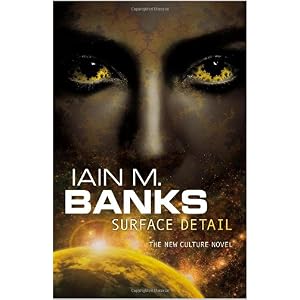
Iain M. Banks: Surface Detail (2010)

Another Banks novel sticks to a formula which he has now used many times. Perhaps this is not a shock, but for someone who was praised for his inventiveness at the beginning of his career, it is disappointing to read another failure to produce something new. That is not to say that Surface Detail is not well written and enjoyable to read; it is just too much like the other Culture novels, without a spark of special inspiration.

The background to the plot does in fact introduce a new (as far as I can remember) element to the Culture. There have been enhanced humans, and intelligent machines, but here in Surface Detail we also have virtualised humans. One of the galaxy's cultures runs virtual hells, into which its inhabitants are loaded on death. This is a practice widely condemned in the galactic community, and a virtual war has been going on for some time between pro- and anti-hell factions.

The descriptions of the hells owe a lot to Dante's Inferno and, more directly, the paintings of Hieronymus Bosch. The torments of the damned seem to me to be more effectively portrayed by Banks' models, as the details of the nastiness of the torture are blunted by their extremity: it is hard to be affected by an account of someone who has been flattened and used to pave a road, because the experience is just so alien and cartoonish. It is hard to accept it as real enough to empathise. Banks is no stranger to the portrayal of the unpleasant and violent, as can be seen from his very first novel, The Wasp Factory.

Against this background, the main action is about revenge. The book starts with a tycoon from a relatively backward world, Veppers, killing a slave who has bitten off his nose. She finds herself not dead, but with her conscious mind transmitted at the moment of death to a Culture ship, courtesy of an unexpected present from a Culture citizen for whom she had done a favour. Equipped with a new body, Lededje sets off on a mission to kill Veppers, which becomes enmeshed into the complex machinations which surround the war over the future of the hells - a war which the Culture is not officially involved, though sympathetic to the anti-hell side.

It is this plot which is infuriatingly similar to previous Culture novels. The idea of a personal quest is an extremely common way to drive a plot, because the concentration on the desires of a single individual makes the story more likely to grip the reader, who is after all an individual human being. But for the Culture, parts of the background make this more difficult to accept than usual: why would the immensely powerful machines, who can create superhuman avatars at will, manipulate human beings into taking the central roles in their schemes? Banks also has a tendency to dilute the effectiveness of the personal quest through the use of multiple viewpoints, which doesn't help. Usually, this hasn't affected my enjoyment of Banks' writing too much (though I've never enjoyed the Culture novels as much as his others), but here it does seem particularly problematic.

Given that I often take space in these reviews to criticise a book's production (appearance, proof reading, gushing blurbs, etc.), it is nice to be able to say that I really liked the design of this edition of Surface Detail, which uses fractal images (specifically the Mandelbrot set) effectively and evocatively in the cover image. And, most importantly, the picture used is relevant to both the title and the content of the novel.

All in all, Surface Detail is a well executed but ultimately disappointing Iain Banks novel - 6/10.


Edition: Orbit, 2010
Review number: 1418

Sunday, 17 January 2010

Iain M. Banks: Matter (2008)


Edition: Orbit, 2009
Review number: 1394

Like several of its predecessors, Iain Banks' latest Culture novel begins on a comparatively primitive world which is not part of that galactic civilisation. There, traitorous plotters have murdered the warlord of the burgeoning empire of the Sarl, proclaimed the death of his eldest surviving son, and set their leader as regent for the younger son. The elder brother, Ferbin, is the central character of the novel, which is about his journey to seek refuge with the Culture, before attempting to gain his revenge. He chooses the Culture because his sister earlier joined them, in a move viewed by their father as the equivalent of a dynastic marriage, whereas in fact she has become an agent of Special Circumstances. an organisation which features in most of the other Culture novels. As described here, they are "practitioners of that ultimately dark art of always well meaning, sometimes risky and just occasionally catastrophic interference in the affairs of other civilisations": the ideal people for Ferbin to interest in the fate of the Sarl.

What is it about this scenario, that of an advanced race observing (and interfering in) the political manoeuvrings of a comparatively barbarous one, holds such an appeal for Banks? It is of course an enduring science fiction plot device, clichéd enough to appear in several episodes of the original Star Trek, hardly ground breaking even in its own day. One benefit used by Banks here and elsewhere in the Culture novels is that it enales the writer to combine ideas from the science fiction and fantasy genres (as Anne McCaffrey does in the Pern novels too, in a less literary manner). A more important general reason for its use in science fiction is that it enables ironic parallels to be drawn between the story and the way that superpowers have interfered in the affairs of other nations, from the development of European colonial empires to the present day war against terror.

The hidden interference with the Sarl and other races gives the plot of Matter several levels. The plotting of the Sarl nobility is influenced and motivated by plotting by the races which are meant to mentor the various nations on their world, while the more still more technological advanced civilisations like the culture look on from afar, with their interference limited by treaty and custom. The interwoven conspiracies make for entertaining reading, while their parallels with the activities of the real nations on Earth give a slightly uncomfortable edge to this entertainment.

 In this edition, the Appendix - a list of names and glossary - is between the last chapter and the Epilogue. So a reader who stops at the apparent last page of the narrative will most some of the tying up of loose ends. There is also another extra, a reprinted magazine interview with the author, which is worth reading for fans.

Matter is not as brutal as many of Banks' novels. It has fairly clear cut "good" and "bad" guys: the sympathies of the reader are clearly engaged by Ferbin and the Culture. This makes it one of the most conventional novels Banks has written, whether science fiction or not. Even so, there is room for plenty of invention. So not Banks' deepest novel, but I felt it was one of the most enjoyable entries in the Culture series: 8/10.

Wednesday, 10 March 2004

Iain M. Banks: Excession (1997)

Edition: Orbit, 1997 (Buy from Amazon)
Review number: 1227

After a couple of novels which, though they seem similar, were not set in Banks' favourite science fiction background, Excession returns to the Culture. Like all the Culture novels, Excession is about how the Culture interacts with outsiders - only this time things are different. In the earlier novels, these contacts are with groups which are technologically inferior, and can be read partly as commentaries on the relationship between the former colonial powers and the cultures with which they came into contact. Here, though, the contact is with something called an Outside Context Event, a potentially disastrous meeting with an alien entity far ahead of the Culture's technology. This takes the form of an excession, the entry of an object into normal space from an unknown origin (excession literally means "going beyond").

The Culture are not the only galactic civilization interested in this alien object. Such analysis as is possible points to incredible potential developments in physics, applicable in technologies such as instantaneous travel, or almost incomprehensible weaponry including the means to subvert the Minds (artificial intelligences) of the Culture, not just an advanced civilization but one very different (one assumes) from that of the object's origin. Apart from Culture splinter group the Elench, the main competitors are the Affronters, whose general behaviour is reminiscent of the most drunken rugby club dinner. There are also complicated political games between the Culture Minds that are involved. The story is, however, told mainly through the experiences of the humans manipulated by the massively more intelligent Minds, punctuated by messages passed between the Minds themselves. (This is typical of the Culture novels, and basically makes it easier for a human reader to identify with characters while feeling that there is more going on behind the scenes than the text reveals.)

Banks' writing in Excession is up to his highest standard, and it has an extremely clever ending. It is the best of the Culture stories and is probably one of the main touchstones for the new school of space opera which is currently popular.

Saturday, 29 November 2003

Iain M. Banks; Against a Dark Background (1993)

Edition: Orbit, 1994
Review number: 1199

The novels which Iain Banks publishes with his central initial usually share the space opera background of the Culture, even if only tangentially (as in Inversions). In Against a Dark Background, however, the setting is carefully differentiated from the Culture, even if it is apparently quite similar on the surface. (Banks distances the setting from the galaxy-wide Culture by describing Golter, the planet on which Against a Dark Background is set, as orbiting a star a million light years from any other, something which makes the standard space opera device of inhabiting the planet with a disctinctly human race of beings ludicrous, presumably deliberately so.)

Like several of the Culture novels, the plot of Against a Dark Background concerns an attempt to acquire a missing technological relic, a lost ancient weapon. In this case, it is a quest to find the last remaining Lazy Gun, one of eight whimsical weapons produced for a long ended war. Sharrow and her companions are also the surviving parts of an eight-fold weapon - a unit of commandos with an enhanced ability to predict each others' actions, a useful skill in combat.

The planet of Golder is an interesting, anarchic background, full of the trademark whimsical touches that Banks delights in - the Solipsist mercenaries, the Useless Kings, and so on. It is a background typical of some of the more recent writers influenced by Banks - MacLeod or Reynolds, for example - and is really more designed to fascinate than to be believeable. The story contains many flashbacks, and sometimes (undoubtedly deliberately) it is hard to tell for a few pages whether the story is in the narrative present or past.

This is not one of Banks' best novels (I seem to have felt that quite regularly about the ones I have reread recently). The plot and much of the background are by now over familiar (the Culture novels are more successful if a lengthy gap is left between reading any two of them); the flashbacks may illuminate Sharrow's character and explain how she came to be in her current situation, but they don't have the kind of explosive purpose that they are used for in Use of Weapons. For someone who did a lot of narrative experimentation early in his career, Banks has seemingly employed less care than usual in putting this novel. Nevertheless, even "Iain Banks by numbers" is enjoyable enough.

Friday, 3 October 2003

Iain M. Banks: The State of the Art (1991)

Edition: Orbit, 1991
Review number: 1186

The State of the Art is unique in Banks' output in being a collection of short stories. It contains seven short stories, previously published in magazines and anthologies, alongside the novella The State of the Art which had appeared in the States but not in the UK. The book really falls into two parts: the Culture stories (the long novella and two others) and the rest. To deal with the latter first, these stories are basically parodies of some of the basic clichés of the science fiction genre (first contact stories, for example) or fairly heavy handed social commentary. The parodies are heavily indebted to American giants of the short story form, such as Fredric Brown, while the other stories lean heavily on the shoulders of the British New Wave, particularly Michael Moorcock. In neither case does Banks really match the quality of those whose work he draws on. The best of each group are Odd Attachments, about an alien shepherd whose disappointing love life proves disastrous for a human astronaut, and Piece, about the fight between rational and irrational thought in eighties culture.

One of the Culture stories, Descendant, is really in the same vein as the non-Culture tales; it is only incidentally set in the same milieu as Banks' science fiction novels. A Gift from the Culture and The State of the Art pick up on one of the novels' major themes, the way that the Culture reacts to other civilizations. The State of the Art describes a Contact survey of the Earth in 1977 (Contact being the part of the Culture which deals with external relations), with the aim of deciding whether the galactic civilisation should reveal itself to us or not. This isn't a particularly new science fiction idea, but the decision of one of the surveyors to remain on Earth whatever is decided makes it an interesting exploration of the theme.

I found A Gift From the Culture to be the most effective of these stories. A former Culture citizen is blackmailed into performing an act of terrorism. It has a deeper exposition of character than is usually managed in a short story; Wrobik's life seems a mess but he (and Banks manages something unusual with the gender; born female but changing sex as is quite normal in the Culture, Wrobik is made quite a feminine man) doesn't really want to change it. This reluctance is epitomised by his relationship with a faithless dancer. He is a misfit now, and presumably was always one even in the anarchistic Culture, and this is what it makes it possible to manipulate him into the act of violence he is desperately keen to avoid.

The general impression given by The State of the Art is that Banks is a novelist dabbling in short story writing, an impression which is strengthened by the small number of short stories he has produced in his career. The collection is worth reading, but in the end is likely to appeal more or less exclusively to fans of the author's novels.

Wednesday, 13 August 2003

Iain M. Banks: Use of Weapons (1990)

Use of Weapons coverEdition: Orbit, 1992
Review number: 1179

This Culture novel, the third, combines two of the themes common in the writing of Banks' other persona (the one without the central 'M'). It has the multiple interlinked narratives (just two of them; one is a series of flashbacks, nearly in reverse chronological order), and it has some sickening, unpleasant violence.

Like many of the other Culture novels, Use of Weapons is built around a thriller style operation by Special Circumstances, which is really the covert operations section of what amounts to their secret service (in the midst of the anarchy that is the apparent form taken by their government). The mission itself isn't really what the novel is about, though (Banks' treatment of it becomes extremely perfunctory towards the end); Use of Weapons is more interested in the background of the agent Cheradiene Zakalwe than anything else.

Apart from the presence of standard Iain Banks tricks, Use of Weapons is of interest for the way in which the author subverts some of the standard cliches of the thriller genre (the Culture series as a whole tends to do this with science fiction). Thus, it features the flawed maverick central character haunted by his passed, the disillusioned missing operative selected as the only one who can carry out the mission, and so on. It breaks little new ground; and, like its near contemporary, Canal Dreams, can be seen as Banks marking time as he prepares to move to a new phase in his writing.

Tuesday, 1 July 2003

Iain M. Banks: The Player of Games (1988)

Edition: MacMillan, 1988 (Buy from Amazon)
Review number: 1169

The second Culture novel is a good deal less ambitious than the first, Consider Phlebas. Indeed, it is outwardly, at least, one of Banks' simplest novels. The Culture is concerned about its relationship with a distant, aggressive interstellar empire named Azad. There, position in life, and even imperial policy, are determined by a game, also named Azad, which is a massively complex simulation of life which has aspects akin to such games as chess, Diplomacy, Risk, go and bridge. Contact, the aspect of the Culture which deals with the outside, chooses a famous game player to take part in the annual grand tournament, and he is the book's central character.

The story is simple enough, but what The Player is about is a little more than this. There are several ways in which the ideas of the novel could be related to the real world, and I suspect that Banks means some or all of them. Many games, of course including the board games mentioned above, model aspects of real life, usually emphasising combat for obvious reasons. We don't tend to equate skill in such games with social success; a chess grand master may be considered clever, but most people would probably feel it was a pretty nerdish thing to be. This is partly because of the limitations of the games' representations of the real world (a simplification which also provides a reason for some people's obsession with them), but also partly that players become engrossed in the games themselves to the extent that they can't be bothered to attempt to succeed in the real world. (This is of course particularly true of computer and role playing games.) To such people, the game is the world, in the same way that Azad the game is Azad the empire.

On the other hand, one of the major tools which is used to determine government policy in the Western world, particularly in the economic sphere, is computer simulation, based on the ideas of game theory. These simulations are basically games without human players, though setting the conditions of the simulation (such as interest rates) is one activity analogous to game play, and the actions of agents simulated by the computer program form another. Azad has elements of this sort of simulation in it, particularly in the parts of the game which are affected by the philosophical statements set down by the players in advance. (The connection is clear if these are thought of as the ideologies which suggest if not determine policy.) Azad is this development exaggerated (though, curiously, without any explicit mention of computers), and the attitude that Banks seems to have to the empire is his commentary on where this might lead. Azad is a stagnated society run by an elite for their own benefit, regardless of the brutalisation of two thirds of the population (the dominant species has three sexes); even the game itself is manipulated. Of course, no government would dream of faking the results of simulations for their own ends...

Other suggestive aspects of the novel include the game-like machinations of Contact to get the Culture's champion to Azad, or the possibility that Banks is commenting on the tendency of the science fiction genre to have a hero prevail by lateral thinking, solving a puzzle about as realistic as a Bond villain's mechanism for killing the famous spy, something which makes some novels seem like poor role playing scenarios.

The Player of Games is not the only Banks novel which gives game playing an important role; the futile, impossible games in Walking on Glass are another example. Here the author is successfully playing a little game with the reader, hiding a great deal of complexity under a simple surface.

Tuesday, 20 May 2003

Iain M. Banks: Consider Phlebas (1987)

Edition: Orbit, 1988
Review number: 1160

Despite the literary origins of its title, from The Wasteland by T. S. Eliot, the first of Banks' Culture novels is his least sophisticated. It is set in a war between the Culture and another major galactic power, the Idirans; even though most of the characters are either neutral or on the Idiran side, Banks' interest and sympathy clearly lie with the Culture. The central character is a Changer named Horza, member of a genetically engineered race who can counterfeit the appearance and mannerisms of humans - clearly based on the Face Dancers of Frank Herbert's Dune series. At the beginning of the novel, he is about to be executed by drowning in a sewer, but is able to escape to take on a mission to travel to the planet Schar's World to try to find a Culture Mind (one of the artificial intelligences which run Culture society) which escaped seemingly certain destruction to take refuge there. For Schar's World is a monument, a commemoration of its native people who destroyed themselves in a holocaust, and it is conserved by a guardian who is very choosy about who is allowed in. Horza has already been there, and so the Idirans hope he will be permitted to land again.

Space opera is a subgenre of science fiction which has had mixed fortunes over the years, often being derided for overblown and ludicrous scenarios and unbelievably heroic central characters. Banks is one of the authors involved in attempts to revive space opera from the late eighties onwards, seeking to add more literary ideas while taking advantage of one of the genre's richest collections of standard ideas and the immense grandeur of scale offered by such fiction. In each Culture novel, certain ideas from the sub-genre are re-used; in this case, huge empires of worlds, linked by faster than light travel, and the quest for some object of tactical significance (many space operas use military scenarios). The main change from older works by authors such as E. E. "Doc" Smith is that Horza is in no sense a heroic figure. In fact, his quest for the mind is more a series of disasters than the traditional crescendo of successes, and the main superhuman aspect of his character is his ability to survive these debacles. (Such changes would form an ideal part of a parody, but Consider Phlebas appears to be more serious in intent than that.)

The novel never really grabs the reader, unlike the space opera it is based on (which tends to emphasise excitement given a sufficient readiness to suspend disbelief) or the later Culture novels. It has some nice touches; the nature of space opera and the fact that a large proportion of the Culture's population is human leads the reader to make the assumption that it is an Earth-derived civilisation, but then the appendix reveals that the events described took place in our thirteenth century - Earth humanity is clearly a less developed offshoot of the species in Banks' scenario. This detail seems quite a neat if slightly contrived subversion of the genre. It is also the only clear piece of humour in Consider Phlebas, which is really the most po-faced of Banks' novels, and that makes it a much less interesting read. Banks turns the genre around, but here doesn't offer a convincing alternative.

Wednesday, 26 March 2003

Iain M. Banks: Look to Windward (2000)

Edition: Orbit, 2000
Review number: 1149

The very first of Banks' Culture novels was entitled Consider Phlebas, a quotation from The Wasteland; by giving this novel a title taken from the previous line, it is clear that the author intends the reader to immediately connect the two more intimately than are the half dozen or so written in between. The nature of the connection is perhaps given by the remainder of the "Consider Phlebas" line, "who was once handsome and tall as you" - though The Wasteland is a notoriously difficult poem to understand - and indicates that the novels are intended as commentaries on the life style of the reader. The two novels are also more closely concerned with the core of the Culture than the others, which tend to concentrate on its periphery.

The idea that the novel is intended as a commentary makes Look to Windward sound difficult and worthy, but in fact it is one of Banks' most accessible and enjoyable novels. It is about the preparations being made to commemorate an event of a long finished war, as the light from two stars turned to novae as weapons reaches Culture Orbital Masaq'. The event is to be marked by the first perfmance of a new work by an eminent Chelgrian composer, an exile from his home world because of his attitude to his species' caste system. The concert is to be attended by an ambassador from the Chelgrians, ostensibly on a mission to persuade Ziller to return home but in fact aiming to destroy the orbital as revenge for the deaths of millions of Chelgrians in a civil war at least partially fomented by the Culture, who felt that the caste system was wrong.

This may not seem at first sight to be a commentary on current culture (and the name of the centrepiece of Banks' novel is another clue to the purpose of the series), but it is: it is about cultural imperialism and how the West has, ever since the Conquistadores, attempted to remake other peoples' ways of life into the image of their own. In particular, the attitude of the Culture to the Chelgrian caste system is reminiscent of the efforts made in India by the British to eradicate the similar system there. The message is similar to that of The Business, Banks' previous novel, also among his most accessible.

Humour is an element in most of Banks' work, even though it is usually of an extremely black variety. In Look to Windward and The Business, the humour is lighter and more obvious, which is the major reason why they are particularly easy to read. (They also eschew the experimental structure common in his work, though an unusually large proportion of Look to Windward does take place in flashback.) Either would be an excellent introduction to Banks' work.

Monday, 6 September 1999

Iain M. Banks: Inversions (1998)

Inversions coverEdition: Orbit, 1998


Iain Banks is fascinated by the idea of a novel constructed from seemingly independent strands which turn out to be connected. Inversions is at least the fourth time he has done this (Walking on Glass, The Bridge and Feersum Endjinn are earlier examples). Inversions is rather simpler than these earlier novels for two reasons: there are only two stories being told in parallel, and there is a prologue in which we are told that there are connections between the stories, instead of having to work it out ourselves from hints in the narrative. (The nature of the connection, though, is something the reader is left to speculate about; Banks gives clues but doesn't specify it exactly.)

Both stories are set on the same world, where a large empire has recently disintegrated into warring kingdoms at a late medieval level of technology (hand guns are new technology, so about the level of fifteenth century Europe). The background seemed to have an Eastern flavour for some reason that I can't quite put my finger on; it is possible that the cover illustration, of some Chinese-style architecture, has something to do with this.

The two stories are set in two warring kingdoms, each telling of the influence of a manipulative stranger on the kingdom's affairs. A heavy hint is given that the strangers - or at least one of them - are agents of the Culture, the advanced galactic civilisation which forms the background of many of Banks' science fiction novels. The one, Vossil, whose access to advanced Culture-style technology shows her origin with a degree of certainty, is acting as physician to the king of one state. The other, DeWar, is bodyguard to the ruler of another. Thus both are protecting life, though DeWar perhaps in a less sophisticated way than Vossil. DeWar tells stories which seem to be about himself and Vossil before they came to their current positions - the stories present the Culture as fairy tales for children, a neat irony. This is the main evidence that he too is from a more sophisticated culture. DeWar is the most interesting character in Inversions, and this interest starts with his name: a multilingual pun in our world not that of the novel's setting, as well as ironically a famous Scottish name.

It is hard to see the exact reason for the title Inversions. Possible ones which occurred to me include that it is a Culture novel set on a low technology world, that it is about a relationship between two people who never interact, that it is something to do with how it is meant to reflect our world, that it is a science fiction novel that appears to be fantasy (though what "magic" there is in Inversions is clearly advanced technology, recalling Arthur C. Clarke's famous saying) or even a historical novel.

Despite being an engaging novel which raises questions in the minds of its readers, Inversions is not as profound as any of the three earlier Banks novels mentioned above. It is more accessible since it is less complex while offering appetising interesting ideas, and so might perhaps serve as a good introduction to his writing for anyone who hasn't read any of his books before.