Tuesday, 11 December 2012

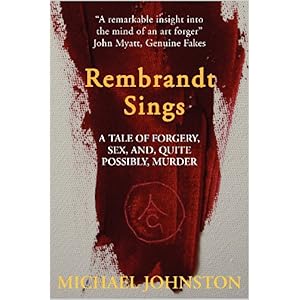
Michael Johnston: Rembrandt Sings (2012)

Edition: akanos, 2012
Review number: 1469

Art historian Bill Maguire tells the reader his life story in Johnston's new novel. At least, he narrates a version of his life: he is clearly a constant reviser of material from his journals, and undercuts much of what he says with sardonic footnotes. His story is bound up with that of a rather older man, a painter named Joe Rembrandt, and most of Maguire's story is taken up with Joe's recital of his own life story, told to the young Bill while in the last stages of terminal illness. And in turn, Rembrandt's story is bound up with (fictional) painter Alexander Golden, whose daughter he married. Or perhaps not: it is clear fairly quickly that not only is Bill Maguire an unreliable storyteller, so is Joe Rembrandt, even if he does share an insight into Golden's paintings which Maguire uses to establish his academic reputation.

What unites these characters is a love for (and knowledge of) fine art. Even their involvement in dubious activities - including forgery and possibly, murder, as the front cover puts it - is fuelled by and part of their love for painting. Johnston captures the power of their obsession well, which is particularly useful, as it is of vital importance to the plot, as well as making the characters sympathetic: a forgery (and even a murder) for the love of art is easier to accept than the same crime carried out just to make money.

Rembrandt Sings is not intended to be an action thriller, and is more concerned with the motivation of the forger than anything else. The ending has a nice thriller-style twist to it; if reading the novel, do not skip forward as you would ruin a treat. Having said that, it is also a novel I wished had been longer, a rare object. There is nothing much recorded from Bill's live between the early twenties when his academic career was beginning and the position of senior and respected art historian, a likely candidate for the next head of the Tate gallery, who is looking back to his early days in the art world. Perhaps nothing out of the ordinary would have happened, just a standard academic career path, but more information would have been interesting.

Painting is not really my thing (colour blindness means that I tend to have problems perceiving pictures in the same way as people with normal vision), but I do enjoy fiction about art. I was in fact just starting Michael Gruber's Forgery of Venus as I finished Rembrandt Sings, another novel about art forgery, with a rather different slant on the subject. And I love Iain Pears' Jonathan Argyll series, which seem to have finished, unfortunately; they are more traditionally crime stories, and have less convincing forgers than Joe Rembrandt (which is not surprising, as it is  not the point of the books). I don't think that, even though music is the art form dearest to me, I would find a musical faker as interesting as the characters in this book, no matter how well done.

Altogether, I found this an interesting and impressive picture of the forger, with a clever twist, though lacking in pace for most of the time. My rating: 7/10.

Saturday, 1 December 2012

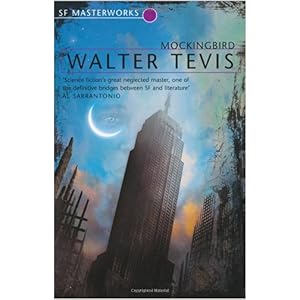
Walter Tevis: Mockingbird (1980)

Edition: Gollancz, 2007
Review number:1468

The best known novels by Walter Tevis are famous as films: The Hustler, The Man Who Fell to Earth, and The Color of Money - a trio which certainly demonstrates versatility. As a genre writer, he is also known for Mockingbird, here reprinted as one of Gollancz's "SF Masterworks" series.

One of TS Eliot's most famous lines, known to many who have no idea who wrote it (one online quotation search engine bizarrely attributes it to actor Vin Diesel) is "This is how the world ends, not with a bang but a whimper". It is almost a one sentence summary of Mockingbird, and is quoted at one point towards the end of the novel. Perhaps "human civilization" would be more apt than "world", but otherwise the mood and fit of the line is pretty much perfect.

The setting of Mockingbird is at the end, then, of the human history. With all tasks handled by robots, humans have sunk into a listless, drugged apathy, almost entirely of their own (or their ancestors') making. The main characters include one of the last, most advanced, robots to be made, named Spofforth, and one of the youngest remaining humans, named Bentley, who eventually realises the meaning of the demolition of his school once he and the rest of his year group leave: there are no more children.

The third major character is a woman named Mary Lou, who has been living an outsider's life in New York Zoo, inhabited otherwise only by the robots who manage it and who pretend to be children visiting - and which may well also be many of the exhibits. She has been surviving by eating sandwiches made available by a bug in the management system: a robot is provided with them to fill a vending machine, but always has five more than fit, and no instructions for what to do with them, so is effectively immobilised until May Lou takes them from it. She has managed somehow to escape from the system and is therefore free from the drugs taken by every other human. The robots have seen that humans are happier in general without high intelligence or dramatic events, so the drugs make their takers less excitable and less clever.

Once this is established, a strange thing happens, the most important event in the story, and one which almost knocks the whole novel off its mournful path. Spofforth denounces Bentley as a criminal - a true accusation, for Bentley, having worked out how to read from a book, teachers Mary Lou, and this is a crime because reading can distract from the bland happiness which humans are supposed to experience. Bentley is sent to prison, and Spofforth moves himself and Mary Lou into an abandoned apartment, following a rather atavistic prompting of a hidden part of his mind, which was not constructed but is based on a recording of the mind of a human being.

With the end of reading, of education, there is so much that people just don't know any more. Like a prehistoric inland dweller who has never seen the ocean, Bentley comments: "I did not know sea water was undrinkable. No one had ever told me." This, on top of the general apathy brought by the drugs, is really what is bringing the end; things break down, and no one knows how to fix them or how to get a robot to fix them, and no one cares to do either, anyway. Temporary measures, such as the one which added contraceptives to the drugs to curb population increase, are set in place, but then no one remembers to rescind them afterwards.

The title of the novel comes from a caption in a silent film watched by Bentley, who is put to recording the words of such films as no one can read the captions any more: "Only the mockingbird sings at the edge of the forest". Apparently, the Northern Mockingbird does indeed live and sing at the edge of forests during their breeding season, but Tevis' intention is to say something about his theme, but I found it hard to choose between several different interpretations of the phrase. The lives which are led by Bentley, Spofforth, and Mary Lou could be said to be a mockery of those who are living normal lives in the forest, and the mockingbird a symbolic outsider; the odd relationship between Spofforth and Mary Lou, while she is pregnant, is a mockery of twentieth century city life (as well as referencing the breeding season of the bird); or it could refer to Tevis' role as a commentator on the negative sides of the human drive to increase comfort and settle for the banal in experience as safer than living on the edge.

This is the kind of novel I would point to as a counter to those who think nothing with a science fiction genre label on it can be literary, or discuss real issues. Dealing with apathy, depression, and suicide as it does, Mockingbird is hardly cheerful reading, but is definitely recommended. My rating: 9/10.

Thursday, 1 November 2012

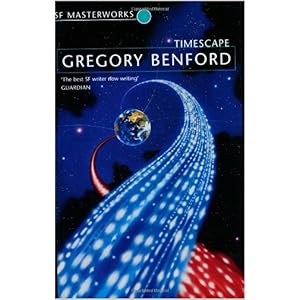
Gregory Benford: Timescape (1980)

Edition: Millennium, 2000
Review number: 1467

Gregory Benford is an author whose writing I like, but I have never got round to reading much of his work. Timescape is a classic science fiction, not quite about time travel but considering how history might be affected by the possibility of sending messages to the past. Half of the novel is set in San Diego in 1963, and half in Cambridge in 1998, with chapters more or less alternating between the two settings. (The dates were clearly chosen to that the novel appeared halfway between the two.)

In 1998, the world is experiencing a massive environmental catastrophe caused by mutations in oceanic plankton induced by the indiscriminate use of certain chemicals in agriculture. Physicists in Cambridge are investigating tachyons, sub-atomic particles which travel faster than the speed of light, and it occurs to one of them that it would be possible to send some kind of message to the past by sending a beam of tachyons to the point in space where the Earth once was, and interfering with physics experiments being carried out at the time when the Earth was at that position (direct detection of the tachyons being impossible, as technology wouldn't be in a position to pick them up at that point). The early sixties were chosen as a target because experiments which can be affected by beams of tachyons were beginning to be studied then.

Some people divide the science fiction genre into "hard" and "soft" writing. Hard SF is concerned with science: it views the genre almost as a way to carry out an informal discussion of more less speculative ideas, usually in physics, in a fictional setting. Soft SF is more often interested in the social aspects of science and technology, centring on culture. It is perhaps something of an outmoded way to view the genre, which seems to be more simply speculative in nature (i.e. centred around "what if" ideas) than anything else, where science fiction elements (such as space travel) are not simply props to a story which doesn't depend on them except as part of the background.

If the distinction has any meaning, then Gregory Benford has usually been regarded as a hard science fiction writer, partly because he is also a physics professor, and partly because he is also concerned to get the science in his stories as compatible with known fact (and interesting fact-based speculation) as possible. Most of the physics in Timescape is  based on what was known, or what at least seemed plausible in 1980, including what is quite likely to be the earliest mention of dark matter in a science fiction novel. The exception to this is the tachyons, which physicists still generally doubt could possibly exist. How they could behave if they did exist has been the subject of a certain amount of speculation, and Benford builds in part on this. And of course, tachyons are needed for the central plot device in Timescape of sending the message back in time, even if this violation of causality is one of the main reasons that their existence is considered unlikely. Benford has a rather convoluted but clever and interesting mechanism to get out of this trap, which I will not give away.

At the same time, Benford is able to write well enough to avoid the major criticism often levelled at hard SF writers, that they neglect important aspects of the story such as characterisation because of their overwhelming interest in the scientific idea. In Timescape, the reader does care about the characters in both timelines, and the background is believable - possibly in part because the setting is the physics research community which Benford is a member of in real life. It all works well, and the end product is a fascinating novel - at least, I think it would be to anyone interested in the physics. My rating - 9/10.

Thursday, 18 October 2012

Michael Moorcock: The Twilight Man (1966)

Also available under the title The Shores of Death
Edition: Sphere Books, 1970
Review number: 1466

Like The Blood Red Game (which I bought in the same second hand bookshop as The Twilight Man in May), this is a reworking of an earlier piece of writing, in this case a serial which was written to fill space in New Worlds during the earliest months of Moorcock's editorship of that later famous science fiction magazine.

Clovis Marca is a former leader of Earth's government, leading a humanity which is now doomed to extinction after an alien visitation has left everyone infertile. As the book begins, Marca returns from a year in space, his way of dealing with the catastrophe. The desperate decadence of the society he finds on his return is a clear precursor of my favourite Moorcock series, The Dancers at the End of Time.  The Twilight Man is a staging post between it and the Arthur C. Clarke novel, The City and the Stars, which appears to have influenced Moorcock greatly, though I do not actually know that he read this particular novel (as I discuss in its review). Doomed decadence is one of Moorcock's recurring themes, as well - part of what he wants to say to his readers through his writing.

While much more Moorcockian (so to speak) than The Blood Red Game, The Twilight Man is still not fully individual in its style: clearly still the work of a writer finding his way, even five years after the publication of the first Elric novel, The Stealer of Souls. Perhaps because it is more like the author's later work, The Twilight Man is less interesting to read than The Blood Red Game: it is slightly too much like the fan's guess as to what early Moorcock would be like to engage.

Reasonably enjoyable in itself, I would give The Twilight Man 6/10.

Saturday, 6 October 2012

Anthony Horowitz: The House of Silk (2011)

Edition: Orion Books, 2011
Review number: 1465

The character of Sherlock Holmes has been part of a huge literary industry, possibly the largest collection of what would now be known as fan-fiction ever produced. But The House of Silk remains an unprecedented event, being the first Sherlock Holmes novel actually authorised by the estate of Arthur Conan Doyle. The writer chosen to produce this work is Anthony Horowitz. His prior literary output consists of thrillers for teens, the Diamond Brothers and the Alex Rider series. Rather more relevant, I suspect, is his role as the creator and writer of the acclaimed historical crime TV series Foyle's War.

As an authorised continuation of Conan Doyle's writing, it is to be expected that The House of Silk is more like the 'canon' than much of the Sherlock Holmes literature produced by other writers, and this is indeed the case. It does use some of the common devices of Holmes fan-fiction, in particular the idea that narrator Dr Watson had cases that he wished to write about but which were to sensitive to publish, and which were then stored after his death for a number of years. It does not play around with the canon as some Holmes novel do, including some of my favourites, Laurie R. King's Mary Russell series.

The many Conan Doyle-like touches include an American connection, with the story opening with Holmes employed to track down a man who has been terrorising his client, believed to be a gangster from Boston, Mass., where Holmes client had been instrumental in the capture of the gang he belonged to. This story bears a resemblance to the Scowrer plot in The Valley of Fear, also involving the early employees of the Pinkerton detective agency working against a violent gang.

Slightly oddly, given the potential of a series of authorised Sherlock Holmes novels, The House of Silk seems to be designed as a one-off, judging by the preface and afterword (in which John Watson explains the reasons for not publishing this story at the time it happened). Maybe Horowitz didn't enjoy writing this, maybe the Conan Doyle estate only wanted a one off - there's plenty of time for more, though, before the final US copyright runs out on a Sherlock Holmes novel (assuming no changes in the relevant law before then).

The incidentals of the tale - the atmospheric depiction of Victorian London and its exotica, the energetic sleuthing of Holmes and Watson, and so on - are very much done in the Conan Doyle manner, but I found the puzzle very simple indeed. I found it a bit hard to work out whether this is authentic recreation of canon, or something which is Horowitz's own, because I know the Holmes stories fairly well so am not surprised by the twists in them, and I am a much more sophisticated and experienced reader of detective fiction than I was when I first encountered Sherlock Holmes in a comic strip version of The Sign of Four in the pages of Look and Learn in the mid-1970s. Thinking about it, I feel that the mysteries in Conan Doyle are mostly more difficult for the reader to solve. This is my only real caveat; in every other way, The House of Silk is a pretty good addition to the Sherlock Holmes industry, even if in 2012 it would be hard to write a novel with the impact of the original series that was true to the originals as this is. My rating: 7/10.

Tuesday, 25 September 2012

Julian Barnes: The Sense of an Ending (2011)

Edition: Jonathan Cape, 2011
Review number: 1464

When The Sense of an Ending won the Man Booker Prize last year, I remember seeing a suggestion that this was more a belated recognition of Barnes' career than an award which was deserved by this specific novel. Length aside, I don't think that this is the case, as the The Sense of an Ending is an immensely enjoyable yet deeply felt novel which reminds me of the early works which I like best out of Barnes' output.

The Sense of an Ending tells of a school friendship, following by a gradual growing apart while the friends are at different universities and an end with the suicide of one of the young men. Then, in the second part, the survivor has the past brought back to life decades later when he is unexpectedly left a legacy, which includes the diary of the dead man. And so the narrator. now in his sixties, looks back on the events of his teens and his early twenties.

So this is a novel about friendship, memory, and death. But although it addresses these potentially weighty themes, it is often funny, especially in the first section, which is set at the school. A lot of this section prepares the way for the rest of the book, as when, for example, the boys are made to discuss the nature of history by their teacher, an anecdote which is also used to suggest that the narrator of the novel is not entirely reliable: he ends up deciding that history is the story told by the survivors, rather than, as is usually suggested, by the victors. The Sense of an Ending is about "closure", hence the title, but it also has a satisfying and somewhat unexpected ending itself.

The problem with The Sense of an Ending is how short it is, especially by modern standards. I can think of several acknowledged masterpieces - oddly, mainly French - which are no longer but 150 pages is very short in these days of word processors. However, the important thing to realise is that this story seems to fit the length (which is more a tribute to Barnes' craftsmanship than something innate to the plot ideas). There are no wasted words, and no feeling that there are elements which should be in the book but are missing - even though there is a gap of forty years between Parts One and Two. A longer version of the novel would clearly be possible, but would lack the focus which Barnes is able to bring to his chosen subject by his concentrated treatment of it.

Barnes is a writer who I've read and enjoyed sporadically over the years, and this is in my opinion one of his best - 9/10.

Sunday, 16 September 2012

Esi Edugyan: Half Blood Blues (2011)

Edition: Serpent's Tail, 2011
Review number: 1463

The treatment of Jews by the Nazis during the Second World War is well known (even if a small minority of people claim that the Holocaust did not happen), but the knowledge that similar efforts were made to destroy other groups (such as gypsies and homosexuals) is less widespread. This novel is the story of three black men, jazz musicians, in Germany and then France as the war broke out and France was occupied. Jazz music was banned as degenerate by the Nazis, which makes them even worse in the eyes of the German state and its functionaries, One of the musicians, trumpeter Hiero, is actually German by nationality, so is even more unwelcome in the land of his birth. He is unable to get travel papers as easily as the others, who are Americans, and they end up making a recording named Half Blood Blues in a tiny studio in Paris, which, when discovered after the war, is acclaimed as a classic, along with Hiero being regarded as a jazz great tragically lost when he is arrested and taken to the concentration camps shortly after the session.

Half Blood Blues was nominated for the 2011 Man Booker Prize, but failed to win. Neither is a surprise to me. The novel has some truly brilliant writing, but my interest flagged in the middle. The background of wartime Europe is less interesting than the sections about jazz, and what it feels like to be a jazz musician is far more enthralling than the plot.

Although jazz has never been music which really spoke to me - I keep on trying, to see if I can pick up what others love about it so much - I have done a fair amount of musical improvisation. I can't claim to be very gifted at it, but on occasion it has just clicked, and when this happens while playing with others also "in the groove", it produces a euphoric feeling which is like no other I have ever felt and which I can never forget even though I rarely play now and never perform any more. In her descriptions of the session when the main characters jam with Louis Armstrong and in the Half Blood Blues session itself, Edugyan comes close to expressing that feeling in prose, and then goes on to nail the draining numbness and despair which comes to those who (unlike me) have been able to touch a vein of inspiration frequently enough to become professionals when they are unable to perform as well as they want: a feeling probably at the source of at least some of the drug habits which have plagued many famous jazz musicians.

It is the wartime aspects of the novel - the terrible choices which must be made, the lost companions, the betrayals - which work less well. However gifted Edugyan is at bring the experience of music making alive for the reader, she does not appear to be a thriller writer. The slackness of this side of the novel is why the middle parts drag.

While tempted to give a higher rating to this novel for the brilliance of its evocation of performance, I don't really think that Half Blood Blues can be rated higher than 6/10 overall.