Showing posts with label time travel. Show all posts

Friday, 29 September 2017

Iain Pears: Arcadia (2015)

Edition: Faber & Faber, 2016
Review number: 1508

Iain Pears' 2015 novel may seem to be something of a departure from his earlier work - if I'd been asked to read it blind and guess the author, I think I'd have picked David Mitchell. As both are among my favourite authors, this boded well for enjoying the book.

Arcadia is a complex narrative, with multiple strands and connections which involve time travel. The order of the chapters is (at least to begin with) not actually hugely important; indeed, it is sufficiently random that there is an app available to allow readers to restructure the book (which I haven't had the opportunity to try out). The complexity comes partly from the shortness of the chapters, but is mainly because they don't follow a chronological order as experienced by an individual character.

The structure is closely entwined with the form of time travel which Pears uses as the basis of the novel. Many time travel novels are built round an exploration of the grandfather paradox - how a time traveler in the past can influence the future to make it different from the one they came from - and this is no exception. It is, however, unusually fully thought through. In Arcadia, time travel is about manipulating probabilities. Only one universe can exist, but if that universe is no longer the most probable, then it disappears and a new sole universe not only come into being, but has always existed (except in the mind of the traveler). Pears is not absolutely consistent about this position, and there is debate among the characters about whether this is a true description of the universe. So far as I can remember, this is the only time travel novel I have read which is so ruthless about multiple timelines without making change impossible, though it perhaps has a predecessor in Clifford Simak's Time Quarry, which I was coincidentally reading at the same time.

There are three main universes in Arcadia. The central one is a version of Oxford in 1960, where a minor writer, one of the Inklings alongside Tolkien and Lewis, has written about his own fantasy world. This world itself is also a universe, deliberately brought into being in Professor Lytten's basement by Angela Meerson. She is a fugitive character from the third universe, a dystopian England where research into time travel is being carried out on a Hebridean island. A third major character is Rosie Wilson, a fifteen year old girl who becomes a friend of Professor Lytten and discovers Anterworld in the basement. A major theme, which I suspect may have been the original motivation for writing the book, is the relationship between Lytten and the world he imagined.

Clearly, Arcadia is extremely ambitious, more so than any of Pears' earlier novels. I found it challenging, partly because my reading of it wasn't helped by having to put it aside for days at a time on a number of occasions. In the end, I would have enjoyed it more if the narrative had been more traditional and linear; it felt as though the content was not quite interesting enough in itself to reward the effort of comprehending the structure. I think I'd have enjoyed it more at a time when I wasn't so distracted by other things. My rating: 6/10.

Friday, 9 May 2014

Connie Willis: To Say Nothing of the Dog (1997)

Edition: Gollancz, 2013
Review number: 1485

To Say Nothing of the Dog is a time travel novel, a farce around the idea of a professional time traveller sent to a time which is not his specialist historical period - Victorian England instead of the Second World War. A powerful and rich woman is trying to recreate the original Coventry cathedral destroyed in the Blitz after the sixties replacement is turned into a shopping centre. She is able to monopolise the services of the Oxford time travellers, retrieving items believed destroyed by the bombing at the last moment (so their removal doesn't create a paradox). But there is one ornament which is supposed to be there on the night of the bombing, but which can't be found - so operative Ned Henry is sent further back than 1940 to find out what happened to it.

In the 1880s, Henry gets involved with eccentric Oxford dons, a trip down the Thames, an upper class houseparty, and a manic attempt to introduce the right pair of lovers to each other so that the future is saved, even though Henry only knows the identity of one of them and the initial letter of the name of the other.

On top of this manic plot, Willis piles on a huge variety of references to other literature: a wide selection of the more popular English language writers from Jane Austen to PG Wodehouse and Robert Heinlein via Dorothy Sayers are either directly referenced or are clear influences. The book as a whole is a homage to Three Men in a Boat - the title To Say Nothing of the Dog is the subtitle to Jerome's comic classic. (I want to point out that the ending of The Moonstone is given away - so anyone planning to read Wilkie Collins' novel who doesn't want to know what happens beforehand should read that first.) Few of the references need to be familiar in order to follow To Say Nothing of the Dog; the most important after Three Men in a Boat is probably Gaudy Night. However, the more of them which the reader picks up, the more they will enjoy the game. This is a type of meta-novel which appeals to me greatly, and I would put several of them into my all time favourites list, of which To Say Nothing of the Dog is now also one.

Very funny, fantastically clever: To Say Nothing of the Dog leaps straight into my list of favourite science fiction novels. I'm a little surprised I hadn't read it before, as it's a Hugo winner and I have been avidly reading the genre since well before it was published, but now I am very glad I have done - 10/10.

Thursday, 1 November 2012

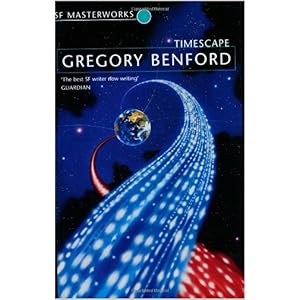
Gregory Benford: Timescape (1980)

Edition: Millennium, 2000
Review number: 1467

Gregory Benford is an author whose writing I like, but I have never got round to reading much of his work. Timescape is a classic science fiction, not quite about time travel but considering how history might be affected by the possibility of sending messages to the past. Half of the novel is set in San Diego in 1963, and half in Cambridge in 1998, with chapters more or less alternating between the two settings. (The dates were clearly chosen to that the novel appeared halfway between the two.)

In 1998, the world is experiencing a massive environmental catastrophe caused by mutations in oceanic plankton induced by the indiscriminate use of certain chemicals in agriculture. Physicists in Cambridge are investigating tachyons, sub-atomic particles which travel faster than the speed of light, and it occurs to one of them that it would be possible to send some kind of message to the past by sending a beam of tachyons to the point in space where the Earth once was, and interfering with physics experiments being carried out at the time when the Earth was at that position (direct detection of the tachyons being impossible, as technology wouldn't be in a position to pick them up at that point). The early sixties were chosen as a target because experiments which can be affected by beams of tachyons were beginning to be studied then.

Some people divide the science fiction genre into "hard" and "soft" writing. Hard SF is concerned with science: it views the genre almost as a way to carry out an informal discussion of more less speculative ideas, usually in physics, in a fictional setting. Soft SF is more often interested in the social aspects of science and technology, centring on culture. It is perhaps something of an outmoded way to view the genre, which seems to be more simply speculative in nature (i.e. centred around "what if" ideas) than anything else, where science fiction elements (such as space travel) are not simply props to a story which doesn't depend on them except as part of the background.

If the distinction has any meaning, then Gregory Benford has usually been regarded as a hard science fiction writer, partly because he is also a physics professor, and partly because he is also concerned to get the science in his stories as compatible with known fact (and interesting fact-based speculation) as possible. Most of the physics in Timescape is  based on what was known, or what at least seemed plausible in 1980, including what is quite likely to be the earliest mention of dark matter in a science fiction novel. The exception to this is the tachyons, which physicists still generally doubt could possibly exist. How they could behave if they did exist has been the subject of a certain amount of speculation, and Benford builds in part on this. And of course, tachyons are needed for the central plot device in Timescape of sending the message back in time, even if this violation of causality is one of the main reasons that their existence is considered unlikely. Benford has a rather convoluted but clever and interesting mechanism to get out of this trap, which I will not give away.

At the same time, Benford is able to write well enough to avoid the major criticism often levelled at hard SF writers, that they neglect important aspects of the story such as characterisation because of their overwhelming interest in the scientific idea. In Timescape, the reader does care about the characters in both timelines, and the background is believable - possibly in part because the setting is the physics research community which Benford is a member of in real life. It all works well, and the end product is a fascinating novel - at least, I think it would be to anyone interested in the physics. My rating - 9/10.

Saturday, 4 August 2012

Liz Jensen: My Dirty Little Book of Stolen Time (2006)

Edition: Bloomsbury, 2007
Review number: 1461


If the title did not warn the reader, the first sentence's appropriation of the famous opening to Rebecca would make it clear that My Dirty Little Book of Stolen Time is not going to be entirely serious. It is a personal history, told by Charlotte, a prostitute from late nineteenth century Copenhagen. When times are hard, she manages to inveigle her way into a respectable house as a maid, only to be accidentally catapulted into twenty-first century London bye the HG Wells-style time machine hidden in the basement.

My Dirty Little Book is broad comedy, sometimes even cruel (Charlotte's treatment of the dim overweight woman who accompanies her is a case in point). But it is still very funny. In fact, I was reading it alongside a P.G. Wodehouse I hadn't read before (The Girl in Blue), and Liz Jensen held her own even in this company. Few indeed will be those readers who follow Charlotte's exhortation in a time of adversity to return the book in disgust to the shop or library from which it was obtained.

I have tagged this review as science fiction because of the time travel element, though one of the reviews quoted on the cover describes it as "less science fiction than fairy tale", which is in many ways true. I don't have a tag for fairy tale currently, but I actually think that science fiction is the right genre in which to place this book (subsidiary to humour, which is obviously its main point). My feeling is that Tom Holt and Terry Pratchett are readily filed under science fiction or fantasy, because the genre themes and ideas are important elements in the structure of their books, provide much of the humour, and are the subjects of parody. Not only that, but the detailed nature of the genre elements is frequently given in some detail and is important to the story: dragons in The Colour of Magic (to pick one example) are not just fairy story beasts with no explanation, but projections of a human belief in dragons and a parody of Anne McCaffrey's Pernese dragons. And I think that all these criteria hold for Liz Jensen's book as well. Time travel is essential to the plot and the humour; there are moments of genre parody, particularly of H.G. Wells; the time machine itself is analysed further (there is even some discussion of the famous grandfather paradox). In fact, the nature of the fuel which propels the time machine is the closest that My Dirty Little Book comes to having a serious point, consisting as it does of three liquids embodying the struggle of history (blood, sweat, and tears), mixed with that more comical essential lubricant, strong alcoholic spirits.

The plot of My Dirty Little Book is farcical and not particularly important, except as the means by which the humour is generated. This mainly takes the form of Charlotte's observations of the worlds of both time periods. She is a most lively storyteller, occasionally a little too keen to address the reader directly, perhaps, but certainly an individual and entertaining voice. The amoral narration and humorous twists and turns of Charlotte's exploits made me think of Harry Flashman, not a bad model for this sort of comic novel.

My rating: 8/10.

Thursday, 25 May 2006

Poul Anderson: Time Patrol (2006)

Edition: Baen, 2006
Review number: 1314

The Time Patrol stories of Poul Anderson are classics of the science fiction genre, dealing with the efforts of the eponymous group to maintain the status quo of history against the accidental or deliberate manipulations of other time travellers. This book, sharing the name of the original story which began the series, collects them all (and it is not to be confused with an earlier volume, also called Time Patrol, which contains only the first two or three stories).

The central character in the stories is Time Patrol agent Manse Everard, who is "unattached" - basically, a troubleshooter who can visit any time and place in order to sort out serious problems. (Most Time Patrol agents work in a single milieu, either as researchers studying the period or as officials regulating the activities of time travellers.) Apart from the first story, which is about Everard's recruitment, the basic plot of the remaining stories is simple and consistent: some problem requires Everard's intervention at a particular time and date.

Though the stories were written over a period of five decades and though they vary wildly in length (between about 30 and 160 pages, as reprinted here), they are very similar to each other. Anderson doesn't quite make the different periods and locations all that distinct (though having several stories set just outside the borders of the Roman Empire doesn't really help with this). Everard also remains pretty much the same through the series, maybe a little more world-weary, but basically an action hero. Like many long running series of self-contained stories, the Time Patrol tales work better in relatively small doses rather than by reading them all the way through in one volume.

Given these obvious flaws, why is Time Patrol worth reading, and why are the stories important in the development of the genre? For one thing, there is one story in the series which really stands out, which would be a classic of the genre even without the rest. Delenda Est has Everard returning from a vacation on a base in the prehistoric past to his own time (the mid twentieth century) only to discover that everything has changed. In what is effectively a parallel world, he has to work out what pivotal event has been altered, and then decide if he is morally able to destroy an entire new civilization in order to bring back his own familiar time line (or alternatively destroy the lives of all those living in his own timeline to save the new future). This single story is one of the best of all those ever written about time travel.

For the other stories, the point of this series is really the introduction of adventure to time travel, and particularly to stories involving time travel paradoxes. The fates of nations, of the godlike Danellians from Earth's far future (the beings who set up the patrol to preserve their existence) rest on Everard's capable shoulders: he is a hero who can think as well as act. In the original time travel story, Wells' The Time Machine, the use of time travel is to be a mechanism allowing the main character to see the far future (which is, of course, at least partly a reflection on Wells' present); the machine itself has very little part to play in the story. It is like the visions in The House on the Borderland, or the mental link to the future in Last and First Men: the point is the vision itself, not the mechanism by which it becomes available to the protagonist. Stories of time travel to the future tend to be like this in tone, and it is perhaps the introduction of the possibility of paradox with travel to the past which makes the idea work better as the background of a thriller. (The actual introduction of the famous grandfather paradox came as late as 1947, and even then in stories unlikely to be read by the mainstream English language science fiction fan: French genre fiction, with the exception of Jules Verne, is still considered pretty obscure.) Anderson joined other American writers of his time such as Robert Heinlein and Isaac Asimov in bringing adventure to mainstream time travel fiction (The Door Into Summer and The End of Eternity are approximately contemporary with the earliest Time Patrol stories); Anderson's stories are the most epic of these as adventures.

Delenda Est is a must read for any science fiction fan. The rest are interesting in small enough doses, though a bit too similar to each other to make the omnibus a pleasure. So I would recommend seeking out other collections which contain one or more of the stories along with others, rather than investing in the omnibus.

Wednesday, 25 June 2003

John Dickson Carr: Fire, Burn! (1957)

Edition: Carroll & Graf, 1994
Review number: 1168

John Dickson Carr is best known to those interested in old-fashioned crime fiction for his detective Gideon Fell, who solved the many variations on the locked room mystery theme which Carr thought up. Fire, Burn!, though still a locked room mystery, is very different. The detective, John Cheviot, is a Scotland Yard superintendent, who finds himself travelling back in time to 1829, to the earliest days of the Metropolitan Police. This is before the days when policemen began to be respected (a situation to which we seem to have been returning for some time), before the institution of the CID, before the ideas on which modern police work is based. He meets a woman with whom he falls in love, but has to risk alienating her and breaking the code governing honourable conduct (in the days when duels were still being fought) in order to solve his case.

Since the publication of Fire, Burn!, historical crime stories have become big business. It is really a precursor to this genre, but it has this unusual time travel aspect as well. One of the major difficulties with the genre is that readers expect modern investigative methods - sifting of evidence, attention paid to forensic detail including examination of the body, elimination of suspects by logical deduction, being willing to suspect anybody - which would have been considered strange and even improper in the past. (The tendency which is still sometimes seen today to automatically blame society's outsiders was often the principal method of criminal investigation.) Difficulties inherent in suspecting or even questioning members of the upper classes are often glossed over for the sake of the plot. By bringing his detective from the future, Carr neatly sidesteps all these problems, and also makes the contrast between the expectations of eighteen twenties society and those of a nineteen fifties policeman the core of the novel.

This makes Fire, Burn! more serious than the majority of Carr's massive output, and it is successful as a carefully documented historical novel as well as in the genre more familiar to the author.

Tuesday, 15 April 2003

Jack Finney: Time and Again (1970)

Edition: Gollancz, 2001
Review number: 1152

Because of the famous film, Finney is best known for (Invasion of) The Body Snatchers, but he wrote a dozen or so novels over about four decades; Time and Again is probably the next most famous. It is still, after thirty years, a time travel novel with many differences from the ideas on the subject which have become commonplace in the science fiction genre, and thus it remains worth reading for any fan despite its obvious flaws.

Si Morley is an artist, but feels as though his current job in advertising (drawing bars of soap) is a dead end. So he is interested when approached by a stranger with an interesting proposition - how would he like to become involved in a government project so secret that Si can't even be told what it is about until he joins it?

The secret is, of course, time travel. The discovery has been made that position in time is a subjective thing, that it is the knowledge we have of past events that determines when the present is. (For example, knowing that Kennedy was assassinated places the present after 1963, knowing I'm 34 means it's 2003.) The point of this is that by appropriate training and self hypnosis time travel becomes possible; if you can forget everything which happened after a particular date and will yourself into the mindset of a person of that time, then suddenly that date becomes the present for you. Si uses this method to travel to the New York of the early 1880s, before the skyscraper, before the automobile. There, he investigates a minor (invented) historical mystery, and is strongly attracted to a young woman of the time.

There seem to me to be serious flaws in the premise by which this method of time travel is supposed to work, starting with the philosophical one that it makes the fundamental nature of time simultaneously subjective and objective - position in time depends on our knowledge of events, and yet the relative orderings of these events is given by their position in time, which is determined by what? Even if we allow the passage of time to be subjective for a conscious being and yet objective for an unconscious object, it seems to me that it is impossible for such changes as are required for time travel to occur in our minds, particularly given our consciousness of alterations in our own bodies. A good example of this problem is that Si grows a beard to fit in to the male fashion of the 1880s, and surely he would have been unable to get away from realising that it was only a few weeks old.

More seriously, to travel in time leaves the traveller on a tight rope, surely to be bounced back as soon as any conscious thought of future events intrudes. For the sake of the plot, Finney must ignore this, so that Si is constantly aware of who he is and of the changes due to take place in the century he has travelled - he even makes a sketch showing how one of the streets will look. Finney is also self indulgent, in that he is unable to resist displaying some of the fruits of his research, which makes Time and Again seem in places like a guide book complete with photos and drawings.

Having catalogued some of the flaws, what are the strengths of this novel? The main one is that Finney conveys far more of how different the world of even the relatively recent past would seem to a time traveller; in its usual Wellesian, machine driven mode, time travel fiction is often very blase about how easy it is to fit in, and certainly about how little culture shock the traveller would suffer even from the details of their new environment. The open acknowledgement of two different times being involved gives Finney an advantage over the traditional historical novel, too; Si can comment on things in a way not possible outside the science fiction genre.

The two foci of the novel are the rapid pace of change since 1882 as exemplified by Si's reactions to nineteenth century New York, and the character of Si as narrator. Little room is left to flesh out the other characters, who are left as ciphers. The interest of the novel is rather along the lines of collections of old photographs of landmarks, as commonly seen filling up space in local papers; this lessens the impact of the novel for someone with no particular interest in New York.

Time and Again could be better, even if most of its flaws are integral to the way that Finney has set up his mechanism for time travel. It is, as I have said, of interest to aficionados, but is not really going to convert anyone not already interested in the science fiction genre.

Saturday, 24 February 2001

Michael Moorcock: The End of All Songs (1976)

Edition: Granada, 1981
Review number: 765

The conclusion of The Dancers at the End of Time trilogy opens at almost the opposite point in the earth's history, with Jherek Carnelian and Amelia Underwood marooned in the distant past, in the Devonian period with a broken time machine. They are eventually rescued, and return to the end of time, depicted more sombrely than before, to witness the end of the universe that had been predicted by aliens, seeking to warn pleasure loving earth dwellers that their massive consumption would bring the end much sooner.

The way in which this points a finger at our society is if anything more obvious than it was a quarter of a century ago. The whole of the series is a commentary on the present, as much of science fiction is designed to be; this is a particularly successful example.

This third in the trilogy is much darker than the first two, and the description of the earth as the end approaches and things begin to fail is quite chilling. While pessimistic, the novel does have positive moments. All in all, it is a satisfying ending to one of the best trilogies in science fiction.

Friday, 9 February 2001

Michael Moorcock: The Hollow Lands (1974)

Edition: Granada, 1981
Review number: 749

Like the first volume in the Dancers at the End of Time trilogy, An Alien Heat, The Hollow Lands is set partly just before the end of the universe, and partly at the end of the nineteenth century. It has little to add to what has been said by the earlier novel, and is mainly a continuation of the plot in a fairly predictable way.

Jherek Carnelian has returned to his own time when the Victorians attempted to hang him. He is still in love with Amelia Underwood, and now seeks a new time machine in which he can travel back to Bromley in 1896. He cannot throw himself into the creations which amuse the dwellers at the end of time in the same way that he used to. All he wants to do is to recreate what he saw in the past and to return there as soon as possible.

The virtues of The Hollow Lands are shared with An Alien Heat: the vivid description of the end of time, the bemusement of Carnelian in the nineteenth century, and the satiric parallels with twentieth century Western life. It is a little lighter and more humorous than its predecessor, but it is very much the middle novel in a trilogy.

Tuesday, 7 November 2000

Robert Heinlein: The Door Into Summer (1956)

Edition: Gollancz, 1985
Review number: 674

One of the most well known of Heinlein's early novels, The Door Into Summer is typical of the best of them. It is about the use of that staple of science fiction, cold sleep, to outlive a difficult situation in the present. Most candidates for this treatment are terminally ill patients who want to be woken when a cure has been found; but Heinlein's hero wants to escape the consequences of the theft of his business.

Some complicated adventures ensue, as his former partner drugs him to attempt to get his remaining assets through post-hypnotic suggestion, and then sends him through cold sleep anyway when his most recent invention - he is an engineer who has created the first household robots - goes missing. Eventually, he is able to return using a time machine and sort a lot of things out.

There are clear holes in the plot (why has his partner let him get away rather than drugging and hypnotising him immediately, for example), and it is a little difficult to keep track of what is going on, but the first person narrative is quite compelling. To someone interested in new technology, it is fascinating to see just how over-optimistic Heinlein could be in 1956 - household robots and cold sleep in 1970, while here we are in 2000 with neither of these developments. In the case of the robots, it is not exactly an overestimate of the rate of development of technology that Heinlein got wrong; the ones in this novel are based on vacuum tubes rather than integrated circuits - it is that the problem of fully automating housework is far more difficult than he imagined.

The Door Into Summer is entertaining if shallow classic science fiction.

Friday, 1 September 2000

Michael Moorcock: An Alien Heat (1972)

Edition: Granada, 1981
Review number: 596

The first Michael Moorcock novel I ever read, An Alien Heat remains one of my favourites. On the surface, it is about the very far future, from the very last days of the universe (which is why it begins a trilogy called The Dancers at the End of Time). The people who live at the end of time are extremely powerful, controlling vast amounts of energy to make and remake matter at will. They spend their time in an endless round of sophisticated parties - so much so that sometimes parties are set up to fail deliberately, for the sake of variation - and pointless hobbies, such as creating hordes of living miniature soldiers to re-fight all the wars of history.

As a diversion, then, Jherek Carnelian (whose name is significantly a variant of Jerry Cornelius) decides to fall desperately in love. The chosen object of his affections is a time traveller, a young married woman mysteriously abducted from her house in Victorian Bromley. Having started this as a joke, Jherek finds himself falling in love in earnest, just when Amelia Underwood disappears, returned to her home by one of his friends as a prank. Playing the part of a distraught lover to perfection, he sets out to follow her.

The baroque world if the end of time is very vividly portrayed; by contrast, the nineteenth century seems rather less real. This is deliberate, because it is seen through Jherek's eyes, and he has very little understanding of what is going on around him. He has never come across money before, for example, and morality is to him just a game - in what is perhaps a slightly obvious attempt to shock, the novel opens with an incestuous sex scene with his mother.

The name of the central character of The Dancers at the End of Time trilogy makes it clear that there is a connection with the Jerry Cornelius chronicles. Characters with variants on this name crop up fairly frequently in Moorcock's work, and they are usually figures rather like a medieval jester. Their function is to comment on a world that they are separate from, to point out the absurdity of their surroundings.

The purpose of Jherek Carnelian is slightly more direct: it is to point out the absurdity of modern Western culture. There are many parallels between the end of time and consumer led capitalist society (and, in the sixties and seventies, many people feared the imminent end of the world in nuclear war). Moorcock clearly wants to mock our meaningless, pleasure obsessed lives, and does so reasonably subtly.

It is chiefly on its surface level as a brilliantly imagined tale of a decadent far future that An Alien Heat succeeds; the targets it aims at are rather too diffuse for it to be entirely convincing as a satire. It is as a writer of fantasy background that Moorcock is a master, and this novel shows off this talent at its peak form.

Thursday, 22 October 1998

Julian May: The Adversary (1984)

Edition: Pan, 1984
Review number: 141

In the final book of the Saga of the Exiles series, the rebel metapsychic Marc Remeillard plays a large part; the title of the novel itself is one of his nicknames. His children, and the others of their generation, inhabiting the small settlement set up by the rebels, have gone to Europe, with the intention of setting up a copy of the time gate at the Pleistocene end so that they can return to the future. They were too young to have been involved in the rebellion, and hope for acceptance by the Concilium which rules the human polity.

Marc, however, has his own plans for them The roots of his disagreement with the Concilium were his plans for Mental Man, an entity purely of the mind. He wanted to accelerate human evolution to achieve this, using his own genes as a basis (as a member of the strongest human family of metapsychics, with a unique gene giving self-rejuvenation, he was a not unreasonable choice). But the death of his wife in the fighting occasioned by his refusal to accept the Concilium decision to discontinue his research led to a psychological infertility (his germ plasm no longer appeared to be fertile). Thus his plans relied on the availability of germ plasm from his children, hence his determination not to let them travel six million years into the future. He has been unable to bring himself to tell them, partly because he doesn't know what he would do in case of refusal, and partly because he hopes he himself might recover.

Naturally, the various factions with political interest in the Many-Coloured Land all wish to explot this scenario for their own ends. This provides the main interest of the novel.

Monday, 28 September 1998

Julian May: The Non-Born King (1983)

Edition: Pan, 1983
Review number: 121

The third of May's Saga of the Exiles follows on from the climactic events of The Golden Torc, which ended with the Atlantic flooding in past Gibraltar to begin the creation of the modern Mediterranean. The three communities, Tanu, human and Firvulag, are all seeking to rebuild in various ways, the different factions among them trying to use the chaos - coming more from the deaths of a large proportion of the Tanu ruling class than from the other damage done - to seize power and influence events.

The major factions are the main body of the Tanu, led by the extraordinary human Aiken Drum (a test-tube baby, the non-born king of the title); the traditionalist Tanu, looking for a return to the old ways of before the arrival of the humans; the Firvulag, who escaped from the catastrophe relatively unscathed but in uneasy alliance with Drum; the Howlers, deformed Firvulag who have finally discovered that the radioactive stone around their country is causing their problem and desiring re-integration with the main body of Firvulag society; a peace faction, led by the human operant Elizabeth; and the remnants of the Lowlives, human rebels against the Tanu, who have discovered that the aliens are poisoned by iron.

Into the political bickering of these well-established factions erupts a new force. Marc Remeillard is familiar to those who have read May's later published (though earlier conceived) novels, Intervention and the Galactic Milieu trilogy. I don't remember his introduction into the story being confusing the first time I read The Non-Born King, without the benefit of reading the later books, but I can easily see that it might cause a great deal of difficulty for a reader. The story is that after the rebellion's failure (detailed in the Galactic Milieu trilogy), a band of the metapsychics involved escaped through the time gate, lead by Remeillard, who was the main instigator of the rebellion. (Hence, to the people of the Milieu he is known as Abaddon, or the Adversary.) This group settled in Pleistocene Florida, where they have been searching for the early civilizations of the other species who make up the Galactic Milieu. The disorganisation of Tanu society has now convinced some of the younger members of the group that they can take advantage of the confusion to take over the time gate and construct a mechanism to enable them to return to the future.

As The Many Coloured Land was a preparation for the dramatic events of The Golden Torc, this novel is a scene setter for the climax of the series in The Adversary. The plot is less exciting, though the alien politics are interesting. The focus of the book is on establishing new characters and deepening our understanding of old ones. This process does reveal some limitations in May's ability to create characters that differ in depth as well as on the surface; many of the alien characters are extremely sketchy.

Wednesday, 10 June 1998

Robert A. Heinlein: Time Enough for Love (1973)

Edition: New English Library, 1979
Review number: 64


Throughout his career, Heinlein kept on returning to the character of Lazarus Long, the man who lived for thousands of years. Time Enough for Love is the most extended work with Long as a central character.

The book is structured in two main parts. The first contains a series of (self-contained) anecdotes as told by Long during a rejuvenation session. These are of varying interest, and are designed to demonstrate Long's (and hence Heinlein's) philosophy of life. This philosophy is an old-fashioned libertarian one; everyone should be able to do all they need for themselves except women, who are to be protected at all costs. (All the women in the book are described as beautiful.)

The second part is the story of Long's return in a time machine to the period of his childhood, and tells how he falls in love with his mother and gets involved in the First World War. The incestuous elements here can be quite unpleasant if you think about it, but the fact that Long's apparent age is similar to that of his mother means that the feeling of repugnance is kept quite far in the background.

Like many of Heinlein's later books, the adolescent philosophy is a major stumbling block. Here, that is combined with an inflated length (600+ pages). Nevertheless, it is an easy read, while distinctly unchallenging.