Showing posts with label Hugo award winner. Show all posts

Saturday, 1 December 2018

Ann Leckie: Ancillary Justice (2013)

Edition: Orbit, 2013
Review number: 1514

Back in 2013/4, Ancillary Justice won just about every award going in the science fiction genre: Hugo, Nebula, Arthur C. Clarke, BSFA. It's the only novel to have done this (no others have won even all the first three), though the more limited scope of some of the awards makes this slightly less impressive than it otherwise would be. It also led to suggestions that Leckie was a natural successor to Iain M. Banks (as reprinted on the back cover of this edition).

Ancillary Justice tells the story of Breq, a Radsch ancillary. The Radsch are the rulers of a space empire, colonialists dedicated to the expansion of their civilisation, and ancillaries, known colloquially as "corpse warriors", are their soldiers, basically zombies with added artificial intelligence, sharing a gestalt mind with several others of their kind. Breq is part of the mind of a warship, and she is at a colony planet when the human officers of the ship are ordered to carry out a mass murder. The ship's reaction to this leads Breq to discover that the gestalt human mind which makes up the leader of the Radsch is divided against itself, and to a journey to kill this group individual. Rather unusually for a part of a trilogy, Ancillary Justice has its own satisfying ending, which leaves enough openings for a promising second and third volume (which I have already read, as this is my second reading of the series).

The first thing that strikes me about Ancillary Justice (and its sequels) is the originality of the universe that Leckie has invented. Yes, it has echoes of other pan-galactic civilisations in science fiction, especially Banks' Culture, but it contains many different elements which make it unique, and also fascinating as expert world building. Many details contribute to this, especially the otherness of Breq. Leckie very cleverly takes ideas used in much science fiction (artificial intelligence, space travel, interstellar wars and colonial empires, telepathic communication, and so on) and gives them a novel twist, guaranteeing the interest of the long term science fiction fan.

Engagement with issues is also very clearly part of what Leckie wished to achieve, from nearly the beginning of Ancillary Justice: there are few novels which deal with why people follow orders to commit an atrocity, and what effect this has on otherwise normal, decent human beings when they have done so. And it is unusual for science fiction to deal with this kind of issue. The fictional discussion of colonialism is more commonplace, but adds another aspect to an already multiply faceted background.

Leckie manages to describe the feelings of Breq-as-part-of-a-gestalt in a convincing way to those of us who have never experienced being a mind split between several bodies. This experience is used to make Breq seem alien to the reader: successful portrayal of the alien is rare in science fiction, when it is so much easier to make an "alien" just like a human being inside a costume. Another aspect of this is provided by making Breq unable to identify the gender of the humans she meets, assigning (as she says at one point) masculinity or femininity to people based on whether she thinks their actions are masculine or feminine, which results in a fluid concept of gender, one very different to the still common binary expectations of many of today's humans. This also ties into Leckie's use of the novel to engage with issues, with its clear ties to discussions of what gender means in the twenty first century.

Science fiction, it is said, is always about the era in which it was written. And Ancillary Justice definitely has contemporary relevance. It is also a fascinating portrayal of an alien world, and an exciting story about characters the reader cares for. It is perhaps in this way that Leckie can be described as a successor to Iain M. Banks, and she joins him in my list of favourite science fiction authors. My rating: an unsurprising 10/10.

Monday, 5 September 2016

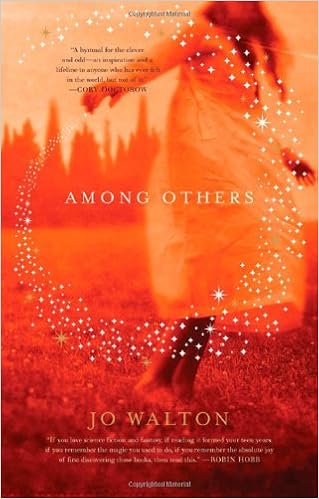
Jo Walton: Among Others (2011)

Edition: Tor (2011)
Review number: 1502

Diary of a lonely teenager? Misfit at boarding school? Both form and setting of Among Others may seem to have been done until there is nothing new which could be extracted from the limp and tired ideas. Has Jo Walton managed it?

Morwenna (Mor) has run away from her mother's home in Wales, and sought her estranged father, who she has not seen since she was a baby. Her father's sisters promptly see her sent to Arlinghurst, a boarding school, one specialising in sports - not the most sympathetic environment for a teenage bookworm with a damaged foot. Mor has another thing which makes her different: all her life she has been able to see fairy spirits invisible to most, and believes her mother is a witch whose powers Mor has inherited (though she does not want to use these selfishly, as she feels that her mother does). It is interesting that the school is almost completely devoid of magic - she has to work at it through acts like burning letters from her mother - unlike the spirit filled world of the Welsh valleys she knew before.

Much of the novel is about the science fiction she reads, exhaustively, perceptively, precociously, and perhaps unbelievably. Most of what she says will perhaps mean little to those who haven't read everything from Poul Anderson to Roger Zelazny, or those who, like myself, don't share her likes and dislikes. I can really see this book being virtually unreadable if you don't at least know something about Samuel Delany and gender politics, John Brunner and dystopias, characterisation in Ursula Le Guin, world-building in J.R.R. Tolkien (just to mention a few of the recurring topics and authors). But at the same time this extended love letter to science fiction is surely one aspect of this novel which made it successful in both the Hugo and Nebula awards, joining the handful of genre classics which have won both.

At the same time, it is possible to read the novel as a magic realist work, where the magic seen by Mor is her own way of dealing with her life - an imaginative piece of private world-building. It is perhaps important if this is Walton's intention (whether it is or not only really becomes clear at the end). In some ways, the imaginary world view of the novel is more interesting, and gives a completely different significance to the diary, as an act of therapy.

How much you like Among Others will depend very much on how irritating you find Mor as central character, how much you understand and sympathise with her likes and dislikes in science fiction. I found her more annoying as I progressed through the book, and the dogmatic science fiction pronouncements seemed less interesting and more self indulgent on Walton's part. This is perhaps because Mor does not seem to change a great deal, which is surely a realistic portrayal of a teenager starting a new school, especially not one with a traumatic past. The dramatic events which led to her arrival at Arlinghurst are followed by...nothing much really. Making friends and enemies. Lots of reading science fiction. A bit of learning - her introduction to the works of T.S. Eliot is one of the more memorable moments of the novel.

While I can see why Among Others won awards, it feels to me that it did not really deserve to do so. The subject matter resonated with science fiction fandom, which explains why it won. But I would rate it lower because Mor was so annoying, and also because to me the ending was trite and unconvincing. My rating: 5/10.

Friday, 9 May 2014

Connie Willis: To Say Nothing of the Dog (1997)

Edition: Gollancz, 2013
Review number: 1485

To Say Nothing of the Dog is a time travel novel, a farce around the idea of a professional time traveller sent to a time which is not his specialist historical period - Victorian England instead of the Second World War. A powerful and rich woman is trying to recreate the original Coventry cathedral destroyed in the Blitz after the sixties replacement is turned into a shopping centre. She is able to monopolise the services of the Oxford time travellers, retrieving items believed destroyed by the bombing at the last moment (so their removal doesn't create a paradox). But there is one ornament which is supposed to be there on the night of the bombing, but which can't be found - so operative Ned Henry is sent further back than 1940 to find out what happened to it.

In the 1880s, Henry gets involved with eccentric Oxford dons, a trip down the Thames, an upper class houseparty, and a manic attempt to introduce the right pair of lovers to each other so that the future is saved, even though Henry only knows the identity of one of them and the initial letter of the name of the other.

On top of this manic plot, Willis piles on a huge variety of references to other literature: a wide selection of the more popular English language writers from Jane Austen to PG Wodehouse and Robert Heinlein via Dorothy Sayers are either directly referenced or are clear influences. The book as a whole is a homage to Three Men in a Boat - the title To Say Nothing of the Dog is the subtitle to Jerome's comic classic. (I want to point out that the ending of The Moonstone is given away - so anyone planning to read Wilkie Collins' novel who doesn't want to know what happens beforehand should read that first.) Few of the references need to be familiar in order to follow To Say Nothing of the Dog; the most important after Three Men in a Boat is probably Gaudy Night. However, the more of them which the reader picks up, the more they will enjoy the game. This is a type of meta-novel which appeals to me greatly, and I would put several of them into my all time favourites list, of which To Say Nothing of the Dog is now also one.

Very funny, fantastically clever: To Say Nothing of the Dog leaps straight into my list of favourite science fiction novels. I'm a little surprised I hadn't read it before, as it's a Hugo winner and I have been avidly reading the genre since well before it was published, but now I am very glad I have done - 10/10.

Monday, 18 November 2013

John Scalzi: Redshirts (2012)

Edition: Gollancz (2013)
Review number: 1482

Redshirts is based on a fairly simple but effective idea. In bad science fiction television shows - and the original series of Star Trek was especially notorious for this - there are frequent missions in which the dramatic tension is racked up by killing off one of the characters, almost always an ephemeral one with no back story played by an unknown actor. In Star Trek, these individuals usually wore red shirts. Scalzi's idea is to look at these events from the point of view of the low ranking, inexperienced officers who would be likely candidates for death by the writers' pens.

What makes Redshirts more than a fan-fiction style parody is Scalzi's use of multiple levels of irony, as his characters gradually become aware that they are living in a fictional universe, when, in fact, they and the writer of the TV show are fictional products themselves. Not only that, he manipulates the plot to use this in a variety of ways, some more subtle than others. For instance, he invents an episode of The Adventures of the Intrepid, part of the novel's back story, in which an encounter with a black hole sends the characters back to 2010 (the date at which the episode is supposed to have been broadcast), which is, as the characters point out, a science fiction cliché which makes it possible to comment on contemporary society as well as (in a low budget TV show) saving on production costs. The ironic twist is that when Ensign Dahl and his companions use the same trick in order to complain to the show's writers about their treatment, they travel back in time to 2012, when Redshirts was published.

There is a widely circulated stereotypical view that Americans don't understand irony. This is something which Scalzi disproves with ease. When, therefore, we notice that, in his effort to highlight the absurdities in the cliché of the expendable extra, Scalzi has fallen into another common recourse of the lazy genre writer, the apparent weak character who turns out to be the hero of the story, we might well suspect that something else is going on. That this is common (good examples include stories by J.R.R. Tolkien, Robert A. Heinlein and Lois McMaster Bujold) is almost an understatement - it is something which is part of the appeal of science fiction and fantasy to the teenager and especially the stereotypical type of fan, the geeky social outcast. To some extent the use of this trope is n inevitable consequence of the premise of Redshirts: by concentrating on the minor characters, he is promoting them to central status. I am sure that Scalzi is aware that he has done this, and that it is therefore another ironic twist in the novel's construction.

John Scalzi's work is frequently compared to that of Robert A. Heinlein, partly because the military science fiction of his debut Old Man's War reminded people of of Starship Troopers. In a recent blog post, he asked people to suggest writers that his work might be compared to, and he specifically said that there was no point in answering, "Heinlein". Here, though, two other writers came to my mind. James Blish is an obvious point of comparison, as the writer of many Star Trek novelisations, though it is far too long since I read any of them for me to pick out specific similarities (and I think that TV science fiction, including Star Trek itself, is a far more important influence anyway). A more obscure writer, though, has touched on a similar theme, with the same kind of humour but without the irony: James Alan Gardner's League of Peoples series is about the role of ECMs (expendable crew members) in space exploration.

In my view, Redshirts is Scalzi's best fiction so far. I enjoyed Old Man's War and Agent to the Stars, but found The God Engines unreadable. I've generally found his blogging more interesting: I would urge everyone to read the fabulous collection of his blog posts in book form, Your Hate Mail Will Be Graded (almost worth reading from the title alone). Enjoyable, funny, approachable, yet with clever irony, I rate Redshirts at 9/10.