With the final film out, and the imminent arrival of the Pottermore website, it seems to be time to re-read the Harry Potter books. Whatever else they are, they are the publishing phenomenon of our time. The later books, and later the films, created an immense amount of excitement when they first appeared. Words used in the series such as "muggle" seem to have entered the language. The series starts out as a fairly standard children's school story about trainee wizards, a plot thread used by many writers before Rowling (Jill Murphy's Worst Witch and Diana Wynne Jones' Chrestomanci are two older series which immediately spring to mind).
What is it which makes them so popular? Will they continue to be so popular, or will Rowling be forgotten in fifty years' time - will she be Charles Dickens or Marie Corelli as far as posterity is concerned? Do the stories reward re-reading?
Note before reading, that this post contains spoilers to every book in the series. At this time, it seems reasonable to do this, given that the final sentence of the whole saga appears in the Wikipedia article on The Deathly Hallows.
Harry Potter and the Philosopher's Stone (1997)
Originally reviewed 2000.
The first book in the series sets the scene for the rest of the series. It is aimed at the youngest readers, and is perhaps most likely to be considered childish by older people. The plot takes the reader through Harry's discovery that he is a wizard, and a famous one too, through his first year at Hogwarts school, culminating with his first encounter with Voldemort's plots after his initial attack on Harry as a baby.
While still finding The Philosopher's Stone enjoyable, I tended to notice some more aspects of this novel which I think could have been better. The wizarding world may be deliberately less technologically advanced than the muggle one, but much about the muggle world still seems old fashioned than its nineties setting would suggest; the general feel is perhaps more seventies - the time of Rowlings' own childhood. The only more modern items in the story are the videos and computer games of Dudley Dursley, but they play little part; even Vernon Dursley's job is in the sort of heavy industry which hardly exists in post-Thatcherite Britain. The setting is mainly 1991, before widespread public use of the Internet, before DVDs; perhaps I have been forgetting how different life was before these things.
There are fairly obvious plot holes. Why do none of the teachers at Harry's primary school notice what must have been a fairly apparent case of problems at home? Why does Dumbledore move the stone from a secure location like a bank to a school (however heavily warded) where one of the teachers is tasked by Voldemort to find just such an item, and put it behind protective screens devised by the teachers which turn out to be beatable by three eleven year old children (not to mention a task requiring the capture of flying keys where a flying broom has conveniently been left for the use of anyone wishing to use one), for example? Indeed, why are the tasks apparently specifically designed to play to the strengths of the three central characters? Why is there not better vetting of the teachers? Vicious ones like Snape or simply incompetent ones like Binns might well appear in any school, but how did Quirrell get through - surely someone might have suspected that what happened to him over the summer had some serious consequences for his ability to teach and what he might be wanting to do? (This is an issue which is perhaps more acute in the later novels, particularly in The Goblet of Fire where an imposter fools Dumbledore into thinking that he is a man whom the headmaster knows personally.)
I also feel that the first couple of chapters are not the best way to start the novel. They act as a prologue, but the story would surely grab the reader more immediately if it started with Harry in his cupboard on the day that the first letter arrives. As it is, about half the novel is completed before he even arrives at Hogwarts, and the second half concentrates on the first few days at Hogwarts and then skips over most of the year until the final confrontation with Quirrell/Voldemort.
There are problems with the world building, too. The school seems to have a large number of Muggle-born children, but very little attention is paid to helping them understand the differences between the world in which they grew up and wizarding culture. Some aspects of magic, mainly ancient charms such as that which protects platform 9 3/4, or the commonplace animated photographs, seem hugely more sophisticated than others. Quidditch is a stupid game, pretty clearly a literary invention rather than something which is actually played. Most sports can be boiled down to a single sentence describing their basics: football (soccer) and similar sports such as hockey and basketball are about trying to score goals by putting the ball in the opposition's goal/hoop, cricket is about defending the wicket from the ball (or trying to hit it with the ball, depending on which side the players are on). But Quidditch seems to consist of two games played simultaneously, the seekers' search for the snitch and the rest of the players trying to score goals rather like polo, with the scoring biased extremely heavily in favour of the former, even though the snitch is too small for the spectators to see.
Humour is always going to be less effective the second time around. Indeed, I'm not entirely sure I'd classify humour as a major part of the novel as I did in 2000, let alone of the progressively darker sequels. There are amusing touches, mainly details of the magical culture, such as Bott's Every Flavour Beans, but much of it seems childish (Dumbledore's speech at the welcome banquet, for example), and it gives the impression that some of the world building is done just for the sake of humour rather than being integrated into the background and the plot of the novel. Though I suppose that to many people in the real world, particularly children, sweets are just there, and not subject to analysis.
Despite all this, The Philosopher's Stone continues to be enjoyable to read, and forms a pretty good introduction to the rest of the series. I'd rate it now at 7/10.
Harry Potter and the Chamber of Secrets (1998)
Originally reviewed 2000
I originally thought, reading one pretty much after the other for the first time, that The Chamber of Secrets was less amusing than The Philosopher's Stone. Now, however, I find the opposite to be true; clearly, the humour in The Chamber of Secrets survives re-reading better.
The plot covers the second year at Hogwarts for Harry, during which something is attacking students, and putting threatening messages on the walls about the Chamber of Secrets, hidden somewhere inside Hogwarts castle by one of its founders. He has particular problems with a house elf named Dobby - the first to appear in the series - who attempts to dissuade him from returning to Hogwarts and has various schemes which are supposed to be to keep Harry safe but which do not please the boy at all.
Some of the early parts of The Philosopher's Stone seem a little experimental: the characters of Dumbledore and McGonagall are not perhaps fully formed in the parts which precede Harry's arrival at Hogwarts, and are slightly different to their later selves. By this second novel in the series, things are more finalised and Rowling more confident as a writer, which means that The Chamber of Secrets holds together better.
In fact, The Chamber of Secrets seems to me now to be one of the best books in the whole series. The plot is less far fetched than that of The Philosopher's Stone - the explanation for the Chamber of Secrets is more believable than that behind the presence of the stone in the school. Additionally, it provides some information about the background of series villain Lord Voldemort which is made much more interesting to read than that in The Half-Blood Prince later on.
I'd rate The Chamber of Secrets now at 8/10.
Harry Potter and the Prisoner of Azkaban (1999)
Originally reviewed 2000
This now seems to me to be the best of the whole series. It has a wider scope than the first two instalments, but still retains a concision missing from this point onwards, with The Goblet of Fire being as long as the first three books put together, and the final three novels as long or longer.
I suspect that two characters introduced in The Prisoner of Azkaban, Remus Lupin and Sirius Black, are for many fans favourites among the large cast of Harry Potter supporting characters. They also have huge meaning for Harry himself, as the closest friends of the parents he never knew. One of the big difficulties in fiction is how to pass information needed by the reader; Remus and Sirius provide something of a masterclass in how it should be done, integrated into the plot and seeming naturally part of the narrative. Unfortunately, this is a lesson she seems to have completely forgotten by the time she wrote The Half-Blood Prince.
But Harry's discoveries about his parents do not all bring him delight. Throughout the novel, Hogwarts school is surrounded by Dementors, to protect the children from an attack by Sirius, escaped prisoner thought to be a vicious murderer out to get Harry. As is now well known, these are monsters used as guards in the wizarding prisoner of Azkaban, who feed on happy thoughts (they are, in fact, a rather allegorical representation of the effects of depression). Harry turns out to be be particularly susceptible to them, as their presence takes him back to a pre-conscious memory of the day on which his mother and father were killed.
On the first reading, the big surprise is clearly meant to be the revelation that Sirius Black is not the mass murderer he is thought to be, nor the betrayer of Harry's parents, but someone who has been falsely imprisoned for years. This of course is no longer a surprise on re-reading the book (nor probably will it be a shock to new first-time readers). The ingenuity of the ending, where a lot of minor plot strands (such as the mystery of why Hermione is able to take as many subjects as she does) come together, is no longer a surprise either, though it is still to a point interesting to pick out the various strands expertly woven into the story by Rowling to prepare for it.
The Prisoner of Azkaban would make little sense on its own, but ids definitely still a series high point, the moment where everything comes together as a writer for J.K. Rowling, before the huge success of the series seems to have blunted her edge.
I'd rate The Prisoner of Azkaban now at 9/10.
Harry Potter and the Goblet of Fire (2000)
Originally reviewed 2001
The fourth Harry Potter novel is something of a sudden change of gear for the series. It is much longer than the earlier novels, though shorter than those which follow. It is darker, starting with a killing and ending in an attack on Harry from which he barely escapes with his life as his companion is contemptuously killed with the command "Kill the spare" from Harry's enemy Lord Voldemort. And teenage sexuality starts to plan an important part in proceedings.
The story proper begins with the Quidditch World Cup, held in Britian over the summer holidays. The Weasleys have tickets to a match and invite Harry and Hermione to join them, but the even is ruined by an attack by Voldemort's death eaters on the Muggles at the campsite used for the crowds. The main plot of the novel is about the Triwizard Tournament, a most unusual competition between three champions, each representing one of the premier schools of magic in Europe. The tournament has been dormant for centuries because of the death toll, but it is revived at this moment for the sake of encouraging friendship among the schools; an extremely foolish thing to have done (sporting rivalry hardly ever leads to closer relationships between groups of opposing fans). The champions are chosen by a magical artefact, the eponymous Goblet, and Harry's name is chosen as an extra champion through a subterfuge, even though he is under the legal age to compete. This is effectively an attempt on his life, as the tasks the champions face would be pretty dangerous even for an adult wizard. . Naturally, few believe that Harry was innocent and didn't himself find a way to enter his name despite the charms in place to enforce the age limit, the assumption being that a celebrity will always embrace new opportunities for fame. Fame and its drawbacks are series themes, but this is the novel in which they are most prominent, probably as a reflection of some of Rowling's own experiences, particularly with the way that the press mis-reports Harry's activities, and the ethics-free zone which is reporter Rita Skeeter.
It seems to be a bit strange in terms of overall planning for the series to include the World Cup and the Triwizard Tournament in the same novel, but Rowling handles potential similarities quite well so that The Goblet of Fire does not appear to be too tediously sport related.
The longer story gives Rowling the space to be more expansive, which works quite well in the main. There are, however, a fair number of paragraphs, and even a couple of chapters, which could be cut completely without really being missed - The Weighing of the Wands, for example, adds minimally to the background, nothing constructive to the plot development, and nothing significant to the characterisation. Generally, Rowling uses the extra words to establish a stronger sense of atmosphere, which is one reason why The Goblet of Fire and the other later novels in the series come across as darker in tone. Before I re-read the novel, my memory suggested that the Quidditch World Cup was covered in a long-winded, hugely tedious manner over a hundred or so pages, but this isn't the case at all: the World Cup just takes a couple of chapters.
All in all, I feel that The Goblet of Fire is a below average entry for the series, but I am at something of a loss to explain why. There are holes in the plots of all of the books, but here it does in places seem particularly implausible. For example, the explanation given by Dumbledore about why Harry has to compete once his name has been drawn out of the goblet is rather unconvincing, since a magical artefact which has been so easily tricked into including his entry should not be difficult to trick again - particularly in a world with polyjuice and other tricks for hiding a wizard's identity. There would surely be some sort of safeguard built in, for example, if a chosen champion fell and broke their leg before the start of the first task, making them unable to compete through no fault of their own. More importantly, why was Dumbledore unable to detect changes in a friend of his who is being played by someone else magically transformed in appearance - it should be just about for Barty Crouch to play Moody in front of someone who knows him better. Moody himself advocated the use of questions with answers only known to the questioner and the person seeking to establish their identity as a test; why doesn't Dumbledore do that? Come to that, after the similar problem with Quirrell in Harry's first year, why aren't there charms around Hogwarts to make such an impersonation impossible? (The need to use a compromised teacher twice in the series suggests a certain poverty in Rowlings' imagination, too.)
I really quite liked this entry in the series a decade ago - my review was based on an all night reading session to finish the novel in one sitting. Other people also liked it: The Goblet of Fire was the only Harry Potter book to win a Hugo award. But on more careful re-reading ten years later, it doesn't really stand up so well. My rating now: 6/10.
Harry Potter and the Order of the Phoenix (2003)
Originally reviewed 2003
I was rather disappointed with The Order of the Phoenix first time round, but unlike The Goblet of Fire, I have warmed to it since and now think it rather better than its predecessor.
The plot is similar to the other novels, with more mature themes than the earlier books. Harry is still having to spend the summer holidays with the Dursleys, and is extremely cross about it, particularly because the letters he receives from his friends are uninformative. Then things start to happen - a Dementor attack targets his cousin Dudley, and Harry saves him with the Patronus spell, only to be summoned to a hearing for underage magic. He then discovers that the magical press has been portraying him and Dumbledore as deranged for believing in the return of Lord Voldemort over the summer: the Ministry of Magic wants to deny that this has happened to help Cornelius Fudge stay in power as minister.
Then, when the school year starts, the Ministry is interfering at Hogwarts, enforcing the appointment of nightmare teacher and Ministry official Dolores Umbridge as Defence Against the Dark Arts teacher. Naturally, she persecutes Harry especially, and his lack of control of his temper gives her the excuse to, for example, ban him from playing his beloved Quidditch for life. At the same time, he has visions of the actions of Lord Voldemort, and lessons from Professor Snape in a method to prevent this are utterly unsuccessful due to the antipathy between the two of them; eventually, Voldemort is able to take advantage of the connection to get Harry and some of his friends to fall into an ambush at the Ministry of Magic. The battle which follows effectively concludes the book, the death of Harry's godfather Sirius Black putting a damper on Harry's victory.
While Harry's teenage angst is interesting, and presumably likely to appeal to those of a similar age to the boy in the book, it is not treated in great depth. Rowling is no Homer, The Order of the Phoenix no Iliad, and Harry's anger not the wrath of Achilles of which Homer sings with the help of the muse. For a long novel, The Order of the Phoenix has a plot which seems to move quite rapidly, and builds up effectively to the battle in the Ministry; a development which is the most effective of any of the novels in the series. It is easy to get caught up and ignore the problems.
And problems there are. Like the other later Harry Potter novels, The Order of the Phoenix could do with cutting, but less so as it is better structured to fill the length it has than the others. There are (minor) inconsistencies between details here and the background elsewhere. In the Ministry battle, for instance, spells which are fired by both sides but miss their human targets cause damage to the Ministry building and its contents, which is somewhat different to the precision with which spells seem to work in most of the stories. There is the idea that a prophecy can only be retrieved from storage by someone mentioned in it, but when the children start destroying the store to divert Voldemort's followers, the stored prophecies start to recite themselves - it should, presumably be impossible to move them from the shelves even if the shelves are destroyed if the same rules which apply to the prophecy concerning Harry and Voldemort apply to the rest of them.
But in the end the faster moving plot makes this the most gripping of the later novels. My rating now: 8/10.
Harry Potter and the Half-Blood Prince (2005)
Originally reviewed 2005
The first four chapters and the last four chapters of The Half-Blood Prince are among the best in the whole Harry Potter series. Each of the first group is different from the others, even though they all involve meetings, encompassing the introduction of the new Minister for Magic to the Muggle Prime Minister, the confrontation between Narcissa Malfoy, Bellatrix Lestrange and Snape, Dumbledore talking to the Dursleys about Harry, and the recruitment of Slughorn as a teacher by Dumbledore and Harry. The last four, with the trip to retrieve a Horcrux and the attack on Hogwarts by Death Eaters which culminates in the death of Dumbledore (an event which I didn't want to reveal in my original review) also show Rowling's quality as a writer of action scenes. The latter is a really good example of a major strength of Rowling's work in Harry Potter: it is full of clues to events in the final book and with ambiguities which will also be drawn on in The Deathly Hallows.
It is a pity that the twenty two chapters in between are so dull. There are some other good bits, but the whole thing sinks under two heavy burdens: the irritation caused by Harry's obsession with Draco, and the dullness of the revelations about Lord Voldemort's early life as revealed to Harry in the special lessons he has with Dumbledore.
Throughout the whole series, the contemptuous dislike between Harry and Draco is a major theme of the stories. In this book their enmity comes to a head, and Harry is paranoid about what he might be up to, with some reason, as it turns out. But it is not really justified by the evidence available to him, as even Hermione and Ron are willing to point out. The extreme nature of Harry and Draco's obsession with each other is surely one reason why homosexual love between them is such a popular theme on fan fiction sites. The purpose of it here is partly to keep the reader guessing what exactly Draco is up to (the second chapter makes it clear that he is indeed up to something), and the continuing tension is meant to develop the characters, something which I did pick up from The Half-Blood Prince the first time around. But on a second read, it all just becomes tiresome adolescent posturing, which may be true to the emotional maturity of sixteen year old boys but which is not interesting to read about.
The imparting of background information is something which is particularly difficult in science fiction and fantasy, where the world being portrayed is unfamiliar to the reader. Rowling has actually been quite good at it up to this point, aided by the common device of a viewpoint character who is also new to the world being described: useful, because they can ask questions without the reader wondering why they needed to when it would be common knowledge. But here there are great dollops of recorded memories of the early years of Lord Voldemort: tedious, unnecessarily lengthy, tales. The reader (and, indeed Harry too) does not need to know every detail of Voldemort's back story to support Dumbledore's suspicion that Voldemort has created Horcruxes, dark magical objects which store parts of his soul and which give him an immortality of sorts (he cannot truly die while any of the Horcruxes are in existence).
This means that The Half-Blood Prince feels the hardest work to read of the whole series, which makes it particularly unrewarding a second time around. I feel that this is the poorest of the novels, and would now rate it at 5/10.
Harry Potter and the Deathly Hallows (2007)
Originally reviewed 2007
When I first read this, back in the summer of 2007, the hype and interest was such that I reviewed the novel when I had only completed the first ten chapters, in order to ensure that I did not include any spoilers in what I wrote: a unique distinction among the over 1400 reviews published here. But now I think it is safe enough to reveal what happens, especially as the ending and the epilogue are quite important influences on my opinions about the book, and, because they give the reader their final impressions, of the series as a whole.
The Deathly Hallows seems very different to the rest of the series. One contributing factor is the setting. The main locations used by the other stories (Privet Drive, the Burrow, and most of all Hogwarts School), appear only in a few chapters each, with most of the rest of the story following Harry, Hermione, and (for most of the time) Ron searching the country for the Horcruxes. Another is character. Dumbledore is of course killed at the end of The Half-Blood Prince, and it is in this book that his absence makes it clear just how important he is to the tone of the other stories. But the difference is also that in The Deathly Hallows, things really become serious; all that has happened before is in a sense just training to prepare Harry for the end of this book. (That isn't to say that the humour is lost entirely, as I noted the first time around.)
The important event which sets the plot in motion is the fall of the Ministry of Magic to Voldemort and his followers. A regime which Rowling clearly models on Nazi Germany is instantly set up, with checks on the "blood status" of witches and wizards, checks that Voldemort himself, with a Muggle father, would fail (a rather over-emphasised irony). This also leads to Harry becoming a wanted fugitive as "Undesirable Number One", and sets him along with Ron and Hermione off on the hunt for the Horcruxes. The hunt forces them to turn up in places which are not good refuges for people on the run - for example, they raid wizarding bank Gringotts after discovering that one of Voldemort's followers stores a Horcrux in her vault there.
The book climaxes - with the climactic battle between Voldemort's followers and his opponents at Hogwarts, coinciding with Harry and his friends arriving to track down the last of the missing Horcruxes (there are two more, but they are not exactly accessible to be destroyed at this point). Harry turning up is the trigger for the arrival of Voldemort's forces. It is as though (at the end of the Lord of the Rings) Frodo arrives at Mount Doom to find that it is actually the location of the Battle of Pelennor Fields. The combination makes the story rather bitty, as the the viewpoint switches between the various groups of fighters and Harry as he approaches a final confrontation with Voldemort. All in all, it's exciting, but by this point there are few surprises - I suspect most readers work out the meaning of the prophecy pretty much as soon as they know the properties of the three Hallows, and this is the key to what happens in this chapter. The direct confrontation may be more visceral, but (although generally I don't feel that Tolkien is a great writer), the Lord of the Rings does it better, giving the impression that the older story is based on a more mature understanding of the nature of evil.
Following this climax, there is the inevitable chapter for tying up loose ends, mostly. Then there is the Epilogue, set nineteen years later. Both of these are naturally anti-climactic, but the Epilogue is more interesting. What it describes is a domestic scene in the household of Harry and Ginny, now married and getting ready to take their second son to Kings' Cross station to catch his first train to Hogwarts. Rowling doesn't use it to tell the reader what happened next to the other characters, other than incidentally - among those we do learn about are Neville, Ron, Hermione, and Draco. We don't know what Harry does for a living, or any of the others except for Neville. But one thing is very clear: Harry has finally managed to get away from his fame as the Boy Who Lived. His children don't even know that he is a celebrity, which is somewhat unlikely - their oldest child James Sirius must surely have been the subject of gossip at Hogwarts. The wizarding world has not forgotten Harry, as is clear from the reaction of the those on Platform 9 3/4 when the family arrives. I know that J.K. Rowling has not precisely been comfortable with the fame that Harry Potter has brought her, and that this has found its way into several books (notably in terms of Harry's portrayal by the media). Personally, I feel that the Epilogue is not terribly interesting, and doesn't add much to the end of the book. Its main purpose is to mark that this is the end, and close off at least some of the fan desire for a sequel, through the final words "The scar had not pained Harry for nineteen years. All was well." I think that Rowling could have found a more interesting way to make this clear. In the end, the Epilogue detracts from the book and the series as a whole.
Understanding death is the main theme of the book, and has been important through the whole series because of Voldemort's continuing obsession with immortality. This works well as the mainspring of the plot, and Rowling's apparent message, that death at the end of a fulfilled life is to be peaceably accepted (as in the Nunc Dimittis, from the gospel of Luke, used as a prayer in the liturgies of many Christian denominations), marks the light from the dark effectively. So Harry can go to meet Voldemort expecting to die, and then deliberately lose the Resurrection Stone in the forest, as Dumbledore accepted his death at the end of The Half-Blood Prince, using his knowledge to promote the anti-Voldemort agenda.
A fitting end to the series (Epilogue excepted), and one of the better novels. My rating - 8/10.
The Series as a Whole
Like other school stories before this, Harry Potter describes a school year in each instalment; another obvious example for children being the Enid Blyton Malory Towers books. This gives a well defined timespan to each story, but does give the individual plots a degree of predictability, compounded by Rowling's structural plan of ending each book with a climactic battle with Voldemort. The seventh book is a little different, as Harry never actually makes it to the school until the final battle, which takes place there.
Hogwarts is an odd place to find in a series of books published around the turn of the millennium. It is a boarding school, not a type of school which will be familiar to the vast majority of the readers. It is more common in books, though, perhaps because such a school has a built-in isolation which makes it easy to give the story a circumscribed location: while at the school, Harry rarely goes outside the grounds, particularly in the earlier books. The use of the boarding school is extremely old fashioned, giving the story something of the feel of a homage to books from the thirties and forties like Blyton's, or to C.S. Lewis' Narnia stories, featuring children who also board, though the schools play little part in the novels.
The plots of the earlier novels in particular follow effectively the same plan: over the summer Harry is introduced to something he hadn't come across before in the wizarding world, while being unhappy with the Dursleys; then he gets to school after some minor adventure; school is wonderful but overshadowed by various issues, including Snape and Malfoy; he does something (or has something done to him) which makes him unpopular with the other students; then a final testing adventure at the end of the year closes the book as a climax.
Encapsulating a school year in each book, and making the age group aimed at increase each time (perhaps suitable for readers a year or two younger than Harry if they are good readers for their age), is a good idea when the books were first released, as child fans would have grown a year in between the publication dates. Of course, it doesn't work now that all of them are available, and this is something that parents need to consider: The Deathly Hallows is unlikely to be suitable for a nine or ten year old.
These two aspects of the stories give them a sort of version of two of the three unities: time (a year, rather than a day) and place (though Hogwarts is quite a large and complex scene). Usually, novels do not approach anywhere near a unity of action, tending to focus on one main character's actions, thoughts and emotions, rather than on a single plot line, but unity is also provided here by the concentration on the struggle between Harry and Voldemort.
The three main characters are something of a cliché, too. The hero and his two helpers are common enough in fantasy fiction to be parodied in China Miéville's Un Lun Dun: the chosen one, the clever one, and the funny one. Harry, Hermione, and Ron fit very well into these slots, even though Rowling does try to make them more three dimensional than this.
The length of the later novels is a problem, as it seems to stem from a lack of willingness to cut rather than a need to include all the material, particularly in The Half-Blood Prince, the dullest of the novels. Each of the last few novels would be improved by judicious pruning, of at least fifty pages of material if not more.
What will the new Pottermore website do to J.K. Rowling's reputation as a writer? I have not yet read any of the material it contains, only the reactions of others to it, and it sounds like a collection of more or less finished background material, fleshing out the gaps in the series. This hardly ever works well - The Dune Encyclopedia is a similar sort of collection (different mainly by not being written by the original author), and served only to reduce the stature of Frank Herbert's books. The main problem with this sort of collection is that you need to be really fanatical about the stories to appreciate the details, and even then, you may prefer to use your own imagination to fill in the gaps.
All in all, I would say that the series is good, but not particularly original. The characters are well drawn, but stereotypical. The background is fun, but doesn't give the impression of consistent world building - details seem to be decided on for the purposes of the moment, not to fit into any overall structure. The plot of the series as a whole is very typical fantasy genre, the chosen hero coming of age and fighting the strong evil; but at least there is some grey in the "good" characters. And of course, the writing is quite addictive: first time around, I read several of the books in one sitting, with deleterious affects on my sleep. However, on re-reading, I've felt mystified as to why it has been just so popular; there are any number of better fantasy series around. So I'd bet that Harry Potter will be a minor footnote, barely remembered, in fifty years' time.
Review number: 1430
Thursday, 22 September 2011

Saturday, 13 August 2011
David Mitchell: The Thousand Autumns of Jacob de Zoet (2010)
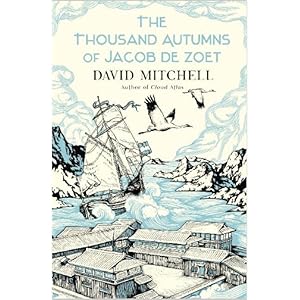
The Thousand Autumns is a novel about culture clash, between two representatives of two countries effectively in decline. During the novel, the Netherlands is conquered by the French Revolutionary armies, after which its status as a colonial power is greatly lessened; the Japanese shoguns continue the policy of seclusion until 1853 (when the American navy forces the borders to be opened more fully) but even in 1799 it is pretty clear that this end is inevitable in the face of superior technology.
Like Ghostwritten, The Thousand Autumns has a supernatural element, in the doings of villainous abbot Enomoto. Through a bloody ritual involving the sacrifice of babies born to coerced and drugged nuns, he has gaind himself an unnaturally extended lifespan. It is tempting to believe that he is some kind of magic realist symbol, like the children in Midnight's Children, in this case an embodiment of the tyrannical and outdated isolationist regime of the Shogun. The picture of Japan on the cusp of the nineteenth century painted in this novel is pretty repellent, made up of fear, paranoia, and cruelty. Most of the European characters are not much better, either, being depicted as bigoted, uncultured, crude, and venal. Enomoto is not like most of the other Japanese characters, while the Europeans are less nasty but their vices are more widespread through the population.
With a historical novel, the question which is always asked is how accurate it is (though the answer does not necessarily make much difference to how enjoyable or interesting it is to read). Mitchell apparently went to a great deal of trouble to ensure that the details were accurate, but his own emotional reaction to the society may colour his writing about it; but even so, I would certainly not wish to have lived there and then. The attention to detail definitely makes the novel very convincing. This is not an episode of history I was particularly knowledgeable about, and it does make for a fascinating novel.
Not as good as Ghostwritten or numberNineDream, but more straightforward (and to my mind infinitely superior as a historical novel to Hilary Mantel's overrated Wolf Hall), I rate The Thousand Autumns of Jacob de Zoet at 8/10.
Edition: Sceptre, 2010
Review number: 1429
Sunday, 24 July 2011
Imogen Robertson: Anatomy of Murder (2010)

This means that towards the end of 1781 they are asked to look into a body found in the river Thames, a body of interest because it had been tied town to keep it from being found - a subterfuge which failed because the killer didn't take into account the action of the tide. The dead man turns out to be a former musician from the opera house, bringing the world of eighteenth century music which featured in Instruments of Darkness into this novel as well - perhaps an unlikely coincidence, but clearly allowing Robertson to write about a world with which she is familiar and comfortable: the case involves castrati, a French soprano in fact born in the London slums, and the relationship between the opera and high society. A suspicion of espionage - the novel is set during the American War of Independence after all - provides the driving force behind the crime and its aftermath, though this is never really very convincing. The mystery itself is not particularly taxing to unravel for the reader, but the story does manage to hold the interest nonetheless.
Anatomy of Murder is a lighter read than Instruments of Darkness, lacking much of the Gothic atmosphere of the earlier novel, despite the introduction of a Tarot-card reading fortune teller. The world of the opera in London is a brighter, more passionate one than the decaying manor in the depths of rural Sussex which formed the background of Instruments of Darkness. Though squalor and deprivation are depicted, London is never made as sinister as the countryside. Moving the setting to London allows Robertson to show her extensive background knowledge of a different aspect of eighteenth century England.
The misanthropy of Gabriel's character has been softened somewhat, too, though the lack of romantic tension between Gabriel and Hannah remains a strength: the avoidance of the crime genre cliché of the detectives who start to fall for each other because of working together marks out Imogen Robertson's work as refreshingly different from the norm. After all, people often work together in the real world without developing a romantic attachment.
Sometimes sequels can be read on their own without spoiling the first book too much, but Anatomy of Murder is not really one of these. It gives away a great deal which the first time reader of Instruments of Darkness would probably prefer to first encounter in its proper place. There is of course no reason why sequels need to be stand alone; but it is a warning that the earlier story should definitely be read first.
Even though less good than its prequel, Anatomy of Murder is still an atmospheric piece of historical crime fiction, with central characters who are consistently interesting - if not entirely likeable. It could do with a better and more convincing mystery, though, which is why I rate it only at 6/10.
Edition: Headline, 2010
Review number: 1428
Thursday, 7 July 2011
John Meaney: Bone Song (2007)
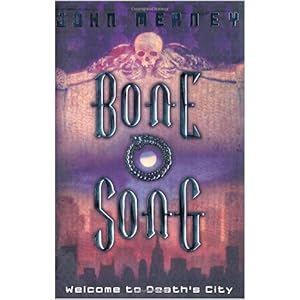
While not as revolutionary as Baxter's praise suggests, Bone Song starts in a marvellously atmospheric and imaginative manner, evocatively written with a compelling central character. The setting is Tristopolis, not just the "city of sadness" its name suggests but somewhere where death is all important; ghosts and zombies are among the citizens, and wraiths power many machines, while a mystical process applied to bones provides the fuel in the city's power stations. Donal Riordan is a policeman in Tristopolis, assigned to protect a visiting opera singer: she is the next potential victim of a killer who is murdering creative people because their bones can be used to experience a "high".
The excellence of the first hundred pages is not maintained. Much of the middle of Bone Song seems to this reader to consist of dull running around by Riordan and his colleagues, provoking a tedium which perhaps makes it more true to life than many police procedurals. The interest does pick up again towards the end, and, while it never shows sufficient originality to justify Baxter's praise, Bone Song remains an intriguing novel.
In a further bout of hype, the back cover also describes Bone Song as "an extraordinary melding of visionary SF and dark horror". This might have been more convincing if China Miéville and Neil Gaiman (to pick two writers who came to mind while reading this story) had never published their fiction. While the background is more like Miéville, there is a stylistic influence from comic books which suggests Gaiman. There is even a paragraph where Meaney uses a common comic book technique where dialogue is interrupted by action but then continues as though nothing had happened: along the lines of three frames containing "Stop..." | THUD | "...that" as text.
As for a rating: I'd give the first and last thirds 9/10, and the middle 3/10, which averages to 7/10 overall.
Edition: Gollancz, 2008
Review number: 1427
Thursday, 23 June 2011
Arthur C. Clarke & Frederik Pohl: The Last Theorem (2008)

The Last Theorem is a novel about an alien invasion of Earth, a theme of science fiction which goes all the way back to The War of the Worlds. Concerns today are not those which prompted Wells to produce a novel which is about colonial warfare, however; the motive for the invasion here is not a search for resources, but pest control. Immensely powerful aliens have detected the explosion of the first nuclear bomb on Earth in 1945 and applied their inflexible rule: eradicate the dangerous vermin who act so aggressively. This is surely not a very original scenario (even though I cannot immediately think of exact parallels), and it is indeed not the most interesting part of the novel.
For while the aliens are travelling to Earth (making use of some "loopholes" in the laws of relativity, but still slow enough to allow the plot to unfold), human beings are continuing their usual lives. The authors focus on one man, a Sri Lankan mathematics student at the beginning of The Last Theorem, who goes on to prove Fermat's Last Theorem. (This requires a certain amount of explanation, as Andrew Wiles was already famous for this feat before the novel was written. But Wiles' proof is far too lengthy to be the one Fermat was unable to write in the margin for lack of space, and that is the proof that Ranjit Subramanian finds. In addition, the authors feel - as indicated in their postscript comments - that a proof which relies on computer checking is not really as convincing as one in which the details can be grasped in their entirety by a human mind. So Ranjit's fictional five page proof is the "real" one.) The proof brings him international celebrity and a role in the alien encounter to come (though his daughter coincidentally has an even more important part to play).
At the start of The Last Theorem, the narrative voice is jocular and quite informal; and irritating. But one of the most impressive aspects of the novel depends on this. Once something unpleasant happens to Ranjit (the bridge between being a carefree student and an international celebrity), the narrative voice changes, and becomes more grown up.
The Last Theorem, while readable, is not the best work of either Clarke or Pohl by a long way. As well as the sloppy plotting of the coincidence already mentioned, there are other incidents in the story which don't really ring true. There is nothing new in the basic ideas in the novel. The mathematical components are well done, if you're interested in that sort of thing, and no prior knowledge is needed. But perhaps that is not really enough from two of the greatest writers of the science fiction genre - 4/10.
Edition: HarperVoyager, 2009
Review number: 1426
Thursday, 9 June 2011
William Heaney: Memoirs of a Master Forger (2008)

Heaney is also involved with working with the homeless, sitting on various quangos and Home Office committees, and directly supporting a hostel named GoPoint, something of a thorn in the flesh of the authorities, but where some amazing work to help the most difficult cases is carried out, led by a woman whom Heaney has no hesitation in describing as an angel.
The plot of the novel combines two events from the narrative present with flashbacks to show the path which led Heaney to the life he lives. Heaney is divorced but unable to let go of his relationship with his ex-wife; but now he meets another woman with whom he rapidly falls in love. At the same time, he tries to stop a homeless former soldier from blowing himself up at the railings of Buckingham Palace, and the man passes him a notebook, which describes how this man also became able to see demons during the (First) Gulf War. The flashbacks tell Heaney's equivalent story, of how writing a fake Satanic ritual manuscript found by a fellow student who used it to successfully summon a demon caused him not just to see demons but to drop out of college and become homeless for a while himself.
Much of the novel turns around conversations in old London pubs, and Heaney clearly revels in them and their connections (one pub is where Blake had lodgings, another where some of the bones of Thomas Paine were allegedly interred in the cellar, for example). Their story is described as the basis for "an alternative history of London", and their associations are said to make them a fertile ground for demons to hunt. The atmosphere created by these scenes is reminiscent of one of my favourite novels, Michael Moorcock's Mother London.
The story written in the first person by a narrator who shares his name with the book's apparent author. First person narrative by a character who has the name from the front of the book is a device which underlines the memoir form, which is as common there as it is unusual in fiction. (And can you think of any third person memoirs other than Caesar's Gallic Wars?) He has a voice which convincingly seems to be rooted in the experiences he has had, which makes the memoir conceit work quite well. Incidentally, the actual author, award winning fantasy writer Graham Joyce, also published the novel under his own name at about the same time as this paperback edition came out, using the title How to Make Friends with Demons, a much less interesting way to publish with an inaccurate, much less intriguing (indeed, rather off-putting) title. It's the name of a book referred to in the novel, but, as Heaney spends just about all his time avoiding demons, it's not at all indicative of the content.
Another reason to prefer the Master Forger title is that it suggests a certain way of thinking to the reader: if the author describes himself in these terms, how much of what he says is trustworthy? It is almost as clear an indication that he is an unreliable narrator as it is possible to get (perhaps surpassed only by the beginning of Iain Banks' Transition). The idea of an unreliable narrator always fascinates me, as it is interesting to try and work out what is really going on (in fictional terms) from what they tell you, somewhat like the way that the investigators of a crime try to decipher what actually happened from the testimonies of more or less accurate witnesses. Is the reader really meant to suppose that Heaney really does see demons, or are they a product of his mental instabilities and obsessions? (In other words, is Memoirs of a Master Forger a fantasy novel or about delusion?) Was that really the reason why he dropped out of college without even a word to his fiancée? Was his involvement in Satanism quite as secular and relatively innocent as he makes out? Is there a reason why he sees only demons and not angels - something to do with his spiritual state, attitude to the world, or the nature of London in the twenty-first century?
With sly humour, interesting characters, atmospheric setting and a supernatural edge, Memoirs of a Master Forger is a fascinating read - 8/10.
Also published as How to Make Friends With Demons, by Graham Joyce
Edition: Gollancz, 2009
Review number: 1425
Saturday, 4 June 2011
Ursula K. Le Guin: The Word for World is Forest (1972)

The Word for World is Forest was not quite long enough to qualify for the best novel category in the Hugo awards (which she won twice), but it won the best novella category, before appearing in stand alone book format in 1976 (it originally formed part of the famous anthology sequel, Again, Dangerous Visions).
Like much of Le Guin's work, this novel is inspired by her knowledge of anthropology. Indeed, there is little of the novel which demands a science fictional setting: the "world" could fairly easily be some remote part of Africa or New Guinea. The point of using science fiction, other than Le Guin's established reputation in the genre, is that it enables the writer to create her own background, one which emphasises the points she wishes to make. As a result, the story does sometimes seem rather one sided, but the spiritual effects on the Athsheans which result from their espousal of violence are in the end striking: by becoming as vicious as the humans, they destroy a precious part of their culture forever, knowing that this will be the outcome of their actions.
In one way, Le Guin does undermine the point she is trying to make, as far as I am concerned: she adds a feminist element. The culture of the colonists as she depicts it is extremely male-dominated; human settlements are basically logging camps filled with macho lumberjacks where the only women are prostitutes and concubines. These women have no voice in the story: they don't even have names, being referenced by their measurements; they are objects used by the men for stress relief. They do show that the men can behave bestially towards people far more like them than the Athsheans. In the end, unless her overall point is less than I think it is - unless Le Guin is saying that a culture in which women are less than equal with men is capable of terrible crimes - the women are a distraction and dilute the impact of the story.
In the author's note at the beginning of Knowledge of Angels, Jill Paton Walsh wrote: "A fiction is always, however obliquely, about the time and place in which it was written." The Word for World is Forest is not really about aliens and the future, but about us, here and now - at least, as much as the world has not changed in the last forty years. It is an attack on colonialism, both as practiced in the past and in our own time, as rich western nations grind the so-called third world in poverty and hopelessness - and it could well be intended as a warning to the complacency of the western world. It obviously exaggerates for effect, as no earthly culture has ever been as innocent as the one portrayed here. There is also an underlying criticism of science fiction in general. The theme of the colonisation of an alien planet by humans is a commonn theme in the genre, and usually the author is put firmly on the side of the plucky colonists. But, Le Guin tells the seventies SF community, that is not the only imaginable side of the story. There are often clear parallels between tales of colonisation and westerns, and Le Guin is putting the side of the American Indians.
Re-reading The Word for World is Forest, I was struck by just how much it seems to have influenced a film made almost forty years after the story was published: Avatar. The Athsheans are not hugely similar to the Naavi, but much about the setting and the ecological parts of the message are really close. I'd recommend the book to anyone who enjoyed the film.
Though others might choose The Lathe of Heaven or The Left Hand of Darkness, my choice as Le Guin's greatest work would be this compact story. Even so, it has never inspired the affection I still feel for the first of her books I ever read, the Earthsea trilogy. The Word for World is Forest is Ursula K. Le Guin writing uncompromisingly an unpalatable message for adults; it is not a novel the reader is meant to like, but one which is meant to hammer home its point. My rating for one of the most effective uses of science fiction: 9/10.
Edition: Tor, 2010
Review number: 1424
Subscribe to:
Posts (Atom)

 Posts
Posts

