Original title: Voyage to Venus (Buy from Amazon)
Edition: Pan, 1960
Review number: 930
Medieval theologians argued about the question of the multiplicity of worlds, whether there could exist other environments which were home to living creatures. A major issue in these arguments was the way in which the fall and redemption of mankind would have affected such communities - were the sin of Adam and Eve, the incarnation and crucifixion events that happened only on earth but affecting the rest of the Universe, or were there parallels to them elsewhere, or were there even communities where the fall hadn't taken place at all?
Since science fiction writers began approaching the issue of extraterrestrial life from another point of view, this has become of interest once again. There are at least two novels of note which take these theological questions as their starting point - this one, the second of Lewis' Ransome novels, and James Blish's A Case of Conscience. Perelandra - the original title was insisted on by the publishers and never pleased Lewis - is a truly magical tale, completely unique in the science fiction genre.
Ransome is commissioned to go to Perelandra (Venus) by the eldila (the angelic supernatural agents encountered in Out of the Silent Planet); he is propelled there in a coffin-like box. Perelandra turns out to be a newly living planet, the description of which owes much to that of Tormance in David Lindsay's A Voyage to Arcturus, a novel which the publisher's title for this one seems designed to evoke.
After some time just enjoying the way that everything on Perelandra is full of life, Ransome meets a human native, a glamorous and beautiful woman who is the equivalent of Eve, and the purpose for which he was brought to the planet becomes clear when Weston, the physicist of Out of the Silent Planet, turns up. Weston has now been completely posessed by the spiritually evil power who rules the earth, and he aims to bring about the Fall again on Perelandra. Ransome is there to argue against him.
These arguments take up quite a lot of space in the novel, and make it among the most theologically explicit pieces of Christian apologetics in Lewis' fictional output. This may put off many readers. However, the dramatic interest of the idea of the argument and the descriptions of the pre-Fall planet make Perelandra still one of my favourite science fiction novels.
Friday, 31 August 2001

Justina Robson: Silver Screen (1999)

Review number: 931
One of the most important themes of science fiction since at least the publication of Neuromancer in the mid eighties has been the future of computing. Silver Screen is a novel in this tradition, and is, like Neuromancer itself, about the nature of artificial intelligence.
The central character, Anjuli O'Connell, stands out from those around her because of her high intelligence and perfect memory. Ever since her childhood in a school for gifted children, she has worried about the nature of her own mind - she may seem to be an unusually intelligent human being, but does her memory mean that she is actually some sort of freakish machine? She cannot convince herself that she relates to the world and, more specifically, other people, in the same way that the other pupils do and this creates a massive feeling of inferiority in her.
Years later, and she is one of the world's most prominent AI psychologists; she works on 901, latest in a series of evolving, self-replicating and massively complex systems. Following the suicide of one of her closest and oldest friends, the unstable Roy Croft, a legal bid is made to have 901 declared a person with the same rights as any human being. Anjuli's employers OptiNet are fighting this, and she is clearly going to be the major expert witness. Roy's death is also connected in some way to the theft of some dangerous nanotechnology from OptiNet's laboratories, and Anjuli's boyfriend has become obsessed with military cyborg technology; both of these problems are things she finds very disturbing.
While it is possible to criticise aspects of Silver Screen - Anjuli's ability to do mathematics better than her classmates because of her memory is unlikely, there are inconsistencies about the levels of technology required for some of the different computer systems, and the way that the trial goes ahead quickly and apparently without any legal wrangling is very unlikely - it is a clever novel which has something interesting to say about our relationships to computers, now and in the future.
Thursday, 30 August 2001
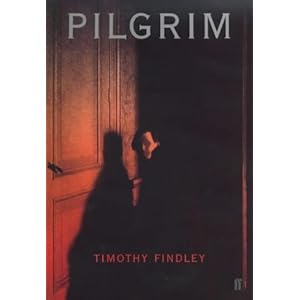
Timothy Findley: Pilgrim (1999)
Review number: 929
What can you do with a man who persists in attempting to commit suicide, yet always comes back to life after doctors pronounce him dead? In this novel, set in pre-First World War Europe, the answer is to pack him off to the Burghölzi clinic in Zurich, a centre of the new science of psychiatry, where Jung is one of the medical staff.
The novel tells the story of Mr Pilgrim's treatment there, and the reader has to make the same decision as the characters: what should be made of his story, that he has been living for hundreds of years as a variety of people - the model for the Mona Lisa, a shepherd boy befriended by St Theresa of Avila, a craftsman at the construction of the windows of Chartres cathedral, and so on.
With its theme of long life and gender swapping, the obvious novel to compare Pilgrim to is Virginia Woolf's Orlando. Though the similarities are more than superficial, there is a profound difference. Orlando is about a particular personality (it is a portrait of Vita Sackville-West), but Pilgrim is about the mind. That, I think, is the reason for the different types of people he has been.
Another aspect of the interest in mind in the novel is the depiction of the Burghölzi. There, Pilgrim and some of the other patients seem happier than the doctors, all of whom, including Jung, are portrayed as understanding little of what they are doing.
Pilgrim is a fascinating novel, written in a style reminiscent of Jill Paton Walsh which gives it a magical air.
Leslie Charteris: Thanks to the Saint (1958)

Review number: 928
In this late fifties collection of six stories, Simon Templar returns to the America that has really been his home for the preceding twenty years. It is not one of the more interesting collections, though it does have an unusually high proportion of tales where the Saint is investigating a murder. The reluctance with which he does this is something of a running joke throughout the entire series of stories, objecting on the grounds that he is an action hero rather than Sherlock Holmes, but he does usually take on the role reasonably competently. (The motive for doing so is normally that the police automatically assume that he is responsible for any crime committed while he is in the neighbourhood, so he is working to clear his name. In these stories, this isn't the case, for some reason, but the reluctance is still there.)
Wednesday, 29 August 2001
John le Carré: The Secret Pilgrim (1991)
Edition: Coronet, 1991
Review number: 927
The last Smiley novel is unique in le Carré's output. It is very episodic, and in many places reads like a collection of short stories. It has a regretful, valedictory tone, but is one of the easiest of le Carré's novels to read.
The narrator is Ned, the former head of the Russia House in the novel of that name, now running a secret service training course. He invites the long retired, legendary George Smiley to talk to the group, to find that the discussion that follows sparks memories of his own past.
Like most of le Carré's spy fiction, the episodes which come to Ned's mind do not reflect much credit on the British secret service and, being arranged neatly chronologically, demonstrate his growing disillusion with the job he is doing. Even so, the tone is light, perhaps a response to Ned's retirement, the vantage point from which he is writing. It is also, presumably, from le Carré's point of view part of giving Smiley a proper send off; it is made very clear that no more is to be written about him (he even asks, at the end of the evening, not to be asked back again, so that the new generation can move on from his influence).
Review number: 927
The last Smiley novel is unique in le Carré's output. It is very episodic, and in many places reads like a collection of short stories. It has a regretful, valedictory tone, but is one of the easiest of le Carré's novels to read.
The narrator is Ned, the former head of the Russia House in the novel of that name, now running a secret service training course. He invites the long retired, legendary George Smiley to talk to the group, to find that the discussion that follows sparks memories of his own past.
Like most of le Carré's spy fiction, the episodes which come to Ned's mind do not reflect much credit on the British secret service and, being arranged neatly chronologically, demonstrate his growing disillusion with the job he is doing. Even so, the tone is light, perhaps a response to Ned's retirement, the vantage point from which he is writing. It is also, presumably, from le Carré's point of view part of giving Smiley a proper send off; it is made very clear that no more is to be written about him (he even asks, at the end of the evening, not to be asked back again, so that the new generation can move on from his influence).
Jacob Bronowski: The Ascent of Man (1973)
Edition: BBC, 1976 (Buy from Amazon)
Review number: 926
Like Kenneth Clarke's Civilisation, The Ascent of Man is a series looked up to by every producer of factual, educational TV programmes. It probably wouldn't get made today, as its broad canvas is not really fashionable, and it is not about ordinary people. Its subject is the history of science, far removed from the pseudo-anthropology of "Reality TV".
The arrangement of material is a little unusual; it is basically thematic, each chapter tracking a particular subject (evolution, or the structure of matter, say) to modern times. The coverage of each theme is also slightly idiosyncratic and yet is exceptionally clear, even when not accompanied by the TV picture (the text sometimes refers to footage, which can be slightly confusing).
After thirty years, a fair amount is out of date, but much remains to form an excellent introduction to basic modern scientific ideas, including some of the best explanations of relativistic travel and a wonderful demonstration of Pythagoras' Theorem.
Review number: 926
Like Kenneth Clarke's Civilisation, The Ascent of Man is a series looked up to by every producer of factual, educational TV programmes. It probably wouldn't get made today, as its broad canvas is not really fashionable, and it is not about ordinary people. Its subject is the history of science, far removed from the pseudo-anthropology of "Reality TV".
The arrangement of material is a little unusual; it is basically thematic, each chapter tracking a particular subject (evolution, or the structure of matter, say) to modern times. The coverage of each theme is also slightly idiosyncratic and yet is exceptionally clear, even when not accompanied by the TV picture (the text sometimes refers to footage, which can be slightly confusing).
After thirty years, a fair amount is out of date, but much remains to form an excellent introduction to basic modern scientific ideas, including some of the best explanations of relativistic travel and a wonderful demonstration of Pythagoras' Theorem.
Sunday, 26 August 2001
Ngaio Marsh: Enter a Murderer (1935)
Edition: Collins, 1986
Review number: 924
The earliest Ngaio Marsh novels have a rather tentative air which probably would not be tolerated by publishers today. This, her third and the first with a theatrical setting, is the one in which she really hit her stride.
The plot is simple. Journalist Nigel Bathgate, who appears in many of the early novels, takes Inspector Alleyn to a West End play. It is a thriller, which climaxes with a shooting. But this particular night, someone has switched the dummys usually used with real bullets.
It is one of the archetypal plots of crime fiction, reused by Marsh in her last novel, Light Thickens (whose title also comes from Macbeth). The puzzle here is quite easy, especially given the hint in the mildly amusing foreword. The character of Alleyn is still in the process of development in this novel, though he is already considerably more human than in The Nursing Home Murder and A Man Lay Dead.
Review number: 924
The earliest Ngaio Marsh novels have a rather tentative air which probably would not be tolerated by publishers today. This, her third and the first with a theatrical setting, is the one in which she really hit her stride.
The plot is simple. Journalist Nigel Bathgate, who appears in many of the early novels, takes Inspector Alleyn to a West End play. It is a thriller, which climaxes with a shooting. But this particular night, someone has switched the dummys usually used with real bullets.
It is one of the archetypal plots of crime fiction, reused by Marsh in her last novel, Light Thickens (whose title also comes from Macbeth). The puzzle here is quite easy, especially given the hint in the mildly amusing foreword. The character of Alleyn is still in the process of development in this novel, though he is already considerably more human than in The Nursing Home Murder and A Man Lay Dead.
Subscribe to:
Posts (Atom)

 Posts
Posts

