Edition: Longmans, 1950 (Buy from Amazon)
Review number: 1145
Stella Gibbons is overwhelmingly best known as the author of the hilarious Cold Comfort Farm; so much so that I was surprised to discover the existence of another novel. (It was in a furniture shop, one of a number of old second hand books used to make bookcase shelves look less bare; the shop assistant offered it to me when I picked it up and started looking through it.)
There are many stories about how people endured hardship during the Second World War; less well remembered (as less glamorous) is that life continued to be difficult for many people for some years following its end. In Britain, it was the first war accompanied by massive destruction at home for centuries (since the Civil War in England, or the Jacobean rising in Scotland). Many families were bombed out, and food rationing continued for years. The Matchmaker is about one such family, driven from a middle class existence to a poor cottage in the country, and the people that they meet in the neighbourhood.
The father of the three girls is still in the army, on duty in occupied Germany, so the main focus is on their mother, Alda. She is the incorrigible matchmaker of the title, continually trying to pair people up. (This isn't apparent until the second half of the novel; up till then, Gibbons is describing how Alda and the girls settle in and establishing the characters of those around them, including the Italian prisoners of war working on the neighbouring farm.)
No one who reads this novel now, as forgotten as the aspect of post-War Britain it describes, is likely to be unfamiliar with Cold Comfort Farm. This makes it virtually impossible to read without constantly comparing the two. There are obvious links - both being about the English countryside, portraying it without the sentimentality that pastoral themes often evoke (Cold Comfort Farm is in part an attack on this tendency) - but at first there seem to be more differences. For a start, The Matchmaker doesn't seem to be funny. It is only towards the end, when Alda is shown up as being so bad at fixing people up that the novel begins to amuse, and even then the fun is tempered by the realisation of how much damage this sort of manipulation can do to people. It isn't a parody, but its publication date is close enough to the date at which it is set for it to require knowledge in the reader, just as a parody does; if it were a historical novel published now, The Matchmaker would contain a great deal more explanation. It is a competent and enjoyable novel, and yet it is easy to see that the spark of outrageous humour present in Cold Comfort Farm is missing; that is why one novel has been remembered while the other is forgotten.
Saturday, 22 February 2003

Tuesday, 18 February 2003
Jan Siegel: Propero's Children (1999)

Review number: 1144
Since Snow White, the character of a witch stepmother is quite a common one in fantasy. Prospero's Children combines this with another idea frequently seen in modern fiction, if not in fantasy - children trying to indicate their disapproval of a candidate to become a stepmother. (This development in fiction is mainly a reflection of changes in Western society, where it has become usual for children - at least of a certain age - to be able to express an opinion on this issue.) So how can a sixteen year old girl tell her father that his girlfriend is (literally) an evil witch?
I suspect that this was the idea from which Prospero's Children developed. It is clearly close to fantasies aimed at children and adolescents - portions frequently reminding me of writers like Alan Garner or Susan Cooper - but combines this with a more adult sensibility, reminiscent in other pages of Clive Barker, or John Crowley. It falls into the subgenre of fantasy novels in which a mundane world is found to contain hidden magic, in this case the inheritance of the descendats of the dispossessed citizens of Atlantis who are known as Prospero's children. A talisman, key to the door of death, was lost in the destruction of Atlantis, but in twentieth century Yorkshire it is about to come to light again. At the death of a distant seafaring relation, the Capel family inherit a house on the edge of the moor near Whitby, and the children become suspicious when they realise that their father's girlfriend is more interested in getting into the house than in him as a person. In their Wuthering Heights influenced setting, the children gradually become involved in a world of magic, particularly once it becomes apparent that the sister has the gift herself.
Imaginative while grounded in the traditions of the fantasy genre, Prospero's Children is an admirable novel. It combines the immediacy of the children's writers mentioned with the stronger imagery of Barker, and makes a stepping stone between the works admired in earlier years and those aimed at adults alone.
Saturday, 8 February 2003
Harry Mulisch: The Discovery of Heaven (1992)
Translation: Paul Vincent, 1996
 Edition: Penguin, 1998
Review number: 1143
This novel charts the lives of two close friends, liberals in sixties Holland, and their love affairs with a Concertgebouw cellist. One of them, Onno Quist, comes from a patriarchal family eminent in conservative politics, while Max Delius' father was a war criminal executed for betraying his Jewish wife and in-laws, leading to their deaths at Auschwitz. This much background immediately demonstrates that politics and the legacy of the war will be two of the novel's major themes.
The Discovery of Heaven has another theme, however, as is indicated in the dialogues which separate its four parts and provide prologue and epilogue. These make it clear that angelic beings of some kind are manipulating Max and Onno for their own purpose: the production of a specific child to fulfil a particular destiny. This supernatural framework prepares the reader for the philosophical and metaphysical discussions which fill the novel, although it does pre-empt a fair proportion of them. I feel that as far as the majority of the novel is concerned, they should have been omitted; without them, however, the ending would make very little sense. The dialogues seem to be there to add a half-hearted touch of magic realism, which detracts from the strengths of the novel (the depiction of the relationship between Onno and Max, for example); I would have found a different method of introducing Quinten's destiny more interesting.
The main interest in the novel is, as I have indicated, its central relationship and the discussions between the two men involved (which makes it pointless to read the novel if you are uninterested in philosophy and politics). There are occasional amusing snippets, such as the "demonstration" that Bacon wrote Nabokov's novels, or the Cuban conference, which make me suspect that humour has been to some extent lost in translation.
The Discovery of Heaven is an enjoyable read, as intellectual as (say) Iris Murdoch, even if not so well put together. Parts of it are better than others; it succeeds best as an account of an unusual friendship.
Edition: Penguin, 1998Review number: 1143
This novel charts the lives of two close friends, liberals in sixties Holland, and their love affairs with a Concertgebouw cellist. One of them, Onno Quist, comes from a patriarchal family eminent in conservative politics, while Max Delius' father was a war criminal executed for betraying his Jewish wife and in-laws, leading to their deaths at Auschwitz. This much background immediately demonstrates that politics and the legacy of the war will be two of the novel's major themes.
The Discovery of Heaven has another theme, however, as is indicated in the dialogues which separate its four parts and provide prologue and epilogue. These make it clear that angelic beings of some kind are manipulating Max and Onno for their own purpose: the production of a specific child to fulfil a particular destiny. This supernatural framework prepares the reader for the philosophical and metaphysical discussions which fill the novel, although it does pre-empt a fair proportion of them. I feel that as far as the majority of the novel is concerned, they should have been omitted; without them, however, the ending would make very little sense. The dialogues seem to be there to add a half-hearted touch of magic realism, which detracts from the strengths of the novel (the depiction of the relationship between Onno and Max, for example); I would have found a different method of introducing Quinten's destiny more interesting.
The main interest in the novel is, as I have indicated, its central relationship and the discussions between the two men involved (which makes it pointless to read the novel if you are uninterested in philosophy and politics). There are occasional amusing snippets, such as the "demonstration" that Bacon wrote Nabokov's novels, or the Cuban conference, which make me suspect that humour has been to some extent lost in translation.
The Discovery of Heaven is an enjoyable read, as intellectual as (say) Iris Murdoch, even if not so well put together. Parts of it are better than others; it succeeds best as an account of an unusual friendship.
Tuesday, 4 February 2003
Jasper Fforde: Lost in a Good Book (2002)
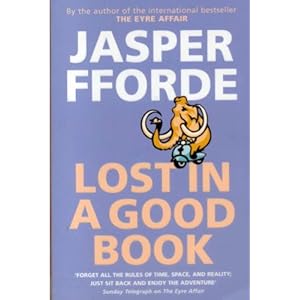
Review number: 1142
The second of Fforde's manic Thursday Next stories easily passes the first test of the comedy sequel: it is still funny when read almost immediately after The Eyre Affair. It starts with Next reluctantly allowing herself to be forced into taking part in public relations events; her work documented in The Eyre Affair has made her something of a celebrity, and the Big Brother style Special Operations units are determined to milk every last possible drop of good publicity out of this. On top of this, she is soon mixed up in new plots originating with the Goliath Corporation, who want her to bring back their executive Jack Schitt, whom she imprisoned in a copy of Poe's The Raven.
To read The Eyre Affair, an acquaintance with Jane Eyre is vital. There is no single book so important here, but much of the humour is derived from literary references, so the book is funnier the more the reader picks them up. The range of references is quite large, but will probably be familiar enough to anyone reasonably well read in English literature. (It helps, for example, to have some idea what Tristram Shandy is like, even if you haven't read it, or if you have at least seen a film or TV version of Great Expectations.) The analysis of The Tale of the Flopsy Bunnies is particularly amusing.
Lost in a Good Book is less of a constant string of jokes than The Eyre Affair; there is nothing in it to match the wonderful Rocky Horror Show style production of Richard III, for example. This may make it less hilarious, but it also becomes more interesting as a novel. (That is, apart from being less self-contained than its predecessor.) The disappearance of her new husband gives Fforde the opportunity to flesh out Thursday's character more fully. It's left me waiting eagerly for The Well of Lost Plots, due out later this year.
Saturday, 25 January 2003
John Brunner: The Long Result (1965)
Edition: Penguin, 1968
 Review number: 1141
Much early American pulp science fiction is extremely chauvinistic, having an attitude to alien races closely related to the worst racist propaganda; aliens are menacing, evil creatures seeking to take over the universe. (It is easy to get carried away by an exciting story, only to realise afterwards that it has an unpleasant hidden meaning of this sort.) Superhuman heroes battle inhuman hordes and win the love of beautiful women; women are kidnapped and rescued in the nick of time from tentacular fates worse than death.
John Brunner has always written novels which were for their time slightly apart from the science fiction mainstream, and in The Long Result he produced one in opposition to the clichés of the genre (even if they were already outmoded by 1965). The main menace in the novel comes from the crackpot Stars Are For Man League, dedicated to putting human beings in a superior position over the various alien races in this part of the galaxy, on the grounds that humanity invented the star drive which enabled them to discover the aliens rather than the other way round. (This is - not coincidentally - similar to nineteenth century arguments to justify colonialism.)
The narrator, Roald Vincent, is a senior official of the Bureau of Cultural Relations, which handles contacts not just with the aliens but also with human colony worlds. He has to handle a rapidly escalating crisis when a ship from Starhome, the first interstellar ship not to be built on Earth, announces when about to land that it carries a diplomatic mission from a newly discovered alien species. This makes them the focus of attacks by the League, and the crisis is also being used in political manoeuvring between Earth and Starhome, a colony beginning to press for independence.
The political ideas are unusually sophisticated for the science fiction of the time, and yet The Long Result is still primarily an adventure story which has a style owing a lot to John Wyndham. It is clearly a milestone on the path of development which led Brunner to Stand on Zanzibar and the dystopias which followed it; well worth reading.
Review number: 1141Much early American pulp science fiction is extremely chauvinistic, having an attitude to alien races closely related to the worst racist propaganda; aliens are menacing, evil creatures seeking to take over the universe. (It is easy to get carried away by an exciting story, only to realise afterwards that it has an unpleasant hidden meaning of this sort.) Superhuman heroes battle inhuman hordes and win the love of beautiful women; women are kidnapped and rescued in the nick of time from tentacular fates worse than death.
John Brunner has always written novels which were for their time slightly apart from the science fiction mainstream, and in The Long Result he produced one in opposition to the clichés of the genre (even if they were already outmoded by 1965). The main menace in the novel comes from the crackpot Stars Are For Man League, dedicated to putting human beings in a superior position over the various alien races in this part of the galaxy, on the grounds that humanity invented the star drive which enabled them to discover the aliens rather than the other way round. (This is - not coincidentally - similar to nineteenth century arguments to justify colonialism.)
The narrator, Roald Vincent, is a senior official of the Bureau of Cultural Relations, which handles contacts not just with the aliens but also with human colony worlds. He has to handle a rapidly escalating crisis when a ship from Starhome, the first interstellar ship not to be built on Earth, announces when about to land that it carries a diplomatic mission from a newly discovered alien species. This makes them the focus of attacks by the League, and the crisis is also being used in political manoeuvring between Earth and Starhome, a colony beginning to press for independence.
The political ideas are unusually sophisticated for the science fiction of the time, and yet The Long Result is still primarily an adventure story which has a style owing a lot to John Wyndham. It is clearly a milestone on the path of development which led Brunner to Stand on Zanzibar and the dystopias which followed it; well worth reading.
Thursday, 16 January 2003
Dorothy K. Haynes: Thou Shalt Not Suffer a Witch (1949)

Review number: 1140
Dorothy K. Haynes was not a name I had come across before, my eye being drawn to this short story collection because it was illustrated by Mervyn Peake. It is easy to see why the stories captivated an initially reluctant Peake (to the extent that he produced an extra "illustration to an unwritten story by Dorothy Hayes" for which a tale was duly produced). The stories are about atmosphere, for the most part exploring the edges of the supernatural. The title story is typical: a Crucible-like tale of a young girl frightened into making accusations of witchcraft. Many of them take the point of view of a lonely small child, an echo of Haynes' own orphanage upbringing.
In this edition, the original collection is expanded about half again with some of Haynes' later stories. The standard is high, but the tales are very uniform; it is a collection to read in small doses. The apparent lack of development is quite surprising, given the inclusion of the later work. Though probably found in the horror section of a bookshop or library, Haynes' stories are not really frightening despite the occasional gruesome touch. This is partly because none of them have a formal plot, being more like a passage setting the scene for a novel than a conventional short story; and yet, they are complete enough in their creation of a dourly Scots world tinged with the supernatural that they are extremely satisfying.
Richard Morgan: Altered Carbon (2002)

Review number: 1139
For many years, there has been science fiction about how death might be defeated (going back at least as far as Robert Heinlein's Howard Families stories). The closest match to the ideas explored here is probably found in the Gateway series by Frederik Pohl, in which the rich can make copies of their personalities to live in a virtual world. This idea is not the main one in Pohl's novel, and Morgan is able to develop a similar scenario more thorougly because he makes it central to Altered Carbon. This is a future in which people can not only copy themselves into computers, but where the copies can be downloaded into other bodies, which have in consequence become known as "sleeves". Morgan has created an entire culture based around this, where (for example) criminals spend sentences having their minds stored on stacks, where people keep backup copies, and where organic damage is a more serious crime than mere murder. An important part of Altered Carbon is the reaction of established religions to the idea; not surprisingly, Christian groups tend to view resleeving as a denial of the possibility of a final resurrection.
A new breed of special forces came into being - the UN Envoys, transmitted at supra-light speed (Morgan assumes technology to transmit information but not mass faster than light) to troublesome planets, downloaded into a strange sleeve, trained to overcome the disorientation which follows from waking in a new body. Kovacs, the central character, was one of these soldiers, now (in common with a fair proportion of his comrades) into a criminal, an assassin. Sentenced to a couple of centuries on the stack for his latest killing, Kovacs is unexpectedly revived on Earth by a rich man in need of a private investigator. The police have decide that a few days ago he committed suicide, blowing his own head off. This contradicts his own opinion of hinself, once he is revived - if he had wanted to commit suicide, he would have prevented a new sleeve (he keeps clones for the purpose) being ready to take his stored backup personality. The police, on the other hand, were convinced that his security arrangements would prevent an intruder gaining access - in other words, this is basically a locked room mystery.
In style, Altered Carbon is clearly strongly influenced by Raymond Chandler; Kovacs is one of the many Marlowe-like private detectives in crime fiction. Elements in the scenario also recall more specific Chandler moments - Kovacs' arrival at the mansion reminded me of the equivalent in The Big Sleep, for example.
There are also obvious science fictional influences, particularly from cyberpunk and post-cyberpunk writers, though it would be safe to say that cyberpunk has become the dominant voice in the genre today. Altered Carbon is at the grittier end of the genre, with some grimly humorous details (I liked the idea of a crime of "excessively armed robbery".) The most immediate cross-reference which occurred to me is Jon Courtenay Grimwood's redRobe.
Altered Carbon is very enjoyable, so long as violence does not put you off too much (and it does not produce the sordid feeling that I get from some writers). Richard Morgan is certainly someone to look out for in future.
Subscribe to:
Posts (Atom)

 Posts

