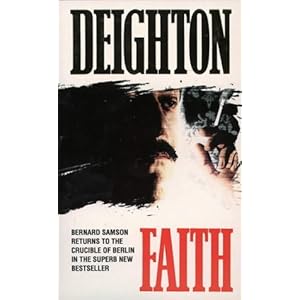
Edition: HarperCollins, 1997
Review number: 1283
This is the concluding novel not just of the long running Bernard Samson saga but of Len Deighton's fiction as a whole. It brings to a close a series of attempts to deal with the ending of the Cold War - an event with a big impact for an author of spy fiction: different settings tangential to the genre in MamISTA, City of Gold, and Violent Ward, and the story of the downfall of Communism itself in the last trilogy of Samson novels. I suspect that the difficulty Deighton experienced in finding a new theme appropriate to the times was a contributing factor to his stopping fiction writing when he did.
The reader's expectation with Charity is that it will wrap up the remaining loose ends, and leave Bernard and Fiona's future sorted out. Having read Spy Sinker, followers of the series know more about what really happened on the day of Fiona's return to West Berlin than Bernard does - so the big question is really how much does he find out, and how much pain does he bring on himself and those around him by his investigations?
Although Charity is set before the end of Soviet control over Eastern Europe, Deighton makes sure we know what happens after the end of the novel with little ironic reminders - such as describing a falling person as looking "like a toppling statue of a tyrant". The ending itself is rather abrupt; the last chapter comes with something of a jerk. It is really about new beginnings for the characters, starting relationships over again - entirely appropriate, given the huge changes about to impact their world.
Three series characters dominate British spy fiction: James Bond, George Smiley, and Bernard Samson. They are all quite different from each other, even if you could argue that Bernard is very similar to Deighton's earlier Harry Palmer character and something of a mix of the other two. Smiley is all subtle intellectual; James Bond is all brute force action. Bernard does both parts, and this makes him both more exciting to read about than Le Carré's character and more interesting and certainly less unpleasant than Ian Fleming's. More is revealed about Bernard's inner character than about either Smiley or Bond, even though his narration (and neither Smiley or Bond is every allowed the luxury of telling their own story) is written in such a way that it is clear that Bernard is hiding quite a lot. This of course makes him more believable as a character, as does the way that his powers as an intellectual spy master and an action hero are both carefully limited by Deighton, presumably to this end. The series (ten novels in all, including a prequel not involving Bernard personally) is a substantial body of work, intimately connected to the fall of Communist East Germany and thus a major fictionalisation of some of the most important historical events of the last half century.
Tuesday, 25 January 2005
Tuesday, 18 January 2005
Monica Ali: Brick Lane (2003)
Edition: Doubleday, 2003
Review number: 1282
Since the success of Midnight's Children, there have been quite a few novels about the Indian subcontinent; but there are not so many about the experience of the immigrant community in the UK (or at least, not so many that are well known). The most obvious writer to compare Monical Ali to is Hanif Kureishi, but his novels portray very different people. Brick Lane is about the poorest of Bangladeshi immigrants, living in a rundown Whitechapel housing estate, one of those places where each block seems to contain large numbers of people originating from the same village, huddled together as a way to shelter from the strangeness of urban London.
Nazneen has been sent over from Bangladesh in the early eighties to make an arranged marriage to a much older man, but one who prides himself on being advanced and modern (unlike some of the men, who hardly allow their wives to leave the home). Brick Lane is about how she comes to terms with the city, taking her story right up to the time of writing. Nazneen's life is compared with that of her sister, who remained in Bangladesh and who had a much harder time.
Brisk Lane is a much praised bestseller for a debut novel, and yet I did not feel it was as good as I expected it to be. Life in these estates is pretty grim (as I saw when I was a student in the area, and as I am sure Monica Ali knows full well). There are difficult times for the novels's characters - it climaxes in a riot - but they always seem to be more at arm's length than they should be. The setting is nothing like as bleak and certainly not as expressively conveyed as Zola's Paris, for example. This is partly because description in this novel is very sparse; Ali is concerned with Nazneen as a character to the exclusion of everything else, and she is (for me) too placid and passive to carry the novel. The subject matter is perhaps one reason for the success of Brick Lane - it's very much the sort of thing that is bound to be praised by the majority of the liberal community, and it obviously struck a chord with many readers. It didn't work so well for me, for some reason.
Review number: 1282
Since the success of Midnight's Children, there have been quite a few novels about the Indian subcontinent; but there are not so many about the experience of the immigrant community in the UK (or at least, not so many that are well known). The most obvious writer to compare Monical Ali to is Hanif Kureishi, but his novels portray very different people. Brick Lane is about the poorest of Bangladeshi immigrants, living in a rundown Whitechapel housing estate, one of those places where each block seems to contain large numbers of people originating from the same village, huddled together as a way to shelter from the strangeness of urban London.
Nazneen has been sent over from Bangladesh in the early eighties to make an arranged marriage to a much older man, but one who prides himself on being advanced and modern (unlike some of the men, who hardly allow their wives to leave the home). Brick Lane is about how she comes to terms with the city, taking her story right up to the time of writing. Nazneen's life is compared with that of her sister, who remained in Bangladesh and who had a much harder time.
Brisk Lane is a much praised bestseller for a debut novel, and yet I did not feel it was as good as I expected it to be. Life in these estates is pretty grim (as I saw when I was a student in the area, and as I am sure Monica Ali knows full well). There are difficult times for the novels's characters - it climaxes in a riot - but they always seem to be more at arm's length than they should be. The setting is nothing like as bleak and certainly not as expressively conveyed as Zola's Paris, for example. This is partly because description in this novel is very sparse; Ali is concerned with Nazneen as a character to the exclusion of everything else, and she is (for me) too placid and passive to carry the novel. The subject matter is perhaps one reason for the success of Brick Lane - it's very much the sort of thing that is bound to be praised by the majority of the liberal community, and it obviously struck a chord with many readers. It didn't work so well for me, for some reason.
Labels:
English literature,
fiction,
literary fiction,
Monica Ali
Tuesday, 4 January 2005
Biff Mitchell: The War Bug (2004)
Edition: Double Dragon, 2004
Review number: 1281
There are two, clear, parallel trends in modern computing. One is that the virtual world is going to become more like the real one, in the sense that it will be possible to deceive human participants into perceiving it as though it were real: like the virtual world of The Matrix, internally consistent and believeably solid, yet containing possibilities beyond mundane physics. No illusion destroying tools like keyboards in the way; and no system failures. On the other hand, reality is becoming more like the virtual world, as computers take over more and more (gadgets like Internet connected fridges which eliminate the need for food shopping, for example), and interfaces become smaller and more invisible and intuitive. The War Bug is set in a future in which reality and virtual reality are almost indistinguishable, in which most individuals live complex virtual lives more satisfying than their real existences, interacting with the avatars of other real people and constructed virtual personalities. There are two big hurdles, one legal, and the other technical: the Reality Laws prohibit the construction of a virtual personality which pretends to be real; and no one has yet managed to endow a virtual personality with true sentience. The plot of The War Bug concerns a man who has created a virtual family, a wife and daughter, who are somehow true people and who can convincingly persuade others of this (though Mitchell is more vague about the definition of sentience to link it to this kind of Turing Test like view; he seems to indicate more that it is the ability to carry out introspection). When his secret is discovered, all three are put in great danger from powerful people who control the online world, who want to exploit computer sentience for their own ends. At the same time, an extremely sophisticated computer virus, the War Bug, is beginning to destroy whole virtual communities - how is this, which appers to Abner as a huge pig, connected to his work and his family?
There is one immense hurdle to reading The War Bug, and that is its style. It is extremely colloquial, relentlessly quirky and often exceptionally irritating. The prose gives the impression that it is the act of a strange stand-up comedian. It is well worth keeping going, though, and the style is reasonably appropriate to the content. (I can see that other people would possibly find it amusing, too, but it is not a form of humour that greatly appeals to me, and as a joke it goes on far too long - a criticism I also often feel is applicable to stand-up comedians as well.) The informality of the prose is so great that it presents something of a paradox: it is written in language so colloquial that it becomes hard to read. The chapters are very short, and jump around a lot, which means it takes a long time to understand what is going on and to get a feel for the main characters. Some editing would have been useful here, particularly of the background presented in the very first pages, which nearly persuaded me not to continue.
In some ways this is basically a criticism that certain aspects of this novel are not to my taste; other readers may well love the way in which The War Bug is written. Once I did finally get into it, I found the story fascinating; it deals with philosophical ideas that have interested me for a long time, ones which could be said to be basic to the (intelligent end of) the science fiction and fantasy genres: the nature of reality, and the nature of humanity. The story suddenly becomes gripping at the point where Abner's family is kidnapped by powerful individuals who want to obtain the secret of sentience, in a way that the destruction of the virtual cities and even the deaths of thousands whose avatars were caught up in their ends had not been. Though many of the ideas are not particularly new (reference points include the obvious Gibson and Stephenson, but I felt that there was also a strong kinship with the drug induced virtual worlds of Stanislaus Lem's The Futurological Congress), it is well done and the background shows that Mitchell is a writer with at least some ideas of his own.
Review number: 1281
There are two, clear, parallel trends in modern computing. One is that the virtual world is going to become more like the real one, in the sense that it will be possible to deceive human participants into perceiving it as though it were real: like the virtual world of The Matrix, internally consistent and believeably solid, yet containing possibilities beyond mundane physics. No illusion destroying tools like keyboards in the way; and no system failures. On the other hand, reality is becoming more like the virtual world, as computers take over more and more (gadgets like Internet connected fridges which eliminate the need for food shopping, for example), and interfaces become smaller and more invisible and intuitive. The War Bug is set in a future in which reality and virtual reality are almost indistinguishable, in which most individuals live complex virtual lives more satisfying than their real existences, interacting with the avatars of other real people and constructed virtual personalities. There are two big hurdles, one legal, and the other technical: the Reality Laws prohibit the construction of a virtual personality which pretends to be real; and no one has yet managed to endow a virtual personality with true sentience. The plot of The War Bug concerns a man who has created a virtual family, a wife and daughter, who are somehow true people and who can convincingly persuade others of this (though Mitchell is more vague about the definition of sentience to link it to this kind of Turing Test like view; he seems to indicate more that it is the ability to carry out introspection). When his secret is discovered, all three are put in great danger from powerful people who control the online world, who want to exploit computer sentience for their own ends. At the same time, an extremely sophisticated computer virus, the War Bug, is beginning to destroy whole virtual communities - how is this, which appers to Abner as a huge pig, connected to his work and his family?
There is one immense hurdle to reading The War Bug, and that is its style. It is extremely colloquial, relentlessly quirky and often exceptionally irritating. The prose gives the impression that it is the act of a strange stand-up comedian. It is well worth keeping going, though, and the style is reasonably appropriate to the content. (I can see that other people would possibly find it amusing, too, but it is not a form of humour that greatly appeals to me, and as a joke it goes on far too long - a criticism I also often feel is applicable to stand-up comedians as well.) The informality of the prose is so great that it presents something of a paradox: it is written in language so colloquial that it becomes hard to read. The chapters are very short, and jump around a lot, which means it takes a long time to understand what is going on and to get a feel for the main characters. Some editing would have been useful here, particularly of the background presented in the very first pages, which nearly persuaded me not to continue.
In some ways this is basically a criticism that certain aspects of this novel are not to my taste; other readers may well love the way in which The War Bug is written. Once I did finally get into it, I found the story fascinating; it deals with philosophical ideas that have interested me for a long time, ones which could be said to be basic to the (intelligent end of) the science fiction and fantasy genres: the nature of reality, and the nature of humanity. The story suddenly becomes gripping at the point where Abner's family is kidnapped by powerful individuals who want to obtain the secret of sentience, in a way that the destruction of the virtual cities and even the deaths of thousands whose avatars were caught up in their ends had not been. Though many of the ideas are not particularly new (reference points include the obvious Gibson and Stephenson, but I felt that there was also a strong kinship with the drug induced virtual worlds of Stanislaus Lem's The Futurological Congress), it is well done and the background shows that Mitchell is a writer with at least some ideas of his own.
Labels:
Biff Mitchell,
computers,
fiction,
science fiction,
virtual reality
Saturday, 18 December 2004
David Eddings: High Hunt (1973)
Edition: Ballantyne, 1986
Review number: 1280
David Eddings' first novel is very different from his other output, even from his later thrillers and from The Losers, which was written quite soon afterwards even if not published for almost twenty years. (The vast majority of his writing is in the fantasy genre, of course.) It is an extremely American novel, concerning a deer hunt in the Cascade mountains (later made famous worldwide as the location of Mount St Helens, but still one of the most remote parts of the United States). The narrator is an American soldier returned from the draft; this is during the Vietnam War, but Dan was posted to Germany. He rather reluctantly gets back in touch with his older brother, which leads to Dan accompanying a group of friends on a hunt, one complicated by bad feeling within the group (one man is committing adultery with two of the others' wives). Up in the mountains the tensions only increase, with a major rivalry brewing up over a rare white buck they see, and it starts to look as though deer will not be the only casualties of the hunt.
This covers familiar territory, even for the early seventies, but does it extremely well. The range of characters, for example, is wide and vivid, with both more varied and complex than occur in any other of Eddings' novels - a simplified style has obviously proved popular but I prefer this greater range. Some of the effects of High Hunt are obviously not intended: that the hunt begins on September 11th would be a clever ironic touch heightening the sense of foreboding - if the novel had been written thirty years later.
The obvious, and acknowledged influence on High Hunt is Hemingway. The idea of hunting as a rite of passage, as an activity which sorts the men from the boys, is not something I agree with, so that when this is made the basis for a story it has to be well enough done, as it is here, to provide other attractions to make the tale worth reading. There are other influences, some of which I suspect I do not see since the hunting genre is not one that has made its way across the Atlantic to the extent that the Western, its close relative, has. Rather more oddly, Robert Heinlein is clearly the source of the tone of some parts, particularly the scenes between Dan and his girlfriend. Glory Road is the closest novel to High Hunt in tone, even if it is from a completely different genre. Heinlein and Hemingway live together a little uneasily as influences, but High Hunt works.
Review number: 1280
David Eddings' first novel is very different from his other output, even from his later thrillers and from The Losers, which was written quite soon afterwards even if not published for almost twenty years. (The vast majority of his writing is in the fantasy genre, of course.) It is an extremely American novel, concerning a deer hunt in the Cascade mountains (later made famous worldwide as the location of Mount St Helens, but still one of the most remote parts of the United States). The narrator is an American soldier returned from the draft; this is during the Vietnam War, but Dan was posted to Germany. He rather reluctantly gets back in touch with his older brother, which leads to Dan accompanying a group of friends on a hunt, one complicated by bad feeling within the group (one man is committing adultery with two of the others' wives). Up in the mountains the tensions only increase, with a major rivalry brewing up over a rare white buck they see, and it starts to look as though deer will not be the only casualties of the hunt.
This covers familiar territory, even for the early seventies, but does it extremely well. The range of characters, for example, is wide and vivid, with both more varied and complex than occur in any other of Eddings' novels - a simplified style has obviously proved popular but I prefer this greater range. Some of the effects of High Hunt are obviously not intended: that the hunt begins on September 11th would be a clever ironic touch heightening the sense of foreboding - if the novel had been written thirty years later.
The obvious, and acknowledged influence on High Hunt is Hemingway. The idea of hunting as a rite of passage, as an activity which sorts the men from the boys, is not something I agree with, so that when this is made the basis for a story it has to be well enough done, as it is here, to provide other attractions to make the tale worth reading. There are other influences, some of which I suspect I do not see since the hunting genre is not one that has made its way across the Atlantic to the extent that the Western, its close relative, has. Rather more oddly, Robert Heinlein is clearly the source of the tone of some parts, particularly the scenes between Dan and his girlfriend. Glory Road is the closest novel to High Hunt in tone, even if it is from a completely different genre. Heinlein and Hemingway live together a little uneasily as influences, but High Hunt works.
Tuesday, 14 December 2004
Len Deighton: Hope (1995)
Edition: HarperCollins, 1995
Review number: 1279
The Bernard Samson story continues, as the waves thrown up by his brother in law George Kosinski's attempts to investigate the death of his wife (Bernard's wife's sister) continue to threaten to reveal all kinds of unwelcome facts about the actions of British Intelligence in the closing months of the Cold War. (Tessa Kosinski had been killed during her sister's escape from East Germany where she had been working undercover - a British agent who was a senior official in the Stasi secret police.) Now George has himself disappeared, apparently either escaping from or kidnapped by Stasi agents. Bernard undertakes a mission to George's family home, a big house in a remote part of Poland, protected from appropriation by the Communists by a series of compromises made with the regime over the years.
While it is clear when thinking about it dispassionately that the whole of the Bernard Samson series is to say the least unlikely, this is the first of the novels where the improbabilities mount up to the point where the reader takes notice before reaching the end. There is a feeling that Deighton has by this point rather run out of steam, that the third re-interpretation of the story behind Fiona Samson's apparent defection has just too little material to work on. The third trilogy was written rather longer after the events it describes than the earlier novels - Hope is set in 1987, but not published until 1995 - and so lacks the immediacy that they had. (This is apparent even reading them years later - Deighton obviously got fired up about describing the Cold War as it happened.) This also means of course that most readers will know what happens next: the rapid collapse of the Soviet bloc at the end of the eighties hangs over this third trilogy (I suspect it was written because Deighton felt that the reactions of a veteran intelligence officer familiar with Berlin to the demolition of the Wall would make interesting reading). Hope is the poorest novel in the whole sequence and what I have said about several of the others applies with more force here: start at the beginning with Berlin Game and you will want to read the whole Bernard Samson story; do not start in the middle or near the end.
Review number: 1279
The Bernard Samson story continues, as the waves thrown up by his brother in law George Kosinski's attempts to investigate the death of his wife (Bernard's wife's sister) continue to threaten to reveal all kinds of unwelcome facts about the actions of British Intelligence in the closing months of the Cold War. (Tessa Kosinski had been killed during her sister's escape from East Germany where she had been working undercover - a British agent who was a senior official in the Stasi secret police.) Now George has himself disappeared, apparently either escaping from or kidnapped by Stasi agents. Bernard undertakes a mission to George's family home, a big house in a remote part of Poland, protected from appropriation by the Communists by a series of compromises made with the regime over the years.
While it is clear when thinking about it dispassionately that the whole of the Bernard Samson series is to say the least unlikely, this is the first of the novels where the improbabilities mount up to the point where the reader takes notice before reaching the end. There is a feeling that Deighton has by this point rather run out of steam, that the third re-interpretation of the story behind Fiona Samson's apparent defection has just too little material to work on. The third trilogy was written rather longer after the events it describes than the earlier novels - Hope is set in 1987, but not published until 1995 - and so lacks the immediacy that they had. (This is apparent even reading them years later - Deighton obviously got fired up about describing the Cold War as it happened.) This also means of course that most readers will know what happens next: the rapid collapse of the Soviet bloc at the end of the eighties hangs over this third trilogy (I suspect it was written because Deighton felt that the reactions of a veteran intelligence officer familiar with Berlin to the demolition of the Wall would make interesting reading). Hope is the poorest novel in the whole sequence and what I have said about several of the others applies with more force here: start at the beginning with Berlin Game and you will want to read the whole Bernard Samson story; do not start in the middle or near the end.
Labels:
Bernard Samson,
Cold War,
fiction,
Len Deighton,
spy fiction,
thriller
Friday, 10 December 2004
Len Deighton: Faith (1994)
Edition: HarperCollins, 1995
Review number: 1277
The third and final trilogy about Bernard Samson follos more or less straight on from the concluding moments of the preceding novels, skipping over only the months of recovery and debriefing on a remote Californian ranch that follow the escape of Bernard's wife Fiona from East Berlin where she has been a highly placed agent of the British Secret Service. (The setting is still in the days before the demolishing of the Wall.) The confusion left to be sorted out is immense - Bernard, for example, had been living with another woman, believing that Fiona was a defecting traitor; Fiona's sister Tess has apparently been killed in the fight on the autobahn linking Berlin to the West that was organised to cover Fiona's escape; rumours are flying round the Secret Service and no one has any idea what Fiona's role will be when and if she returns to work. Deighton left few loose ends at the end of London Match, the final novel in the first trilogy, but little is resolved in Spy Sinker, by contrast - it is much more obvious that the story would have to continue.
There are really two strands to Faith, one of which initially doesn't seem to be connected to the main narrative. This is a mission that Bernard is sent on to East Germany, to make contact with an officer who has secrets to sell to the West. The other is a private investigation into what happened on the night of the fight and to Tessa's body launched by her husband; this is clearly going to make waves by attempting to uncover secrets that others will want to keep hidden.
While the story naturally grows out of what has gone before, there are some changes of emphasis. We are back here with Bernard as a narrator, which works better than the third person used in Spy Sinker. More oddly, there has been an important change in emphasis which has been made without comment. Earlier, the point of the fight was to make it look as though Fiona had been killed, so that the East Germans and Russians don't know that she was working against them all this time. But now she and Bernard are openly living in the Mayfair flat that belonged to Tessa, and she is starting a high profile job in the London office - surely not something that will be overlooked by the Russian and East German agents still in London, no matter how much their respective countries are sliding into the economic chaos that was the penultimate stage in the fall of Soviet Communism.
Faith is one of the more downbeat Deighton novels, even in a series which focuses on betrayal. It is low key because, like Mexico Set in the first trilogy, it is about picking up the pieces after a trauma and starting again.
Review number: 1277
The third and final trilogy about Bernard Samson follos more or less straight on from the concluding moments of the preceding novels, skipping over only the months of recovery and debriefing on a remote Californian ranch that follow the escape of Bernard's wife Fiona from East Berlin where she has been a highly placed agent of the British Secret Service. (The setting is still in the days before the demolishing of the Wall.) The confusion left to be sorted out is immense - Bernard, for example, had been living with another woman, believing that Fiona was a defecting traitor; Fiona's sister Tess has apparently been killed in the fight on the autobahn linking Berlin to the West that was organised to cover Fiona's escape; rumours are flying round the Secret Service and no one has any idea what Fiona's role will be when and if she returns to work. Deighton left few loose ends at the end of London Match, the final novel in the first trilogy, but little is resolved in Spy Sinker, by contrast - it is much more obvious that the story would have to continue.
There are really two strands to Faith, one of which initially doesn't seem to be connected to the main narrative. This is a mission that Bernard is sent on to East Germany, to make contact with an officer who has secrets to sell to the West. The other is a private investigation into what happened on the night of the fight and to Tessa's body launched by her husband; this is clearly going to make waves by attempting to uncover secrets that others will want to keep hidden.
While the story naturally grows out of what has gone before, there are some changes of emphasis. We are back here with Bernard as a narrator, which works better than the third person used in Spy Sinker. More oddly, there has been an important change in emphasis which has been made without comment. Earlier, the point of the fight was to make it look as though Fiona had been killed, so that the East Germans and Russians don't know that she was working against them all this time. But now she and Bernard are openly living in the Mayfair flat that belonged to Tessa, and she is starting a high profile job in the London office - surely not something that will be overlooked by the Russian and East German agents still in London, no matter how much their respective countries are sliding into the economic chaos that was the penultimate stage in the fall of Soviet Communism.
Faith is one of the more downbeat Deighton novels, even in a series which focuses on betrayal. It is low key because, like Mexico Set in the first trilogy, it is about picking up the pieces after a trauma and starting again.
Labels:
Bernard Samson,
Cold War,
fiction,
Len Deighton,
spy fiction,
thriller
Thursday, 9 December 2004
Philip Pullman: The Subtle Knife (1997)
Review number: 1278
The scope of the His Dark Materials trilogy widens in this second novel, which is set in three worlds, including our own. The Subtle Knife also introduces the second of the two protagonists, Will Parry. Like Lyra, he is an independent child, in his case because his father was an explorer lost on an Arctic expedition when he was a baby, and his mother has become barely able to function after years of stress. When he discovers that her paranoid fantasies have a grain of truth, and then accidentally kills a man who attacks them, he has to flee, and ends up in another world where he meets Lyra. He has his own quest, to find his father, but it becomes clear that, for a time at least, their purposes will be parallel and that in some way Will will be key to stopping the forcible removal of the souls of children that motivates Lyra.
While the background remains interesting, the faults of Northern Lights seem magnified here. Will is just as poorly animated a character as Lyra is, and the story really lacks the spark of excitement that would be needed for it to really take off. This is made worse by the splitting of the narrative into two; I can see why the book is organised like this (the purpose of the lesser thread, which is mostly very tedious indeed, is to prepare the ground for a surprise in the other), but it does make the novel drag. I suspect that if this had been the first novel in the trilogy, few children would have bothered to read it. (Mind you, I get the impression that this is a series that adults rave about as a fantastic children's trilogy but not one which is really a great favourite with young readers.)
It is in the latter part of the novel that Pullman's controversial twisting of Christian theology really begins. As it appears here, it is basically a reversal of how orthodox Christianity looks at the universe - the side that a Christian would call good is here about regulation and conformity; while the traditional "fallen angels" want to bring freedom and happiness to humanity. This is hardly a new way to attack the Christian religion, particularly as it is based on an institutionalised version of Christianity that has little to do with what the Bible actually says (and attacking it is really a version of what is known as a "straw man" argument - demolishing a misrepresentation of an opponent's position). Samuel Butler in The Way of All Flesh has a similar message, and that was written over a century ago as an attack on the hypocrisy of the Victorian church. And yet this trilogy has generally been singled out for praise, as though every book that children could read before Pullman began writing were putting the same point of view as C.S. Lewis (whose Narnia stories are, incidentally, better written and more fun.) Christianity is an irrelevance to the majority of people in the West today - there are far more interesting targets that could be attacked truly controversially, from the cult of celebrity, to cultural imperialism, to the morality of today's capitalism. There is no reason to start fighting our grandparents battles over again.
Considering the amount of praise I have heard heaped on this series, it has proved immensely disappointing. I will probably eventually read The Amber Spyglass, but I'm certainly not holding my breath in anticipation.
Labels:
children's fiction,
fantasy,
fiction,
His Dark Materials,
Philip Pullman
Subscribe to:
Posts (Atom)