Saturday, 13 August 2011

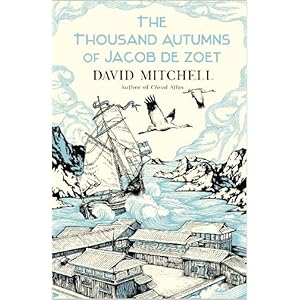
David Mitchell: The Thousand Autumns of Jacob de Zoet (2010)

David Mitchell's fifth novel is his third to feature Japan as a setting, but does mark a new departure by being a historical novel. It is the story of Jacob de Zoet, a clerk working for the Dutch East India Company in the enclave on the island of Dejima near Nagasaki, in 1799 the only place where Europeans were permitted to trade with the Japanese (see the informative Wikipedia article on this here). The story starts when Jacob arrives in Japan, accompanying a new governor for the enclave, whose mission is to fight the endemic corruption among the Company traders, more interested in self-enrichment than the success of the Company as a whole. Jacob soon falls in love with an absolutely unattainable woman, a young girl of good breeding who is one of the students of a Western doctor on Dejima. (Her backstory is quite complicated, to explain how a woman who is neither a prostitute nor a concubine could meet a European, given that such women would normally neither be allowed on the island nor permitted to study Western medicine.)

The Thousand Autumns is a novel about culture clash, between two representatives of two countries effectively in decline. During the novel, the Netherlands is conquered by the French Revolutionary armies, after which its status as a colonial power is greatly lessened; the Japanese shoguns continue the policy of seclusion until 1853 (when the American navy forces the borders to be opened more fully) but even in 1799 it is pretty clear that this end is inevitable in the face of superior technology.

Like Ghostwritten, The Thousand Autumns has a supernatural element, in the doings of villainous abbot Enomoto. Through a bloody ritual involving the sacrifice of babies born to coerced and drugged nuns, he has gaind himself an unnaturally extended lifespan. It is tempting to believe that he is some kind of magic realist symbol, like the children in Midnight's Children, in this case an embodiment of the tyrannical and outdated isolationist regime of the Shogun. The picture of Japan on the cusp of the nineteenth century painted in this novel is pretty repellent, made up of fear, paranoia, and cruelty. Most of the European characters are not much better, either, being depicted as bigoted, uncultured, crude, and venal. Enomoto is not like most of the other Japanese characters, while the Europeans are less nasty but their vices are more widespread through the population.

With a historical novel, the question which is always asked is how accurate it is (though the answer does not necessarily make much difference to how enjoyable or interesting it is to read). Mitchell apparently went to a great deal of trouble to ensure that the details were accurate, but his own emotional reaction to the society may colour his writing about it; but even so, I would certainly not wish to have lived there and then. The attention to detail definitely makes the novel very convincing. This is not an episode of history I was particularly knowledgeable about, and it does make for a fascinating novel.

Not as good as Ghostwritten or numberNineDream, but more straightforward (and to my mind infinitely superior as a historical novel to Hilary Mantel's overrated Wolf Hall), I rate The Thousand Autumns of Jacob de Zoet at 8/10.


Edition: Sceptre, 2010
Review number: 1429

Sunday, 24 July 2011

Imogen Robertson: Anatomy of Murder (2010)

Having enjoyed Robertson's first novel, Instruments of Darkness, I had high hopes for the sequel. These were, for the most part, realised. Her two detectives, naval wife Hannah Westerman and anatomist Gabriel Crowther, have become somewhat notorious as a result of the publication of lurid pamphlets describing the events of the first novel.

This means that towards the end of 1781 they are asked to look into a body found in the river Thames, a body of interest because it had been tied town to keep it from being found - a subterfuge which failed because the killer didn't take into account the action of the tide. The dead man turns out to be a former musician from the opera house, bringing the world of eighteenth century music which featured in Instruments of Darkness into this novel as well - perhaps an unlikely coincidence, but clearly allowing Robertson to write about a world with which she is familiar and comfortable: the case involves castrati, a French soprano in fact born in the London slums, and the relationship between the opera and high society. A suspicion of espionage - the novel is set during the American War of Independence after all - provides the driving force behind the crime and its aftermath, though this is never really very convincing. The mystery itself is not particularly taxing to unravel for the reader, but the story does manage to hold the interest nonetheless.

Anatomy of Murder is a lighter read than Instruments of Darkness, lacking much of the Gothic atmosphere of the earlier novel, despite the introduction of a Tarot-card reading fortune teller. The world of the opera in London is a brighter, more passionate one than the decaying manor in the depths of rural Sussex which formed the background of Instruments of Darkness. Though squalor and deprivation are depicted, London is never made as sinister as the countryside. Moving the setting to London allows Robertson to show her extensive background knowledge of a different aspect of eighteenth century England.

The misanthropy of Gabriel's character has been softened somewhat, too, though the lack of romantic tension between Gabriel and Hannah remains a strength: the avoidance of the crime genre cliché of the detectives who start to fall for each other because of working together marks out Imogen Robertson's work as refreshingly different from the norm. After all, people often work together in the real world without developing a romantic attachment.

Sometimes sequels can be read on their own without spoiling the first book too much, but Anatomy of Murder is not really one of these. It gives away a great deal which the first time reader of Instruments of Darkness would probably prefer to first encounter in its proper place. There is of course no reason why sequels need to be stand alone; but it is a warning that the earlier story should definitely be read first.

Even though less good than its prequel, Anatomy of Murder is still an atmospheric piece of historical crime fiction, with central characters who are consistently interesting - if not entirely likeable. It could do with a better and more convincing mystery, though, which is why I rate it only at 6/10.

Edition: Headline, 2010
Review number: 1428

Thursday, 7 July 2011

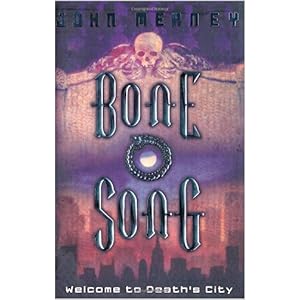
John Meaney: Bone Song (2007)

Back in February, I reviewed Absorption by John Meaney, wondering why the author of that somewhat tedious novel was described by Stephen Baxter as having "rewired SF". Bone Song, Meaney's début, is why.

While not as revolutionary as Baxter's praise suggests, Bone Song starts in a marvellously atmospheric and imaginative manner, evocatively written with a compelling central character. The setting is Tristopolis, not just the "city of sadness" its name suggests but somewhere where death is all important; ghosts and zombies are among the citizens, and wraiths power many machines, while a mystical process applied to bones provides the fuel in the city's power stations. Donal Riordan is a policeman in Tristopolis, assigned to protect a visiting opera singer: she is the next potential victim of a killer who is murdering creative people because their bones can be used to experience a "high".

The excellence of the first hundred pages is not maintained. Much of the middle of Bone Song seems to this reader to consist of dull running around by Riordan and his colleagues, provoking a tedium which perhaps makes it more true to life than many police procedurals. The interest does pick up again towards the end, and, while it never shows sufficient originality to justify Baxter's praise, Bone Song remains an intriguing novel.

In a further bout of hype, the back cover also describes Bone Song as "an extraordinary melding of visionary SF and dark horror". This might have been more convincing if China Miéville and Neil Gaiman (to pick two writers who came to mind while reading this story) had never published their fiction. While the background is more like Miéville, there is a stylistic influence from comic books which suggests Gaiman. There is even a paragraph where Meaney uses a common comic book technique where dialogue is interrupted by action but then continues as though nothing had happened: along the lines of three frames containing "Stop..." | THUD | "...that" as text.

As for a rating: I'd give the first and last thirds 9/10, and the middle 3/10, which averages to 7/10 overall.

Edition: Gollancz, 2008
Review number: 1427

Thursday, 23 June 2011

Arthur C. Clarke & Frederik Pohl: The Last Theorem (2008)

This is the novel with which Clarke rounded off his lengthy and prolific career. Like much of his later work (later in this case basically meaning novels published after Clarke was eighty), The Last Theorem is a collaboration. While most genre collaborations are between established authors and newcomers, this is different, in that Frederik Pohl is one of the very few authors who could be considered one of Clarke's near equals for prestige in science fiction.

The Last Theorem is a novel about an alien invasion of Earth, a theme of science fiction which goes all the way back to The War of the Worlds. Concerns today are not those which prompted Wells to produce a novel which is about colonial warfare, however; the motive for the invasion here is not a search for resources, but pest control. Immensely powerful aliens have detected the explosion of the first nuclear bomb on Earth in 1945 and applied their inflexible rule: eradicate the dangerous vermin who act so aggressively. This is surely not a very original scenario (even though I cannot immediately think of exact parallels), and it is indeed not the most interesting part of the novel.

For while the aliens are travelling to Earth (making use of some "loopholes" in the laws of relativity, but still slow enough to allow the plot to unfold), human beings are continuing their usual lives. The authors focus on one man, a Sri Lankan mathematics student at the beginning of The Last Theorem, who goes on to prove Fermat's Last Theorem. (This requires a certain amount of explanation, as Andrew Wiles was already famous for this feat before the novel was written. But Wiles' proof is far too lengthy to be the one Fermat was unable to write in the margin for lack of space, and that is the proof that Ranjit Subramanian finds. In addition, the authors feel - as indicated in their postscript comments - that a proof which relies on computer checking is not really as convincing as one in which the details can be grasped in their entirety by a human mind. So Ranjit's fictional five page proof is the "real" one.) The proof brings him international celebrity and a role in the alien encounter to come (though his daughter coincidentally has an even more important part to play).

At the start of The Last Theorem, the narrative voice is jocular and quite informal; and irritating. But one of the most impressive aspects of the novel depends on this. Once something unpleasant happens to Ranjit (the bridge between being a carefree student and an international celebrity), the narrative voice changes, and becomes more grown up.

The Last Theorem, while readable, is not the best work of either Clarke or Pohl by a long way. As well as the sloppy plotting of the coincidence already mentioned, there are other incidents in the story which don't really ring true. There is nothing new in the basic ideas in the novel. The mathematical components are well done, if you're interested in that sort of thing, and no prior knowledge is needed. But perhaps that is not really enough from two of the greatest writers of the science fiction genre - 4/10.


Edition: HarperVoyager, 2009
Review number: 1426

Thursday, 9 June 2011

William Heaney: Memoirs of a Master Forger (2008)

There are demons and angels around us, and some people can see them; William Blake was one such, and William Heaney is another. That is the premise of this novel. Heaney sees demons, but not angels, and he has them meticulously classified, into 1,567 distinct types, all of whom hang around and torment humanity (looking thoroughly miserable while they do so). He is an obsessive man on the fringes of the London literary scene, making his living by selling fake first editions of nineteenth century novels while also supplying the poems for a friend of his who is fêted as a hip young Asian gay poet. (He is genuinely Asian and gay, he just doesn't write the poems.) This side to his life is the apparent reason for the title.

Heaney is also involved with working with the homeless, sitting on various quangos and Home Office committees, and directly supporting a hostel named GoPoint, something of a thorn in the flesh of the authorities, but where some amazing work to help the most difficult cases is carried out, led by a woman whom Heaney has no hesitation in describing as an angel.

The plot of the novel combines two events from the narrative present with flashbacks to show the path which led Heaney to the life he lives. Heaney is divorced but unable to let go of his relationship with his ex-wife; but now he meets another woman with whom he rapidly falls in love. At the same time, he tries to stop a homeless former soldier from blowing himself up at the railings of Buckingham Palace, and the man passes him a notebook, which describes how this man also became able to see demons during the (First) Gulf War. The flashbacks tell Heaney's equivalent story, of how writing a fake Satanic ritual manuscript found by a fellow student who used it to successfully summon a demon caused him not just to see demons but to drop out of college and become homeless for a while himself.

Much of the novel turns around conversations in old London pubs, and Heaney clearly revels in them and their connections (one pub is where Blake had lodgings, another where some of the bones of Thomas Paine were allegedly interred in the cellar, for example). Their story is described as the basis for "an alternative history of London", and their associations are said to make them a fertile ground for demons to hunt. The atmosphere created by these scenes is reminiscent of one of my favourite novels, Michael Moorcock's Mother London.

The story written in the first person by a narrator who shares his name with the book's apparent author. First person narrative by a character who has the name from the front of the book is a device which underlines the memoir form, which is as common there as it is unusual in fiction. (And can you think of any third person memoirs other than Caesar's Gallic Wars?) He has a voice which convincingly seems to be rooted in the experiences he has had, which makes the memoir conceit work quite well. Incidentally, the actual author, award winning fantasy writer Graham Joyce, also published the novel under his own name at about the same time as this paperback edition came out, using the title How to Make Friends with Demons, a much less interesting way to publish with an inaccurate, much less intriguing (indeed, rather off-putting) title. It's the name of a book referred to in the novel, but, as Heaney spends just about all his time avoiding demons, it's not at all indicative of the content.

Another reason to prefer the Master Forger title is that it suggests a certain way of thinking to the reader: if the author describes himself in these terms, how much of what he says is trustworthy? It is almost as clear an indication that he is an unreliable narrator as it is possible to get (perhaps surpassed only by the beginning of Iain Banks' Transition). The idea of an unreliable narrator always fascinates me, as it is interesting to try and work out what is really going on (in fictional terms) from what they tell you, somewhat like the way that the investigators of a crime try to decipher what actually happened from the testimonies of more or less accurate witnesses. Is the reader really meant to suppose that Heaney really does see demons, or are they a product of his mental instabilities and obsessions? (In other words, is Memoirs of a Master Forger a fantasy novel or about delusion?) Was that really the reason why he dropped out of college without even a word to his fiancée? Was his involvement in Satanism quite as secular and relatively innocent as he makes out? Is there a reason why he sees only demons and not angels - something to do with his spiritual state, attitude to the world, or the nature of London in the twenty-first century?

With sly humour, interesting characters, atmospheric setting and a supernatural edge, Memoirs of a Master Forger is a fascinating read - 8/10.


Also published as How to Make Friends With Demons, by Graham Joyce
Edition: Gollancz, 2009
Review number: 1425
Saturday, 4 June 2011

Ursula K. Le Guin: The Word for World is Forest (1972)

One of Le Guin's shortest novels is also one of her most effective. The Word for World is Forest is a telling description of the ecological and moral atrocities committed by a group of human colonists on a peaceful world covered in forest, and how their barbaric treatment of the apparently passive Athshean natives provokes a bloody uprising, leaving the natives changed forever, fallen, as it were, from their state of innocence.

The Word for World is Forest was not quite long enough to qualify for the best novel category in the Hugo awards (which she won twice), but it won the best novella category, before appearing in stand alone book format in 1976 (it originally formed part of the famous anthology sequel, Again, Dangerous Visions).

Like much of Le Guin's work, this novel is inspired by her knowledge of anthropology. Indeed, there is little of the novel which demands a science fictional setting: the "world" could fairly easily be some remote part of Africa or New Guinea. The point of using science fiction, other than Le Guin's established reputation in the genre, is that it enables the writer to create her own background, one which emphasises the points she wishes to make. As a result, the story does sometimes seem rather one sided, but the spiritual effects on the Athsheans which result from their espousal of violence are in the end striking: by becoming as vicious as the humans, they destroy a precious part of their culture forever, knowing that this will be the outcome of their actions.

In one way, Le Guin does undermine the point she is trying to make, as far as I am concerned: she adds a feminist element. The culture of the colonists as she depicts it is extremely male-dominated; human settlements are basically logging camps filled with macho lumberjacks where the only women are prostitutes and concubines. These women have no voice in the story: they don't even have names, being referenced by their measurements; they are objects used by the men for stress relief. They do show that the men can behave bestially towards people far more like them than the Athsheans. In the end, unless her overall point is less than I think it is - unless Le Guin is saying that a culture in which women are less than equal with men is capable of terrible crimes - the women are a distraction and dilute the impact of the story.

In the author's note at the beginning of Knowledge of Angels, Jill Paton Walsh wrote: "A fiction is always, however obliquely, about the time and place in which it was written." The Word for World is Forest is not really about aliens and the future, but about us, here and now - at least, as much as the world has not changed in the last forty years. It is an attack on colonialism, both as practiced in the past and in our own time, as rich western nations grind the so-called third world in poverty and hopelessness - and it could well be intended as a warning to the complacency of the western world. It obviously exaggerates for effect, as no earthly culture has ever been as innocent as the one portrayed here. There is also an underlying criticism of science fiction in general. The theme of the colonisation of an alien planet by humans is a commonn theme in the genre, and usually the author is put firmly on the side of the plucky colonists. But, Le Guin tells the seventies SF community, that is not the only imaginable side of the story. There are often clear parallels between tales of colonisation and westerns, and Le Guin is putting the side of the American Indians.

Re-reading The Word for World is Forest, I was struck by just how much it seems to have influenced a film made almost forty years after the story was published: Avatar. The Athsheans are not hugely similar to the Naavi, but much about the setting and the ecological parts of the message are really close. I'd recommend the book to anyone who enjoyed the film.

Though others might choose The Lathe of Heaven or The Left Hand of Darkness, my choice as Le Guin's greatest work would be this compact story. Even so, it has never inspired the affection I still feel for the first of her books I ever read, the Earthsea trilogy. The Word for World is Forest is Ursula K. Le Guin writing uncompromisingly an unpalatable message for adults; it is not a novel the reader is meant to like, but one which is meant to hammer home its point. My rating for one of the most effective uses of science fiction: 9/10.


Edition: Tor, 2010
Review number: 1424

Friday, 27 May 2011

E. Phillips Oppenheim: Last Train Out (1941)

Described in his heyday as "the Prince of Storytellers", the name of E. Phillips Oppenheim was familiar to me pretty much only from the back covers of the Leslie Charteris novels I own in these Hodder yellow jacket editions. When I saw this one - in a book case in the garden of a cottage in the Welsh mountains containing books for sale to support education charities working in Africa - I was keen to take the chance to make my acquaintance with the author. (I would never have thought of searching for it, though; this kind of serendipity is one major reason why physical second hand bookstores are such wonderful places.)

Published in 1941, Last Train Out must be one of the earliest thrillers to describe the build up to the Second World War. Its story is built around the escape of a Jewish banker from Vienna to Switzerland from before the annexation of Austria by Germany in March 1938 to just after the declaration of war on Germany by Britain in France in September 1939 following the German invasion of Poland.

The hero of Last Train Out, Charles Mildenhall, is an upper class British adventurer, working for the Foreign Office in a role somewhere between a diplomat and a troubleshooting spy. It is he, for example, who travels to Poland to assure the leaders there that Britain and France would indeed honour their treaty commitments and declare war if a German invasion takes place. While Oppenheim's novels are publicised on the back of those by Leslie Charteris, Mildenhall resembles the central characters in books by Dornford Yates more than he does the Saint. Apart from his class background, he is more likely to succeed the liberal use of cash than to be supremely useful in a fight with the bad guys. But there are qualities Mildenhall shares with Simon Templar. Both use intelligence to work their way through a problem while not being as cerebral as, say, Holmes or Poirot; both have a personal charm well portrayed by their respective writers; and both, as a result, have a large network of friends everywhere they go who can be counted on to provide aid as needed.

Despite the soubriquet bestowed on Oppenheim, I felt there were occasional infelicities in the storytelling in the Last Train. The most noticeable is the sudden jump from the eve of the Anschluss to the eve of the invasion of Poland, with Mildenhall's activities during these seventeen months described only later as he describes them to others. Oppenheim clearly wanted to keep most of the action in Vienna and not bring in characters and activities elsewhere in Europe, but it would have made the story flow better to follow his hero's actions chronologically.

Overall, though, the characters are good, the story is exciting (if a little slow compared to more modern thrillers), and Oppenheim carefully builds up the tension towards the final scenes as the last train out leaves for Switzerland. I was pleased to enjoy reading it, and will look out for more of Oppenheim's novels in the future. My rating - 8/10.


Edition: Hodder & Stoughton, 1952 (Buy from Amazon)
Review number: 1423