Edition: Michael Joseph, 2009
Review number: 1405
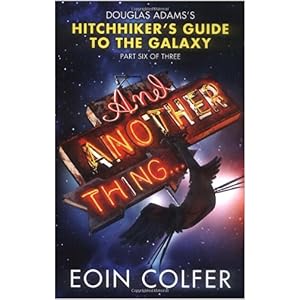
I borrowed this book from the library expecting to hate it. Even though I didn't like the end of the Hitchhiker series as it stood at Douglas Adams' death, I couldn't imagine anyone else continuing it in the way that he might have been able to (if he'd overcome the blocks he experienced in the later part of his writing career). I'd also read Artemis Fowl, which made Colfer's name, and didn't think much of it.
And, when And Another Thing... came out, it was serialised on BBC Radio 4 as an audiobook, and I listened to that and did indeed hate it. Hitchhiker was always hilarious, and the abridged version - 340 pages in 75 minutes which I'd estimate means leaving out 75% of the text - failed to raise a smile. Of course, that could have been the cuts ("let's leave out the jokes to keep the plot comprehensible"), or the way it was read (not Steve Mangan's finest hour and a quarter), or some of the plot decisions (the way Colfer got out of the problems caused by the ending of Mostly Harmless seemed trite and unconvincing to me). Would the book itself be more worth reading? Friends who might have read it turned out not to have done. So, there was only one way to find out...
Initially, my reaction was positive. At greater length, the unravelling of the finality of the ending of Mostly Harmless, while still not very imaginative, worked better and contained some amusing touches. But things do go downhill from there. Some of the issues are with the characters as created by Douglas Adams. I have always found Zaphod Beeblebrox verging on being more irritating than funny, and Colfer makes him a particularly important character here and he becomes an annoying manipulator of the plot: more self-centred than ever. Wowbagger, the immortal being who is insulting every being in the universe in alphabetical order, also turns up and is made a major character: Colfer's attempts to make him more than the brief joke he is for Adams make him at least as unsympathetic and irritating as a dealmaking Zaphod. And finally, Colfer seems to share Adams' interest in Norse myth, and a lot of the book (even more in the radio abridgement) is about Zaphod's dealings with Asgard - all very dull compared to the meeting with Thor at a party in Mostly Harmless.
All this could be forgiven if And Another Thing... had turned out to be as funny as the first few Hitchhiker books were on first reading. In this aspect, I got the impression that Colfer didn't work too hard, settling for the obvious and poor pun rather than thinking hard about exactly what would be funny. (Apparently Douglas Adams used to agonise about individual words for ages, and this shows in the inventive quality of the first three books in particular.) The way that the book-within-the-book of the actual Guide is handled here is partly to blame for the lack of laughs. The "Book" extracts are among the highlights of the original stories, being extremely funny and often explaining how the bizarre situations Arthur and Ford find themselves in arose. Here, they are intrusive, irrelevant and humourless asides (though it is fairly obvious that Colfer thinks them hilarious). Some attempt has been made to make them stand out typographically, something I don't think Adams ever did, and this, like so much else about And Another Thing... is depressingly unimaginative: the entries are printed in italics. So much more could have been done here to indicate their peripheral nature and liven up the presentation of the book.
Colfer is obviously a fan, and this makes him a good choice as a writer of a sequel. But he is not really very funny at all, even when writing his own books. (I've read Artemis Fowl, and it seems like a good idea - a child evil genius - let down by a lack of imagination and lazy writing, though many people seem to think it extremely funny.) In the end, And Another Thing... reads like a not very wonderful piece of fan fiction, of the sort published in vast quantities on the Internet: and I feel sure that there are likely to be better sequels to Hitchhiker available free at fanfiction.net. My rating - 2/10.
Tuesday, 20 July 2010
Thursday, 8 July 2010
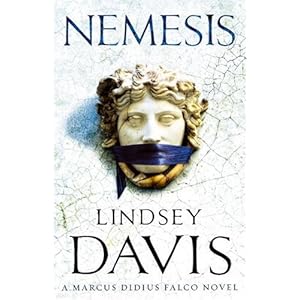
Lindsey Davis: Nemesis (2010)
Edition: Century, 2010
Review number: 1404
After the (to me) unreadable Rebels and Traitors, Davis returns to the Roman crime series which made her name, with the nineteenth Falco novel, Nemesis. But this addition to the series is much darker than most of them: this is not quite the wise-cracking Falco of old.
The darkness starts right at the beginning of the novel, which opens with the deaths of Falco's infant son and his father. The death of new born children has been a part of life throughout history. Take for example Queen Anne, who had the benefit of better medicine and all the care a British Queen could command at the turn of the eighteenth century, but none of whose fifteen children survived to adulthood. And the death of children plays an important part in novels by writers such as Charles Dickens. Yet it is something which is generally skipped over in modern historical fiction. With larger families and more infant mortality, death was a part of life in a way which, at least in the Western world, it is not today. That of course does not mean that parents then did not mourn the death of their children as much as parents today do.
So Nemesis is really about Falco's mourning for both his son and his father, even if in the latter case he doesn't want to show that he is strongly affected. The plot of the story concerns an investigation begun by Falco when he is looking into an unfinished business transaction of his father's. This spirals into a hunt for a family of serial killers, who seem to be protected by someone highly placed in the Roman government, and it becomes a case which pushes Falco onto a morally darker path than he has yet travelled - presumably because of the effects of his bereavement on his emotional state. He becomes a much more ambiguous hero than usual in this series; no matter how bad his life became (the episode in which he went undercover as a slave in a mine is a prime example), he always previously seemed to be a basically good person. In hard boiled detective terms, the Falco of Nemesis is more Dashiell Hammett's tainted Continental Op than a wisecracking Philip Marlowe.
Pushing a character to do nasty things because of his own emotional pain is all very well, but after eighteen more or less humorous novels in a series it comes as something of a shock to readers. More points for literary quality, then, but fewer for enjoyment of the story. I'd give Nemesis 6/10 as a result - angst is not why I read Falco novels.
Review number: 1404
After the (to me) unreadable Rebels and Traitors, Davis returns to the Roman crime series which made her name, with the nineteenth Falco novel, Nemesis. But this addition to the series is much darker than most of them: this is not quite the wise-cracking Falco of old.
The darkness starts right at the beginning of the novel, which opens with the deaths of Falco's infant son and his father. The death of new born children has been a part of life throughout history. Take for example Queen Anne, who had the benefit of better medicine and all the care a British Queen could command at the turn of the eighteenth century, but none of whose fifteen children survived to adulthood. And the death of children plays an important part in novels by writers such as Charles Dickens. Yet it is something which is generally skipped over in modern historical fiction. With larger families and more infant mortality, death was a part of life in a way which, at least in the Western world, it is not today. That of course does not mean that parents then did not mourn the death of their children as much as parents today do.
So Nemesis is really about Falco's mourning for both his son and his father, even if in the latter case he doesn't want to show that he is strongly affected. The plot of the story concerns an investigation begun by Falco when he is looking into an unfinished business transaction of his father's. This spirals into a hunt for a family of serial killers, who seem to be protected by someone highly placed in the Roman government, and it becomes a case which pushes Falco onto a morally darker path than he has yet travelled - presumably because of the effects of his bereavement on his emotional state. He becomes a much more ambiguous hero than usual in this series; no matter how bad his life became (the episode in which he went undercover as a slave in a mine is a prime example), he always previously seemed to be a basically good person. In hard boiled detective terms, the Falco of Nemesis is more Dashiell Hammett's tainted Continental Op than a wisecracking Philip Marlowe.
Pushing a character to do nasty things because of his own emotional pain is all very well, but after eighteen more or less humorous novels in a series it comes as something of a shock to readers. More points for literary quality, then, but fewer for enjoyment of the story. I'd give Nemesis 6/10 as a result - angst is not why I read Falco novels.
Labels:
ancient Rome,
crime fiction,
Falco,
fiction,
historical fiction,
Lindsey Davis
Saturday, 26 June 2010
Humphrey Lyttelton: The Best of Jazz (1999)
Originally published as Basin Street to Harlem (1978) and Enter the Giants (1984)
Edition: Portico, 2008
Review number: 1403
Jazz has always been something of a closed book to me. One of the reasons for this is that despite interest, I had no idea what was worth listening to, particularly given the minuscule selection available in a small provincial town with no proper record shop. So the subtleties of the jazz idiom, like those of, say, Indian classical music, largely passed me by. (I played in wind bands for most of the eighties, but the closest we got to jazz was Glenn Miller, Frank Sinatra and, once, a Duke Ellington song.) The result is that much of it comes across as simultaneously lacking the harmonic inventiveness of classical music or the excitement and drive of rock music. On the other hand, I've always felt that I ought to appreciate jazz more, and the problem is knowing where to start. The most obvious starting point is compilations, but these are too often lazily organised around the easy to license, as a result becoming as representative as sixties pop compilations which suggest that the pre-fame Beatles track Ain't She Sweet is the band's best recording.
These days, it's easier to search out individual downloads, and it is for this that The Best of Jazz becomes an invaluable guide for the jazz novice. For the book is a series of essays on jazz greats with undeniable authority (for Lyttelton was a fine jazz trumpeter who knew many of the most famous stars of the genre personally). Each essay contains an anecdotal description of the subject's career and importance, and a detailed analysis of a representative track by the artist. Originally conceived as a guide to the early 78 rpm recordings, the format translates uncannily well to modern listening habits. As originally published, the first part, Basin Street to Harlem, describes the early history of jazz up to about 1930, concentrating on the three main centres of New Orleans, Chicago, and New York. The second half, Enter the Giants, looks at the big figures of the thirties, from Louis Armstrong (who is the subject of three essays, and is the only artist to appear in both parts) to Roy Eldridge.
It is of course really difficult to describe music in words: a picture may be worth a thousand words, but a music clip is, well, priceless. This has two consequences for the book. Firstly, a little technical knowledge is needed to follow the descriptions of the performances. A knowledge of the notes of the musical scale and harmonic terms such as "diminished" - as would be obtained by learning basic guitar - is assumed. There are occasional references to piano keyboard layout as a means of explanation. Other terms, including jazz specifics such as "swing" are explained in the text; this is not always done on first appearance: the word "diatonic" appears in the first volume, but is only explained when it appears again in the second.
The second issue is basically that it will immensely aid enjoyment of The Best of Jazz to have access to listen to the analysed performances beforehand; being able to listen, with pause and rewind, while reading the discussions of the performances would be the ideal way to read this book. The songs would almost fit onto a single CD, I think - since some artists have several songs discussed, cutting their representation down to one each would do it. Because of their age, almost all of them over 75 years, it would be cheap to license the recordings. So it would seem to be a good piece of marketing to supply an accompanying CD, maybe as part of a deluxe edition. Searching Amazon suggests that no such CD exists: a missed opportunity.
Throughout Enter the Giants, references are made to a projected third volume, which was obviously planned in some detail. This never seems to have happened (again, I say this on the authority of being unable to find it on Amazon). To continue into postwar jazz would have made The Best of Jazz a useful reference on jazz history (though an index would also help achieve this!). As it is, The Best of Jazz is fascinating - probably even to people who know the genre well - and really good reading for the interested novice with some musical knowledge - 8/10.
Edition: Portico, 2008
Review number: 1403
Jazz has always been something of a closed book to me. One of the reasons for this is that despite interest, I had no idea what was worth listening to, particularly given the minuscule selection available in a small provincial town with no proper record shop. So the subtleties of the jazz idiom, like those of, say, Indian classical music, largely passed me by. (I played in wind bands for most of the eighties, but the closest we got to jazz was Glenn Miller, Frank Sinatra and, once, a Duke Ellington song.) The result is that much of it comes across as simultaneously lacking the harmonic inventiveness of classical music or the excitement and drive of rock music. On the other hand, I've always felt that I ought to appreciate jazz more, and the problem is knowing where to start. The most obvious starting point is compilations, but these are too often lazily organised around the easy to license, as a result becoming as representative as sixties pop compilations which suggest that the pre-fame Beatles track Ain't She Sweet is the band's best recording.
These days, it's easier to search out individual downloads, and it is for this that The Best of Jazz becomes an invaluable guide for the jazz novice. For the book is a series of essays on jazz greats with undeniable authority (for Lyttelton was a fine jazz trumpeter who knew many of the most famous stars of the genre personally). Each essay contains an anecdotal description of the subject's career and importance, and a detailed analysis of a representative track by the artist. Originally conceived as a guide to the early 78 rpm recordings, the format translates uncannily well to modern listening habits. As originally published, the first part, Basin Street to Harlem, describes the early history of jazz up to about 1930, concentrating on the three main centres of New Orleans, Chicago, and New York. The second half, Enter the Giants, looks at the big figures of the thirties, from Louis Armstrong (who is the subject of three essays, and is the only artist to appear in both parts) to Roy Eldridge.
It is of course really difficult to describe music in words: a picture may be worth a thousand words, but a music clip is, well, priceless. This has two consequences for the book. Firstly, a little technical knowledge is needed to follow the descriptions of the performances. A knowledge of the notes of the musical scale and harmonic terms such as "diminished" - as would be obtained by learning basic guitar - is assumed. There are occasional references to piano keyboard layout as a means of explanation. Other terms, including jazz specifics such as "swing" are explained in the text; this is not always done on first appearance: the word "diatonic" appears in the first volume, but is only explained when it appears again in the second.
The second issue is basically that it will immensely aid enjoyment of The Best of Jazz to have access to listen to the analysed performances beforehand; being able to listen, with pause and rewind, while reading the discussions of the performances would be the ideal way to read this book. The songs would almost fit onto a single CD, I think - since some artists have several songs discussed, cutting their representation down to one each would do it. Because of their age, almost all of them over 75 years, it would be cheap to license the recordings. So it would seem to be a good piece of marketing to supply an accompanying CD, maybe as part of a deluxe edition. Searching Amazon suggests that no such CD exists: a missed opportunity.
Throughout Enter the Giants, references are made to a projected third volume, which was obviously planned in some detail. This never seems to have happened (again, I say this on the authority of being unable to find it on Amazon). To continue into postwar jazz would have made The Best of Jazz a useful reference on jazz history (though an index would also help achieve this!). As it is, The Best of Jazz is fascinating - probably even to people who know the genre well - and really good reading for the interested novice with some musical knowledge - 8/10.
Friday, 28 May 2010
Kurt Vonnegut: Breakfast of Champions (1973)
Edition: Vintage, 2000 (Buy from Amazon)
Review number: 1402
Even today, Breakfast of Champions is a strange novel, and it would have seemed odder in 1973. It is perhaps even misleading to call it a novel, given the way it is written. Such plot as it has is revealed in the first few pages. It concerns the influence failed science fiction writer Kilgore Trout ends up having on the world. The other main character, Dwayne Hoover, is gradually going mad through the novel, which ends when he and Trout meet. Trout appears in many of Vonnegut's works, including his most famous novel Slaughterhouse Five, and is often the character used to express of the author's ideas - but here Vonnegut also makes himself a character. The plot is not only minimal, it is clearly not the point of the novel.
An immediately noticeable feature of Breakfast of Champions is its format, which is a major part of why it isn't a normal narrative novel. It consists of (mainly) short chapters, each a series of bullet points, rather like an extended Powerpoint presentation. In many of these, Vonnegut ironically describes the writing process for the book, comments on the actions and thoughts of the characters, and what he is trying to do; in others, Kilgore Trout's views and summaries of the science fiction stories are given. As if this isn't unusual enough, Vonnegut has provided a large number of illustrations, few of them particularly to the point; the text will in passing mention the Egyptian pyramids, say, and then continue, "they looked like this", followed by the author's line sketch. The effect, along with the quirky and satirical explanations of references which will be clear to any twentieth century human, is to make it seem that Breakfast of Champions is addressed to an alien race who know nothing of Earth culture. The writing style adopted by Vonnegut for the novel uses very basic and direct English, which reinforces this impression.
So what is the point? Breakfast of Champions is a satirical attack on the culture, ideas, and concerns which shaped America in the seventies; that is clear from the opening pages, which consist of an attack on the American national anthem, described as "gibberish sprinkled with question marks". This may sound like nothing more than a deliberate attempt to offend or shock, and I would agree that the placing of this passage at the very opening of the novel seems to be just that. There must have been many Americans who did not read past page two because of this onslaught. But Vonnegut is making the point that a song abut a flag is not really a sound basis for pride in a nation: without other achievements, the stars and stripes are completely meaningless except to arrant sentimentalists. Throughout the novel, nostalgia, optimism, and even rationalism are attacked.
Vonnegut deals with the major concerns of Breakfast of Champions more conventionally, and to my mind more convincingly elsewhere. The idea that our actions are fixed and meaningless is a major part of Timequake, while here it is conveyed by the continual interjections about the how the author has made the decisions which determine the actions of his characters combined with speculation about whether our actions are similarly controlled by our Creator. Similarly, Galapagos examines the idea that the human capacity for rational thought does not make us happier or the world a better place.
Breakfast of Champions has been compared to Voltaire's Candide, and there are many parallels between the two novels. Both are satirical, attacking prevalent optimistic ideas about the world - in Voltaire's case with the memorable phrase, "All the for the best in the best of all possible worlds", which is the teaching of Candide's tutor's Pangloss. By contrast, Trout thinks that "there was only one way for the Earth to be: the way it was": a pessimistic justification for the same thought, that the world cannot be improved.
In both cases, liberties are taken with narrative: in Candide, terrible things happen to the characters, including death, only for them to appear later apparently unscathed. Both Candide and Trout are quite passive, as the philosophies they hold suggest they should be, Trout relegating himself to a life as a passive observer of the follies of seventies America, from the adult movie theaters of New York, to the signs reminding those entering Philadelphia that its name makes it the city of brotherly love, to the devastation of West Virginia by mining. Both authors use a distinctly ironic style, Vonnecgut more overtly than Voltaire. The biggest difference is that there is no major character in Breakfast of Champions with the naivete of Candide himself, and this ultimately makes Vonnegut's novel far less appealing and amusing.
This is the sort of book which by its idiosyncratic nature and satirical ambitions attempts to walk a narrow path between black comedy and irritating eccentricity for the sake of it. Even though, as a non-American apart from anything else, there is nothing in Breakfast of Champions I would personally consider offensive, I generally found it much more irritating than funny. I like Vonnegut generally, but not this time - 3/10.
Review number: 1402
Even today, Breakfast of Champions is a strange novel, and it would have seemed odder in 1973. It is perhaps even misleading to call it a novel, given the way it is written. Such plot as it has is revealed in the first few pages. It concerns the influence failed science fiction writer Kilgore Trout ends up having on the world. The other main character, Dwayne Hoover, is gradually going mad through the novel, which ends when he and Trout meet. Trout appears in many of Vonnegut's works, including his most famous novel Slaughterhouse Five, and is often the character used to express of the author's ideas - but here Vonnegut also makes himself a character. The plot is not only minimal, it is clearly not the point of the novel.
An immediately noticeable feature of Breakfast of Champions is its format, which is a major part of why it isn't a normal narrative novel. It consists of (mainly) short chapters, each a series of bullet points, rather like an extended Powerpoint presentation. In many of these, Vonnegut ironically describes the writing process for the book, comments on the actions and thoughts of the characters, and what he is trying to do; in others, Kilgore Trout's views and summaries of the science fiction stories are given. As if this isn't unusual enough, Vonnegut has provided a large number of illustrations, few of them particularly to the point; the text will in passing mention the Egyptian pyramids, say, and then continue, "they looked like this", followed by the author's line sketch. The effect, along with the quirky and satirical explanations of references which will be clear to any twentieth century human, is to make it seem that Breakfast of Champions is addressed to an alien race who know nothing of Earth culture. The writing style adopted by Vonnegut for the novel uses very basic and direct English, which reinforces this impression.
So what is the point? Breakfast of Champions is a satirical attack on the culture, ideas, and concerns which shaped America in the seventies; that is clear from the opening pages, which consist of an attack on the American national anthem, described as "gibberish sprinkled with question marks". This may sound like nothing more than a deliberate attempt to offend or shock, and I would agree that the placing of this passage at the very opening of the novel seems to be just that. There must have been many Americans who did not read past page two because of this onslaught. But Vonnegut is making the point that a song abut a flag is not really a sound basis for pride in a nation: without other achievements, the stars and stripes are completely meaningless except to arrant sentimentalists. Throughout the novel, nostalgia, optimism, and even rationalism are attacked.
Vonnegut deals with the major concerns of Breakfast of Champions more conventionally, and to my mind more convincingly elsewhere. The idea that our actions are fixed and meaningless is a major part of Timequake, while here it is conveyed by the continual interjections about the how the author has made the decisions which determine the actions of his characters combined with speculation about whether our actions are similarly controlled by our Creator. Similarly, Galapagos examines the idea that the human capacity for rational thought does not make us happier or the world a better place.
Breakfast of Champions has been compared to Voltaire's Candide, and there are many parallels between the two novels. Both are satirical, attacking prevalent optimistic ideas about the world - in Voltaire's case with the memorable phrase, "All the for the best in the best of all possible worlds", which is the teaching of Candide's tutor's Pangloss. By contrast, Trout thinks that "there was only one way for the Earth to be: the way it was": a pessimistic justification for the same thought, that the world cannot be improved.
In both cases, liberties are taken with narrative: in Candide, terrible things happen to the characters, including death, only for them to appear later apparently unscathed. Both Candide and Trout are quite passive, as the philosophies they hold suggest they should be, Trout relegating himself to a life as a passive observer of the follies of seventies America, from the adult movie theaters of New York, to the signs reminding those entering Philadelphia that its name makes it the city of brotherly love, to the devastation of West Virginia by mining. Both authors use a distinctly ironic style, Vonnecgut more overtly than Voltaire. The biggest difference is that there is no major character in Breakfast of Champions with the naivete of Candide himself, and this ultimately makes Vonnegut's novel far less appealing and amusing.
This is the sort of book which by its idiosyncratic nature and satirical ambitions attempts to walk a narrow path between black comedy and irritating eccentricity for the sake of it. Even though, as a non-American apart from anything else, there is nothing in Breakfast of Champions I would personally consider offensive, I generally found it much more irritating than funny. I like Vonnegut generally, but not this time - 3/10.
Labels:
American literature,
fiction,
humour,
Kurt Vonnegut,
literary fiction
Tuesday, 18 May 2010
Charlotte MacLeod: It Was an Awful Shame (2002)
Edition: Five Star, 2003
Review number: 1401
Of all genre writing, it may be the case that crime short stories are the most difficult to pull off, despite the pioneering example of Arthur Conan Doyle, whose Sherlock Holmes short stories remain among the best of this type. To fit a convincing description of a crime, several suspects, their motives, means and opportunity, as well as the solution, into a few pages is not easy. To make them funny as well is so difficult that to try seems almost like showing off.
And in this collection, Charlotte MacLeod manages to do this without apparent effort. Not only that, she is often able to convey an enviable sense of place: most of the stories are set in a New England clearly dear to her heart. The stories are also rather old fashioned, and portray an upper class New England that almost certainly became extinct before the Second World War (the original publication dates for the stories are between 1963 and 1989, mainly in the first decade).
The quality of the stories is variable, but there are no really poor ones in the collection. However, the ordering of the stories does leave something to be desired for newcomers to the author (as I was when I picked up this book in the library). MacLeod wrote two long series of novels with recurring characters, and fans will be pleased to know that both make appearances in this collection. The problem is that the first two stories here are from one of these series, and don't really stand alone too well, and this is an off putting start for those readers not familiar with the novels. The stories from the second series work much better, appearing later on and apparently coming near the start of the series' internal chronology. These series characters made me think of Dorothy L. Sayers' short stories, which are not particularly distinguished (and certainly not as good as MacLeod's), but which are collected in such a way that Lord Peter stories draw the fan into reading each of the collections. There, too, a certain knowledge of Lord Peter is assumed, but not perhaps as much as MacLeod does in the first two here. The first story, which provides the title for the collection, also deals with the childish rituals of a fraternity lodge, and so seems particularly removed from real life.
Similarly, the level of humour varies between the stories. Some of the best moments, such as the magnificently silly spoof The Mysterious Affair of the Beaird-Wynnington Dirigible Airship and the Wodehouse-style combination of goat, shotgun, helium balloon, trousers and halibut in Fifty Acres of Prime Seaweed, are not likely to be quickly forgotten by any reader.
The old fashioned air occasionally reminds me of O. Henry or P.G. Wodehouse: very old fashioned, and similarly cosy. In no way could MacLeod's stories be described as gritty reflections of the mean streets of modern America. That is not necessarily a bad thing; there should always be a place for expertly written, light and fun reading, even if it occasionally strays into the twee. My rating: 7/10.
Review number: 1401
Of all genre writing, it may be the case that crime short stories are the most difficult to pull off, despite the pioneering example of Arthur Conan Doyle, whose Sherlock Holmes short stories remain among the best of this type. To fit a convincing description of a crime, several suspects, their motives, means and opportunity, as well as the solution, into a few pages is not easy. To make them funny as well is so difficult that to try seems almost like showing off.
And in this collection, Charlotte MacLeod manages to do this without apparent effort. Not only that, she is often able to convey an enviable sense of place: most of the stories are set in a New England clearly dear to her heart. The stories are also rather old fashioned, and portray an upper class New England that almost certainly became extinct before the Second World War (the original publication dates for the stories are between 1963 and 1989, mainly in the first decade).
The quality of the stories is variable, but there are no really poor ones in the collection. However, the ordering of the stories does leave something to be desired for newcomers to the author (as I was when I picked up this book in the library). MacLeod wrote two long series of novels with recurring characters, and fans will be pleased to know that both make appearances in this collection. The problem is that the first two stories here are from one of these series, and don't really stand alone too well, and this is an off putting start for those readers not familiar with the novels. The stories from the second series work much better, appearing later on and apparently coming near the start of the series' internal chronology. These series characters made me think of Dorothy L. Sayers' short stories, which are not particularly distinguished (and certainly not as good as MacLeod's), but which are collected in such a way that Lord Peter stories draw the fan into reading each of the collections. There, too, a certain knowledge of Lord Peter is assumed, but not perhaps as much as MacLeod does in the first two here. The first story, which provides the title for the collection, also deals with the childish rituals of a fraternity lodge, and so seems particularly removed from real life.
Similarly, the level of humour varies between the stories. Some of the best moments, such as the magnificently silly spoof The Mysterious Affair of the Beaird-Wynnington Dirigible Airship and the Wodehouse-style combination of goat, shotgun, helium balloon, trousers and halibut in Fifty Acres of Prime Seaweed, are not likely to be quickly forgotten by any reader.
The old fashioned air occasionally reminds me of O. Henry or P.G. Wodehouse: very old fashioned, and similarly cosy. In no way could MacLeod's stories be described as gritty reflections of the mean streets of modern America. That is not necessarily a bad thing; there should always be a place for expertly written, light and fun reading, even if it occasionally strays into the twee. My rating: 7/10.
Labels:
Charlotte MacLeod,
crime fiction,
fiction,
short stories
Tuesday, 4 May 2010
Alastair Reynolds: Ternminal World (2010)
Edition: Gollancz, 2010
Review number: 1400
Many science fiction novels are in a way more about their setting than anything else: it is something that non-fans tend to dislike about the genre. The best of them, of course, make the setting the core of a wider, rounded, story. Where this core is an artefact, it is referred to in science fiction fandom as a "Big Dumb Object" or BDO, for which the prototype is Larry Niven's Ringworld (see the article in the TV Tropes WIKI for other famous examples). BDOs are usually alien artefacts being investigated by human explorers, and Reynolds has already written some stories of this type, such as Absolution Gap and his debut Revelation Space.
Terminal World is a slightly different kind of BDO story. Spearpoint is a huge, decaying city, towering over its surroundings. Both the city and its environs are divided into shifting Zones, where different levels of technology can work, including one known as the Bane which is so inimical that not even basic forms of life can survive. Both Spearpoint and the Zones are human artefacts, but not ones which the current inhabitants, not even the nano-technology using "angels" of the upper levels of the city, can now understand.
Doctor Quillon, the main character of Terminal World, is a renegade angel, product of an experiment by these people - already drastically changed from their human ancestry - to modify themselves so that they could live in the lower levels of Spearpoint. When it seems that his past is about to catch up with him, Quillon escapes from the city and begins a journey across the strange fractured landscape outside the city. While the doctor is quite a well realised character, this journey, the main part of Terminal World, is more about making it possible for the reader to see more of the Zones and the different cultures which have grown up with each level of permissible technology.
This is a pity, as it means that the plot is pretty rudimentary, just a framework to illustrate the Zones in a way that is less interesting than it could be: I think that the way they affect life in Spearpoint is more interesting than what it is like outside the city. The image of a sophisticated cyborg effectively chaining himself to a boiler room in order to use steam power, while unlikely, is intriguing; while that of the Swarm, a loose federation of airship fliers, is much less so. Some of the plot doesn't quite hold together: for example, the leader of the Swarm has recently developed a means of producing large quantities of medicine which helps humans deal with the physiological effects of the passage from one Zone to another just at the time when a major humanitarian crisis caused by shifting Zones in Spearpoint means that it is urgently needed. A journey of discovery like this is typical of BDO stories, but I would have preferred a plot which remained in the fascinating city; this would perhaps have made Terminal City seem rather like one of China Miéville's novels, but that would not necessarily be a bad thing.
The ideas behind Terminal World are connected with quantum dynamics. In each of the Zones, it appears that the basic structure of matter is slightly different, which means that technologies which rely on, say, electricity may not work in some of them. I don't think the rules are applied quite consistently: how different are the electrical currents in the wire connecting a slight switch and a bulb from the signals in animal nervous systems at a fundamental physical level? So perhaps quantum mechanics - which is suggested by one of the characters in the novel as a possible explanation for the Zones - is not actually behind Reynolds' concept at all, but a red herring.
However, it does fit in with something else: the role of the tectomancers. These are characters with some kind of mental connection to the Zones. They can move the Zone boundaries, and are persecuted and feared as witches or dismissed as legends. One of the more mysterious aspects of quantum mechanics is the role of an observer, whose intervention is required to collaps a statistical description of a phenomenon (the probability that a particle is in a volume of space) to a physical one (the knowledge whether or not the particle is in that volume). Tectomancers seem to be a kind of super-observer, able not just to affect the collapse of the quantum state vector but the rules which define it.
In the end, the combination of one or two good characters, an interesting BDO, and some ideas about quantum mechanics are not enough for Terminal World to be a great science fiction novel. Part of the problem is that none of the characters really understand the Zones, so the reader is not left with much information to work out what they really are, and part is the abandonment of the city for the middle section of the novel. Other questions - such as whether Spearpoint is built on the Earth of the far future, or elsewhere - are left undiscussed, perhaps to provide material for a sequel. Terminal World does make an interesting change from the space opera for which Reynolds is most well known, and is well worth reading by fans of the author. My rating: 6/10.
Review number: 1400
Many science fiction novels are in a way more about their setting than anything else: it is something that non-fans tend to dislike about the genre. The best of them, of course, make the setting the core of a wider, rounded, story. Where this core is an artefact, it is referred to in science fiction fandom as a "Big Dumb Object" or BDO, for which the prototype is Larry Niven's Ringworld (see the article in the TV Tropes WIKI for other famous examples). BDOs are usually alien artefacts being investigated by human explorers, and Reynolds has already written some stories of this type, such as Absolution Gap and his debut Revelation Space.
Terminal World is a slightly different kind of BDO story. Spearpoint is a huge, decaying city, towering over its surroundings. Both the city and its environs are divided into shifting Zones, where different levels of technology can work, including one known as the Bane which is so inimical that not even basic forms of life can survive. Both Spearpoint and the Zones are human artefacts, but not ones which the current inhabitants, not even the nano-technology using "angels" of the upper levels of the city, can now understand.
Doctor Quillon, the main character of Terminal World, is a renegade angel, product of an experiment by these people - already drastically changed from their human ancestry - to modify themselves so that they could live in the lower levels of Spearpoint. When it seems that his past is about to catch up with him, Quillon escapes from the city and begins a journey across the strange fractured landscape outside the city. While the doctor is quite a well realised character, this journey, the main part of Terminal World, is more about making it possible for the reader to see more of the Zones and the different cultures which have grown up with each level of permissible technology.
This is a pity, as it means that the plot is pretty rudimentary, just a framework to illustrate the Zones in a way that is less interesting than it could be: I think that the way they affect life in Spearpoint is more interesting than what it is like outside the city. The image of a sophisticated cyborg effectively chaining himself to a boiler room in order to use steam power, while unlikely, is intriguing; while that of the Swarm, a loose federation of airship fliers, is much less so. Some of the plot doesn't quite hold together: for example, the leader of the Swarm has recently developed a means of producing large quantities of medicine which helps humans deal with the physiological effects of the passage from one Zone to another just at the time when a major humanitarian crisis caused by shifting Zones in Spearpoint means that it is urgently needed. A journey of discovery like this is typical of BDO stories, but I would have preferred a plot which remained in the fascinating city; this would perhaps have made Terminal City seem rather like one of China Miéville's novels, but that would not necessarily be a bad thing.
The ideas behind Terminal World are connected with quantum dynamics. In each of the Zones, it appears that the basic structure of matter is slightly different, which means that technologies which rely on, say, electricity may not work in some of them. I don't think the rules are applied quite consistently: how different are the electrical currents in the wire connecting a slight switch and a bulb from the signals in animal nervous systems at a fundamental physical level? So perhaps quantum mechanics - which is suggested by one of the characters in the novel as a possible explanation for the Zones - is not actually behind Reynolds' concept at all, but a red herring.
However, it does fit in with something else: the role of the tectomancers. These are characters with some kind of mental connection to the Zones. They can move the Zone boundaries, and are persecuted and feared as witches or dismissed as legends. One of the more mysterious aspects of quantum mechanics is the role of an observer, whose intervention is required to collaps a statistical description of a phenomenon (the probability that a particle is in a volume of space) to a physical one (the knowledge whether or not the particle is in that volume). Tectomancers seem to be a kind of super-observer, able not just to affect the collapse of the quantum state vector but the rules which define it.
In the end, the combination of one or two good characters, an interesting BDO, and some ideas about quantum mechanics are not enough for Terminal World to be a great science fiction novel. Part of the problem is that none of the characters really understand the Zones, so the reader is not left with much information to work out what they really are, and part is the abandonment of the city for the middle section of the novel. Other questions - such as whether Spearpoint is built on the Earth of the far future, or elsewhere - are left undiscussed, perhaps to provide material for a sequel. Terminal World does make an interesting change from the space opera for which Reynolds is most well known, and is well worth reading by fans of the author. My rating: 6/10.
Tuesday, 6 April 2010
Iain Banks: Transition (2009)
Edition: Little, Brown, 2009
Review number: 1399
The idea behind Transition is not one particularly new in science fiction: there are millions of alternate Earths, and it is possible to travel between them through the use of a special drug; septus works rather like the sixties perception of the action of psychedelics, letting the mind transfer to a new body in a different world. However, a secret society, the Concern, acts in all the accessible worlds to ensure that history develops in a particular direction. To those it recruits, Concern claims to act to improve the lot of humanity, by eliminating (assassinating) those who will cause large scale suffering if their actions remain unchecked. Not everyone believes in the benevolence of the Concern, and the novel tells the story of one group which sets out to subvert the organisation and its shadowy leadership.
One of the things I like about Iain Banks is that its not that easy to suggest names of other authors who might be considered major influences. His novels tend to remind me of others of his novels. (At least, that applies to the non-Culture novels; the hyped-up space opera of the books for which he uses his middle initial has rather more obvious debts to earlier science fiction.) But here, in his twenty-fourth novel, I was almost immediately and strongly reminded of Michael Moorcock, particularly the Jerry Cornelius and Oswald Bastable novels.
The parallel worlds are what makes me think of Oswald Bastable: a fairly mundane link. (Jerry Cornelius is more similar in style and feeling.) However, Moorcock's worlds are much less similar to each other than Banks', and the people in them less important in comparison to those who are able to travel between the worlds. In the Bastable novels, following the careers of alternate versions of real people from Mick Jagger to Stalin is a large part of the interest, but few such people are mentioned by Banks. The alternate realities are barely more than just a mechanism to end a scene, like a punch line in a sketch show. The main difference between most of the alternates and reality is that the perceived terrorist threat to the Western world comes mainly from radical Christian extremists in the worlds Banks constructs.
The Concern is akin to the Business, from Banks' novel of that name, but seen in a darker light. (Though Kate, the heroine of The Business, eventually rejects them, too.) But, all in all, Transition is not much like the rest of Banks' writing. When reviewing The Steep Approach to Garbadale, I complained that it was too much a rehash of ideas from his other novels, but Transition goes too far the other way, throwing the baby out with the bathwater.
Transition is told using multiple viewpoints (some in the first person, some in the third). Each chapter advances the personal stories of several, but not always the same ones. Only one is constant, Patient 8262, who is apparently hiding from the Concern in a mental hospital. Other viewpoints include a hedge fund manager, a torturer, an assassin, and a member of the Concern's ruling council. It is these central characters which are Transition's major weakness, as none of them are consistently interesting or enjoyable to read about.
Warning is given at the very beginning of the novel that the words on the page should not necessarily be believed. The title page tells us that Transition is "based on a false story", and the first words of the prologue are "Apparently I am what is known as an Unreliable Narrator". These gimmicks perhaps belabour the point rather too heavily, but it certainly sticks in the back of the mind while reading the novel. I personally would have preferred to have been left to work out the narrator's unreliability for myself, and start with the line from the third section of the prologue: "This is how it ends": a much more effective irony.
All the constructive effort of the multiple narrative threads (something of a favourite device for Banks) needs to be rounded off with a satisfying, rounded ending in which they are brought together. This is more or less done, though the details are undermined by the emphasis on the unreliable narrator. (I myself have probably rather over-emphasised it here, but that is because it does seem to be a cause of many of the negative aspects of Transition.)
I never expected to say of an Iain Banks novel that it was boring, but it was something of a struggle to get to the end of Transition. Maybe it will seem better on a second reading, but that is not an experiment I am looking forward to conducting. 4/10.
Review number: 1399
The idea behind Transition is not one particularly new in science fiction: there are millions of alternate Earths, and it is possible to travel between them through the use of a special drug; septus works rather like the sixties perception of the action of psychedelics, letting the mind transfer to a new body in a different world. However, a secret society, the Concern, acts in all the accessible worlds to ensure that history develops in a particular direction. To those it recruits, Concern claims to act to improve the lot of humanity, by eliminating (assassinating) those who will cause large scale suffering if their actions remain unchecked. Not everyone believes in the benevolence of the Concern, and the novel tells the story of one group which sets out to subvert the organisation and its shadowy leadership.
One of the things I like about Iain Banks is that its not that easy to suggest names of other authors who might be considered major influences. His novels tend to remind me of others of his novels. (At least, that applies to the non-Culture novels; the hyped-up space opera of the books for which he uses his middle initial has rather more obvious debts to earlier science fiction.) But here, in his twenty-fourth novel, I was almost immediately and strongly reminded of Michael Moorcock, particularly the Jerry Cornelius and Oswald Bastable novels.
The parallel worlds are what makes me think of Oswald Bastable: a fairly mundane link. (Jerry Cornelius is more similar in style and feeling.) However, Moorcock's worlds are much less similar to each other than Banks', and the people in them less important in comparison to those who are able to travel between the worlds. In the Bastable novels, following the careers of alternate versions of real people from Mick Jagger to Stalin is a large part of the interest, but few such people are mentioned by Banks. The alternate realities are barely more than just a mechanism to end a scene, like a punch line in a sketch show. The main difference between most of the alternates and reality is that the perceived terrorist threat to the Western world comes mainly from radical Christian extremists in the worlds Banks constructs.
The Concern is akin to the Business, from Banks' novel of that name, but seen in a darker light. (Though Kate, the heroine of The Business, eventually rejects them, too.) But, all in all, Transition is not much like the rest of Banks' writing. When reviewing The Steep Approach to Garbadale, I complained that it was too much a rehash of ideas from his other novels, but Transition goes too far the other way, throwing the baby out with the bathwater.
Transition is told using multiple viewpoints (some in the first person, some in the third). Each chapter advances the personal stories of several, but not always the same ones. Only one is constant, Patient 8262, who is apparently hiding from the Concern in a mental hospital. Other viewpoints include a hedge fund manager, a torturer, an assassin, and a member of the Concern's ruling council. It is these central characters which are Transition's major weakness, as none of them are consistently interesting or enjoyable to read about.
Warning is given at the very beginning of the novel that the words on the page should not necessarily be believed. The title page tells us that Transition is "based on a false story", and the first words of the prologue are "Apparently I am what is known as an Unreliable Narrator". These gimmicks perhaps belabour the point rather too heavily, but it certainly sticks in the back of the mind while reading the novel. I personally would have preferred to have been left to work out the narrator's unreliability for myself, and start with the line from the third section of the prologue: "This is how it ends": a much more effective irony.
All the constructive effort of the multiple narrative threads (something of a favourite device for Banks) needs to be rounded off with a satisfying, rounded ending in which they are brought together. This is more or less done, though the details are undermined by the emphasis on the unreliable narrator. (I myself have probably rather over-emphasised it here, but that is because it does seem to be a cause of many of the negative aspects of Transition.)
I never expected to say of an Iain Banks novel that it was boring, but it was something of a struggle to get to the end of Transition. Maybe it will seem better on a second reading, but that is not an experiment I am looking forward to conducting. 4/10.
Subscribe to:
Posts (Atom)